

 Platform Overview

 Integration Hub

 Agent One™

 Agent One Teams™

 Customer Data Management

 Personalization

 Journey Orchestration

 Reporting & Data

 Behavioral Analytics

 Web
Web

 Email
Email

 Site Search

 Conversational CX

 WhatsApp

 Web Push

 InStory

 App
App

 SMS & RCS

 Join the $0 Migration Movement™

 The Insider One Difference

 Compare Vendors

 Switch to Insider One

 Success Story

 Retail & Ecommerce

 Financial Services

 Travel & Hospitality

 Beauty & Cosmetics

 Automotive

 Telecommunications

 Total Economic Impact™ Study

 Blog
Blog

 E-Books & Guides

 Glossary
5 Best Real-Time Personalization Software in 2026

Updated on 14 Sep 2026
8 mins
Table of Contents
- Summary
- How does real-time personalization work?
- Real-time personalization software: Key features and benefits
- 5 real-time personalization software worth trying in 2026
- 1. Insider One
- 2. Braze
- 3. Salesforce Marketing Cloud
- 4. WebEngage
- 5. MoEngage
- Real-time personalization trends shaping 2026
- How to choose the right real-time personalization software
- Why Insider One is worth considering for real-time personalization
- Start your real-time personalization journey with Insider One
- Frequently asked questions
Most Popular
Summary
- Insider One: Best for B2C brands that want to connect real-time customer data, AI-powered personalization, predictive audiences, and omnichannel activation in one platform
- Braze: Best for mobile-first brands focused on real-time engagement, messaging, and event-triggered journeys
- Salesforce Marketing Cloud: Best for large enterprises already invested in the Salesforce ecosystem and broader customer data infrastructure
- WebEngage: Best for consumer brands looking for behavioral targeting, web personalization, and in-app experiences.
- MoEngage: Best for mobile-first businesses combining customer analytics, engagement, and real-time personalization.
- What to prioritize in 2026: Look beyond basic behavioral triggers. The strongest personalization platforms now combine real-time data, predictive AI, first-party data, contextual information, experimentation, and cross-channel activation.
- What’s changed: Data warehouse activation, zero-copy architectures, AI-powered decisioning, and contextual data are becoming increasingly important for enterprise personalization.
Customers increasingly expect brands to understand what they want and respond while they’re still engaged. A visitor browsing a product page, abandoning a cart, opening an app, or interacting with an email can generate signals that change what they should see or receive next.
Real-time personalization turns those signals into immediate action. Instead of waiting for a daily audience refresh or manually updating a campaign, personalization software can use current behavior, customer history, predictive insights, and contextual data to determine the next experience.
The technology behind this is also changing. In 2026, real-time personalization is moving beyond simple rules such as “show this banner when a visitor views a product.” Leading platforms increasingly combine AI, predictive audiences, unified customer profiles, first-party data, real-time segmentation, recommendations, and automated decisioning.
This guide explains how real-time personalization works, the features to evaluate in 2026, and five platforms worth considering.
How does real-time personalization work?
Real-time personalization uses current customer behavior and available customer data to adapt an experience while the interaction is happening.
A typical personalization workflow looks like this:
- Capture behavior: The platform collects events such as page views, searches, clicks, purchases, app activity, and campaign interactions.
- Connect the data: These events are associated with a known or anonymous customer profile.
- Interpret intent: Rules, AI models, recommendations, or predictive audiences determine what the customer is likely to need next.
- Deliver the experience: The platform changes content, recommendations, messaging, or journey logic across the relevant channel.
- Learn from the response: The customer’s next action becomes another signal that can influence subsequent personalization.
For example, imagine a customer visits an ecommerce site and views several products from the same category. A real-time personalization platform could use that behavior to update their audience immediately, change product recommendations, personalize the homepage, and trigger a relevant follow-up message.
The important distinction is timing. Traditional personalization might use a customer segment that was created hours or days earlier. Real-time personalization can respond to what the customer is doing now.
Real-time personalization is becoming predictive
Real-time personalization is also moving from reactive to predictive experiences.
Instead of only responding to what someone just did, AI can combine current behavior with historical data to estimate what the customer is likely to do next.
That can include predicting:
- Purchase intent
- Product affinity
- Churn risk
- Next-best channel
- Preferred content
- Optimal send time
- Likely next action
This allows personalization platforms to make decisions based on both current intent and predicted intent.
Real-time personalization software: Key features and benefits
When evaluating real-time personalization software in 2026, look beyond the number of channels or AI features a vendor lists. The underlying data and decisioning architecture matter just as much.
| Key Feature | What It Does | Why It Matters |
| Real-time data ingestion | Captures behavioral events as they happen | Keeps personalization based on current customer intent |
| Unified customer profiles | Connects behavioral and customer data | Provides more complete context for personalization |
| Real-time segmentation | Updates audiences as behavior changes | Prevents customers from remaining in outdated segments |
| Predictive AI | Anticipates future customer behavior | Enables proactive rather than purely reactive personalization |
| Product recommendations | Selects products or content based on behavior and affinity | Helps customers discover relevant options |
| Contextual data | Uses information such as inventory, pricing, location, or product attributes | Makes personalization more relevant to the situation |
| Cross-channel orchestration | Coordinates experiences across web, app, email, push, SMS, WhatsApp, and other channels | Creates a consistent customer journey |
| Data warehouse activation | Uses existing first-party data from a warehouse | Reduces unnecessary data movement and duplication |
| Experimentation and optimization | Tests experiences and identifies better-performing variants | Helps measure and improve personalization impact |
5 real-time personalization software worth trying in 2026
The five platforms below take different approaches to real-time personalization. The right choice depends on your data architecture, customer journey, channels, technical resources, and how much control you need over personalization.
1. Insider One
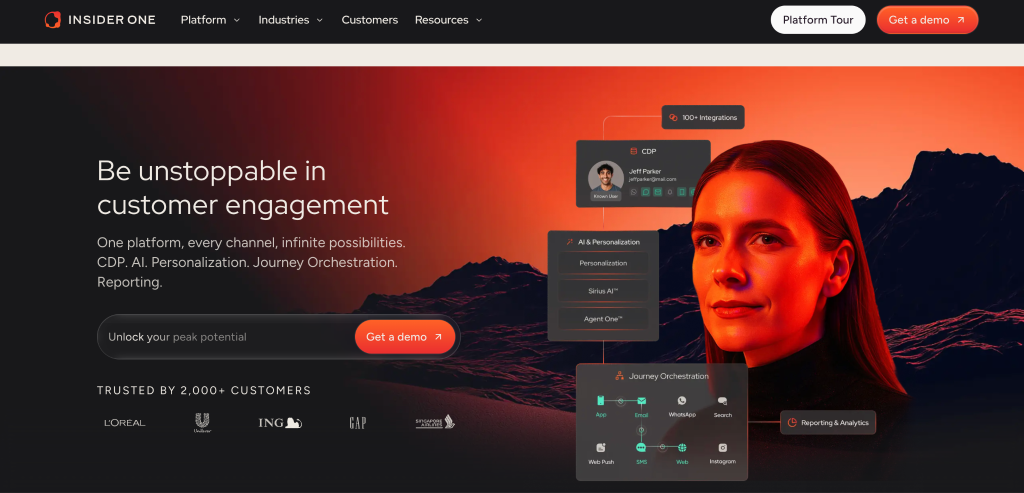
Best for: B2C brands that want real-time personalization connected to customer data, predictive intelligence, and omnichannel engagement.
Insider One combines customer data management, real-time segmentation, predictive audiences, recommendations, personalization, and customer journey orchestration.
Rather than treating personalization as a single website feature, the platform connects customer signals with activation across web, email, push, SMS, WhatsApp, and other channels.
Real-time customer profiles and segmentation
Insider One can capture behavioral signals from customer interactions and use them to build audiences around current behavior and predicted intent.
Marketers can create segments based on attributes such as browsing behavior, purchase activity, engagement, lifecycle status, and likelihood to purchase. As customer behavior changes, those audiences can update and feed into campaigns and journeys.
This helps solve one of the biggest problems with traditional personalization: customers don’t stay in the same segment throughout their journey.
Predictive personalization with AI
Insider One also uses AI to support predictive audiences, recommendations, and journey optimization.
Instead of relying only on rules such as “customer viewed product X,” marketers can use predictive signals to identify customers with higher purchase intent, potential churn risk, or other behavioral propensities.
The platform can then use those audiences to personalize experiences or determine how customers should progress through a journey.
Activate first-party data without unnecessary duplication
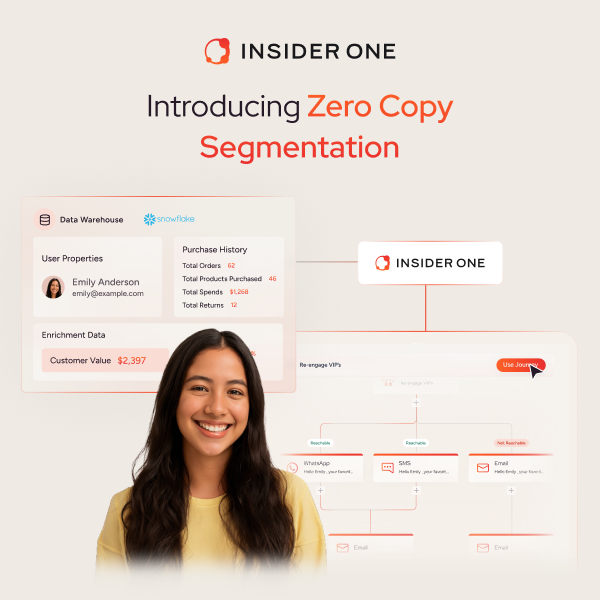
A significant development in Insider One’s 2026 data capabilities is Zero Copy Segmentation.
Zero Copy Segmentation allows organizations to create audiences from supported data warehouses without copying the underlying warehouse data into Insider One.
This is particularly relevant for enterprises that maintain their customer data in platforms such as Snowflake, BigQuery, or Databricks and want to activate that data without creating another copy.
That makes real-time personalization increasingly compatible with the way enterprise organizations manage their first-party data.
Add contextual information with Lookup Tables
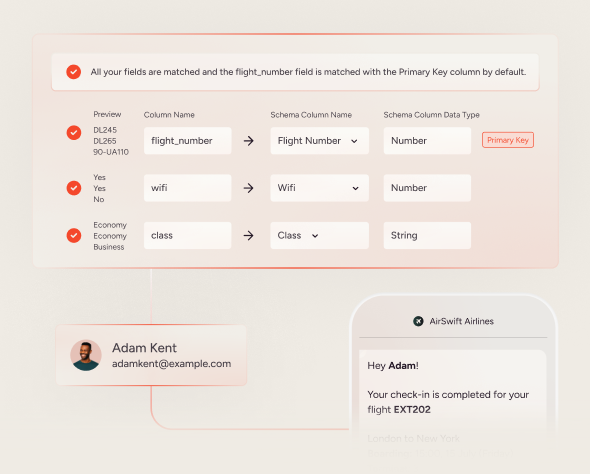
Another newer capability is Lookup Tables, which allow businesses to use shared contextual data alongside customer information.
This is useful when personalization depends on information that isn’t specific to an individual customer.
For example, a retailer may need store information, a travel company may need flight details, or a telecom company may need plan information when determining what experience to show.
By combining customer behavior with contextual business data, personalization can become more relevant than simply using a customer’s previous actions.
Pros:
- Connects customer data and activation in one platform
- Supports real-time and predictive segmentation
- Combines personalization with omnichannel engagement
- Supports warehouse-based audience activation
- Allows contextual business data to be used in personalization
- Supports both anonymous and known customer experiences
Cons:
- Broad functionality can create a learning curve for teams new to comprehensive customer engagement platforms
- Businesses looking only for a simple website personalization tool may not need the full platform
2. Braze
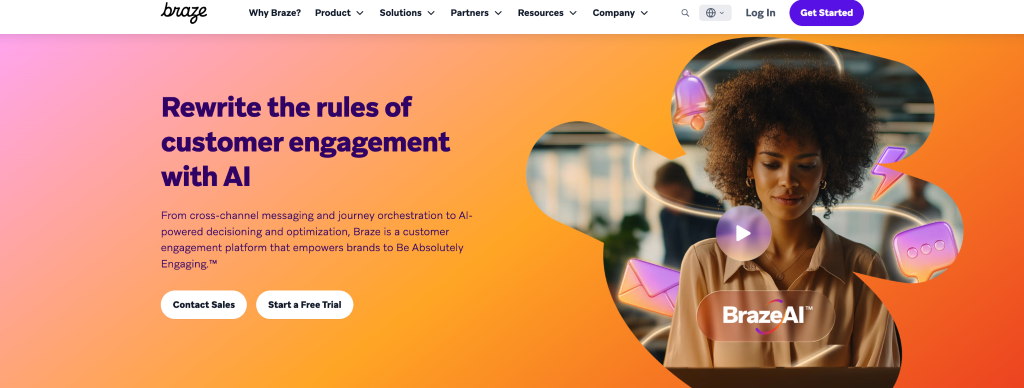
Best for: Mobile-first brands focused on real-time engagement.
Braze has a strong focus on event-driven customer engagement and supports personalization across mobile and messaging channels.
Its real-time capabilities allow customer actions to trigger messaging and experiences based on events such as app activity, purchases, or interactions with previous campaigns.
Pros:
- Strong mobile engagement capabilities
- Mature event-based journey functionality
- Broad messaging channel support
- Strong fit for lifecycle marketing
Cons:
- Organizations with complex data environments may require additional data infrastructure
- Advanced personalization use cases can require significant event instrumentation
3. Salesforce Marketing Cloud
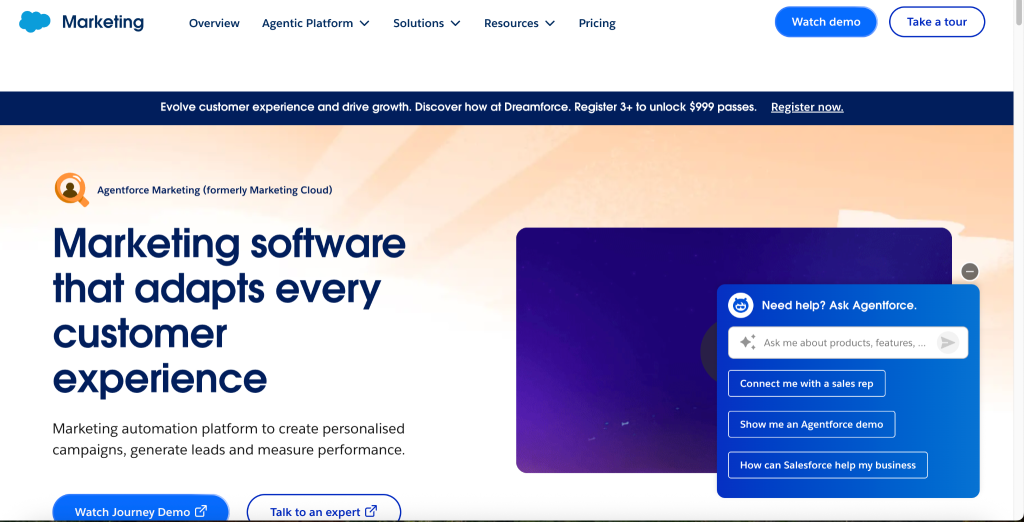
Best for: Enterprises that already rely heavily on Salesforce and want personalization integrated with their existing customer infrastructure.
Salesforce Marketing Cloud provides personalization, segmentation, journey orchestration, and customer engagement capabilities within the broader Salesforce ecosystem.
Its main advantage is the ability to connect marketing activity with CRM and customer data already managed within Salesforce.
Pros:
- Broad enterprise ecosystem
- Strong CRM integration
- Extensive integrations
- Suitable for complex organizations
Cons:
- Implementation can require significant resources
- The broader ecosystem can be complex
- Costs and functionality depend on the Salesforce products and add-ons deployed
4. WebEngage
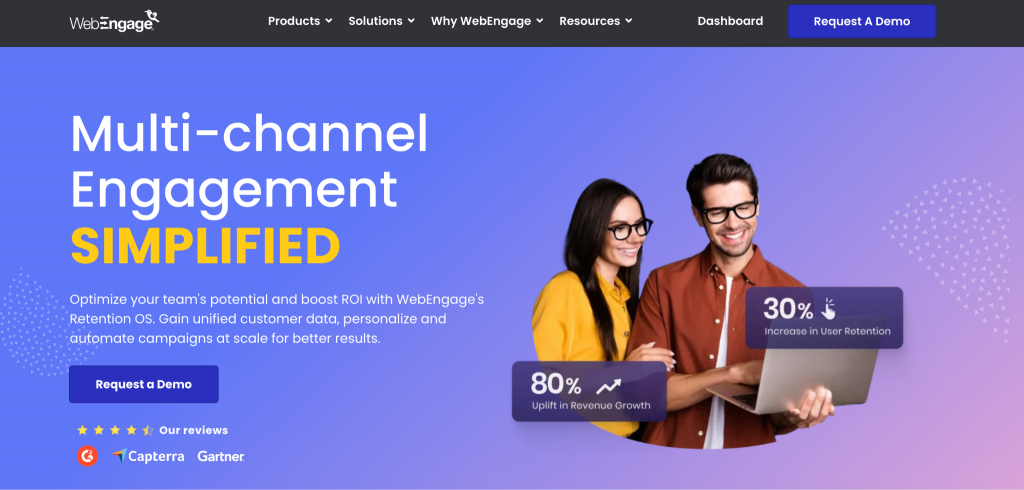
Best for: Consumer businesses looking for behavioral targeting combined with personalization and engagement automation.
WebEngage combines behavioral segmentation, personalization, and customer engagement.
Its capabilities can be used to respond to customer actions with contextual web and app experiences while connecting those interactions to broader lifecycle campaigns.
Pros:
- Strong focus on consumer engagement
- Supports behavioral targeting
- Combines personalization and campaign automation
- Multiple engagement channels
Cons:
- Advanced use cases may require additional implementation work
- Enterprises should evaluate integration requirements against their existing data architecture
5. MoEngage
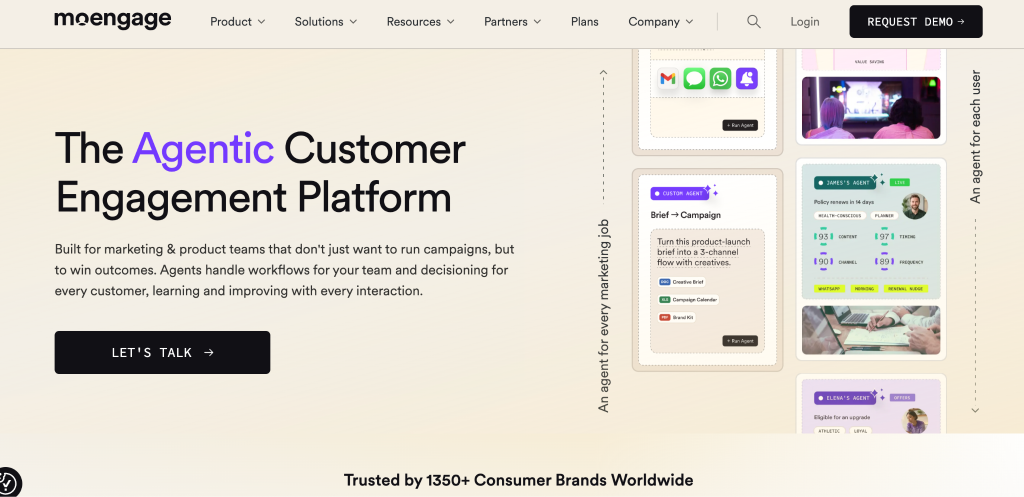
Best for: Mobile-first and consumer businesses combining analytics, engagement, and personalization.
MoEngage combines customer analytics with engagement and personalization capabilities. Teams can use behavioral insights to determine which customers should receive specific content, recommendations, or messages.
Its mobile focus makes app activity an important source of personalization signals.
Pros:
- Strong mobile engagement capabilities
- Analytics and engagement in one platform
- Behavioral targeting
- Multiple engagement channels
Cons:
- Advanced use cases can require substantial behavioral data
- Organizations with complex enterprise data architectures should evaluate integration requirements
Real-time personalization trends shaping 2026
The category is changing quickly, and several developments are worth considering when choosing a platform this year.
First-party data is becoming the personalization foundation
As third-party identifiers become less reliable and privacy expectations increase, brands are placing greater emphasis on first-party and zero-party data.
Website behavior, purchases, app events, loyalty information, preferences, and customer interactions can provide the signals needed to personalize experiences without relying on external identifiers.
This makes identity resolution, consent management, and data governance increasingly important parts of the personalization stack.
AI is developing personalization from reactive to predictive
The next step beyond “respond to what the customer just did” is predicting what the customer is likely to do next.
AI can analyze behavioral patterns and help determine which product, message, channel, or experience is most likely to be relevant.
This is particularly useful when customer journeys are too complex to manage through hundreds of manually maintained rules.
Data warehouses are becoming activation sources
Enterprise customer data increasingly lives in warehouses such as Snowflake, BigQuery, and Databricks.
Instead of copying that data into every marketing platform, brands are looking for ways to activate their existing first-party data while keeping the source of truth in the warehouse.
Insider One’s Zero Copy Segmentation reflects this shift by allowing supported warehouse data to be used for audience creation without copying the underlying data into the platform.
Contextual data is becoming as important as customer data
Personalization isn’t always determined by who the customer is.
It can also depend on what is available or happening around them.
Inventory, pricing, store information, flight details, subscription plans, product attributes, and other business data can influence which experience makes sense.
This is why newer personalization architectures are beginning to treat customer context and business context as separate but complementary data sources.
Personalization is becoming more autonomous
AI is increasingly being used to automate audience creation, recommendations, journey decisions, experimentation, and optimization.
Instead of requiring marketers to manually define every possible customer path, AI can help determine which experience is most appropriate based on available signals.
The marketer’s role shifts from manually configuring every rule to defining goals, guardrails, audiences, and measurement frameworks.
How to choose the right real-time personalization software
The best platform depends on your existing technology stack, data maturity, customer journey, and personalization goals.
Before choosing a vendor, ask:
Can the platform respond to behavior in real time?
Find out how quickly events become available for segmentation and personalization.
A platform that refreshes audiences once per day isn’t providing the same experience as one that can react to current-session behavior.
Where does your customer data live?
If your customer data already sits in Snowflake, BigQuery, Databricks, or another warehouse, determine whether the platform can activate that data without unnecessary duplication.
Can it use contextual business data?
Look beyond customer attributes.
Ask whether the platform can use information such as inventory, pricing, store data, product attributes, loyalty status, or subscription information when determining what experience to deliver.
Does it support predictive personalization?
Rules-based personalization remains useful, but predictive AI can help anticipate customer intent and determine what should happen next.
Can it activate across your important channels?
Evaluate whether the platform supports the channels your customers actually use, including web, app, email, push, SMS, WhatsApp, and other engagement surfaces.
How much technical work is required?
Marketing teams should be able to launch and optimize personalization without requiring engineering support for every change.
At the same time, enterprise teams need APIs, integrations, data controls, and governance capabilities for more advanced implementations.
Why Insider One is worth considering for real-time personalization
Real-time personalization works best when data, decisioning, and activation are connected.
Insider One brings these components together through real-time customer data, behavioral and predictive segmentation, AI-powered personalization, recommendations, journey orchestration, and omnichannel activation.
Its newer data capabilities also address two challenges becoming increasingly important in enterprise personalization: how to activate existing first-party data without unnecessary duplication and how to incorporate contextual business data into customer experiences.
With Zero Copy Segmentation, organizations can use supported warehouse data for audience creation without moving the underlying data into Insider One. Lookup Tables provide another layer of context by allowing shared business information to be used alongside customer data.
For B2C brands, this creates a personalization workflow that goes beyond simply changing content based on the last action:
Start your real-time personalization journey with Insider One
Real-time personalization is most valuable when customer signals can quickly become relevant experiences.
Insider One helps B2C brands connect real-time customer data, predictive audiences, personalization, recommendations, and omnichannel engagement in one platform.
Request a personalized demo or take the interactive platform tour to see how the platform can support your personalization strategy.
Frequently asked questions
Real-time personalization is the process of instantly delivering tailored content, offers, and experiences based on a user’s current behavior, preferences, and context as they interact with a brand. It updates dynamically across channels like web, email, SMS, and apps, ensuring every interaction feels relevant and timely.
Traditional personalization uses static or historical data to deliver segmented, generalized experiences, often updated in batch processes. Real-time personalization reacts immediately to live customer data and actions, adapting content and messaging on the fly to provide highly relevant, context-aware experiences in the moment.
AI can identify patterns across customer behavior and predict what a customer may do next. It can support predictive segmentation, product recommendations, next-best-channel decisions, send-time optimization, and automated experimentation.
Common inputs include website and app events, purchase history, customer profiles, product data, campaign interactions, loyalty information, preferences, and contextual business data. Requirements vary depending on the use case.
Not necessarily. However, a unified customer data layer can make real-time personalization easier to operate at scale. The key consideration is whether the platform can access the customer and contextual data needed to make timely decisions.
Yes. Modern personalization architectures increasingly support activation from data warehouses. Insider One’s Zero Copy Segmentation, for example, allows supported warehouse data to be used for audience creation without copying the underlying customer data into the platform.
Retail, ecommerce, travel, finance, and entertainment are among the top industries benefiting most, as they rely heavily on personalized experiences to engage customers across multiple digital channels and touchpoints
Success can be measured through:
1. Increased conversion rates
2. Higher average order value (AOV)
3. Reduced bounce and cart abandonment rates
4. Greater customer engagement and session duration
5. Improved retention and customer lifetime value (CLTV)
6. Positive ROI on personalized campaigns

Keep Reading
7 min.

Muharrem Derinkok
4 Jun 2026
11 min.

Chris Baldwin
2 Jun 2026
4 min.
Chris Baldwin
3 Feb 2026