

 Platform Overview

 Integration Hub

 Agent One™

 Agent One Teams™

 Customer Data Management

 Personalization

 Journey Orchestration

 Reporting & Data

 Behavioral Analytics

 Web
Web

 Email
Email

 Site Search

 Conversational CX

 WhatsApp

 Web Push

 InStory

 App
App

 SMS & RCS

 Join the $0 Migration Movement™

 The Insider One Difference

 Compare Vendors

 Switch to Insider One

 Success Story

 Retail & Ecommerce

 Financial Services

 Travel & Hospitality

 Beauty & Cosmetics

 Automotive

 Telecommunications

 Total Economic Impact™ Study

 Blog
Blog

 E-Books & Guides

 Events

 Glossary
How Zero-Party Data Makes Customer Segmentation Actually Accurate

Updated on 11 May 2026
9 min.
Table of Contents
- Why behavioral data can still produce broken segments
- What zero-party data actually looks like in a segment model
- Building segments that update themselves: the declared-data loop
- Blending zero-party and first-party data without losing the consent advantage
- Common mistakes that kill zero-party segmentation programs
- FAQs
Most Popular

Summary
| Zero-party data improves segmentation by capturing what customers explicitly want, not just what they do. It fixes gaps in behavioral inference that can cause outdated or inaccurate targeting. When collected through tools like quizzes, preference centers, and surveys, it can directly power real-time segments. The strongest model uses zero-party data as the foundation, with behavioral data as reinforcement. Most failures come from collecting preferences without using them or failing to connect them to activation systems. |
At the centre of many segmentation strategies, there is an assumption that what a customer did last month is a reliable guide to what they want today. However the assumption itself could be wrong. A customer who bought a wedding gift two quarters ago might not be a “gifting customer”, or someone who clicked a clearance email once is not actually “price-sensitive”. But those behavioral signals stick, and the segments drift, which causes the campaigns to keep firing on outdated logic.
Zero-party data, meaning information customers proactively and intentionally share about themselves, offers a different starting point. They are not inferences, but declarations. When someone tells you they are shopping for a new home, training for a half-marathon, or are interested only in sustainable products, you don’t need to guess their intent or preference further. The difference in campaign accuracy is significant, and the difference in customer trust is even larger. This article walks through exactly how to build that into your segmentation model.
Why behavioral data can still produce broken segments
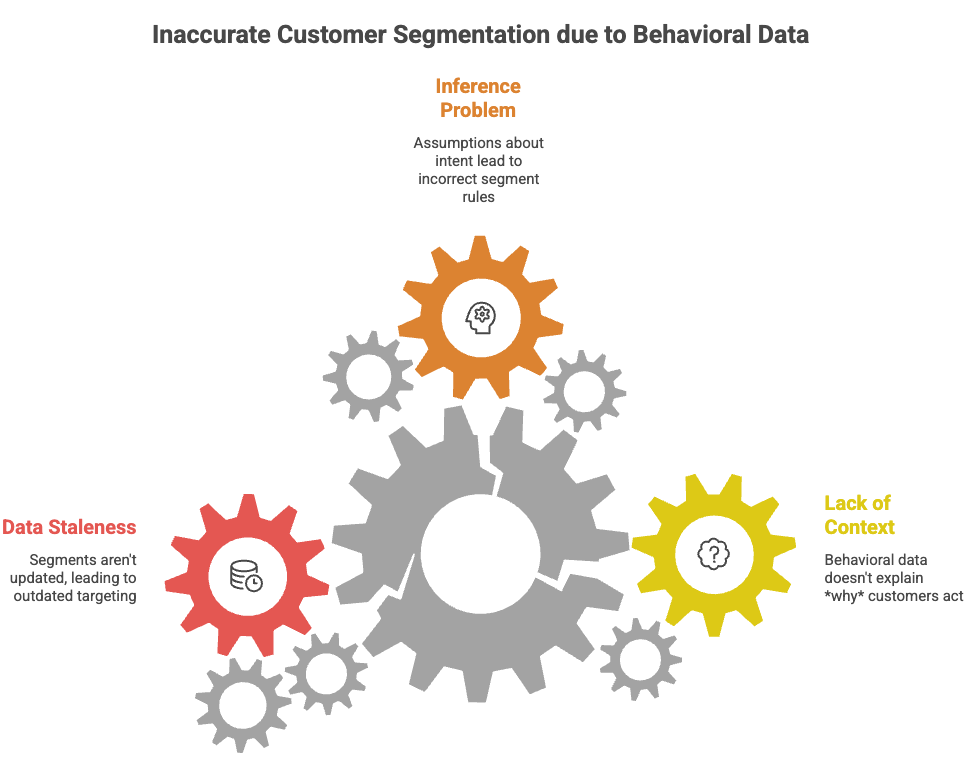
Behavioral data is valuable. Click history, purchase frequency, product category affinity, and browse depth all tell a real story about a customer’s relationship with your brand. The problem is not that behavioral data lies. The problem is that it describes the past without additional context that drove the behavior. A marketer reading that signal has to guess at intent, and guess compounds.
The inference problem creates drift
When you fill in missing context with assumptions, those assumptions become segment rules. Segment rules become targeting logic. Targeting logic becomes a campaign that goes to the wrong person, at the wrong moment, with the wrong message.
A customer whose only purchase was a high-ticket item two years ago looks like a “high-value buyer” in your data model, but they might have churned silently. A customer who opened six consecutive emails last year looks “highly engaged,” but they stopped opening entirely in January, and nobody updated the segment definition.
This is what segment drift looks like in practice. Behavioral segments are accurate at the moment of construction and degrade from there. The more you rely on inference to fill the gaps, the faster the degradation happens. You end up optimizing campaigns against an increasingly fictional picture of your audience. The campaigns do not perform, the team adds more filters, and the segments get more complex without becoming more accurate.
What zero-party data actually looks like in a segment model
Zero-party data is widely understood in the industry as information a customer intentionally and proactively shares with a brand, including preference centre inputs, purchase intentions, personal context, and self-declared identity. Each of these maps cleanly maps to a segment attribute that can anchor a targeting rule.
A declared interest like “I shop mostly for my kids” can be stored as the primary_shopping_context attribute. A stated purchase intention like “looking to buy within the next 30 days” can be flagged using purchase_urgency attribute. A preference centre input like “send me only new arrivals in footwear” should be stored in channel preference and category affinity. These are not inferred, they are recorded facts. That distinction makes them far more stable as segment anchors than behavioral proxies.
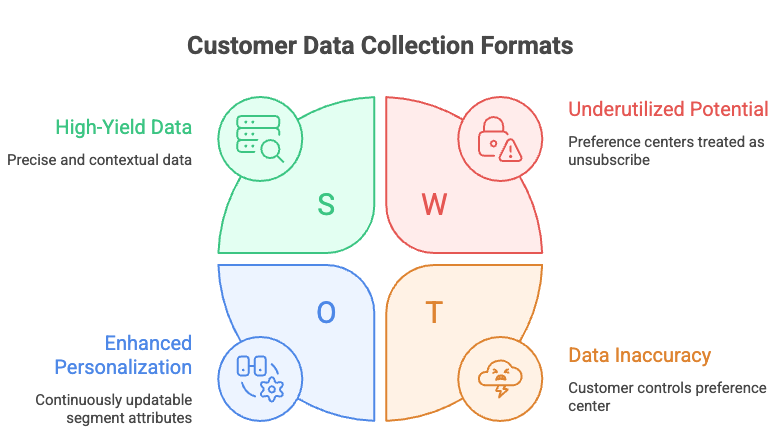
Three collection formats and the attributes they create
Onboarding quiz: A well-structured onboarding quiz, typically presented after account creation or first purchase, is one of the highest-yield collection moments in the customer lifecycle. Questions about product preferences, usage context, goals, and budget range populate foundational attributes that behavioral data would take months to approximate. A beauty brand might learn skin type, primary concerns, and routine complexity in a two-minute interaction. Those three inputs alone support significantly more precise product recommendations and lifecycle messaging than click data from the same period.
Preference centre: Preference centres are underused as segmentation tools. Most brands treat them as an unsubscribe alternative, which wastes the potential entirely. A preference centre that captures communication frequency, channel preference, content interests, and life stage data provides a continuously updatable set of segment attributes. Critically, the customer controls it, which means they are implicitly incentivized to keep it accurate if the personalization visibly improves.
Post-purchase survey: The moment after a purchase is high signal but often being neglected. A short survey asking what drove the purchase decision, whether the product was for the buyer or a recipient, and what they are considering next fills in context that purchase data alone cannot provide. For a brand running behavioral segmentation alongside declared data, this input is the connective tissue between what someone bought and what they are likely to want next.
Building segments that update themselves: the declared-data loop
One of the structural advantages of zero-party data is that customers can maintain their own segments without requiring constant involvement of data analysts. When someone returns to a preference centre and updates their interests because their circumstances have changed, the segment attribute updates, the campaign logic adjusts, and the targeting improves naturally as a result.
The value exchange flywheel
This self-correcting quality depends on one condition: customers need to see the personalization improve when they share data. If someone fills in a detailed onboarding quiz and receives the same generic welcome series as every other new customer, the value exchange has broken down. They gave you a signal, but you ignored it. They will not fill in the next quiz, they will not update the preference centre, and they will likely disengage from any future data-sharing prompt.
The flywheel works in the opposite direction, too. When a customer shares a preference and the very next email reflects it correctly, that experience registers. It signals that the brand is actually listening. The customer is more willing to share more context, the segment becomes richer, the personalization improves further, and the engagement compounds.
Insider One’s personalization capabilities are built to close this loop where declared attributes feed directly into campaign logic so that the payoff from sharing data is visible and immediate, not buried in a data pipeline that takes days to process.
For example, Adidas increased average order value by 259% and conversion rate by 13% in one month using Insider One’s personalization suite, partly by moving away from generic campaign logic and toward segment-level targeting driven by real customer signals.

Blending zero-party and first-party data without losing the consent advantage
The most durable segmentation model treats zero-party data as the anchor and the source of truth for who the customer says they are, while using first-party behavioral data as a validation and enrichment layer. These two inputs are complementary, not competing. Zero-party data gives you stated intent; first-party data gives you observed behavior. Together, they produce a much more complete picture than either provides alone.
A customer who declares they are “interested in running gear” and then consistently browses your running category confirms the declaration. A customer who declares the same interest but never engages with running content might warrant a check-in, a prompt to update their preferences, or a re-engagement sequence built around a different category they do browse. The behavioral signal does not override the declaration, instead it interrogates it and prompts a refresh when it is required.
The override mistake
The common mistake is letting behavioral signals take over. Once a segmentation model starts weighting behavioral data more heavily than declared preferences, you are back in the inference business. A customer who browsed a children’s clothing category twice gets moved into a “parent” segment, even though they declared no such context. The model optimizes for click patterns instead of stated preferences, personalization starts to feel invasive rather than helpful, and the trust that zero-party collection was designed to build begins to erode.
Protecting the consent advantage means establishing a clear hierarchy in your segment logic: declared preferences set the foundation, behavioral signals enrich and validate, and no behavioral trigger reassigns a customer to a different segment anchor without their involvement. For an in-depth look at first-party data strategy and how it connects to declared inputs, the distinction matters most at the point where segment rules are written.
Chow Sang Sang achieved a 23.5% uplift in conversion rate using a combination of onsite and email smart recommendations that drew on unified customer profiles, a clear example of behavioral signals working in service of declared context rather than replacing it.

Common mistakes that kill zero-party segmentation programs
Understanding the right architecture matters less if execution failures prevent the model from working. The most common failures have nothing to do with technology.
Asking for too much too soon
A 15-question onboarding quiz feels comprehensive from a data collection standpoint and overwhelming from a customer experience standpoint. Completion rates drop, the data you collect skews toward your most motivated customers, and you end up with a sample that does not represent your full audience.
A shorter quiz with three to five high-signal questions, followed by progressive enrichment as the relationship deepens, produces better coverage and better data quality. A well-designed preference center should mirror how a good conversation works: start with the most useful questions and build from there.
Collecting preferences that never reach the campaign layer
This is the structural failure that kills more zero-party programs than any other. A preference center lives on one system while campaign logic lives on another and the declared attributes never sync. Customers update their preferences and continue to receive campaigns built on behavioral inference. The brand invested in collection but not in activation, and the customer sees no evidence that sharing their data made any difference.
A well-architected zero-party segmentation stack links collection touchpoints directly to segment attributes in the same platform that runs campaigns. Declared inputs update segment membership in real time, and campaigns that are already running check segment rules at send time rather than at build time.
Insider One’s customer journey orchestration layer is designed specifically for this design with declared attributes and behavioral signals both fed into the same unified profile, so that segment logic reflects the most current version of the customer, not the version that existed when the campaign was built.
Treating zero-party data as a one-time collection event
Preferences change and life circumstances shift. A customer who declared they were shopping for themselves two years ago might now be buying primarily as a parent. A zero-party segmentation program that collects once and never refreshes becomes behavioral inference with extra steps.
Build re-engagement prompts for preference updates into your lifecycle flows, particularly at moments of natural change: post-purchase, anniversary, win-back, and category re-engagement sequences.
If you want to see how Insider One’s Architect and Customer Data Management turn live customer data into coordinated, revenue-driving experiences, book a personalized demo to see the exact use cases, decision logic, and growth levers most relevant to your team.
FAQs
Zero-party data is information a customer intentionally shares with a brand. It includes declared preferences, stated purchase intentions, personal context like life stage or goals, and self-identified interests. Unlike behavioral data, it does not require inference. The customer tells you directly.
First-party data is collected through observation: what someone clicked, purchased, browsed, or opened. Zero-party data is collected through declaration: what someone tells you directly about themselves. Both are consented, privacy-compliant data types, but they serve different roles in a segmentation model. First-party data describes behavior. Zero-party data describes identity and intent.
The highest-yield formats for consumer brands are onboarding quizzes immediately after account creation, preference centers accessible from email footers and account dashboards, and post-purchase surveys that capture buying context. For brands with a market segmentation strategy built around category affinity or life stage, a short quiz early in the customer journey can compress the time to a useful segment by weeks.
Not strictly, but the activation gap becomes difficult to close without a unified data layer. If declared attributes sit in a survey tool and campaign logic sits in an email platform, the connection requires manual intervention and degrades over time. Insider One’s Customer Data Management capability unifies declared and behavioral inputs into a single customer profile, which is what makes real-time segment updating and triggered personalization practical rather than aspirational.

Keep Reading
7 min.

Muharrem Derinkok
4 Jun 2026
11 min.

Chris Baldwin
2 Jun 2026
4 min.
Chris Baldwin
3 Feb 2026