

 Platform Overview


 Integration Hub


 Agent One™


 Agent One™ Teams


 Customer Data Management


 Personalization


 Journey Orchestration


 Reporting & Data


 Behavioral Analytics


 Web


 Email


 Site Search


 Conversational CX


 WhatsApp


 Web Push


 InStory


 App


 SMS & RCS


 Join the $0 Migration Movement™


 The Insider One Difference


 Compare Vendors


 Switch to Insider One


 Success Story


 Retail & Ecommerce


 Financial Services


 Travel & Hospitality


 Beauty & Cosmetics


 Automotive


 Telecommunications


 Total Economic Impact™ Study


 Blog


 E-Books & Guides


 Events


 Glossary
Agentic AI marketing: stop managing campaigns, start owning outcomes

Updated on 28 Oct 2026
10 min.
Table of Contents
- Summary
- What agentic AI marketing looks like when it actually works
- Where execution breaks down for agentic AI marketing
- The data and orchestration layer teams usually miss
- How to fix agentic AI marketing without adding more channel chaos
- What to evaluate before choosing a platform
- Conclusion
- Frequently Asked Questions
Most Popular
Summary
- Agentic AI marketing should be measured by revenue, retention, and lifetime value (LTV), not by how many campaigns an agent launches in a week
- Agentic pilots can lose momentum when teams lack clear ownership, measurement, and an agreed operating model for autonomous engagement
- A working operating model benefits from reliable customer data, defined decision boundaries, and a measurement plan connected to the business result the team intends to influence.
- Insider One’s Agent One™ plans, executes, learns from, and optimizes customer engagement toward defined goals using a shared live customer profile.
- Evaluate any agentic marketing platform on accountability and governance first, execution speed second
Your agentic AI pilot launched dozens of personalized campaigns last quarter, and the demo looked impressive in the boardroom. But when the chief marketing officer asked what it did to churn or lifetime value, nobody on the team had an answer. That gap between activity and accountability can make it difficult for teams to determine whether an agentic AI initiative is ready to scale.
This article is for VP- and director-level marketing leaders, customer relationship management (CRM) and retention leads, and marketing technology (MarTech) or revenue operations (RevOps) teams evaluating agentic AI to replace manual campaign orchestration. You’ll learn what a working agentic system actually looks like, where execution breaks down, the data foundation most teams skip, and how to evaluate a platform before you commit a budget to another pilot.
What agentic AI marketing looks like when it actually works
Agentic AI marketing is most useful when teams define a business outcome rather than a task list and establish how they will assess the initiative against that outcome. That’s a different bar than “launch more campaigns faster.”
Most vendor pitches focus on framing agentic AI as a way to compress the brief-to-content-to-launch cycle inside a single ecosystem. That’s a real benefit, but it’s an execution metric, not an outcome metric. A system that ships fifty campaigns in a week and moves nothing on retention or lifetime value hasn’t solved the actual problem; it has automated the wrong thing faster.
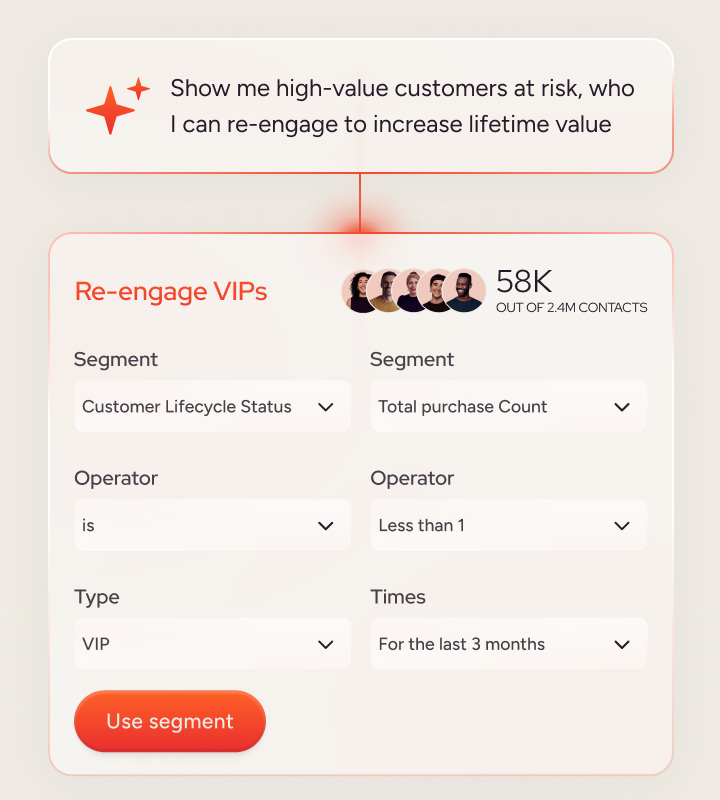
The execution standard that matters looks different between different teams and use cases. For a churn-focused use case, teams should define which decisions, such as channel, timing, offer, or message, may be automated. This requires human review, and how the initiative will be measured against churn rather than send volume. That requires:
- A named business outcome (revenue, retention, LTV) assigned to the agent, not a channel or campaign quota
- Decision boundaries that define what may be automated versus what needs human sign-off
- A measurement plan that connects engagement activity to the key performance indicator (KPI) the team intends to influence
Where execution breaks down for agentic AI marketing
Execution can break down when teams prioritize deployment speed before establishing ownership, measurement, and human-review processes. Addressing those operating requirements early helps teams evaluate results and decide whether to expand an initiative.
The structural blockers are predictable once you’ve seen them. Nobody owns the outcome the agent is supposed to move, so when results are ambiguous, the project loses its internal champion.
Teams should define how they will review unexpected outcomes, pause or revise an engagement approach, and escalate higher-risk decisions before expanding an initiative. Approval requirements should reflect the customer impact and commercial risk of each use case.
Complexity increases as teams add channels. Cross-channel engagement across email, SMS, WhatsApp, and App Push benefits from consistent audience, offer, and message rules so customers receive coordinated experiences.
For example, a retention offer in one channel and a full-price promotion in another can create a disconnected customer experience when teams do not coordinate lifecycle messaging. Clear ownership and review processes help reduce that risk as programs expand.
The data and orchestration layer teams usually miss
A dependable data and orchestration layer is an important consideration when teams evaluate agentic AI at scale. An agentic use case may be better informed when the relevant customer information is current and available to the team’s implementation.
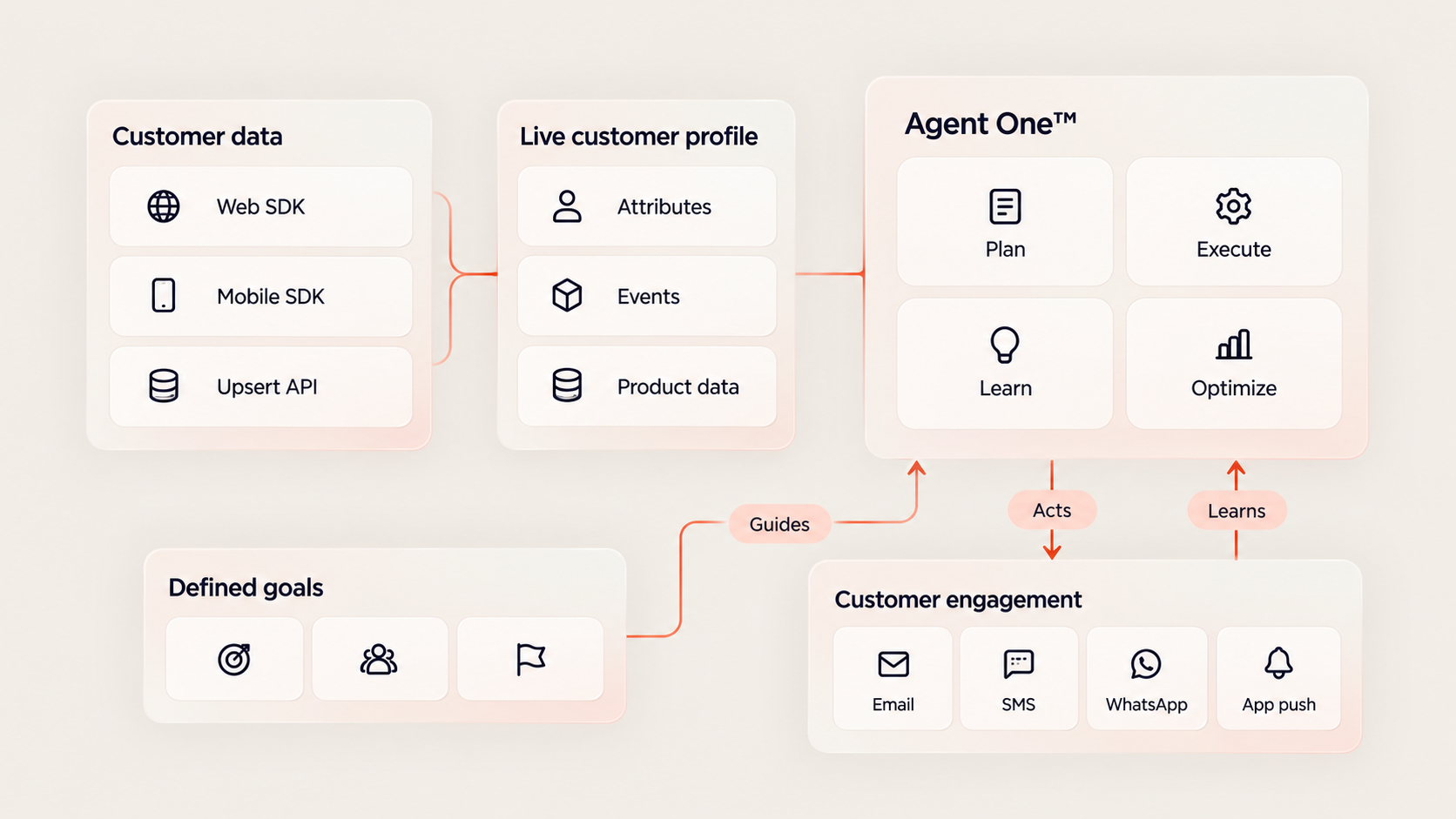
That means the data foundation should include user attributes, events, and product data collected through Web SDK, Mobile SDKs, or the Upsert API so Insider One can build unified user profiles for personalization across channels. Teams can evaluate Customer Data Management alongside their broader data foundation when considering how to bring relevant customer information together for engagement decisions.
Orchestration is the second half of that dependency. Even with clean data, teams need a system that can coordinate engagement across channels, which is what Journey Orchestration is designed to support.
Without coordinated implementation, channel-specific activity can create inconsistent customer experiences. Teams should assess data quality and cross-channel coordination together to reduce that implementation risk.
How to fix agentic AI marketing without adding more channel chaos
A practical starting point is to establish reliable customer data and clear ownership before expanding an agentic use case across a fragmented stack. Adding an agentic layer to disconnected systems can increase implementation complexity and make results harder to assess.
Start with three root-cause fixes, in order:
- Bring together the customer data relevant to the use case before expanding autonomous engagement, so teams can assess whether attributes, events, and product data are sufficient.
- Assign a named KPI owner for every agentic use case (a churn number, an AOV target, a reactivation rate) before launch, not after
- Define decision tiers before launch, including which lower-risk actions may be automated and which higher-impact offers or customer communications require human approval
Insider One’s Agent One™ is its agentic AI system for customer engagement: it plans, executes, learns from, and optimizes engagement toward defined goals through multi-agent systems that share a live customer profile. Evaluate Agent One™ against your specific data, channel, and measurement requirements.
Practical use cases extend beyond retention: teams can use shared customer profiles and cross-channel journeys for onboarding, reactivation, personalized product recommendations, experimentation, analytics, and product discovery experiences such as search and merchandising.
The payoff shows up in outcomes, not just speed. ECCO saw a 7.4x return on investment (ROI) and a 95% conversion rate uplift by tying automated decisioning to a defined outcome rather than campaign volume, and Slazenger achieved 49x ROI running omnichannel decisions through one orchestration layer instead of siloed channel tools. Neither result came from launching more campaigns; both came from an accountable system making better decisions with complete data.
What to evaluate before choosing a platform
The right evaluation criteria are the platform’s data foundation, cross-channel personalization, measurement, and ability to connect engagement work to business goals, not campaign-launch speed alone. Insider One is an AI-powered Growth Management Platform that brings audience segmentation, cross-channel personalization, AI product recommendations, cross-channel analytics, and journey orchestration together for marketers.
Before you commit budget to any agentic marketing platform, push vendors on the questions that expose whether the system was built for accountability:
- How will the team connect an agentic use case to a specific business KPI and assess performance against that KPI rather than campaigns sent
- What decision boundaries, approval workflows, and human-review processes are available for autonomous engagement use cases
- How complete and current is the customer data available for the use case, including the relevant attributes, events, and product data
- How will the team investigate an unexpected outcome, adjust the engagement approach, and assign ownership for the follow-up
These criteria matter more as you scale. A pilot running on three segments may be easier for a team to review closely than a broader rollout. An agentic system used across a full customer base benefits from a sound data foundation, coordinated cross-channel delivery, clear measurement, and appropriate human oversight, which is why platforms worth serious evaluation, including Insider One’s Platform, should be assessed against those requirements. For a deeper look at how autonomous decisioning changes campaign management day to day, our guide on agentic personalization walks through the mechanics in more detail.
Conclusion
Agentic AI marketing earns its place in your stack when teams evaluate it against a business outcome, not campaign-launch speed. Teams can start with reliable customer data, clear KPI ownership, and an agreed operating model before expanding autonomous engagement. Speed without a clear measurement approach can make results harder to assess.
To evaluate how Customer Data Management and Agent One™ may fit your use case, book a personalized demo to review your goals, data requirements, and implementation constraints with the Insider One team.
Frequently Asked Questions
Agentic AI marketing uses AI agents to support planning and execution of customer engagement toward defined goals rather than requiring a marketer to manually build each campaign. In a well-defined use case, teams connect the initiative to a business outcome, such as reduced churn, and measure it against that outcome rather than campaign volume.
Marketing automation commonly follows pre-set rules and sequences a marketer defines in advance. Depending on the implementation, agentic AI can support more adaptive planning and execution toward defined goals, while teams establish the data, decision boundaries, and human oversight appropriate to the use case.
They can stall when teams have unclear KPI ownership, incomplete customer data, or no agreed process for reviewing and improving unexpected outcomes. Clear accountability and measurement help teams assess whether an initiative is delivering value before they scale it.
It needs a reliable unified customer profile built from relevant user attributes, events, and product data, with collection designed around the decisions the team expects to make. When relevant information is incomplete or outdated, it can create implementation risk and make an agentic pilot harder for teams to evaluate.
Prioritize accountability and governance alongside execution speed: assess the data available for the use case, the measurement approach, the decision boundaries, and the human-review process for unexpected outcomes. Speed matters less when a team cannot connect engagement work to a clear business objective.

Keep Reading
4 min.

Chris Baldwin
3 Feb 2026
10 mins.

Nicolas Algoedt
28 Oct 2026
7 min.
Chris Baldwin
28 Oct 2026