

 Platform Overview

 Integration Hub

 Insider One AI™

 Customer Data Management

 Personalization

 Journey Orchestration

 Reporting & Data

 Behavioral Analytics

 Web
Web

 Email
Email

 Site Search

 Conversational CX

 WhatsApp

 Web Push

 InStory

 App
App

 SMS & RCS

 Join the $0 Migration Movement™

 The Insider One Difference

 Compare Vendors

 Switch to Insider One

 Success Story

 Retail & Ecommerce

 Financial Services

 Travel & Hospitality

 Beauty & Cosmetics

 Automotive

 Telecommunications

 Total Economic Impact™ Study

 Blog
Blog

 E-Books & Guides

 Glossary
Best eCommerce Personalization Software: Top 6 Tools for 2026

Updated on 14 Sep 2026
15 min.
Table of Contents
- Summary
- The 6 best eCommerce personalization platforms at a glance
- Why does eCommerce personalization software matter?
- How does eCommerce personalization software work?
- Which features should you treat as non-negotiable?
- How we assessed these platforms
- #1 Insider One
- #2 Dynamic Yield
- #3 Bloomreach
- #4 Adobe Experience Cloud
- #5 Salesforce Marketing Clouds
- #6 Oracle
- Which other platforms are worth shortlisting?
- How should you choose?
- Conclusion
- FAQs
Most Popular
Summary
- The best eCommerce personalization software unifies customer data and activates it across every channel, so assess channel coverage before comparing recommendation algorithms or template libraries.
- Insider One suits enterprise brands consolidating data and channels into one platform, covering web, app, web push, email, SMS, Rich Communication Services (RCS), WhatsApp, Messenger, site search and ad audiences.
- Dynamic Yield, now owned by Mastercard, is strong for on-site and in-app experimentation, though it does not personalize SMS, WhatsApp or Messenger natively.
- Bloomreach combines search, merchandising and marketing under its Loomi AI layer, with agentic capabilities packaged and licensed separately from the core engagement product.
- Adobe Experience Cloud, Salesforce and Oracle Marketing make most sense for teams already standardised on those suites, and each typically requires several products licensed together..
- Ask three questions of any shortlist: which channels it personalizes, whether it can personalize before a visitor identifies themselves, and how quickly your team can go live.
The right eCommerce personalization software collects data on what visitors browse, lets you segment on that data, and personalizes messaging, content and product recommendations across every touchpoint. Done well, it lifts conversion rates, protects margin and reduces customer acquisition cost (CAC).
This article is for ecommerce, digital marketing and customer relationship management (CRM) leaders comparing personalization platforms for budgets. You will get a side-by-side comparison of seven platforms, the trade-offs behind each, and the questions worth asking before you sign. We start with Insider One, our own platform, so treat that section as a vendor description and the comparison points as claims to verify in your evaluation.
The 6 best eCommerce personalization platforms at a glance
| Platform | Best for | Personalization channels | Standout strength | Consideration |
| Insider One | Enterprise brands consolidating data and channels into one platform | Web, app, web push, email, SMS, RCS, WhatsApp, Messenger, site search, ads | Predictive, generative and agentic AI across every channel, with assisted onboarding | Value is greatest when it replaces several point solutions, not one |
| Dynamic Yield (Mastercard) | Retailers focused on on-site and app experimentation | Web, app, email, kiosk | Long-running Gartner Magic Quadrant Leader | No native SMS, WhatsApp or Messenger personalization |
| Bloomreach | Brands wanting search, merchandising and marketing from one vendor | Web, email, SMS, WhatsApp, RCS, app, ads, search | Loomi AI unifies Discovery, Engagement and Content | Agentic add-ons are packaged and priced separately |
| Adobe Experience Cloud | Large enterprises already invested in Adobe | Web, app, email, ads, depending on products licensed | Deep enterprise data and analytics stack | Full personalization usually needs several Adobe products |
| Salesforce | Teams standardised on Salesforce CRM | Web, app, email, SMS, ads, depending on products licensed | Native CRM and service data for personalization | Two overlapping personalization products to choose between |
| Oracle Marketing | Existing Oracle CX customers | Web, email, app, loyalty | Loyalty and business-to-business automation depth | Portfolio built by acquisition, with separate B2B and B2C bundles |
Why does eCommerce personalization software matter?
On the surface, personalization looks like another way to lift sales. It does that, but the larger return is trust. Relevant content, messaging and product recommendations show customers you understand what they need and will not waste their time.
Done properly, that produces higher engagement and conversion rates, more repeat customers, and improvements across the metrics that decide profitability: CAC, customer lifetime value (CLTV) and average order value (AOV).
How does eCommerce personalization software work?
Every personalization platform starts by collecting data: browsing history, cart contents, location, past purchases, preferred channels and app usage. It then uses that data to decide what each customer sees next.
An omnichannel platform like Insider One can deliver product recommendations across websites, apps, emails and messaging channels, help visitors find what they want faster with personalized site search, and personalize every other touchpoint, from category navigation to SMS, WhatsApp and paid media audiences.
Which features should you treat as non-negotiable?
Feature sets differ, but these eight decide whether personalization moves revenue:
- Customer segmentation based on behaviour, attributes, purchase history and predicted intent.
- Product recommendations driven by browsing, purchase history and lookalike behaviour.
- Real-time personalization that adjusts content and offers as the visitor acts.
- Email personalization for triggered campaigns such as cart abandonment and price-drop alerts.
- Location and context targeting for region-specific products, pricing and promotions.
- A/B and multivariate testing so personalization decisions are measured, not assumed.
- Omnichannel orchestration across web, app, email, messaging and ads from one journey builder.
- Analytics and reporting granular enough to attribute incremental revenue.
How we assessed these platforms
We assessed each platform on channel coverage, whether it can personalize for anonymous visitors, data unification, artificial intelligence (AI) capability, time to value and fit by company size. Assessments draw on public vendor documentation, analyst evaluations current as of the review date above, and our own implementation experience with enterprise retailers.
#1 Insider One
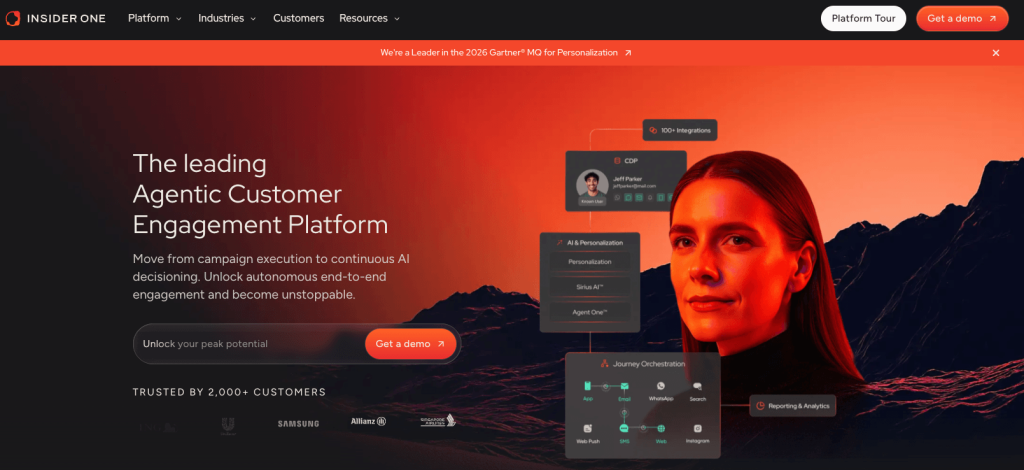
Best for: enterprise brands that want to unify customer data and personalize every channel from one platform.
Personalization channels: web, mobile app, web push, email, SMS, RCS, WhatsApp, Facebook Messenger, site search and ad audiences.
Insider One is our AI-native customer engagement platform. It brings together personalization for established channels such as on-site and email with the channels where growth now happens, including WhatsApp, SMS and RCS.
Core capabilities include:
- Customer data management, which unifies data from your storefront, CRM, point of sale, contact centre and warehouse into a single profile, then makes it usable for campaigns without engineering work.
- Insider One AI, which combines predictive, generative, conversational and agentic AI. Predictive models target on likelihood to purchase, discount affinity and churn risk. Generative features draft content and surface segments from a prompt.
- Smart Recommendations, which serve personalized product recommendations across web, app, email and messaging.
- A/B and multivariate testing across channels, so you can prove which experience wins.
- Eureka site search and InStory, a story-format product discovery experience for mobile.
- Architect, a drag-and-drop builder for cross-channel customer journeys.
In short, Insider One lets you unify fragmented data, activate it across channels, and manage personalization in one place instead of stitching together several logins.
Can you personalize before a visitor identifies themselves?
Yes, and it is where most of the upside sits. With Insider One, personalization starts on the first pageview, so you can convert new visitors without an email address or phone number.
When a new visitor arrives, Insider One creates a profile in your unified customer database and populates it as they browse with the categories they viewed, the product pages they opened, the price range they are shopping in, and the attributes they gravitate to, such as colour, size or brand.
That is enough to personalize in real time and shorten the path from first visit to first order. Philips used Insider One to lift engagement and conversion for new visitors, launching a coupon-code overlay on web and mobile with our account management team. Conversion rate uplift by 40.11%, and AOV increased by 35%. Read the Philips case study.
How do you bring visitors back without paying for retargeting?
Most new visitors do not convert in the first session. The usual answer is retargeting, which works but raises CAC and squeezes margin.
Insider One brings visitors back with personalized web push notifications instead. You collect opt-in through an exit-intent prompt, which asks far less of a visitor than an email address. Because behavioural data already sits on the profile, those notifications are personalized by category, product and price range from the first send.
Lenovo used Insider One web push to reach visitors who had abandoned their carts and bring them back to the site, reducing cart abandonment by more than 10%. Read the Lenovo case study.
How detailed can customer segments get?
Once data is flowing, you can segment on any on-site attribute: category, colour, size or price band. Predictive audiences add affinity, likelihood to purchase, discount affinity and churn risk.
Segments you can build with no personal data at all include iOS visitors who added a specific product to cart, United Kingdom visitors with high discount affinity who abandoned a cart, and returning Android visitors in Latin America with high churn risk.
Adidas used our segmentation to serve different promotional offers to different segments, A/B testing several side-menu coupon variations. The tests produced a 259% increase in AOV among new users and a 35.3% lift in conversion rate among returning ones.
Once segments exist, you activate them. For an anonymous visitor segment, that might mean changing the banners they see, reordering category navigation with Category Optimizer, or running an on-site survey to find out what is holding them back. Survey answers flow back into the profile, which sharpens the next decision.
How does personalization scale across channels?
Once you hold contact details, every touchpoint can be as personalized as your storefront. Take a segment with a clear category and price-band affinity. You can email or message them two hours after they leave, retarget them with a paid social audience the next day, or hold off entirely until a price drop in that category. You set the rules once in Architect and the journey runs itself.
Yves Rocher, the global cosmetics brand, used Insider One across channels to personalize for both visitors and customers:
- Smart Recommendations and push notifications to promote the right products per customer, lifting conversion rate by 20%.
- Predictive segmentation to restrict Facebook and Google ads to customers most likely to buy, producing a 39% uplift in return on ad spend on Google and more than 38% uplift in conversions on Facebook.
- Wheel of Fortune, one of our pre-built templates, to gamify the experience and grow their lead database by 6%.
- Banner management campaigns to show different on-site banners by segment, worth an 18.36% conversion rate lift.
Read the full Yves Rocher case study.
What does setup and migration involve?
Getting started is the hardest part of personalization. Platforms are complex, and many teams wait months for a return.
Insider One handles this differently. We set the platform up with you at no extra charge, and our team reviews your site and analytics before the kick-off call, so you leave that meeting with a personalization strategy rather than a blank canvas. A template library for every supported channel means journeys start from a working pattern, and the $0 Migration Movement covers the cost of moving off your current vendor.
What do analysts and customers say?
- Insider One was named a Leader in the 2026 Gartner Magic Quadrant for Personalization Engines, the fifth time as a Leader.
- In the accompanying 2026 Gartner Critical Capabilities report, Insider One scored 4.07 out of 5.00 for the digital commerce use case and 3.96 for the marketing use case.
- Insider One topped G2’s Fall ’26 reports as the leading platform across 10 categories, including personalization software and customer data platform (CDP).
- Insider One was named a 2026 Gartner Peer Insights Customers’ Choice for Multichannel Marketing Hubs.
- A commissioned Forrester Total Economic Impact study put the return on investment of Insider One at 449%, with $10.2M in attributed revenue for the composite organisation.
#2 Dynamic Yield
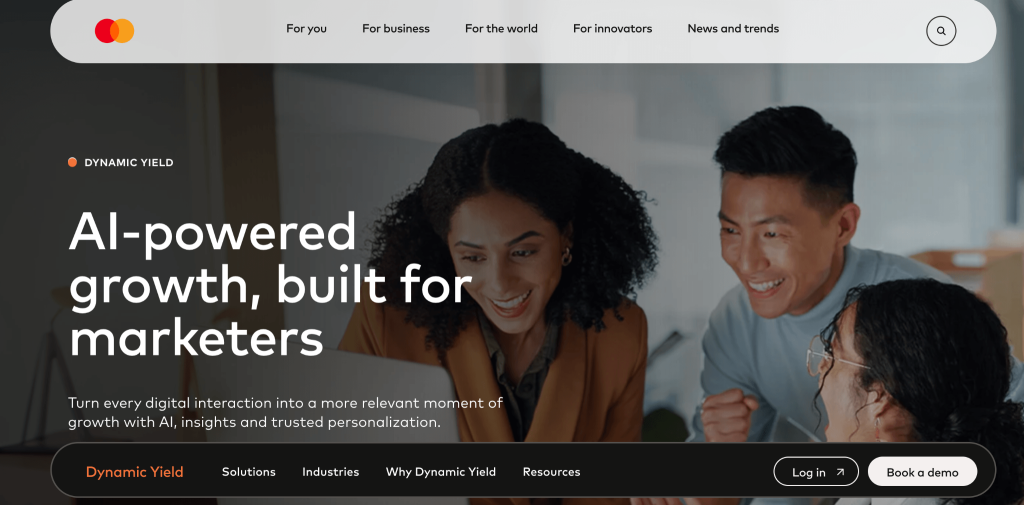
Best for: retailers whose priority is on-site and in-app experimentation.
Personalization channels: web, app, email, kiosk.
Dynamic Yield, owned by Mastercard, is a personalization platform used by online retailers, financial services firms and other consumer businesses. Its capabilities are bundled into an Experience OS, where teams collect and activate customer data for testing, recommendations and on-site personalization.
Segmentation, product recommendations and A/B testing are well covered, and the product has been a Gartner Magic Quadrant Leader for several consecutive years. The gap for omnichannel retailers is messaging: Dynamic Yield does not personalize SMS, WhatsApp or Facebook Messenger natively, so those channels need a second platform.
#3 Bloomreach
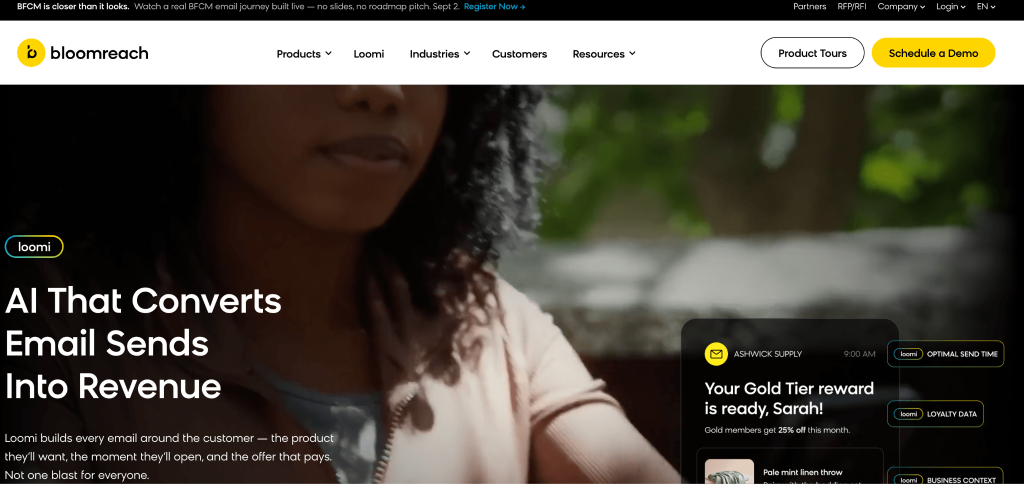
Best for: brands that want search, merchandising and marketing automation from one vendor.
Personalization channels: web, email, SMS, WhatsApp, RCS, app, ads, on-site search.
Bloomreach is an AI-led commerce personalization platform. Its Discovery, Engagement and Content products are now unified by Loomi AI, its agentic layer, with a marketing agent that builds campaign workflows from a prompt and Loomi Connect exposing the platform to external AI agents.
It also offers a unified customer data layer, comparable in intent to Insider One’s customer data management. Two things to note: Bloomreach’s scope reaches well beyond personalization into site search, merchandising and content management, and its agentic features are licensed separately from the core engagement product, so scope the commercials carefully.
See how Bloomreach compares to Insider One and read our guide to Bloomreach competitors and alternatives.
#4 Adobe Experience Cloud
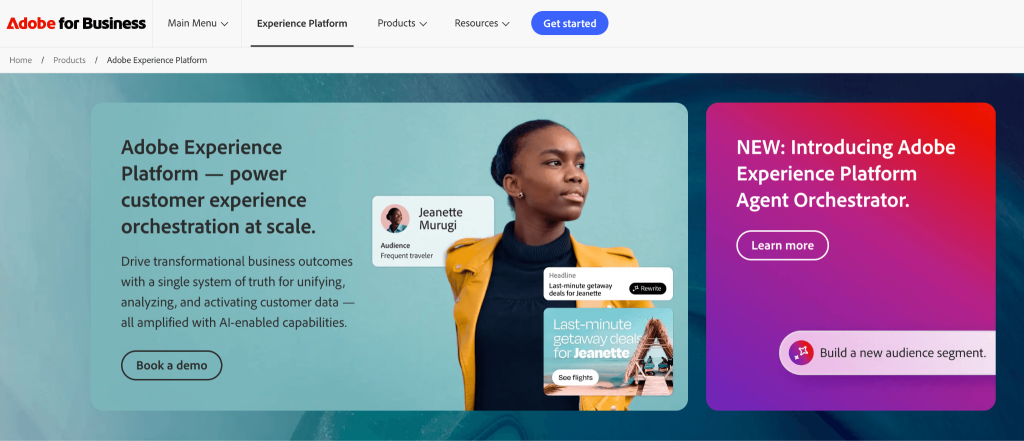
Best for: large enterprises already invested in Adobe.
Personalization channels: web, app, email and ads, depending on which products you license.
Adobe Experience Cloud is a suite rather than a single product. The pieces that matter for personalization are Adobe Real-Time CDP, which unifies data into 360-degree customer profiles; Adobe Journey Optimizer, for real-time orchestration; Adobe Target, for testing and on-site personalization; and Adobe Marketo Engage, for B2B segmentation and campaign automation.
Adobe Target is the personalization engine itself. Gartner’s evaluation notes that complementary Adobe products carry an additional charge, so a complete personalization stack usually means licensing several products together.
#5 Salesforce Marketing Clouds
Best for: teams standardised on Salesforce CRM.
Personalization channels: web, app, email, SMS and ads, depending on the products licensed.
Salesforce approaches personalization through several products. Marketing Cloud handles cross-channel campaign automation, with Journey Builder for orchestration. Marketing Cloud Personalization, formerly Interaction Studio and originally Evergage, is a real-time interaction management product for web, email and mobile. Salesforce Personalization is the newer product built natively on the Salesforce data platform. Commerce Cloud is the storefront for personalized buying experiences.
Two things to check during evaluation. The two personalization products overlap and are also sold as a combined edition, so confirm which one your use cases need. Salesforce has also made Advertising Studio subscriptions non-renewable from August 2026, directing customers to its data platform for ad audiences, so validate the roadmap for any paid media personalization you depend on.
See how Salesforce compares to Insider One and read our guide to Salesforce Marketing Cloud competitors and alternatives.
#6 Oracle
Best for: enterprises already running Oracle CX.
Personalization channels: web, email, app, loyalty.
Oracle Marketing is a traditional marketing cloud built largely from acquisitions. It includes Maxymiser for testing and on-site personalization, CrowdTwist for loyalty and engagement, Eloqua for B2B marketing automation, Responsys for B2C cross-channel orchestration, Infinity for behavioural analytics and Unity as the CDP.
Oracle packages these differently for B2B and B2C, so two Oracle customers can mean two very different capability sets. Confirm exactly which products sit in your entitlement before comparing it to a single-platform vendor.
Which other platforms are worth shortlisting?
Depending on your priorities, these platforms often appear on the same shortlist. Klaviyo is strong for email and SMS on Shopify-centric stores. Braze suits app-first lifecycle messaging. SAP Emarsys is retail-focused with pre-built tactics. MoEngage and CleverTap are both mobile-led engagement platforms. Optimizely is experimentation-led, with personalization built on top.
For a wider view, see our guides to customer engagement platforms, journey orchestration platforms and the best customer data platform.
How should you choose?
- On-site personalization only, with messaging elsewhere: Dynamic Yield, Adobe Target or Optimizely.
- One platform for data plus every channel: Insider One or Bloomreach.
- A suite decision rather than a tooling decision: Adobe, Salesforce or Oracle, matched to the suite you already run.
- A smaller store on Shopify or BigCommerce: Nosto or Klaviyo.
- Anonymous traffic is the blocker, not list size: prioritise platforms that personalize before identity, which rules out anything needing personal data to segment.
Conclusion
eCommerce personalization platforms in 2026 range from on-site testing solutions to platforms that combine customer data, AI decisioning, recommendations, messaging and cross-channel analytics in one place. The right choice depends less on feature checklists than on three things: how many channels you need to personalize, whether you can act on anonymous traffic, and how fast your team can get live without engineering support.
Insider One connects customer data across channels and systems, predicts which segments are likely to convert or churn, and delivers individualised experiences across every touchpoint, including two-way conversations on SMS, WhatsApp, Messenger, Instagram and LINE.
Book a demo to review your goals, data requirements and implementation constraints with the Insider One team.
FAQs
Personalization tailors the shopping experience to the individual using behavioural, transactional and contextual data. In practice it appears as personalized emails, ad audiences, dynamic on-site content, product recommendations, banners, category ordering and messaging on channels such as SMS and WhatsApp. All of it depends on unified, reliable customer data.
Insider One has been ranked as the best eCommerce personalization software by G2 customers (as well as the easiest to use). Other popular options include Dynamic Yield, Bloomreach, Salesforce, Adobe.
Ultimately, the best choice depends on your business needs and budget, as some eCommerce personalization tools are more suitable for small businesses while others are better for midsized and enterprise brands (like Insider One).
Yes, if the platform can act on behavioural data before identity. Insider One creates a profile on the first pageview and personalizes using category, product, price-band and attribute signals, with no email address required. Platforms that segment only on personal data cannot, which matters because most first-time visitors never identify themselves.
A customer data platform unifies data into a single customer profile. A personalization engine decides what each customer sees and delivers it. Some vendors sell them separately, which means an integration project and duplicate data. Insider One combines both, so segments can be activated immediately.
Product recommendations across web, app and email; segmentation that works for anonymous and known visitors; real-time decisioning; omnichannel orchestration; site search; A/B testing; and reporting granular enough to attribute incremental revenue to personalization rather than to the channel it ran in.

Keep Reading
7 min.

Muharrem Derinkok
4 Jun 2026
11 min.

Chris Baldwin
2 Jun 2026
4 min.
Chris Baldwin
3 Feb 2026