

 Platform Overview


 Integration Hub


 Agent One™


 Agent One™ Teams


 Customer Data Management


 Personalization


 Journey Orchestration


 Reporting & Data


 Behavioral Analytics


 Web


 Email


 Site Search


 Conversational CX


 WhatsApp


 Web Push


 InStory


 App


 SMS & RCS


 Join the $0 Migration Movement™


 The Insider One Difference


 Compare Vendors


 Switch to Insider One


 Success Story


 Retail & Ecommerce


 Financial Services


 Travel & Hospitality


 Beauty & Cosmetics


 Automotive


 Telecommunications


 Total Economic Impact™ Study


 Blog


 E-Books & Guides


 Events


 Glossary
7 Best Enterprise Customer Engagement Platforms in 2026

Updated on 10 Nov 2026
13 min.
Table of Contents
- Summary
- What is an enterprise customer engagement platform?
- Enterprise evaluation criteria
- The 7 best enterprise customer engagement platforms
- Comparison: enterprise customer engagement platforms
- RFP checklist for an enterprise customer engagement platform
- How to run a 90-day evaluation
- Conclusion
- Frequently Asked Questions
Most Popular
Summary
- An enterprise customer engagement platform unifies customer data, decides what each customer should receive, and delivers it across channels at scale, with the security, governance and multi-brand controls a large organization needs.
- The seven platforms compared here are Insider One, Salesforce Marketing Cloud, Adobe Journey Optimizer, Braze, Bloomreach, MoEngage and Netcore.
- Insider One is the strongest fit for B2C enterprises that want CDP, personalization, agentic AI and 12+ channels in one platform. Salesforce and Adobe suit organizations already standardized on those clouds; Braze suits app-led, digital-first brands.
- Beyond channel coverage, enterprise selection depends on security, data architecture, scale at peak, multi-brand operations, AI governance and implementation support.
- Use the RFP checklist in this guide so marketing, data, IT security and procurement evaluate vendors against the same questions.
At enterprise scale, choosing a customer engagement platform is rarely a marketing-only decision. The CMO wants faster journeys and better personalization. IT wants single sign-on, audit logs and a clear data architecture. Security wants certifications. Procurement wants a total cost it can defend for three years. A platform that wins the demo can still stall in any of those reviews.
This guide compares seven enterprise customer engagement platforms against the criteria the whole buying committee will apply, and gives you an RFP checklist and a 90-day evaluation plan you can reuse.
What is an enterprise customer engagement platform?
An enterprise customer engagement platform (CEP) is software that turns customer data into personalized interactions across channels such as web, app, email, SMS, WhatsApp, push and conversational messaging. It combines a unified customer profile, segmentation and AI decisioning, journey orchestration and analytics.
What makes it enterprise-grade is not a single feature. It is the ability to do this for millions of customers, across several brands, regions and teams, while meeting security and compliance requirements and connecting to the systems the business already runs, such as the CRM, data warehouse and commerce platform.
| Mid-market CEP | Enterprise CEP | |
| Data | Profiles synced from a store or CRM | Identity resolution across web, app, CRM, offline and warehouse data |
| Scale | Thousands to low millions of profiles | Tens of millions of profiles and peak-day event spikes |
| Organization | One brand, one team | Several brands, regions, languages and teams with separate permissions |
| Security | Basic user roles | SSO, granular roles, audit logs, certifications, data residency options |
| Support | Help center and email support | Dedicated teams, implementation services and contractual SLAs |
For a broader overview of the category, see our guide to omnichannel customer engagement platforms.
Enterprise evaluation criteria
Use these seven criteria to compare vendors. Each one maps to a stakeholder who will need to sign off.
1. Data architecture. Does the platform include a native CDP, require a separate one, or read from your warehouse without copying data? How fast do events reach segments and triggers?
2. Scale and reliability. Profile and event volumes, message throughput, latency at peak (for example, Black Friday), uptime commitments and disaster recovery.
3. Security and compliance. Certifications such as ISO 27001 and SOC 2, single sign-on, role-based access, audit logs, consent management and data retention controls.
4. Multi-brand and multi-region operations. Separate workspaces or permissions by brand and market, localization, regional sending infrastructure and data residency options.
5. AI and agent governance. Whether teams can set goals and guardrails, decide how far AI agents act on their own, and see every automated decision logged and traceable.
6. Channel depth. Which channels are native, which rely on partners, and how journeys fall back from one channel to another.
7. Implementation and total cost. Time to first live journey, migration support, local services, licensing structure and the internal team needed to run the platform.
The 7 best enterprise customer engagement platforms
1. Insider One
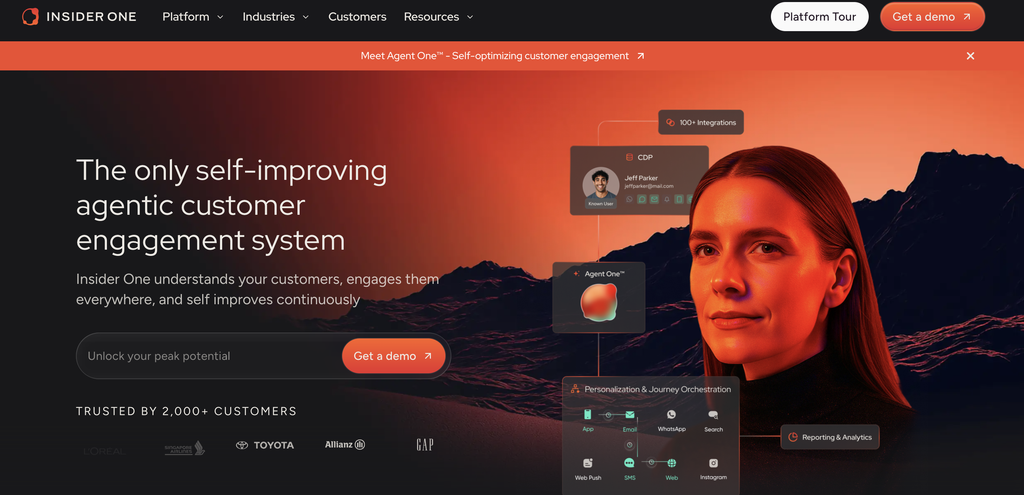
Insider One is an AI-powered customer engagement platform built on a native CDP, used by more than 2,000 brands. It unifies data from 100+ sources through its Integration Hub and runs personalization and journeys across 12+ channels, including web, app, email, SMS, RCS, WhatsApp, web push and conversational experiences.
Enterprise strengths
- Data architecture: real-time customer data management with identity resolution, plus Zero Copy Segmentation for building audiences on Snowflake data without copying it.
- Agentic AI with goals: Agent One™, Insider One’s self-optimizing intelligence system for customer engagement, plans, executes, learns from and optimizes engagement toward the goals teams set. Agent One Teams works on behalf of marketing, ecommerce and customer experience teams, while Agent One Audiences interacts directly with customers, and both share the same customer profile.
- Orchestration: Architect builds cross-channel journeys with A/B testing, next best channel and journey prioritization.
- Security: ISO 27001 certification, a SOC 2 examination and a CSA STAR registry entry, listed on the Insider One security page.
- Regional operations: email sending from Global or EU server regions with region-specific SPF, DKIM and DMARC authentication, AI-led localization, and local email experts organized by region and language.
- Retail scale: in May 2026 Insider One acquired Bluecore, a retail martech company serving more than 400 US enterprise brands.
Proof points
- Named a Leader in the 2026 Gartner® Magic Quadrant™ for Personalization Engines, its fifth time as a Leader, and a Leader in the 2026 IDC MarketScape for Worldwide Agentic Marketing for B2C Enterprises. It is also a 2026 Gartner Peer Insights™ Customers’ Choice for Multichannel Marketing Hubs, with a 100/100 score for willingness to recommend.
- In a Forrester Total Economic Impact™ study commissioned by Insider One, a composite global retailer saw 449% ROI over three years and payback in under six months after consolidating five to six tools.
- MAC Cosmetics Turkey grew email send volume 36% and email-attributed revenue 45% quarter over quarter while keeping a 99%+ delivery rate.
Considerations: pricing is quoted per account. Validate data residency and hosting regions for your markets during the RFP, as with every vendor on this list.
Best for: B2C enterprises in retail, beauty, travel, financial services, automotive and telecom that want one platform for data, personalization and messaging across brands and regions.
2. Salesforce Marketing Cloud
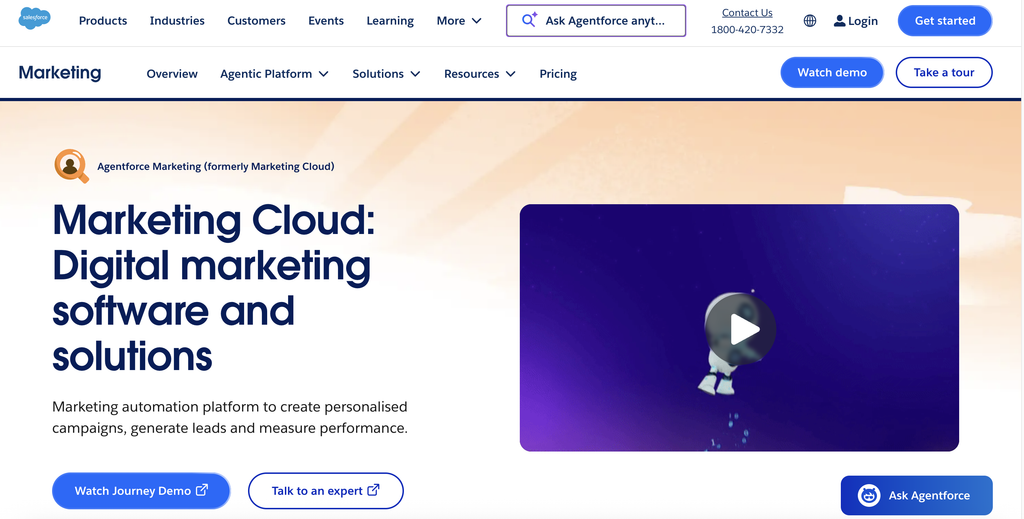
Salesforce Marketing Cloud now leads with Marketing Cloud Next, built on Salesforce’s Data 360 customer data platform and Agentforce AI agents, with journeys across email, SMS, WhatsApp and web. Salesforce is a Leader in the 2026 Gartner® Magic Quadrant™ for Multichannel Marketing Hubs.
Considerations: the platform is assembled from several separately licensed products, and real-time unified profiles typically require Data Cloud. Advanced personalization often needs SQL and AMPscript skills, and most large implementations use a partner. For existing Salesforce customers, the convenience of staying within the ecosystem should be weighed against the full cost of the package they need, including implementation.
Best for: enterprises that run sales and service on Salesforce and have Salesforce admins and developers in-house.
3. Adobe Journey Optimizer
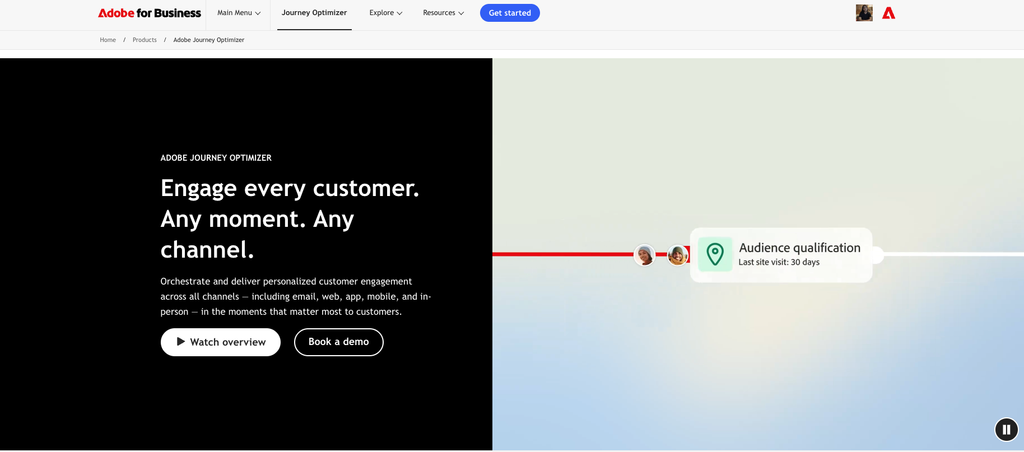
Adobe Journey Optimizer is powered by Adobe Experience Platform and uses its real-time customer profiles to trigger journeys across email, SMS, RCS, push, in-app and web. It includes next-best experience decisioning and AI that generates journeys and content. Adobe is a Leader in the 2026 Gartner Magic Quadrant for Multichannel Marketing Hubs.
Considerations: Journey Optimizer requires Adobe Experience Platform, Adobe Real-Time CDP is sold as a separate product, and pricing is quote-based. Organizations already using Adobe may gain more value from those connections, while buyers new to Adobe should assess the budget, internal resources and time needed to get their priority use cases live.
Best for: large enterprises invested in Adobe Experience Cloud with strong data engineering teams.
4. Braze
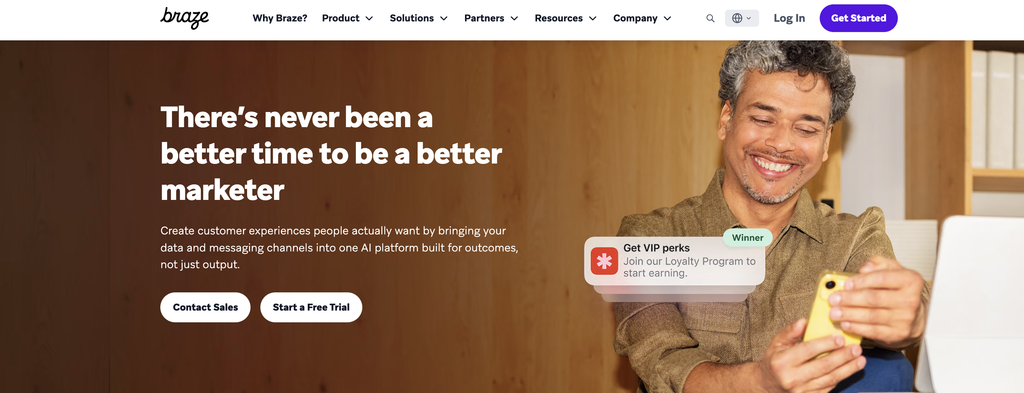
Braze reports more than 2,700 customers and has been named a Leader in the Gartner Magic Quadrant for Multichannel Marketing Hubs for the fourth consecutive year. It covers email, push, in-app, SMS and WhatsApp, with Canvas for journeys, BrazeAI Decisioning Studio for reinforcement-learning-based optimization, and 170+ partner integrations, including Snowflake and Databricks.
Considerations: Pricing is quote-based and scales with monthly active users (MAU). Contracts combine a platform edition, profiles, Action Credits and CX services, so model each in the total cost. Brands that need site search alongside engagement should confirm how it will be covered, and buyers should assess the internal resources needed for advanced use cases.
Best for: best for app-led, digital-first enterprises
5. Bloomreach
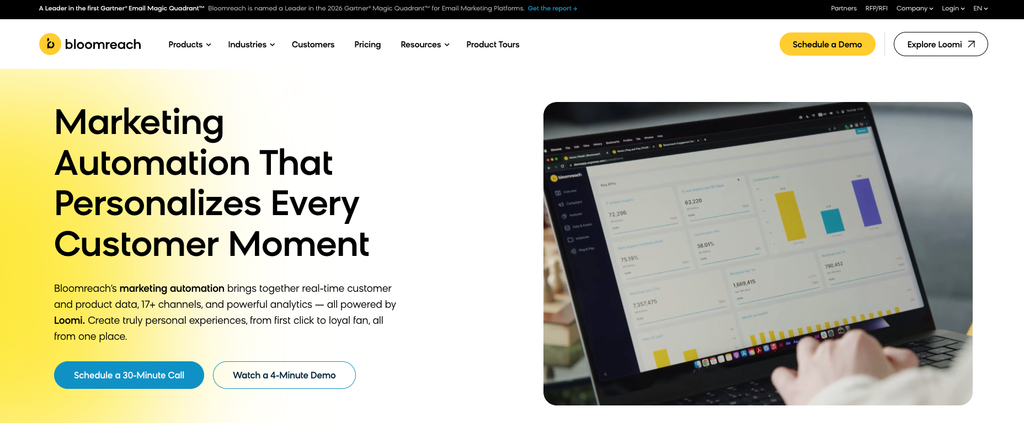
Bloomreach combines a real-time customer data with email, SMS, RCS, WhatsApp, web personalization, mobile app and ads, and pairs engagement with ecommerce search, category merchandising and product recommendations. Its Loomi AI includes agents for building email workflows and answering analytics questions. Bloomreach states it serves more than 1,400 brands and holds SOC 2 Type II and ISO certifications.
Considerations: Pricing is custom and depends on the products turned on, audience and catalog size, and usage, such as messages sent and searches served. Loomi AI agents are add-ons, so confirm the combined cost of engagement, search and AI. Multi-brand organizations should review how Bloomreach’s projects and divisions separate brands and markets, and how teams share customer insights and coordinate campaigns across them.
Best for: retailers that want engagement and on-site search from the same vendor.
6. MoEngage
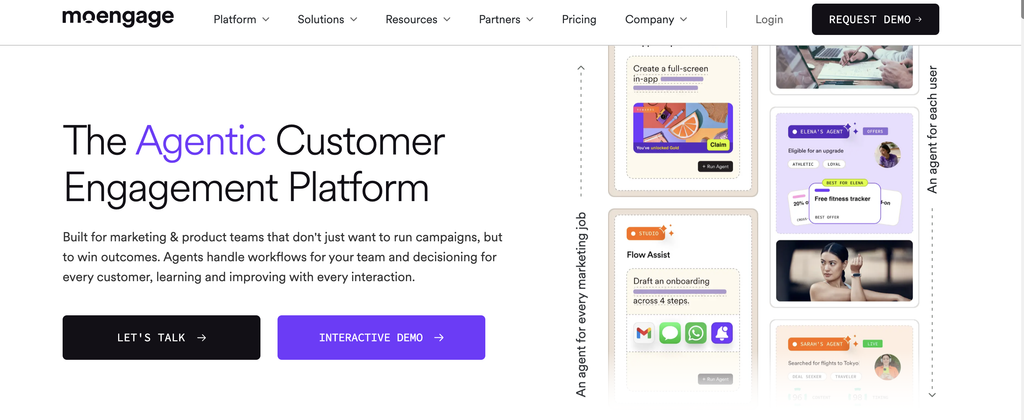
MoEngage is an agentic customer engagement platform used by more than 1,350 brands. It supports 16+ channels, Merlin AI agents, and offer and campaign decisioning.
Considerations: Pricing is not published and is based on monthly tracked users (MTUs), so confirm which channels, services and usage levels each plan includes, and how costs change as your customer base grows. For a direct comparison, see Insider One vs MoEngage.
Best for: app-heavy consumer brands
7. Netcore
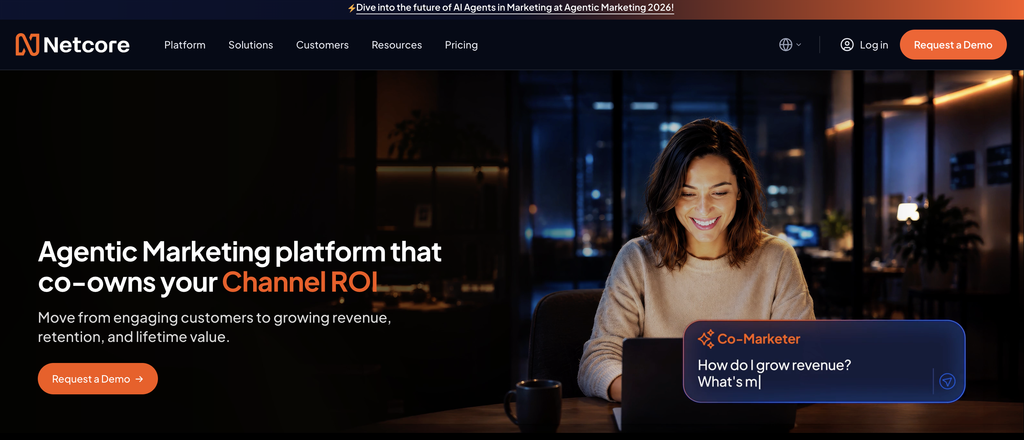
Netcore offers an agentic marketing platform across nine channels, including email, SMS, WhatsApp, RCS and push, with AI agents, a customer data platform, its own CPaaS for messaging, and product discovery through Unbxd. It reports more than 6,500 brands and over 25 years in business.
Considerations: Pricing is custom, based on monthly tracked users and feature configuration, and Unbxd product discovery is offered as a separate product, so confirm whether search, AI and implementation services are included or priced separately. Netcore lists offices in India, the US, the UAE, Nigeria and Southeast Asia, so enterprises operating in other regions should verify local support coverage and service commitments.
Best for: high-volume B2C senders, particularly in India and Southeast Asia.
Comparison: enterprise customer engagement platforms
| Platform | Best for | Data architecture | 2026 analyst recognitions | Pricing |
| Insider One | B2C consolidation across brands and regions | Native CDP; one customer profile shared by Agent One Teams and Audiences; zero-copy Snowflake segmentation | Gartner MQ, Personalization Engines; IDC MarketScape, Agentic Marketing for B2C Enterprises; Gartner Peer Insights Customers’ Choice, Multichannel Marketing Hubs | Custom quote |
| Salesforce Marketing Cloud | Salesforce-standardized enterprises | Data 360, Salesforce’s CDP | Gartner MQ, Multichannel Marketing Hubs | By edition |
| Adobe Journey Optimizer | Adobe Experience Cloud customers | Adobe Experience Platform; Real-Time CDP sold separately | Gartner MQ, Multichannel Marketing Hubs | Not published |
| Braze | App-led enterprises | Braze Data Platform, including zero-copy segmentation | Gartner MQ, Multichannel Marketing Hubs | Custom quote |
| Bloomreach | Ecommerce with search and merchandising | Built-in real-time customer data | Gartner MQ, Email Marketing Platforms | Custom quote |
| MoEngage | Mobile-first B2C | Own data layer; warehouse-native option | IDC MarketScape, AI-enabled CDPs for B2C | Custom, based on monthly tracked users |
| Netcore | High-volume senders in India and APAC | Built-in CDP | Gartner MQ, Search & Product Discovery (Unbxd) | Custom quote |
For head-to-head detail, see how Insider One compares with other vendors.
RFP checklist for an enterprise customer engagement platform
Share one checklist with every stakeholder so vendors are judged on the same questions.
| Stakeholder | Questions to ask every vendor |
| Marketing and CRM | Can marketers build, test and change a journey without engineering? Which channels are native? How are frequency caps applied across channels? Show one of our journeys built live. |
| Data and analytics | Where does the customer profile live? How are identities resolved? Can you segment on warehouse data without copying it? How is incremental revenue measured with control groups? |
| IT and security | Which certifications do you hold (ISO 27001, SOC 2)? Do you support SSO, SCIM and granular roles? Can we set guardrails for AI agents and decide how far they act on their own, with every user and AI action logged? Where is our data hosted, and can we choose the region? |
| Brand and regional teams | Can each brand and market have its own workspace, permissions and templates? How is localization handled? Is support available in our languages and time zones? |
| Procurement and finance | What drives price (profiles, MAU, messages, modules)? Which features are add-ons? What do implementation, migration and support cost? What are the exit terms? |
How to run a 90-day evaluation
1. Weeks 1 to 2, define success: pick two or three priority use cases, such as cart recovery, onboarding or win-back, with current baselines and an owner for each.
2. Weeks 3 to 4, shortlist and RFP: send the checklist above to three vendors and require answers in writing, including security documentation.
3. Weeks 5 to 8, scripted demos and a pilot: have each finalist build one of your journeys with your data, then run a controlled pilot with a holdout group.
4. Weeks 9 to 10, security and legal review: complete the security questionnaire, data processing agreement and data residency review in parallel, not after selection.
5. Weeks 11 to 12, decide on total cost: compare three-year cost including licenses replaced, implementation, migration and internal headcount, against the pilot results.
Migration cost belongs in that comparison. For teams that switch, Insider One’s $0 Migration Movement™ covers migration implementation services and can buy out an existing contract.
Conclusion
The right enterprise customer engagement platform is the one your whole buying committee can approve: marketers can use it daily, data teams trust its architecture, security can sign off, and finance can defend the three-year cost. Map your existing stack, apply the seven criteria above, and test with your own data before you commit.
To see how Insider One brings customer data, personalization, Agent One™ and 12+ channels together for enterprise teams across brands and regions, book a personalized demo or take the interactive platform tour.
Frequently Asked Questions
Multichannel marketing hub is Gartner’s category name for platforms that orchestrate campaigns and journeys across channels. A customer engagement platform covers the same core, and the term is often used for platforms that also include real-time personalization, conversational channels and a built-in CDP.
It can for engagement use cases if it includes a CDP with identity resolution and can ingest all your sources. Many enterprises keep a data warehouse as the system of record and connect it to the engagement platform, ideally without copying data.
A focused rollout for one brand and a few priority journeys can go live in weeks. Multi-brand, multi-region programs typically take several months, mainly because of data integration, security reviews and email IP warm-up.
Ask for ISO 27001 and a SOC 2 report at a minimum, plus documentation for GDPR and any regional privacy laws you operate under. Also confirm single sign-on, role-based access, audit logs and where your data is hosted.
Most enterprise vendors quote custom prices based on profiles or monthly active users, message volume, channels and modules. Ask which capabilities are add-ons and model a three-year total cost, including implementation and the internal team.
Start by setting the business goal and guardrails, such as brand rules, budget limits and rules for regulated messaging. Then decide how far agents act on their own for each use case and channel, from recommending actions to running engagement autonomously, and make sure every agent decision is logged and traceable.
A composable stack built on a warehouse and messaging APIs offers flexibility but needs sustained engineering for integrations, deliverability and orchestration. A unified platform keeps data, decisioning and channels on one customer profile, so what is learned in one channel can improve the next, with fewer handoffs between tools. Enterprises can also combine both approaches with a unified engagement platform that reads from their warehouse without copying data.

Keep Reading
4 min.

Chris Baldwin
3 Feb 2026
8 min.
Chris Baldwin
10 Nov 2026
12 mins.

Nicolas Algoedt
10 Nov 2026