

 Platform Overview


 Integration Hub


 Agent One™


 Agent One™ Teams


 Customer Data Management


 Personalization


 Journey Orchestration


 Reporting & Data


 Behavioral Analytics


 Web


 Email


 Site Search


 Conversational CX


 WhatsApp


 Web Push


 InStory


 App


 SMS & RCS


 Join the $0 Migration Movement™


 The Insider One Difference


 Compare Vendors


 Switch to Insider One


 Success Story


 Retail & Ecommerce


 Financial Services


 Travel & Hospitality


 Beauty & Cosmetics


 Automotive


 Telecommunications


 Total Economic Impact™ Study


 Blog


 E-Books & Guides


 Events


 Glossary
5 Best Martech Tools for Customer Engagement in 2026

Updated on 10 Nov 2026
12 mins.
Table of Contents
- Summary
- What is a martech tool for customer engagement?
- Why more martech has not meant better engagement
- How to evaluate martech tools for customer engagement
- The 5 best martech tools for customer engagement
- Comparison: Martech tools for customer engagement
- Which tool fits your stack?
- How to calculate total cost of ownership before you switch
- Conclusion
- Frequently Asked Questions
Most Popular
Summary
- The best martech tool for customer engagement is the platform that owns the engagement layer of your stack: it reads unified customer data, decides what each customer should receive, and sends it across channels.
- More tools have not led to more use. Gartner found marketers used 33% of their martech stack’s capabilities in 2023, down from 58% in 2020.
- The five platforms compared here are Insider One, Braze, Salesforce Marketing Cloud, Adobe Journey Optimizer and HubSpot Marketing Hub. Insider One is the strongest fit for B2C brands that want to consolidate data, personalization and 12+ channels on one platform, with marketing and customer-facing agents working from the same customer profile.
- Judge each platform on six criteria: data foundation, native channel coverage, AI and agents, consolidation potential, time to value and total cost of ownership.
- Your existing stack narrows the choice: Salesforce and Adobe suit teams already on those clouds, HubSpot suits CRM-led B2B teams, Braze suits digital-first, app-led brands.
The problem is rarely a shortage of tools. The issue is a stack where customer data sits in one system, email in another, SMS and WhatsApp in a third, and on-site personalization in a fourth, with integrations holding it together. Each tool works. The customer still gets messages that do not reflect what they did an hour ago.
Choosing the best martech tool for customer engagement is less about adding a product and more about deciding which platform should run engagement for the whole stack. This guide explains where that platform sits, compares five leading options, and gives you a decision guide and a cost checklist to use before you shortlist.
What is a martech tool for customer engagement?
A martech tool for customer engagement is the platform that turns customer data into messages and experiences. It builds or reads a customer profile, decides who should receive what and when, and delivers it across channels such as email, SMS, WhatsApp, push, web and app. Increasingly, AI agents run and optimize this work toward goals the team sets. Many teams call this a customer engagement platform (CEP).
It is easiest to understand by its place in the stack:
| Stack layer | Main job | Typical tools |
| CRM | System of record for accounts, deals and service cases | Salesforce Sales Cloud, HubSpot CRM, Microsoft Dynamics 365 |
| Data warehouse or CDP | Collects, cleans and unifies customer data | Snowflake, BigQuery, Segment, Adobe Real-Time CDP |
| Engagement | Decides and delivers personalized messages and experiences across channels | Insider One, Braze, Salesforce Marketing Cloud, Adobe Journey Optimizer, HubSpot Marketing Hub |
| Analytics | Measures behavior and campaign results | Google Analytics 4, Adobe Analytics, Amplitude |
| Content and commerce | Hosts the site, catalog and content | Shopify, Salesforce Commerce Cloud, CMS platforms |
Some engagement platforms include their own CDP, which removes a layer. Others rely on a separate CDP or warehouse. That difference affects both cost and implementation time, so it is one of the first questions to ask.
Why more martech has not meant better engagement
The martech market effectively stopped growing in 2026. The 2026 Marketing Technology Landscape from chiefmartec counts 15,505 products, up just 0.79% from 15,384 in 2025. 1,488 products were added and 1,367 were removed.
Inside companies, the issue is use rather than supply. In a 2023 Gartner survey of 405 marketing leaders, organizations used 33% of their martech stack’s capabilities on average, down from 42% in 2022 and 58% in 2020.
Overlap is one common cause. Two tools that both send email, two segment builders that disagree, and a personalization tool that cannot see what the email tool sent. Each overlap adds licence cost, integration work and training, while the customer experience stays fragmented. This is why many teams now look for one engagement platform that can replace several point tools instead of another addition.
How to evaluate martech tools for customer engagement
Use these six criteria. They separate platforms that can run engagement for the whole stack from tools that cover one channel or one task.
1. Data foundation. Does the platform include a CDP, rely on a separate one, or read directly from your warehouse? How fast do website and app events reach segments and triggers?
2. Native channel coverage. Which channels are built in (email, SMS, WhatsApp, push, web, app, conversational), and which need a partner or extra licence?
3. AI and agents. Separate AI that suggests (copy ideas, predicted segments) from agents that act (building audiences, launching and optimizing journeys). Check whether agents work toward the business outcomes and guardrails your team sets, and whether they learn from every result.
4. Consolidation potential. Which tools in your current stack could it replace: ESP, SMS tool, personalization engine, recommendation engine, CDP?
5. Time to value. Can marketers build and change journeys without engineering tickets? How long does a typical implementation take?
6. Total cost of ownership. Licences, add-on modules, message costs, implementation partners, middleware and the people time needed to run it.
The 5 best martech tools for customer engagement
1. Insider One
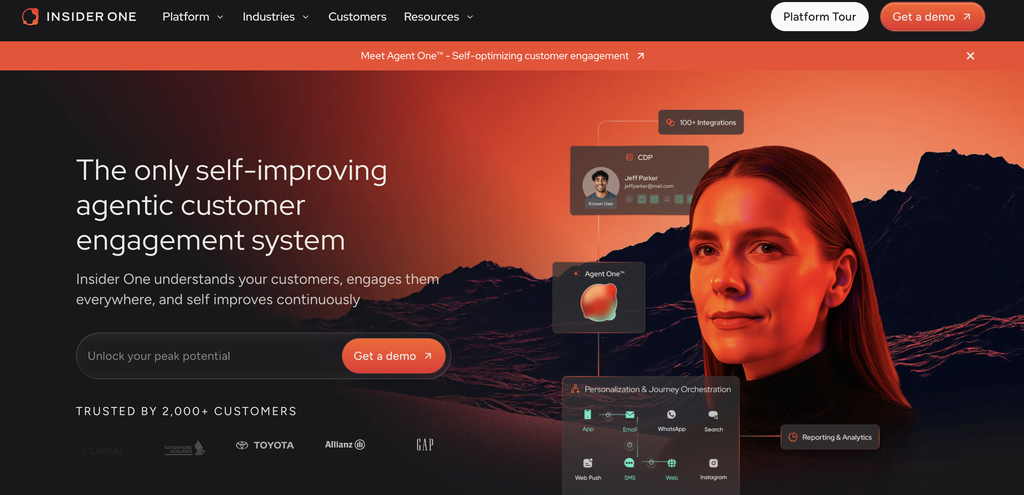
Insider One is an agentic customer engagement platform for autonomous, end-to-end customer engagement, built on an AI-native CDP. It unifies data from 100+ sources through its Integration Hub and runs personalized journeys across 12+ channels, including web, app, email, SMS, RCS, WhatsApp, web push and conversational experiences.
Why it stands out
- One profile for every channel: customer data management, segmentation, web personalization, product recommendations and messaging all use the same real-time profile, so a cart event on the site can change the next email, push or WhatsApp message. Predictive segments such as likelihood to purchase and churn risk use the same profile.
- Agentic AI: Agent One™, the self-optimizing intelligence system for customer engagement, works on both sides. Its agents run engagement on behalf of marketing, coordinating audiences, journeys, content, channels and timing, and interact directly with customers through agents such as the Shopping and Support Agents. Both sides enrich the same customer profile, bringing together what customers do and what they say.
- Teams decide how far agents go: they set outcomes and guardrails, and choose a mode per use case and channel, from executing instructions to running autonomously.
- Journey orchestration: Architect, Insider One’s customer journey orchestration solution, lets marketers build cross-channel journeys from one canvas, with AI features such as Next Best Channel, Send Time Optimization and Auto Winners.
- Warehouse access: Zero-Copy Segmentation builds audiences directly on warehouse data in Snowflake, Google BigQuery or Databricks without copying it into another system.
- Retail depth: in May 2026 Insider One acquired Bluecore, a retail martech company serving more than 400 US enterprise brands, adding its Transparent ID Network and models purpose-built for retail and commerce.
Proof points
In a Forrester Total Economic Impact™ study commissioned by Insider One, the composite organization consolidated five to six tools into a single platform and saw 449% ROI over three years, with payback in under six months. Insider One was named a Leader in the 2026 Gartner® Magic Quadrant™ for Personalization Engines.
Considerations: pricing is quoted per account rather than published.
Best for: mid-market and enterprise B2C brands that want to consolidate customer data, personalization and cross-channel engagement on one platform, connecting marketing execution with customer-facing agents.
2. Braze
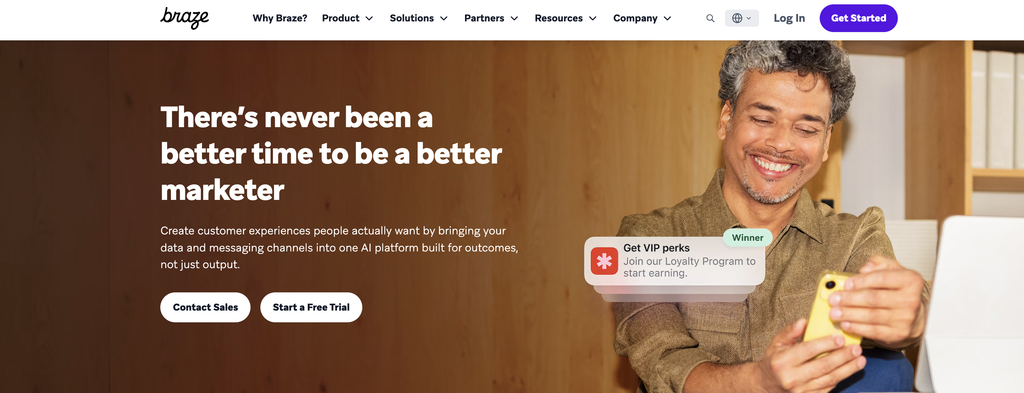
Braze is a customer engagement platform with mobile roots that serves more than 2,000 brands. It covers email, push, in-app messaging, SMS and WhatsApp, with Canvas for journey building and BrazeAI Decisioning Studio, which uses reinforcement learning to test content, timing, channel and frequency for each customer. It integrates with data warehouses such as Snowflake, Databricks, BigQuery and Redshift.
Considerations: BrazeAI Decisioning Studio comes in two tiers: Go, a self-serve option initially focused on optimizing email CTA clicks, and Pro, the full-strength offering. If consolidation is a priority, compare its web and app messaging, including Banners, with the specific tools you plan to retire. Pricing is custom.
Best for: digital-first B2C brands that prioritize cross-channel lifecycle messaging, particularly where mobile apps play a central role, and want AI-assisted campaign execution and individualized optimization.
3. Salesforce Marketing Cloud
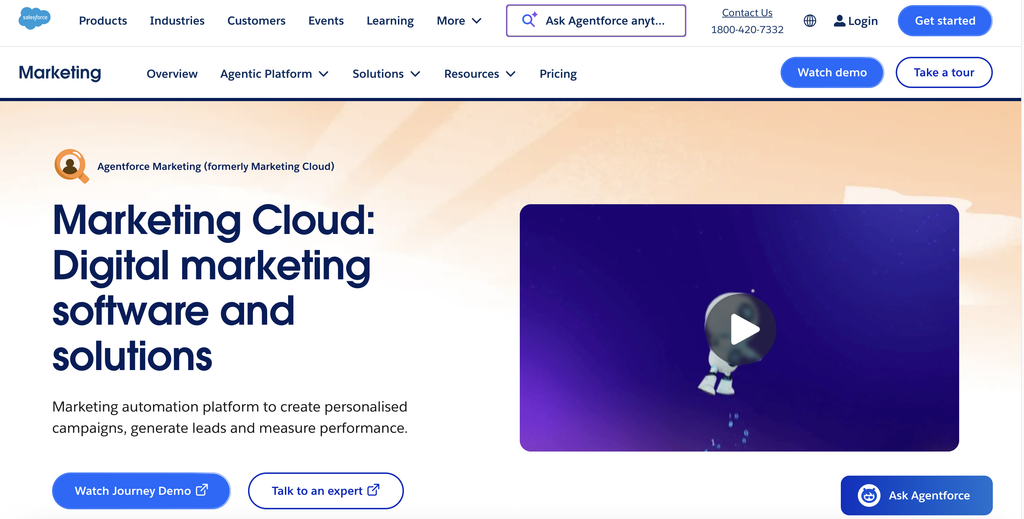
Salesforce Marketing Cloud is available as Marketing Cloud Engagement and Marketing Cloud Next, Salesforce’s newer offering built around AI agents. Marketing Cloud Engagement combines Email Studio, Mobile Studio and Journey Builder for journeys across email, SMS, push and advertising. Agentforce adds AI agents, and Data 360 provides unified profiles.
Considerations: specify whether you are evaluating Marketing Cloud Engagement, Marketing Cloud Next, or a combination. AI capabilities, channels and data entitlements vary by edition, while products such as Salesforce Personalization are priced separately. Compare the full package needed for your use cases, including implementation and ongoing administration, rather than the starting subscription alone.
Best for: enterprises already using Salesforce for sales or service that want marketing, customer data and AI-assisted workflows connected to that ecosystem.
4. Adobe Journey Optimizer
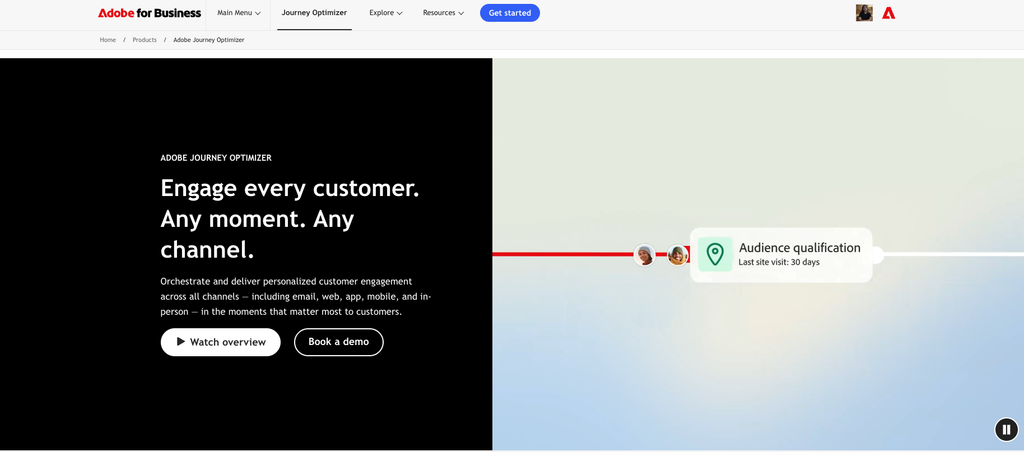
Adobe Journey Optimizer is built on Adobe Experience Platform and uses its unified customer profiles to trigger journeys and enforce consent. It supports email, in-app, push, SMS and web personalization, with real-time next best action decisioning, AI content generation and journeys generated from text prompts.
Considerations: Journey Optimizer requires Adobe Experience Platform: all the data it uses must be modeled and ingested into Experience Platform before journeys can run. The license includes shared platform features up to set profile and data volume limits, while decisioning, mobile and web are add-ons. Pricing is not published.
Best for: large enterprises that want real-time journeys and personalization on Adobe’s data foundation, particularly those already invested in Adobe Experience Cloud.
5. HubSpot Marketing Hub
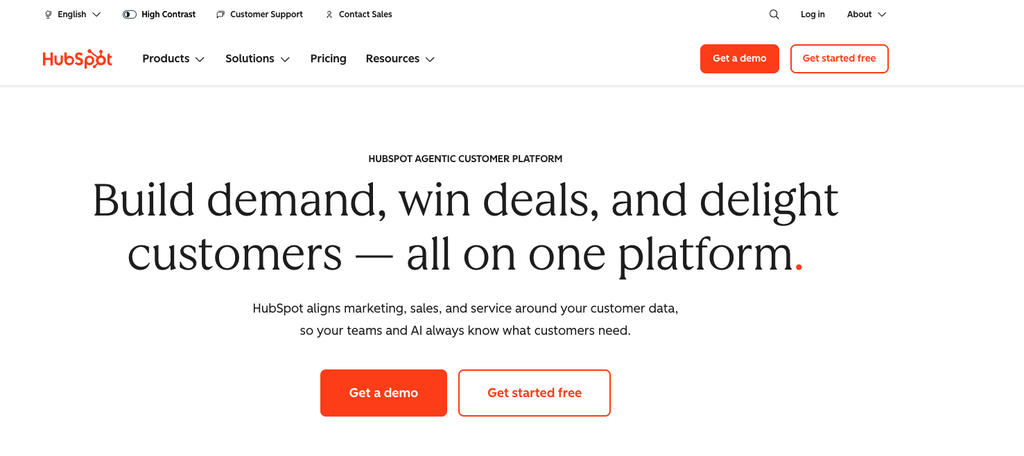
HubSpot Marketing Hub runs email, forms, landing pages, social, live chat and workflows on HubSpot’s CRM, with AI agents such as Customer Agent and Data Agent. Professional and Enterprise tiers add WhatsApp messaging.
Considerations: costs depend on marketing contacts, seats, onboarding and usage-based HubSpot Credits. Pricing tiers are published on HubSpot’s pricing page, and Enterprise requires a one-time onboarding fee. Some AI features consume credits, so estimate your expected usage and check what happens when included credits run out. For B2C programs, validate your mobile messaging, product recommendations and website personalization needs rather than treating CRM-based automation as a full engagement stack.
Best for: B2B and service businesses that want marketing, sales and service on one CRM.
Comparison: Martech tools for customer engagement
| Platform | Best for | Data foundation | Native channels | Tools it can typically replace | Pricing |
| Insider One | B2C consolidation | AI-native CDP; Zero-Copy Segmentation on Snowflake, BigQuery and Databricks | 12+, incl. web, app, email, SMS, RCS, WhatsApp, web push | ESP, SMS tool, web personalization, recommendations, CDP | Custom quote |
| Braze | Digital-first, app-led brands | Own data layer; integrates with data warehouses | Email, push, in-app, SMS, WhatsApp | ESP, push and SMS tools | Custom quote |
| Salesforce Marketing Cloud | Salesforce enterprises | Data 360 | Email, SMS, push, advertising | ESP, SMS tool | By edition |
| Adobe Journey Optimizer | Adobe enterprises | Adobe Experience Platform (required) | Email, push, in-app, SMS, web | ESP, journey tools, web personalization | Not published |
| HubSpot Marketing Hub | CRM-led B2B | HubSpot CRM | Email, social, chat, WhatsApp | ESP, landing page and form tools | Published tiers |
For a head-to-head view, see how Insider One compares with other vendors.
Which tool fits your stack?
Your current systems narrow the shortlist faster than any feature list.
- You run sales and service on Salesforce and have Salesforce admins: start with Salesforce Marketing Cloud, and compare it with an independent platform that integrates with Salesforce CRM.
- You already license Adobe Experience Platform: Adobe Journey Optimizer reuses that data foundation.
- You are a B2B team centred on HubSpot CRM: HubSpot Marketing Hub keeps marketing and sales on one record.
- You are a digital-first brand and your mobile app is central to engagement: Braze is built for that model.
- You are a B2C brand running four or more engagement tools and want fewer: Insider One combines CDP, personalization and messaging in one platform.
How to calculate total cost of ownership before you switch
Licence price is only part of the cost. Before comparing quotes, list what you pay today and what each option would add or remove.
1. Licence: every engagement-related tool, including SMS, push, personalization, recommendations and CDP.
2. Add-ons and usage: message credits, extra channels, data or profile overages, AI usage fees.
3. Integration and middleware: connectors, reverse ETL and the engineering hours that keep data in sync.
4. Implementation: partner fees, migration of templates and journeys, IP warm-up and parallel running time.
5. People time: hours spent building audiences, exporting lists and switching between tools each week.
Migration effort is often what keeps teams on an expensive stack. Insider One’s $0 Migration Movement™ addresses this by buying out existing contracts for teams switching platforms.
Conclusion
The best martech tool for customer engagement is the one that lets fewer tools do more of the work: one profile, one place to build journeys, and channels that share what they know about each customer. Start from your stack, score each platform on the six criteria above, and price the full cost, not just the licence.
If you want to see how Insider One consolidates data, personalization and 12+ channels, book a personalized demo or take the interactive platform tour.
Frequently Asked Questions
A CRM is a system of record for accounts, deals and service cases, mostly used by sales and service teams. A customer engagement platform uses customer data to decide and deliver personalized messages and experiences across channels in real time. Most enterprises run both and connect them, so engagement can use CRM data and the CRM can see engagement history.
Not always. If the platform’s built-in CDP can ingest your web, app, CRM and offline data and resolve identities, it can cover engagement use cases without another tool. Some organizations keep a warehouse or enterprise CDP as the source of truth and connect it to the engagement platform.
There is no ideal number. A useful test is overlap: if two tools send the same channel or build the same segments, one is likely redundant. Gartner’s finding that teams used 33% of stack capabilities in 2023 suggests many stacks carry more capability than teams use.
Yes, when they work toward outcomes and within guardrails your team sets. Teams decide how far agents go, for example letting them build audiences, choose send times and test content variants, while setting rules for budget, pricing and regulated messaging. Agents that learn from every result keep improving engagement over time.
It depends on data complexity, the number of journeys and channels, and sending volume. Large multi-brand programs take longer than single-brand setups. Plan time for email IP warm-up and a short period of running both platforms.
Insider One and Braze quote custom prices, Salesforce prices Marketing Cloud by edition, and Adobe does not publish Journey Optimizer pricing. HubSpot publishes its pricing tiers. Compare total cost of ownership, not licence price alone.
It depends on your team. Best-of-breed tools can go deeper in one area but need integration work and more people to run. An all-in-one engagement platform reduces handoffs and data gaps, which matters most for B2C brands running many channels with a lean team.

Keep Reading
4 min.

Chris Baldwin
3 Feb 2026
8 min.
Chris Baldwin
10 Nov 2026
13 min.
Chris Baldwin
10 Nov 2026