

 Platform Overview


 Integration Hub


 Agent One™


 Agent One™ Teams


 Customer Data Management


 Personalization


 Journey Orchestration


 Reporting & Data


 Behavioral Analytics


 Web


 Email


 Site Search


 Conversational CX


 WhatsApp


 Web Push


 InStory


 App


 SMS & RCS


 Join the $0 Migration Movement™


 The Insider One Difference


 Compare Vendors


 Switch to Insider One


 Success Story


 Retail & Ecommerce


 Financial Services


 Travel & Hospitality


 Beauty & Cosmetics


 Automotive


 Telecommunications


 Total Economic Impact™ Study


 Blog


 E-Books & Guides


 Events


 Glossary
5 Reasons B2C Brands are Rushing to Omnichannel Automation in 2026

Updated on 10 Nov 2026
8 min.
Table of Contents
Most Popular
Summary
- Omnichannel automation has become a retention and revenue decision for B2C brands, not a marketing wish list item
- Execution usually breaks down at the data and orchestration layer, not the channel layer
- Fixing root-cause data gaps can make it easier to coordinate engagement than adding another channel to the stack
- Platform evaluation should weigh unified data and journey orchestration over proprietary AI branding
- Virgin Megastore and Avon provide customer-story context for teams evaluating how connected data and journey logic can support orchestration
Your lifecycle team runs five channels and reports five different conversion numbers, because none of the systems share the same customer record. That gap is one reason omnichannel business-to-consumer (B2C) automation can become an operational priority for leadership teams in 2026.
For retail, ecommerce, travel, and fintech leaders, the pressure isn’t about adding another channel. It is about building an operating model that can use customer behavior consistently across touchpoints, because fragmented systems can leave signals disconnected or delayed. That fragmentation can make it harder for teams to deliver relevant follow-up after the first sale.
This article explains why mid-market and enterprise B2C teams are prioritizing omnichannel customer engagement in 2026, where execution typically fails, and what to evaluate in an AI-powered Growth Management Platform that connects unified customer data, segmentation, personalization, journeys, and measurement. If you’re building a CFO-ready case for consolidation, this is the operational argument, not the feature list.
What omnichannel B2C looks like when it actually works
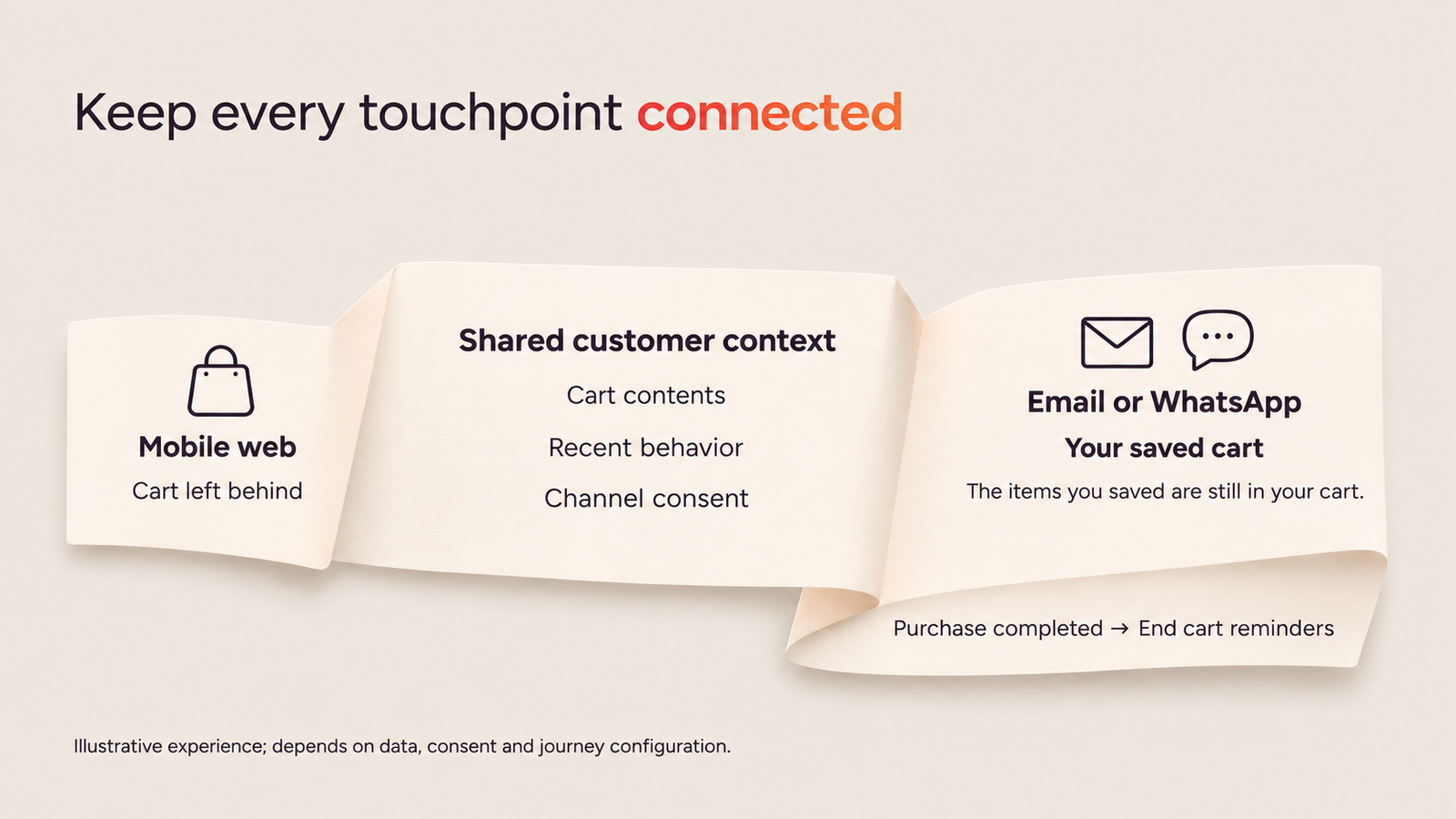
Omnichannel B2C means using a shared customer profile so behavior on one channel can inform coordinated engagement on another. A shopper who abandons a cart on mobile web can receive a consistent, relevant follow-up on email or WhatsApp when the brand has the required data, consent, and journey configuration in place.
The execution standard is not channel coverage alone; it is consistency under real customer behavior. A brand running six channels with contradictory offers may create a less coherent experience than one running three channels with a single coordinated message. Teams should assess customer-experience and business measures that fit their goals rather than relying only on click-through rate for any single send.
Where execution breaks down for omnichannel B2C
Execution breaks down structurally, long before anyone writes a campaign. A typical B2C stack grew channel by channel over several years: an email service provider (ESP) bolted onto a separate SMS tool, a web personalization layer that never synced with the app, and a customer relationship management (CRM) system that updates on a delay. Each channel ends up with its own owner, its own data definitions, and its own release cycle.
As brands add channels to chase customers wherever they show up, this fragmentation compounds rather than resolves. A new channel means another integration, another data mapping exercise, and another team negotiating ownership of the customer record. The result is a stack that looks comprehensive on a vendor slide but behaves inconsistently the moment a real customer crosses from app to email to in-store in the same week.
- Channel-specific tools with no shared customer identity
- Manual data stitching that breaks as soon as volume or segment complexity increases
- Campaign logic owned by separate teams with no shared source of truth
- Batch-updated data that may limit time-sensitive triggering
The data and orchestration layer teams usually miss
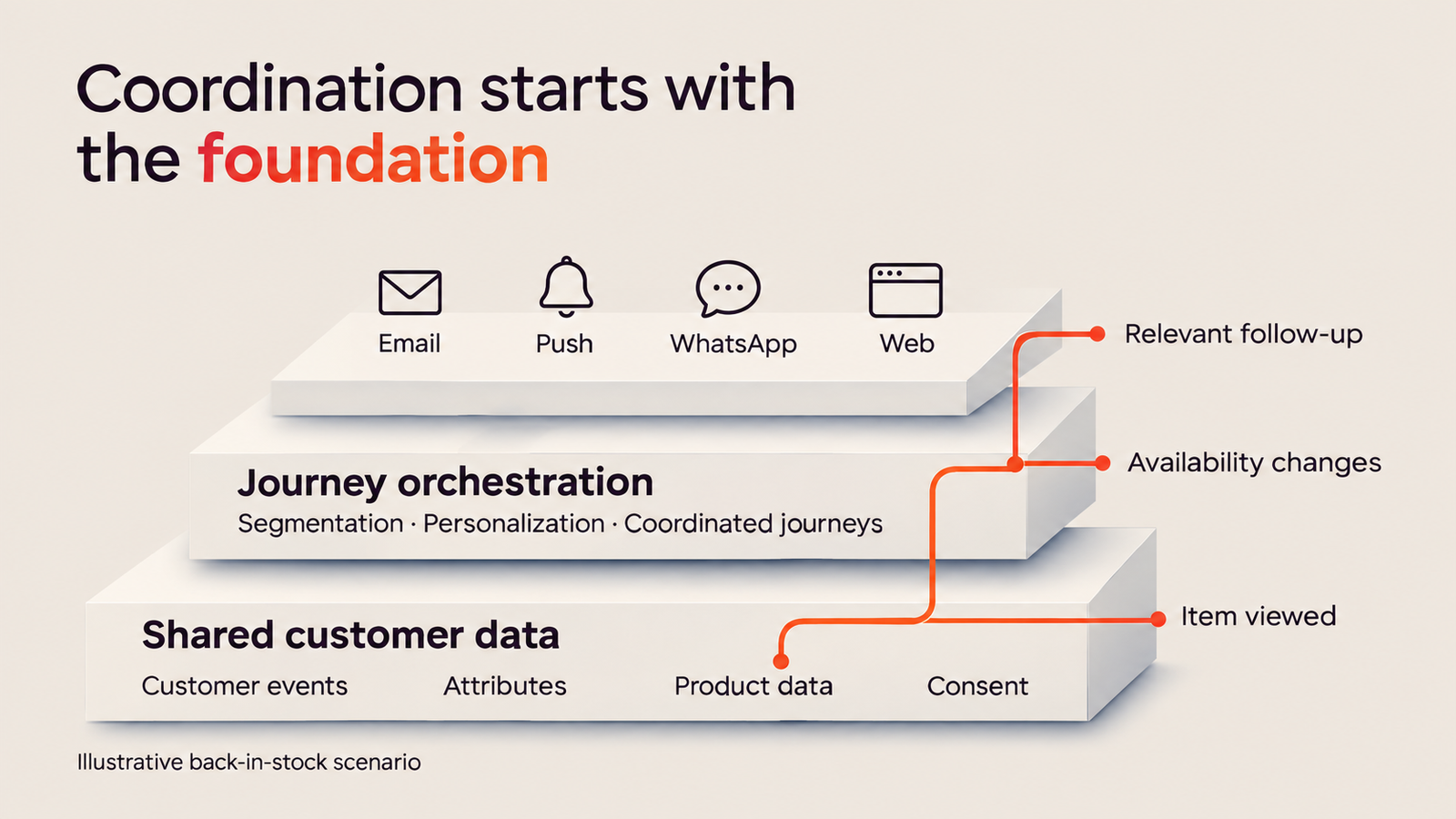
The layer teams miss isn’t a channel. It’s the foundation for a shared customer profile: data ingestion, customer events, attributes, and product data that can inform segmentation, personalization, and coordinated journeys. Without a unified data and orchestration layer, “omnichannel” becomes a series of parallel single-channel campaigns that happen to share a brand name, not a coordinated customer experience.
This dependency appears in moments that should be straightforward. Take a back-in-stock scenario: a customer views an item, it goes out of stock, and the brand may want to notify them when it becomes available again through an appropriate consented channel. Without connected data and journey orchestration, teams can struggle to coordinate that signal across systems and channels.
The same dependency plays out across loyalty, cart recovery, and churn-risk messaging. If customer data lives in five systems with delayed or disconnected synchronization, coordinating these moments becomes more difficult. That’s the structural reason Customer Data Management, meaning a shared customer-data layer, should be considered before expanding channel activity.
How to fix omnichannel B2C without adding more channel chaos
The fix is sequencing, not addition. Brands that solve this start by unifying customer data into a single actionable record, then layer journey orchestration on top, and only then expand channel reach. Adding a new channel before the data layer is solved just multiplies the existing chaos across one more touchpoint.
Journey Orchestration built on a unified data layer can help teams coordinate behavior-led follow-up across email, push, WhatsApp, and web from the same customer profile. With Insider One, teams can use shared customer data, audience segmentation, cross-channel personalization, and coordinated journeys to support more consistent engagement across touchpoints.
Potential operational benefits of this sequencing are worth testing against a brand’s own data and measurement plan:
- More consistent follow-up based on available recent behavior
- Fewer contradictory messages across coordinated touchpoints
- Reusable journey logic across supported channels
- A clearer basis for evaluating engagement across a shared customer profile
For implementation context, review the linked customer-story reference, “Virgin Megastore applied this exact sequencing,” and assess its details against your own requirements. For additional context, review the linked customer-story reference, “Avon followed a similar path,” and assess its approach against your own data and journey requirements.
What to evaluate before choosing a platform
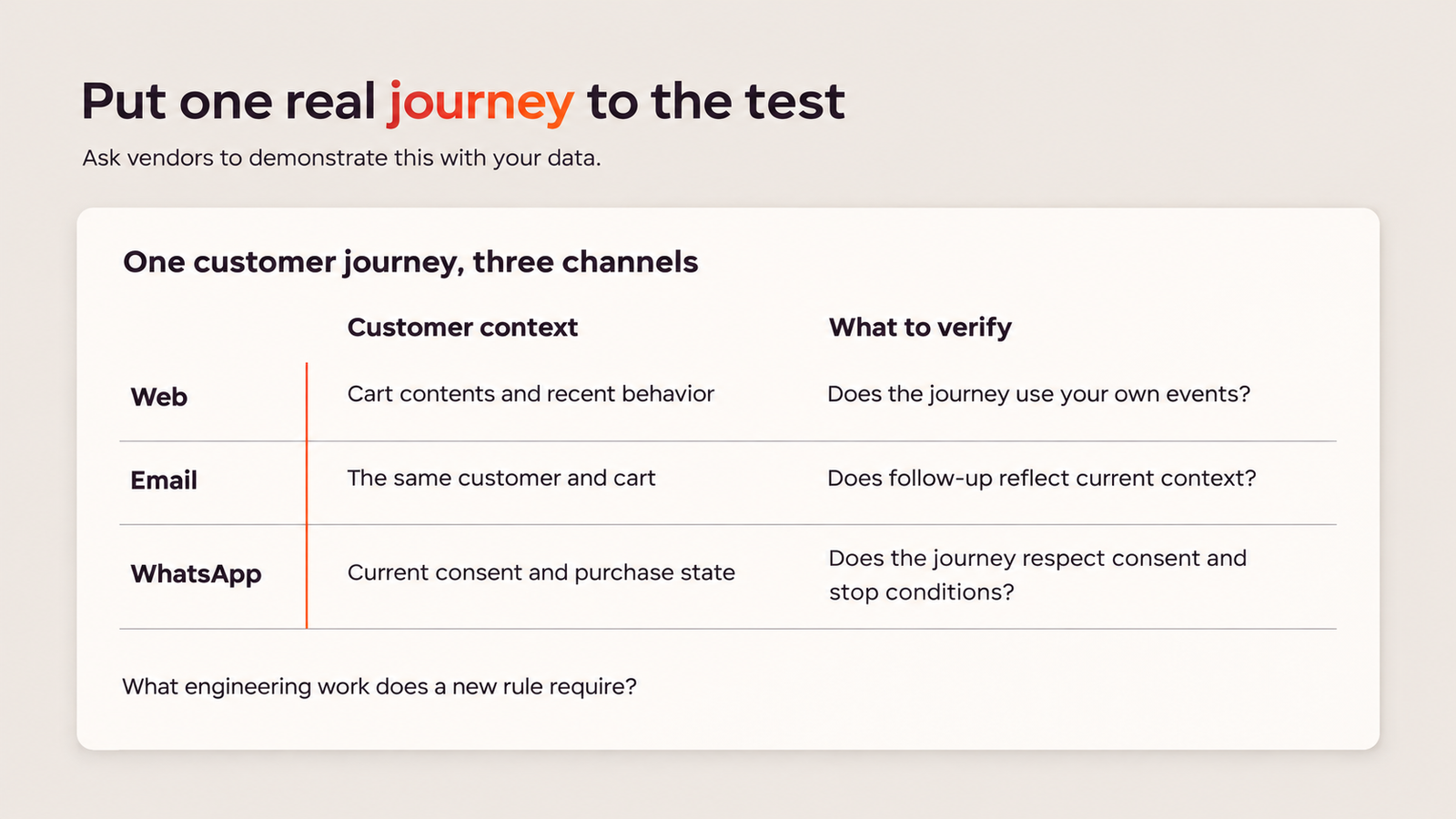
The decision criteria that matter most are data unification, orchestration flexibility, and the ability to scale journey logic without a growing engineering backlog. Evaluate whether a platform connects trustworthy customer data to segmentation, personalization, decisioning, and coordinated execution, and ask what implementation support each new rule or segment requires. If AI is central to the evaluation, ask how Agent One can plan, execute, learn from, and optimize customer engagement toward the team’s goals using a shared live customer profile.
Scale is where this becomes concrete. A brand running ten segments and three channels can tolerate some manual workarounds. A brand running hundreds of segments across six channels, which is where mid-market and enterprise B2C teams are increasingly headed, cannot.
At that scale, the platform’s data architecture and orchestration depth can materially affect the operational work required to manage journeys. For a related customer-story reference, review “MediaMarkt’s uplift in conversion rate from coordinated web push orchestration” only against the underlying approved case-study evidence before relying on it in an evaluation.
Before signing, ask platform vendors to walk through a single customer journey end to end across three channels using your own events, attributes, product data, and audience logic. If that walkthrough requires custom engineering work to demonstrate, treat it as a signal about what post-sale implementation will actually look like, not a minor technical detail.
Conclusion
For many B2C teams, omnichannel automation in 2026 is a retention and margin consideration because shared data can support more relevant engagement across touchpoints. Rather than treating channel count as the goal, buyers can evaluate whether data and orchestration foundations are in place before expanding their programs.
That sequencing matters, but buyers should also evaluate whether one connected platform supports personalization, recommendations, experimentation, messaging, analytics, conversational engagement, and AI-powered optimization from the same customer profile.
To evaluate the fit of a journey-orchestration approach and Customer Data Management for your use case, book a personalized demo to review your goals, data requirements, and implementation constraints with the Insider One team.
Frequently Asked Questions
It means channels such as email, SMS, app, web, and in-store can use a shared customer record and coordinated behavioral signals when the required integrations are in place. The test isn’t how many channels a brand runs; it’s whether those channels can deliver one consistent experience instead of five uncoordinated ones.
For teams focused on retention, fragmented systems can make it harder to use customer behavior consistently across touchpoints. Adding channels without addressing data fragmentation can compound inconsistency, which is why teams may evaluate unification before expansion.
It often fails at the data and orchestration layer, not the channel layer. Disconnected systems, delayed data synchronization, and separate team ownership per channel can make it difficult to coordinate a consistent response across touchpoints.
Prioritize data unification and orchestration flexibility, then evaluate whether AI is connected to reliable customer data and coordinated execution. Ask vendors to demonstrate a single cross-channel journey using your own data model before signing, including how they use segmentation, personalization, experimentation, recommendations, and measurement.
Coordinated orchestration means follow-up messaging can reflect real, recent behavior instead of generic scheduling, supporting more relevant customer experiences across touchpoints. For AI evaluation, also ask how Agent One can plan, execute, learn from, and optimize engagement toward the team’s goals from the same live customer profile.

Keep Reading
4 min.

Chris Baldwin
3 Feb 2026
13 min.
Chris Baldwin
10 Nov 2026
12 mins.

Nicolas Algoedt
10 Nov 2026