

 Platform Overview


 Integration Hub


 Agent One™


 Agent One™ Teams


 Customer Data Management


 Personalization


 Journey Orchestration


 Reporting & Data


 Behavioral Analytics


 Web


 Email


 Site Search


 Conversational CX


 WhatsApp


 Web Push


 InStory


 App


 SMS & RCS


 Join the $0 Migration Movement™


 The Insider One Difference


 Compare Vendors


 Switch to Insider One


 Success Story


 Retail & Ecommerce


 Financial Services


 Travel & Hospitality


 Beauty & Cosmetics


 Automotive


 Telecommunications


 Total Economic Impact™ Study


 Blog


 E-Books & Guides


 Events


 Glossary
Insider One vs. Netcore: Features, AI and Enterprise Growth Compared

Updated on 18 Nov 2026
11 mins.
Table of Contents
- Summary
- Insider One vs. Netcore at a glance
- Platform overview
- Feature comparison: Where Insider One and Netcore differ
- 1. Customer data and CDP: Connecting intelligence with activation
- 2. Cross-channel engagement: Turning customer intelligence into consistent experiences
- 3. Journey orchestration: Moving beyond predefined campaign sequences
- 4. Web personalization and product discovery: Connecting shopping experiences with engagement
- 5. Email marketing: Infrastructure and engagement optimization
- AI compared: Agent One vs. Netcore's agents
- Enterprise readiness: Security, recognition, and global scale
- Commercial model: Pricing, migration, and return on investment
- Which platform fits which team?
- How to evaluate Insider One and Netcore in a proof of concept
- Why connected customer engagement matters
- Frequently Asked Questions
Most Popular
Summary
- Insider One connects customer data, web personalization, product discovery, journey orchestration, and messaging through a unified CDP, giving brands a shared foundation for customer engagement.
- Agent One extends this foundation with coordinated AI agents, goal-driven engagement, and four autonomy modes, helping teams move beyond manually configured marketing workflows.
- Netcore brings established email infrastructure, dedicated product discovery through Unbxd, in-app product experience tools, and a strong presence in India and Southeast Asia.
- Commercial models differ: Both vendors provide custom quotes, while Netcore ties 30% of its platform fee to client KPIs. Insider One offers its $0 Migration Movement to help brands switch platforms.
- The best way to evaluate both platforms is to run a proof of concept around the same revenue-driving journey, using a control group to measure incremental impact.
Choosing between Insider One and Netcore means looking beyond channel coverage and feature lists. Both platforms support cross-channel customer engagement, but they take different approaches to connecting customer data, personalization, and AI-driven marketing.
Insider One brings these capabilities together through a unified customer data platform (CDP), enabling brands to connect customer intelligence with web and app personalization, product discovery, journey orchestration, and messaging. With Agent One, this connected foundation also supports AI-driven decisions that help teams optimize engagement toward business goals.
Netcore brings established email infrastructure, dedicated product discovery through Unbxd, and a strong presence in India and Southeast Asia. For brands evaluating both platforms, the key question is whether they need a collection of specialized engagement capabilities or a connected platform that helps them manage and optimize customer experiences across the entire lifecycle.
This comparison examines how Insider One and Netcore differ in customer data, personalization, orchestration, AI, enterprise capabilities, and commercial models.
Insider One vs. Netcore at a glance
| Category | Insider One | Netcore |
| Positioning | AI-powered customer engagement platform built on its own CDP, with Agent One for autonomous engagement | Agentic marketing platform (Netcore.ai since July 2026) with customer engagement, email, product discovery, and CPaaS |
| Customer data | Native CDP and Agentic CDP; Zero Copy Segmentation with Snowflake; Bluecore identity network | CDP with a Context Layer for a consent-managed customer view; BigQuery and Snowflake access |
| AI | Agent One Teams and Agent One Audiences, four autonomy modes, Shopping Agent | Six named agents: Audience, Shopping, Content, Insights, Scheduler, and Decisioning |
| Channels | Web, mobile app, email, SMS and RCS, WhatsApp, web push, site search, InStory, conversational CX | App push, web push, in-app, web, WhatsApp, email, voice, SMS, and RCS |
| Product discovery | Eureka site search and InStory | Unbxd search and merchandising |
| Customers | 2,000+ brands | 6,500+ brands |
| Pricing | Custom quote per account | Custom quote by plan, MTUs, and features; 30% of platform fee tied to KPIs |
| G2 Rating | 4.7/5 (1,429 reviews) | 4.5/5 (586 reviews) |
G2 figures are from the G2 comparison page as of November 2026 and may change as new reviews arrive.
Platform overview
[Image 1: copy from the original doc]
Insider One: A connected foundation for customer engagement
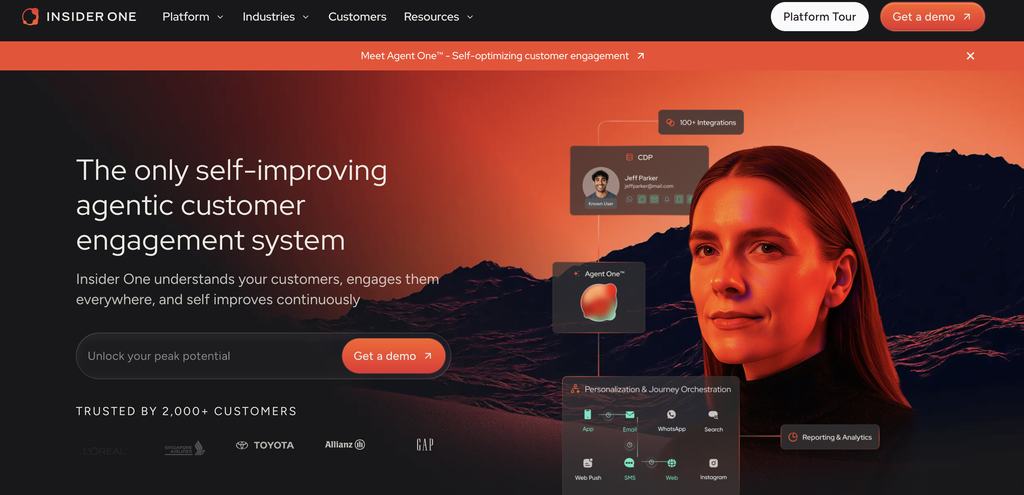
Insider One is an AI-powered customer engagement platform built around its own customer data platform. Rather than treating personalization, product discovery, journey orchestration, and messaging as separate marketing functions, Insider One connects them through unified customer profiles.
This means customer interactions across web, mobile apps, CRM, purchases, and other connected sources can inform how brands personalize experiences and coordinate engagement across channels.
In 2026, Insider One introduced Agent One, its self-optimizing intelligence system, extending this connected foundation into AI-driven customer engagement. The acquisition of Bluecore, a US retail marketing technology company serving more than 400 enterprise brands, further expanded Insider One’s identity capabilities and enterprise retail presence.
Together, these developments strengthen Insider One’s proposition for brands looking to move beyond disconnected marketing tools toward a more coordinated, intelligent approach to customer engagement.
Netcore: Messaging and product discovery capabilities
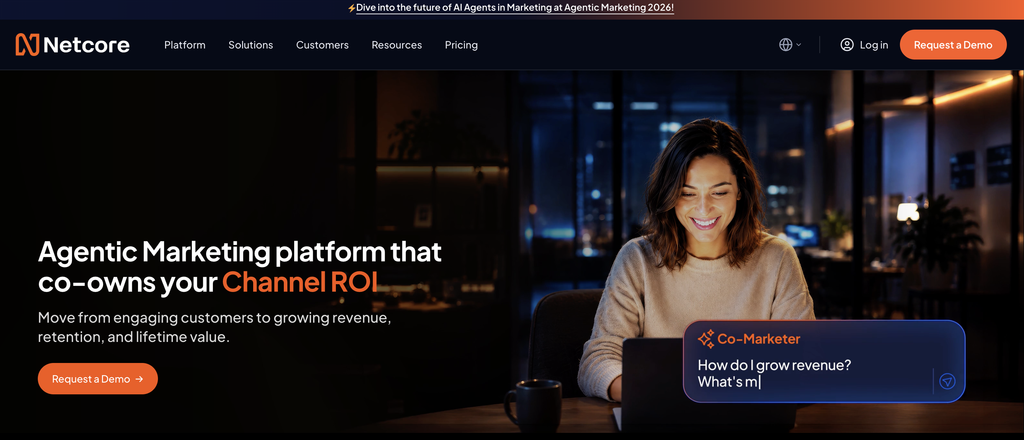
Founded in 1998 and based in Mumbai, Netcore started with email and messaging infrastructure before expanding into a broader customer engagement suite.
Its portfolio now includes customer engagement, email, CDP, personalization, product experience, CPaaS, and Unbxd product discovery. On July 30, 2026, the company rebranded as Netcore.ai and repositioned itself as an agentic marketing platform, emphasizing growth engineers who share accountability for client outcomes.
Netcore says it works with more than 6,500 brands, with an established presence in India and Southeast Asia alongside its international operations.
Feature comparison: Where Insider One and Netcore differ
1. Customer data and CDP: Connecting intelligence with activation
Both platforms include a customer data platform, but the important consideration is how customer intelligence translates into marketing decisions and customer experiences.
Insider One brings web, app, CRM, purchase, and offline data together in a unified, real-time customer profile. Its Agentic CDP extends this foundation with the context, memory, consent, interactions, and outcome data that Agent One uses to inform decisions and coordinate engagement.
This means customer data isn’t limited to audience segmentation or campaign targeting. The same intelligence can inform product recommendations, onsite personalization, journey decisions, and messaging across connected channels.
With Zero Copy Segmentation, teams can also build and activate segments using data in Snowflake without duplicating warehouse data.
Insider One’s Bluecore acquisition further strengthens Insider One’s identity capabilities through its Transparent ID Network, which processes more than 10 billion shopper events daily.
Netcore takes a different approach through its Context Layer and governance layer, which it describes as creating a consent-managed, real-time view of each customer. It also supports warehouse-native access through BigQuery and Snowflake integrations.
For enterprise buyers, the distinction is worth exploring beyond the CDP label. Evaluate how each platform resolves identities across devices and channels, how quickly new events become available for activation, and how customer data informs personalization and engagement across the wider platform.
2. Cross-channel engagement: Turning customer intelligence into consistent experiences
Supporting multiple communication channels is important, but the real value comes from coordinating them around customer behavior and preferences.
Insider One connects web, mobile app, email, SMS and RCS, WhatsApp, web push, app push, and conversational CX within its customer engagement platform. Its capabilities also extend to site search and InStory, allowing brands to connect product discovery with subsequent customer interactions.
For example, a shopper’s browsing and product discovery behavior can inform personalized website experiences and subsequent messaging. Insider One’s SMS and RCS channel also supports automatic SMS fallback when RCS is unavailable, helping brands maintain message delivery across different network capabilities.
Netcore supports email, SMS, RCS, WhatsApp, web push, app push, voice, web, and in-app experiences. It also offers dedicated in-app product experience capabilities, including walkthroughs and nudges. Netcore says it sends more than 200 million WhatsApp messages monthly as a Meta Premier Partner.
Both platforms provide broad channel coverage. The key difference to investigate is how easily teams can coordinate customer experiences across these channels using shared customer intelligence, rather than managing each touchpoint independently.
3. Journey orchestration: Moving beyond predefined campaign sequences
Customer journeys rarely follow a predictable sequence. A shopper may browse a product, abandon their cart, return through a different device, or engage with a support team before making a purchase.
Insider One’s Architect connects customer intelligence with journey execution, allowing marketing teams to build cross-channel experiences around real-time customer behavior.
Rather than relying only on predefined campaign sequences, teams can use behavioral triggers, journey conditions, and AI-driven channel and timing optimization to adapt engagement as customer needs change.
Next Best Channel and Send Time Optimization help determine where and when to reach each customer, while journey-level control groups make it possible to measure incremental impact. Because Architect works with Insider One’s unified customer profiles, decisions can draw on interactions and engagement across connected channels.
Netcore also offers automated journey orchestration, including A/B testing, frequency capping, individual send-time and channel optimization, and Journey Path Optimizer on its Enterprise plan.
For brands evaluating both platforms, the important question is how effectively each one translates customer behavior into coordinated next actions. Consider whether marketing teams can adapt journeys without rebuilding entire workflows, how channel decisions are made, and how easily the impact of orchestration can be measured.
4. Web personalization and product discovery: Connecting shopping experiences with engagement
Product discovery is another important area of differentiation, particularly for retail and ecommerce brands.
Insider One connects web personalization, recommendations, site search, and InStory with journey orchestration and messaging on a shared customer data foundation. This allows product discovery interactions to inform subsequent personalization and engagement across channels.
For example, a shopper’s search activity can influence the product recommendations they see on a website and the content they receive through email or other messaging channels.
Insider One’s Eureka site search supports this approach. Insider One was named a Leader in the 2026 Gartner Magic Quadrant for Personalization Engines for the fifth time. In a customer example, Levi’s Turkey achieved 50–60% click-through on search results and kept its no-result rate below 20% using Eureka.
Netcore brings Unbxd, a dedicated product search and merchandising solution. Unbxd was named a Leader in the 2026 Gartner Magic Quadrant for Search and Product Discovery for the third consecutive time, according to Netcore.
Unbxd offers a specialist approach for brands prioritizing search and merchandising as a dedicated technology investment. Insider One takes a more connected approach, bringing search, recommendations, onsite personalization, and messaging together through customer intelligence.
For enterprise brands looking to connect product discovery with the wider customer lifecycle, this approach offers a more integrated way to manage and optimize digital experiences.
5. Email marketing: Infrastructure and engagement optimization
Email remains a core customer engagement channel for both platforms, although their histories and product emphasis differ.
Email infrastructure is part of Netcore’s heritage. The company operates its own sending infrastructure and was named a Strong Performer in Forrester’s Email Marketing Service Providers evaluation for Q1 2026, according to Netcore.
Insider One approaches email as part of its wider cross-channel engagement platform. Its capabilities include AI text generation, Send Time Optimization, AMP forms, carousels and accordions, spam tests, previews across more than 100 devices, automated IP warm-ups, and regional sending infrastructure.
The advantage of this connected approach is that email engagement can draw on the same customer intelligence used for web personalization and journey orchestration.
For example, customer browsing behavior, purchase history, and engagement signals can inform email content and timing, while responses can feed back into subsequent journey decisions.
MAC Cosmetics Turkey demonstrated Insider One’s email capabilities, increasing email send volume by 36% and email-attributed revenue by 45% quarter over quarter while maintaining a delivery rate above 99%.
For buyers, the evaluation should cover more than deliverability and sending capacity. Consider how easily each platform connects email activity with customer profiles, personalization, and engagement across other channels.
AI compared: Agent One vs. Netcore’s agents
Both Insider One and Netcore are moving beyond traditional marketing automation toward agentic AI. However, the important distinction isn’t how many AI agents each platform offers. It’s how those agents use customer intelligence, coordinate decisions, and act toward business outcomes.
Insider One: Coordinated intelligence with Agent One
Insider One approaches agentic engagement through Agent One, a connected intelligence system built on its Agentic CDP.
Instead of treating AI capabilities as isolated assistants for individual marketing tasks, Agent One Teams and Agent One Audiences help coordinate customer engagement around goals defined by the business.
- Agent One Teams coordinates agents to execute and optimize customer engagement toward business outcomes.
- Agent One Audiences translates customer needs and intent into audience intelligence and actionable engagement decisions.
Teams can choose between four autonomy modes: Command, Advanced, Co-Pilot, and Autonomous. This gives organizations control over how much responsibility AI takes on, from assisting with individual tasks to autonomously optimizing engagement within defined business objectives.
The shared intelligence layer is particularly important. Agent One can draw on customer profiles, context, memory, consent, interactions, and outcomes to inform engagement decisions.
Insider One also offers a Shopping Agent for ecommerce use cases. According to the Agent One page, Braun’s Shopping Agent influenced 18% of ecommerce revenue within eight months and increased average order value for new customers by approximately 22%.
| Insider One | Netcore | |
| Structure | Two multi-agent systems: Agent One Teams runs customer engagement toward an outcome the team sets; Agent One Audiences turns what customers say they want into decisions and actions | Six named agents, each with one job: Audience, Shopping, Content, Insights, Scheduler and Decisioning |
| Shared intelligence | Agentic CDP with profile, context, memory, consent, interactions and outcomes | Context Layer and governance layer |
| Human control | Four autonomy modes: Command, Advanced, Co-Pilot and Autonomous | Dedicated growth engineer on the Enterprise plan; campaign approval workflows |
On results, Insider One reports that Braun’s Shopping Agent influenced 18% of ecommerce revenue within eight months and lifted average order value for new customers by about 22%, according to the Agent One page.
What enterprise buyers should evaluate
The distinction between these approaches becomes clearer when buyers move beyond product demonstrations and test how AI operates in real marketing workflows.
Consider these questions:
- Which decisions can AI make independently, and which require human approval?
- Can agents coordinate actions across multiple channels and customer touchpoints?
- What customer data and contextual signals inform their decisions?
- What guardrails can teams configure, including discount limits, frequency caps, and brand rules?
- How is AI’s impact measured, and can results be validated against a control group?
- Which AI capabilities are included in the platform, and which require additional purchases?
Netcore, for example, sells AI agents and predictive intelligence as capability packs on its Growth plan.
For brands looking to move beyond isolated AI-assisted tasks, Insider One’s connected intelligence and adjustable autonomy provide a way to coordinate engagement toward broader business objectives.
Enterprise readiness: Security, recognition, and global scale
Security and compliance
Both platforms offer enterprise security and compliance credentials, but buyers should evaluate the specific requirements of their industries and operating markets.
Insider One lists ISO/IEC 27001, SOC 2, and CSA STAR certifications.
Netcore’s trust center lists ISO/IEC 27001:2022, SOC 2 Type II, ISO 9001, HIPAA, GDPR, CCPA, and India’s DPDP Act. Netcore also says it has been appraised at CMMI Level 3.
Enterprise teams should request current certification reports, review data processing arrangements, and confirm data residency and regulatory requirements for every market in which they operate.
Analyst recognition and customer reviews
Independent analyst recognition and customer reviews provide additional context when evaluating customer engagement platforms.
Insider One:
- Leader in the 2026 Gartner Magic Quadrant for Personalization Engines.
- 2026 Gartner Peer Insights Customers’ Choice for Multichannel Marketing Hubs.
- Leader in the 2026 IDC MarketScape for Agentic Marketing.
Netcore:
- Unbxd named a Leader in the 2026 Gartner Magic Quadrant for Search and Product Discovery.
- Strong Performer in Forrester evaluations for email and commerce search.
Customer reviews also provide insight into the day-to-day experience of using each platform.
On G2, Insider One scores higher than Netcore in every category where both platforms are rated, including:
- Ease of use: 9.4 vs. 8.9.
- Quality of support: 9.6 vs. 9.0.
- Customer data platform: 9.5 vs. 8.2.
These scores are based on the G2 comparison page as of November 2026. For enterprise buyers, the differences are worth exploring through hands-on evaluations, particularly when assessing onboarding, ongoing platform management, and support requirements.
Regional presence and enterprise growth
Insider One supports more than 2,000 brands across Europe, Asia Pacific, the Middle East, Latin America, and North America. Its acquisition of Bluecore further expands its presence in the US retail market, bringing an established identity network and relationships with more than 400 enterprise retail brands into its ecosystem.
This expansion strengthens Insider One’s position in enterprise retail and supports its broader ambition to connect customer intelligence with personalized engagement at scale.
Netcore has a particularly established presence in India and Southeast Asia, alongside operations in North America, Europe, and Africa.
For multinational organizations, the evaluation should include regional infrastructure, data residency, local support, and the ability to manage customer experiences consistently across markets.
Commercial model: Pricing, migration, and return on investment
Both Insider One and Netcore use custom pricing, so enterprise buyers should evaluate the total cost of ownership rather than compare headline subscription fees alone.
Netcore offers Growth and Enterprise plans based on monthly tracked users and selected capabilities. Its Enterprise model also ties 30% of the platform fee to agreed business KPIs, making it important to clarify how those metrics are defined, measured, and evaluated.
Insider One provides account-based pricing tailored to each brand’s requirements, including product selection, channels, and engagement volumes.
For organizations switching from another platform, Insider One’s $0 Migration Movement helps remove migration costs as a barrier to evaluating a new engagement platform.
The financial case can also extend beyond migration costs. A Forrester Total Economic Impact™ study commissioned by Insider One found a projected 449% ROI over three years for a composite organization. While actual results depend on each organization’s circumstances, the study provides an additional framework for assessing the potential financial impact of adopting Insider One.
When comparing commercial proposals, buyers should consider:
- Platform subscription and usage costs.
- Additional fees for channels, AI capabilities, and integrations.
- Implementation and migration requirements.
- Ongoing engineering and operational resources.
- The potential impact on conversion, retention, and customer lifetime value.
A platform’s value should ultimately be measured by the business outcomes it enables and the resources required to achieve them.
Which platform fits which team?
The right choice depends on how an organization wants to connect its customer engagement capabilities.
| Business Priority | Better fit | Why |
| One profile for web personalization, search, journeys and messaging | Insider One | All modules share its native CDP and Agentic CDP |
| AI that runs engagement toward a goal, with adjustable autonomy | Insider One | Agent One Teams and Audiences with four autonomy modes |
| Enterprise retail identity and US expansion | Insider One | Bluecore’s Transparent ID Network and 400+ US enterprise brands |
| Standalone product search and merchandising | Netcore | Unbxd is a dedicated search product with Gartner recognition |
| In-app onboarding walkthroughs and nudges | Netcore | A dedicated product experience toolset |
| A fee partly tied to business KPIs | Netcore | 30% of the platform fee is linked to agreed KPIs |
For organizations looking to connect customer intelligence, personalization, and engagement across channels, Insider One provides a unified approach. Netcore may be a relevant alternative for businesses prioritizing specialist search, email infrastructure, or specific regional requirements.
How to evaluate Insider One and Netcore in a proof of concept
Feature lists and product demonstrations can show what a platform offers, but they don’t necessarily reveal how well it performs in a real marketing environment.
A proof of concept (POC) allows teams to compare implementation effort, operational flexibility, and business impact using the same conditions.
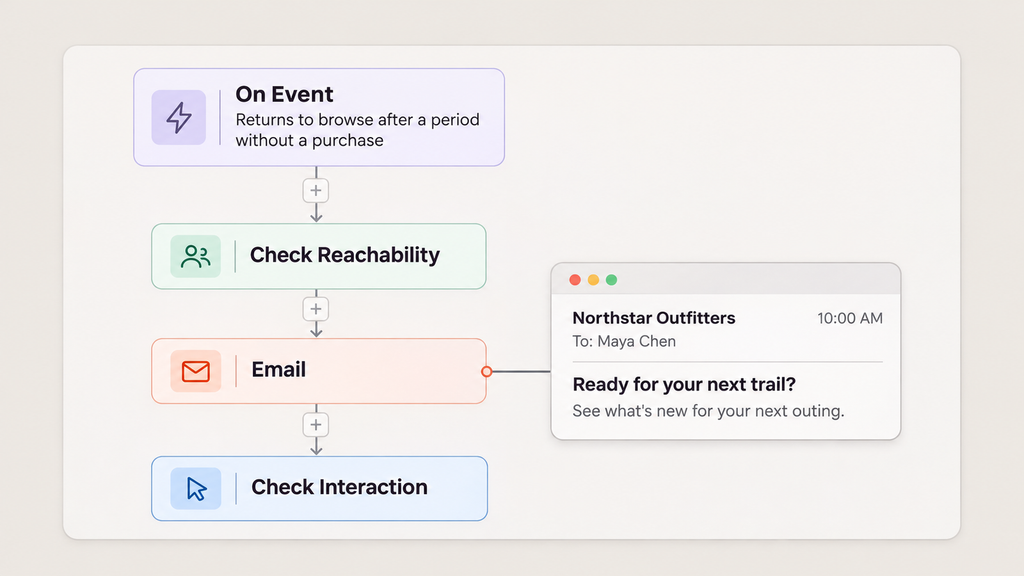
Follow these steps:
1. Select a revenue-driving journey.
Choose a use case with an established baseline, such as abandoned cart, browse abandonment, or post-purchase engagement. Start with a journey that has measurable business outcomes.
2. Connect real customer data.
Use representative product catalog information, website and app events, and customer profiles. This helps reveal how each platform handles identity resolution, segmentation, and real-time activation.
3. Build the same journey on both platforms.
Keep the audience, channels, exit rules, frequency caps, and campaign conditions consistent. This makes the comparison more meaningful.
4. Test AI capabilities and maintain a control group.
Activate one relevant AI capability on each platform and compare the results against a business-as-usual control group. Measure incremental lift rather than relying only on campaign-attributed conversions.
5. Evaluate operational effort alongside results.
Measure setup time, engineering requirements, journey adjustments, and how easily the marketing team can launch subsequent campaigns without additional vendor support.
6. Compare the wider business impact.
Look beyond immediate conversions. Evaluate revenue per journey, customer engagement, operational efficiency, and the resources required to maintain and scale the program.
This approach helps enterprise teams identify which platform can deliver measurable results while supporting their longer-term customer engagement strategy.
Why connected customer engagement matters
The choice between Insider One and Netcore ultimately depends on how a brand wants to connect its customer engagement capabilities.
Netcore brings established email infrastructure, dedicated product discovery through Unbxd, in-app product experience tools, and a strong regional presence in India and Southeast Asia. It can be a relevant choice for organizations prioritizing these capabilities.
Insider One is designed for brands that want to bring customer data, personalization, product discovery, journey orchestration, and messaging together. Its unified CDP provides the foundation for connected customer experiences, while Agent One extends that intelligence into AI-driven engagement and goal-oriented optimization.
For enterprise organizations looking beyond individual marketing tools, this connected approach offers a way to manage the entire customer lifecycle, adapt experiences to changing customer behavior, and optimize engagement around measurable business outcomes.
Explore how Insider One can support your customer engagement strategy with a personalized demo or interactive platform tour. You can also compare Insider One with other leading platforms on our Compare Vendors page.
Frequently Asked Questions
Insider One connects customer data, web personalization, product discovery, journey orchestration, and messaging through a unified CDP. Agent One extends this foundation with coordinated AI-driven engagement. Netcore combines customer engagement capabilities with email infrastructure, Unbxd product discovery, and dedicated in-app product experience tools.
Yes. Netcore Cloud rebranded as Netcore.ai on July 30, 2026, and now positions itself as an agentic marketing platform.
Yes. Insider One supports SMS and RCS with automatic SMS fallback, as well as WhatsApp, email, web push, app push, web personalization, and conversational CX.
Both use custom quotes. Netcore prices its Growth and Enterprise plans based on monthly tracked users and selected features, with 30% of its Enterprise platform fee tied to client KPIs. Insider One offers account-based pricing based on products, channels, and engagement volumes. Its $0 Migration Movement also helps brands switching from another platform reduce migration costs.
Both offer product discovery capabilities, but their approaches differ. Netcore’s Unbxd is a dedicated search and merchandising solution recognized by Gartner. Insider One’s Eureka site search connects with customer profiles, personalization, and messaging, allowing product discovery behavior to inform engagement across other channels.
Migration timelines depend on data sources, the number of journeys, integrations, and email sending volumes. Most migrations involve transferring data connections, templates, suppression lists, and core journeys. Email senders may also need an IP warm-up period. Insider One’s $0 Migration Movement is designed to reduce switching costs and help brands transition from their existing engagement platform.
Both platforms serve enterprise organizations, but their strengths address different priorities. Insider One is suited to enterprises looking to connect customer data, personalization, search, journey orchestration, and messaging through one platform, with Agent One supporting goal-driven engagement and adjustable AI autonomy. Netcore may suit organizations prioritizing established email infrastructure, specialist product search, in-app product experiences, and its strong presence in India and Southeast Asia.

Keep Reading
4 min.

Chris Baldwin
3 Feb 2026
11 mins.
Chris Baldwin
23 Nov 2026
20 mins.

Nicolas Algoedt
23 Nov 2026