

 Platform Overview


 Integration Hub


 Agent One™


 Agent One™ Teams


 Customer Data Management


 Personalization


 Journey Orchestration


 Reporting & Data


 Behavioral Analytics


 Web


 Email


 Site Search


 Conversational CX


 WhatsApp


 Web Push


 InStory


 App


 SMS & RCS


 Join the $0 Migration Movement™


 The Insider One Difference


 Compare Vendors


 Switch to Insider One


 Success Story


 Retail & Ecommerce


 Financial Services


 Travel & Hospitality


 Beauty & Cosmetics


 Automotive


 Telecommunications


 Total Economic Impact™ Study


 Blog


 E-Books & Guides


 Events


 Glossary
CDP Software Explained: Types, Vendors, and How to Choose the Right Platform

Updated on 23 Nov 2026
20 mins.
Table of Contents
- Summary
- What is CDP software?
- The types of CDP software
- CDP software vendors in 2026: The landscape by type
- How to choose CDP software: a 6-step framework
- Step 1: Define three to five priority use cases
- Step 2: Audit data and identity readiness
- Step 3: Match the CDP type to the team that will run it
- Step 4: Score vendors against weighted criteria
- Step 5: Run a proof of concept on your own data
- Step 6: Model three-year total cost of ownership
- Red flags during a CDP evaluation
- Why CDP projects underdeliver, and how to avoid it
- Where Insider One fits
- Turn unified customer data into cross-channel growth
- Frequently Asked Questions
Most Popular
Summary
- CDP software collects customer data from every source, resolves it into one persistent profile per customer, and makes those profiles available to analytics, marketing, service, and AI systems.
- CDPs can be classified two ways: by function (Data, Analytics, Campaign, and Delivery CDPs, as defined by the CDP Institute) and by deployment (packaged, warehouse-native or composable, and hybrid). Many buying mistakes come from mixing up the two.
- The vendor market is consolidating. Gartner’s 2026 Magic Quadrant for CDPs evaluated 11 vendors, dropped several established names, and added agentic AI as an expected capability.
- The right choice depends on who will run the platform and where data must be activated. A data team with a mature warehouse and a CRM team that needs to launch cross-channel journeys need different types of CDP.
- Validate any shortlist with a proof of concept on your own data and a three-year cost model. Gartner research found that companies use less than half of the CDP capabilities they pay for.
Most companies already have more customer data than they can use. It sits in an ecommerce platform, a mobile app, an email service, a CRM, a loyalty program, and a point-of-sale system, and each one holds a slightly different version of the same customer.
CDP software fixes this by joining those records into one profile per person and making that profile usable across every channel.
The harder question is which CDP to buy. The category now covers products as different as a warehouse-native activation layer, a module inside a Salesforce or Adobe suite, and a platform that also sends your emails and WhatsApp messages.
This guide explains what CDP software does, the types of CDP and how they differ, how the 2026 vendor landscape maps onto those types, and a step-by-step framework for choosing one, including the questions to ask in a demo and the costs that rarely appear in a proposal.
What is CDP software?
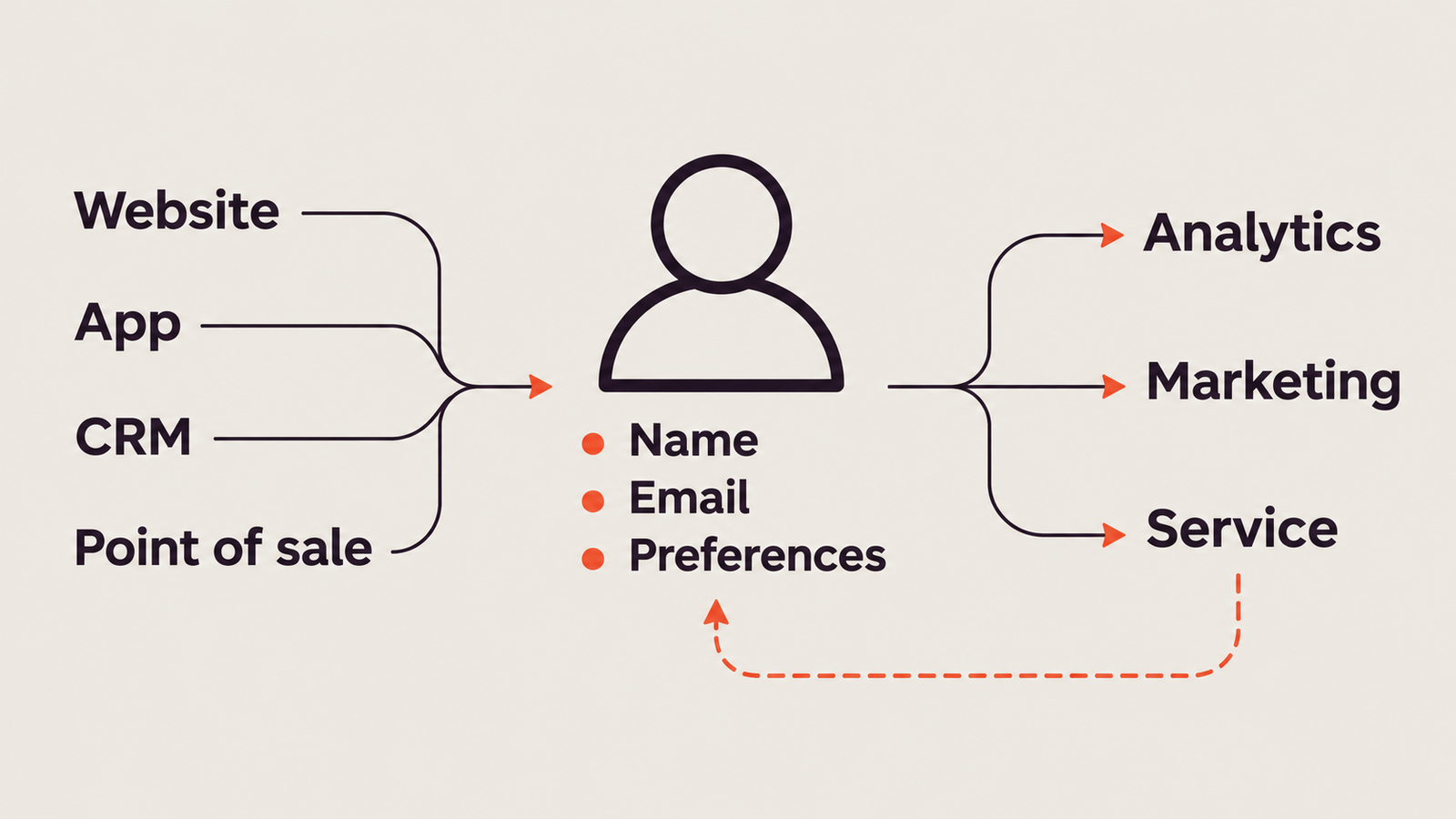
CDP software is a customer data platform: a system that gathers customer data from every source a company uses, links each data point to the right person, keeps a persistent profile for each customer, and shares those profiles with other systems. The CDP Institute, which named the category in 2013, defines a CDP as software that creates and maintains a persistent, unified customer record that other systems can access.
Gartner sets a similar baseline. In its 2026 evaluation, Gartner required CDPs to handle at least data collection, customer data object management, activation, and analytic reporting, according to CX Today’s summary of the Magic Quadrant.
How CDP software works
1. Collect. The CDP ingests data through SDKs, APIs, batch files, and prebuilt connectors from websites, apps, ecommerce platforms, POS systems, CRMs, support desks, and data warehouses.
2. Resolve identity. It matches records that belong to the same person, using deterministic keys (email, phone number, customer ID, loyalty ID) and, in some products, probabilistic signals. Anonymous sessions merge into a known profile once the visitor identifies themselves.
3. Build profiles. Each profile holds attributes, events, computed traits (such as lifetime spend or last category viewed), and predictive scores.
4. Segment and decide. Teams build audiences with rules or models, and increasingly with AI that selects the audience, offer, channel, or timing.
5. Activate. The CDP sends audiences and attributes to channels, or executes messages and onsite experiences itself.
6. Learn. Results flow back into the profile, so the next decision uses the latest behavior.
CDP vs CRM vs DMP vs data warehouse
| System | Main job | Data it holds | Usually run by | How it relates to a CDP |
| CRM | Manage sales and service relationships | Known contacts, deals, and cases, often entered by staff | Sales and service teams | A source for the CDP, and a destination for richer profiles |
| DMP | Build advertising audiences | Mostly anonymous, third-party data with short retention | Advertising teams | A CDP works mainly with first-party data about identified people, kept as long as the company chooses |
| Data warehouse | Store and analyze any business data | Any data, modeled by technical teams | Data engineering | Composable CDPs run on top of it; packaged CDPs sync with it |
| CDP | Maintain unified customer profiles for business activation | First-party behavioral, transactional, and profile data, known and anonymous | Marketing and CRM teams with data support | Connects all of the above |
For a longer introduction to the category, see our guide to what a customer data platform is.
The types of CDP software
Most comparison pages describe CDP types with a single label, such as “composable” or “marketing CDP.” In practice, every CDP sits on two separate axes: what it does and where it runs. Evaluating both prevents the common mistake of comparing a warehouse activation layer with a cross-channel engagement platform as if they were the same product.
By function: Data, Analytics, Campaign, and Delivery CDPs
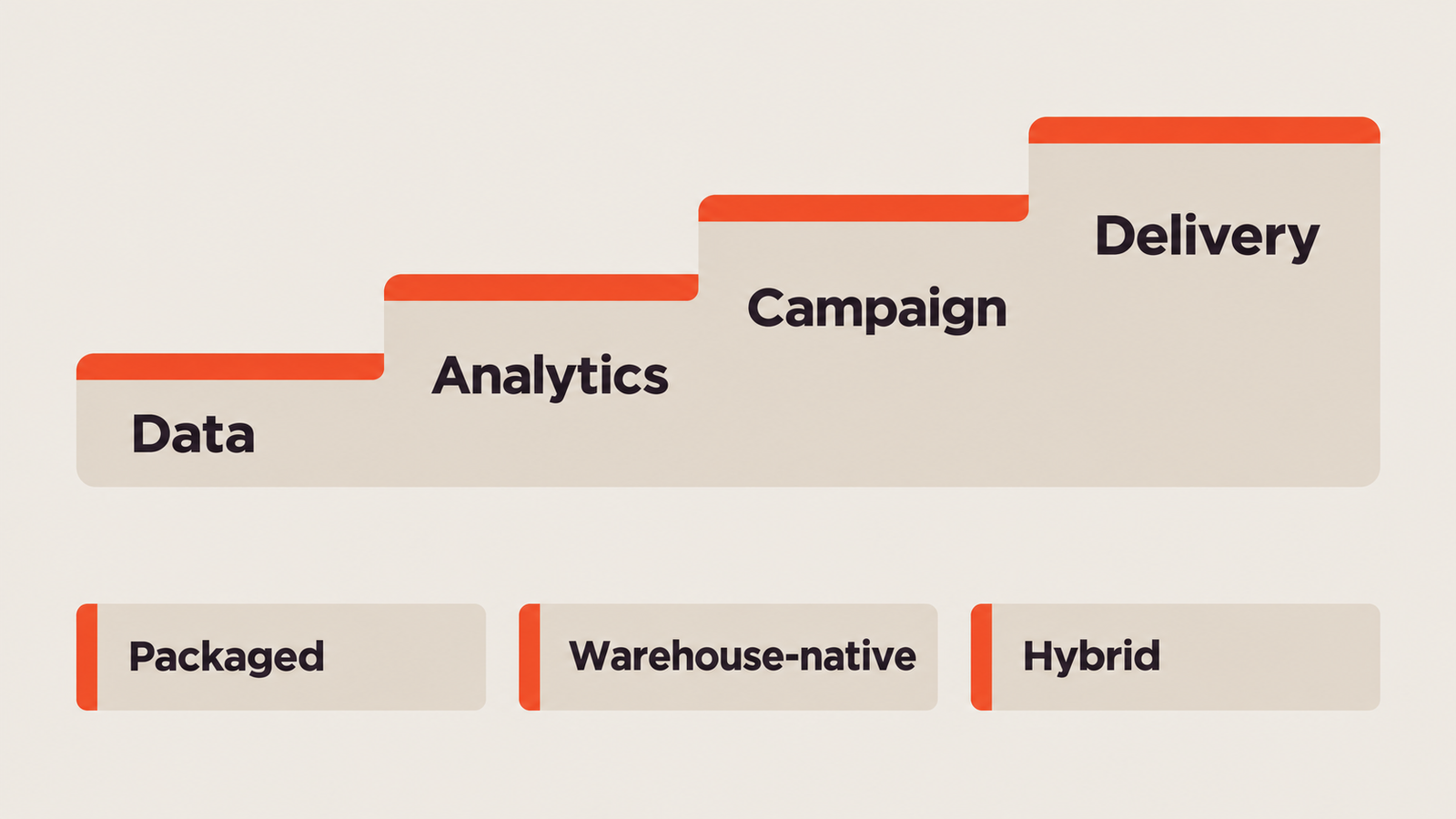
The CDP Institute groups CDPs into four functional categories, each including the capabilities of the one before it:
- Data CDPs collect data, link it to customer identities, store it, and share it with external systems. Many started as tag management or web analytics products.
- Analytics CDPs add segmentation and often predictive modeling, attribution, and journey analysis.
- Campaign CDPs add customer treatments: personalized messages, recommendations, and real-time interactions that can differ for each person within a segment, often orchestrated across channels.
- Delivery CDPs also deliver those messages through email, web, mobile apps, or other channels.
The practical difference is how much work happens after the profile is built. With a Data or Analytics CDP, each channel still needs its own execution platform, which means another integration, another copy of customer data, and another place where suppression and consent rules must be maintained.
With a Campaign or Delivery CDP, the same profile drives both the decision and the message, so there are fewer handoffs, but you depend on the depth of the vendor’s native channels.
By deployment: packaged, composable, and hybrid
The CDP Institute describes three architectures:
- Own-store (packaged) CDPs keep their own copy of customer data. They are typically faster for marketing teams to put into use, and they sync with the warehouse rather than depending on it.
- Warehouse-native (composable) CDPs work directly on data held in a company’s warehouse, such as Snowflake, BigQuery, or Databricks. There is no second customer store, but modeling, identity logic, and pipelines become the customer’s responsibility. Gartner made this point about the leading warehouse-native vendor in its 2026 report.
- Hybrid CDPs support both approaches.
A fourth buying model cuts across these: suite-embedded CDPs, sold as part of a larger platform from Salesforce, Adobe, or Oracle.
They integrate most deeply with their own applications. Gartner’s 2026 analysis flagged trade-offs for this model, including unpredictable credit consumption for one suite and packaging that requires adjacent products to access orchestration for another.
How the main CDP options compare
| Option | Where profile data lives | Who runs it day to day | How data is activated | Typical fit | What to check |
| Packaged Data or Analytics CDP | Vendor’s platform | Data or marketing operations | Audiences sent to separate channel platforms | Many existing execution platforms to feed; strong governance needs | Cost and effort of each downstream integration |
| Composable (warehouse-native) CDP | Your data warehouse | Data engineering | Synced from the warehouse to destinations | Mature, well-modeled warehouse and a standing data team | Engineering headcount, warehouse compute, data freshness for real-time use cases |
| Suite-embedded CDP | Vendor’s suite | Suite administrators or implementation partners | Native to the suite’s applications | Organizations already standardized on that suite | Licensing across multiple modules; value outside the suite |
| Campaign or Delivery CDP | Vendor’s platform, often with warehouse sync | Marketing and CRM teams | Native channels and journeys, plus outbound integrations | Teams that must launch personalized cross-channel journeys quickly | Depth of each native channel; warehouse and API connectivity |
Where AI agents fit
AI is changing what buyers expect a CDP to do after data is unified. Gartner’s 2026 Magic Quadrant added agentic process optimization as a new capability, meaning packaged AI agents that make decisions and take action for specific business functions.
Gartner also described the market splitting in two: CDPs positioned as the data foundation of a broad application suite, and CDPs positioned as the base for autonomous agents that run marketing execution.
Agents are only as good as the profiles they read and the outcomes they can see.
When evaluating AI claims, ask what an agent can do without human approval, which data it can access, how its decisions are logged and explained, and whether it can act on channels directly or only recommend.
CDP software vendors in 2026: The landscape by type
The CDP Institute’s vendor directory lists more than 240 CDP vendors and service providers, but only a small group appears in analyst evaluations.
Gartner’s 2026 Magic Quadrant for CDPs included 11 vendors, and four previously evaluated vendors (ActionIQ, Redpoint Global, mParticle, and Zeta Global) dropped out after Gartner raised its inclusion criteria for customer count and contract value.
Ownership is also shifting. Uniphore acquired ActionIQ in late 2024, Twilio announced the planned sunset of Twilio Engage Premier in June 2025, and on October 20, 2026, Salesforce signed a definitive agreement to acquire Braze, a customer engagement platform, with the deal expected to close in Salesforce’s fiscal year 2028. For buyers, this makes vendor roadmap and ownership a selection criterion in its own right.
The table below maps commonly shortlisted vendors to the types above. It is a starting point for a shortlist, not a ranking. Capabilities and packaging change often, so confirm current details with each vendor.
For detailed profiles, pros, and cons of individual platforms, see our comparison of the best customer data platforms and our guide to enterprise CDPs.
| Vendor | Primary function | Deployment | Often shortlisted when |
| Adobe Real-Time CDP | Data and Analytics | Suite-embedded (Adobe Experience Platform) | The marketing stack is built on Adobe Experience Cloud |
| Amperity | Data and Analytics, identity resolution focus | Packaged | Consumer brands need complex identity unification |
| Bloomreach | Delivery | Packaged, bundled with its engagement product | Commerce brands want engagement and site search together |
| Hightouch | Data and activation | Composable (warehouse-native) | A mature warehouse and data engineering team are in place |
| Insider One | Campaign and Delivery | Packaged, with bidirectional warehouse connection | Marketing teams need unified profiles and native activation across 12+ channels |
| Oracle Unity | Data and Analytics | Suite-embedded (Oracle Fusion) | Profiles must combine customer, account, and ERP or supply chain data |
| Salesforce Data 360 | Data and Analytics | Suite-embedded, with zero-copy warehouse access | CRM, service, and marketing already run on Salesforce |
| Tealium | Data | Packaged | Governed data collection must feed many existing platforms |
| Treasure Data (Treasure AI) | Data, Analytics, and Delivery | Hybrid | Global, multi-brand enterprises need flexible deployment |
| Twilio Segment | Data | Packaged | Developer-led teams want event collection and routing |
| Uniphore (ActionIQ) | Data and Analytics | Warehouse-native | Large enterprises prioritize governance and zero-copy access |
How to choose CDP software: a 6-step framework
Feature checklists make most CDPs look alike. The steps below focus on the factors that actually separate a successful deployment from expensive shelfware: use cases, data readiness, team capacity, and measured performance.
Step 1: Define three to five priority use cases
Write each use case with the data it needs, the channel where it runs, how fast the decision must happen, who owns it, and the metric it should move. For example:
- Recover abandoned carts across email, SMS, and WhatsApp, and stop all messages within minutes of a purchase.
- Win back customers whose predicted churn risk rises above a set threshold.
- Personalize the website for anonymous visitors based on in-session behavior, then continue the journey once they sign in.
- Trigger an online journey from an in-store purchase recorded in the POS system.
- Exclude existing customers from paid acquisition audiences.
Use cases decide the type of CDP more than any feature does. If most require real-time decisions on owned channels, a Campaign or Delivery CDP is a better fit than a Data CDP feeding five separate execution platforms. Our list of CDP use cases and the interactive CDP use case explorer can help you build this list.
Step 2: Audit data and identity readiness
Before talking to vendors, document:
- Which identifiers you collect (email, phone number, customer ID, loyalty ID, device IDs) and where each one is created.
- The share of traffic that is anonymous, and where visitors first identify themselves.
- Offline data sources, such as POS or call center records, and the key that links them to online profiles.
- How consistently events are named and structured across web, app, and backend systems.
- Where consent is recorded for each channel.
- Whether a modeled data warehouse exists, and who maintains it.
This audit sets realistic expectations for match rates and timelines, and it shows which customer data integration work must happen regardless of the vendor you choose.
Step 3: Match the CDP type to the team that will run it
| If this describes you | Start your shortlist with |
| You have a well-modeled warehouse and a data engineering team that will own identity logic, syncs, and monitoring | Composable (warehouse-native) CDPs |
| CRM, service, and marketing already run on one vendor’s suite | That suite’s CDP, priced across every module you will need |
| You need governed data collection to feed many existing channel platforms | Packaged Data CDPs |
| Marketing and CRM teams must build and launch personalized cross-channel journeys without engineering tickets | Campaign and Delivery CDPs |
Step 4: Score vendors against weighted criteria
| Criterion | What to ask | What a strong answer looks like |
| Identity resolution | Which matching methods are supported? Can we configure merge rules? How are anonymous profiles merged? | The vendor runs your sample data and shows the resulting match rate |
| Data ingestion and integrations | Are there connectors for our main sources? Can the CDP read from and write back to our warehouse? | Prebuilt connectors for your top sources and a bidirectional warehouse connection |
| Real-time performance | How long from a customer event to segment entry to message delivery? | A latency figure measured in your proof of concept, not a marketing claim |
| Activation | Which channels are native, and which require integrations? | Every priority use case runs end to end |
| AI and agents | Which predictive models are included? What can agents do autonomously, and how are decisions logged? | Explainable decisions, human controls, and measured uplift |
| Privacy and governance | How is consent stored per channel? Which certifications cover this product? Where is data hosted? | Channel-level consent, configurable retention, and certifications such as ISO 27001 and SOC 2 that cover the CDP itself |
| Usability | Can a marketer build a segment and a journey without SQL? | A live build during the demo, using your use case |
| Pricing model | Is pricing based on profiles, events, credits, or a platform fee? What triggers overage? | A written three-year price with growth assumptions |
| Time to value and support | Who does the implementation work, and when is the first use case live? | A dated plan with named people on both sides |
| Vendor viability | Who owns the company? What is committed on the roadmap? | Roadmap commitments you can reference in the contract |
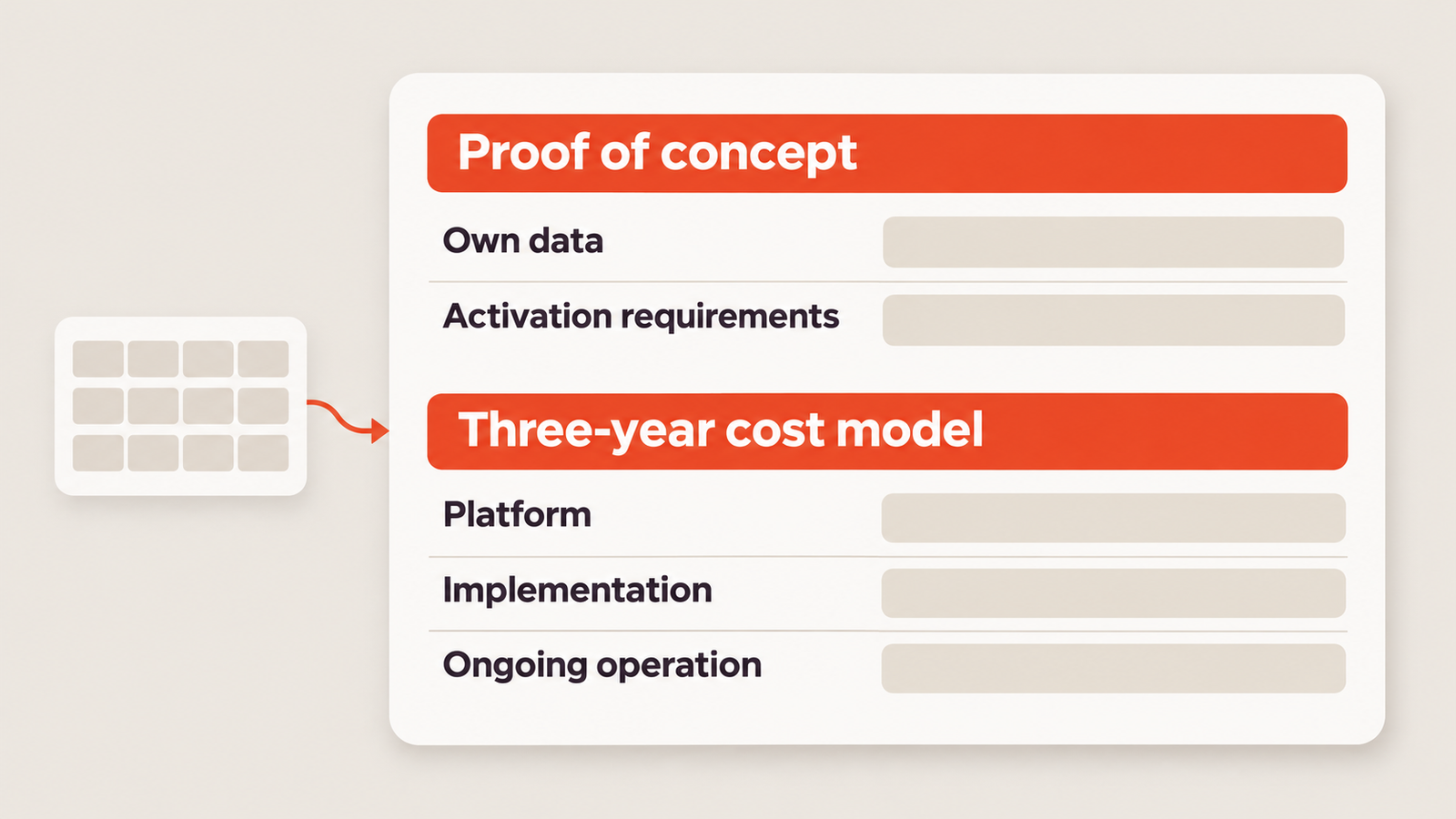
Step 5: Run a proof of concept on your own data
A two- to four-week proof of concept tells you more than any demo. Load a representative sample, such as 90 days of events plus your customer table, and measure:
- The identity match rate compared with your current system.
- The time from a live event to segment qualification and message delivery.
- How long a marketer takes to build one priority journey from scratch.
- Whether segment counts reconcile with your warehouse or BI reports.
Step 6: Model three-year total cost of ownership
License fees are only part of the cost. Include implementation services, internal headcount for data engineering and operations, warehouse compute for composable deployments, the separate channel platforms you will still pay for if the CDP does not deliver messages, migration from your current systems, and training. Each CDP type moves cost to a different place: composable CDPs shift spend from license to engineering, Data CDPs shift it to downstream channel platforms, and suite CDPs shift it to adjacent modules.
Red flags during a CDP evaluation
- The demo only uses the vendor’s sample data.
- “Real-time” is promised without a measured latency figure.
- AI features cannot explain why a customer was selected for a message.
- Pricing depends on credit consumption that the vendor cannot estimate in writing.
- Security certifications cover the parent company but not the CDP product.
- The implementation plan has no named owner on your side.
Why CDP projects underdeliver, and how to avoid it
Buying a CDP does not guarantee that teams use it. In Gartner’s Critical Capabilities for Customer Data Platforms, 67% of respondents to the 2023 Gartner Marketing Technology Survey said they had adopted a CDP, but they estimated using only 47% of the capabilities available, down from 55% the year before.
The causes are usually predictable:
- The platform was bought before the use cases were defined, so nobody owns the outcome.
- There is an activation gap. Profiles are unified, but every campaign still depends on a separate channel platform and a new integration.
- Ownership is split between a data team that maintains the platform and a marketing team that is expected to use it.
- Data quality problems were not addressed before launch, so teams stop trusting the segments.
To avoid this, tie the contract to your priority use cases, launch two or three of them in the first 90 days, assign a single product owner, and track adoption metrics (active users, live journeys, and revenue influenced) alongside technical ones.
Where Insider One fits
Insider One is a Campaign and Delivery type of CDP, built into an agentic customer engagement platform. Its customer data management capabilities unify data from more than 100 prebuilt integrations and connect bidirectionally with your data warehouse. Teams can manage identity resolution rules, segment with more than 120 attributes, and use AI-based predictions such as likelihood to purchase, churn risk, and discount affinity.
The same profiles power activation across more than 12 native channels, including web, app, email, SMS, WhatsApp, and push notifications, with journey orchestration in a single builder. Governance features include channel-level consent management, adjustable data retention, and certifications including ISO 27001, SOC 2 Type 2, and CSA STAR.
Fashion retailer Vogacloset used Insider One’s CDP to unify fragmented customer data and completed its full migration and first campaign launch within eight weeks. Using that data to personalize journeys across channels such as WhatsApp and email, Vogacloset achieved a 30X ROI.
If your main requirement is a warehouse activation layer that feeds many other execution platforms, a composable CDP may be the closer fit. If your marketing and CRM teams need to act on unified data across owned channels from one place, a Campaign or Delivery CDP removes several integration steps and handoffs.
Turn unified customer data into cross-channel growth
Choosing CDP software comes down to three questions: which use cases matter most, who will run the platform, and where the data must be activated. Answer those first, then test your shortlist on your own data.
To see how Insider One unifies customer data and activates it across every channel, request a personalized demo or explore use cases at your own pace in the Insider One Product Demo Hub.
Frequently Asked Questions
Often, yes. A CRM manages sales and service relationships, mostly from data entered by staff or captured in its own system. A CDP ingests behavioral, transactional, and anonymous data from every channel, resolves it into unified profiles, and shares those profiles with other systems, including the CRM. If you need real-time behavioral data for personalization, a CRM alone is usually not enough.
Most vendors quote custom pricing based on the number of profiles, event volume, consumption credits, or a platform fee plus modules, and few publish full price lists. The license is only one part of the cost. Budget for implementation, internal headcount, warehouse compute for composable deployments, and any separate channel platforms you still need. Ask every vendor for a written three-year estimate.
Timelines range from a few weeks to many months. They depend on the number of data sources, identity complexity, warehouse readiness, and whether channels are native or need separate integrations. Suite-embedded deployments that involve several products and partners usually take longest. For example, Vogacloset completed its full migration and campaign launch on Insider One within eight weeks.
Neither is better in every case. A composable CDP avoids a second copy of customer data and suits companies with a mature warehouse and a data engineering team to maintain it. A packaged CDP is usually faster for marketing teams to use and does not depend on in-house engineering. Many vendors now offer hybrid options, so compare total cost and team capacity, not architecture alone.
An agentic CDP pairs unified customer profiles with AI agents that can make decisions and take action, such as building audiences, selecting offers, or optimizing journeys. Gartner added agentic process optimization as a new CDP capability in its 2026 evaluation. When assessing agentic features, check what agents can do without approval, how their decisions are logged, and whether results are measured against a control group.
Not on its own. A warehouse stores and analyzes data, but it does not provide identity resolution, marketer-friendly segmentation, consent enforcement, or activation out of the box. Composable CDPs add those functions on top of a warehouse, while packaged CDPs provide them in their own platform and sync with the warehouse.
Yes. Insider One includes a CDP that unifies online and offline customer data into persistent profiles, and it is listed in the CDP Institute’s vendor directory. Unlike Data CDPs that pass audiences to other platforms, Insider One also activates those profiles through native channels and journey orchestration, which places it in the Campaign and Delivery categories.

Keep Reading
4 min.

Chris Baldwin
3 Feb 2026
13 mins.
Chris Baldwin
23 Nov 2026
11 mins.
Chris Baldwin
23 Nov 2026