

 Platform Overview

 Integration Hub

 Agent One™

 Agent One Teams™

 Customer Data Management

 Personalization

 Journey Orchestration

 Reporting & Data

 Behavioral Analytics

 Web
Web

 Email
Email

 Site Search

 Conversational CX

 WhatsApp

 Web Push

 InStory

 App
App

 SMS & RCS

 Join the $0 Migration Movement™

 The Insider One Difference

 Compare Vendors

 Switch to Insider One

 Success Story

 Retail & Ecommerce

 Financial Services

 Travel & Hospitality

 Beauty & Cosmetics

 Automotive

 Telecommunications

 Total Economic Impact™ Study

 Blog
Blog

 E-Books & Guides

 Glossary
Demographic Segmentation Strategies That Turn Customer Data Into Revenue in 2026

Updated on 15 Sep 2026
7 min.
Table of Contents
- Summary
- The demographic variables still worth segmenting by in 2026
- How demographic segmentation turns into revenue
- Why demographic segmentation alone falls short (and what to pair it with)
- A step-by-step framework to build and activate segments
- Measuring and iterating: KPIs that prove segmentation value
- Conclusion
- FAQs
Most Popular

Summary
- Demographic segmentation strategies only work when each field (age, income, life stage, occupation, language) changes what you send, when you send it, or how you measure it
- Real activation patterns show demographic segmentation is most powerful when paired with behavioral and lifecycle data, not used as a standalone filter
- A repeatable audit-to-activation framework beats one-off segment builds: prune unused fields, map remaining traits to messaging, then assign channels by urgency
- Segment-specific key performance indicators (KPIs), like engagement rate by locale and conversion rate by cohort, catch decay before it costs revenue
- El Corte Inglés, Intersport, and Aramex each turned demographic and regional signals into measurable lifts using Insider One
You know a customer’s age, income bracket, and postal code, yet the campaign still reads like it was written for nobody in particular.
That gap is what demographic segmentation strategies are meant to close: grouping customers by shared traits, such as age, income, life stage, occupation, and language, then using those traits to decide what a brand sends, when it sends it, and how success gets measured.
This guide is for lifecycle and customer relationship management (CRM) marketers at mid-market and enterprise business-to-consumer (B2C) brands who are evaluating or rebuilding a segmentation strategy, often while comparing customer data platform (CDP) or messaging tools.
You will find a ranked look at which demographic variables still predict behavior in 2026, a set of activation patterns, a step-by-step framework for building segments that do not decay, and the key performance indicators (KPIs) that prove the work paid off.
The demographic variables still worth segmenting by in 2026
Not every demographic field earns its place in a segmentation model. Age, income, and life stage still correlate with purchase timing and category preference strongly enough to shape campaign logic on their own.
Occupation and language are weaker in isolation. Language matters more as a delivery requirement than a behavioral predictor, and occupation only helps when it’s tied to a specific product category, such as enterprise software or professional apparel.
The practical test is simple: only collect or keep a demographic field if it changes what you send, when you send it, or what you measure.
If a field sits in your customer data platform unused for six months, it is not a segment variable; it is clutter that slows down every query built on top of it. This logic mirrors zero-party data segmentation: data volunteered by the customer earns its keep only when it drives a decision.
Here’s a practical ranking for most B2C models:
- Life stage (new parent, retiree, recent graduate) predicts category need directly and should almost always be active
- Income band shapes offer type and price sensitivity, useful for retail, travel, and financial services
- Age is a reasonable proxy when life stage data is missing, but it’s a weaker substitute
- Language determines delivery mechanics and compliance, not intent, so treat it as a requirement, not a behavioral signal
- Occupation only earns a place when tied to a specific vertical use case
How demographic segmentation turns into revenue
Demographic segmentation only produces results when a trait maps to a distinct message, offer, or channel, not just a distinct label in a database.
Consider how skin tone and undertone, a demographic-adjacent variable, can determine which product page, ad creative, and shade-matching quiz a shopper sees first in a shade-inclusive beauty launch.
Life stage segmentation can also justify an entirely different booking flow and loyalty structure for retirees than for younger travelers drawn to adventure-focused marketing.
Age cohort alone can decide channel and content format rather than income or occupation, since attention patterns often differ more between generations than spending power does.
Layering demographic data, such as household type or age band, with behavioral signals lets a brand route push notifications to habitual app users and email to lower-frequency segments instead of sending every channel to every cohort.
Brands using Insider One show this pattern with measurable outcomes. El Corte Inglés increased average order value by 37% by pairing locale and purchasing-behavior segments with onsite personalization, while Intersport grew average order value by 4% using personalized onsite promotions built on customer segments rather than blanket discounting.
Why demographic segmentation alone falls short (and what to pair it with)
Demographic segmentation alone frequently misleads because a shared trait does not guarantee shared intent.
Two customers in the same language segment, for instance, Spanish speakers, can have very different lifetime value: one is a high-frequency buyer researching in Spanish, the other opened one email in that language two years ago and never converted.
Segmenting by language without layering purchase recency and frequency treats both customers identically, and the campaign underperforms for both.
The fix is layering, not replacement. Demographic traits set the outer boundary of a segment, behavioral signals such as browsing, purchase, and engagement recency narrow it, and lifecycle stage (new, active, lapsing, dormant) decides urgency and channel.
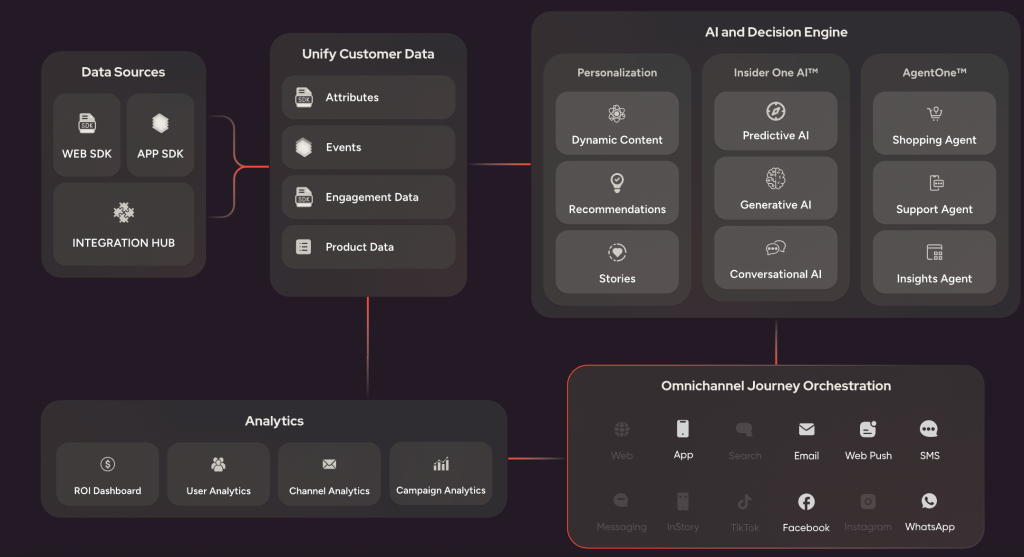
Insider One’s customer data management layer unifies these signals so a single segment query can combine age band, purchase recency, and RFM (recency, frequency, monetary value) status without stitching together separate exports.
This layered approach also opens the door to predictive work. Rather than segmenting only on who a customer already is, brands can use behavioral history to estimate what a customer is likely to do next, an approach covered in our guide to artificial intelligence (AI) customer segmentation.
Aramex applied layered targeting across regional segments and drove a 41.18% lift in conversion, a result unlikely from demographic filtering alone.
A step-by-step framework to build and activate segments
Building demographic segments that survive contact with real campaigns requires a repeatable process, not a one-time export. The sequence below moves from audit through activation, and it works best when run quarterly rather than once a year.
Audit and prune your demographic fields
Start by listing every demographic field currently stored in your CRM or CDP, then check which ones have been used in a live campaign within the past 90 days.
Fields with no recent use get archived rather than deleted, since they may become relevant again. For each surviving field, note the specific message or offer it justifies changing.
- List every demographic field currently collected and its last campaign use
- Archive fields with no campaign use in the past quarter
- Map each surviving field to one specific message, offer, or timing change
- Flag fields that only make sense combined with a behavioral signal, like income plus purchase frequency
Map segments to channels and messaging
Once fields are pruned, assign each surviving segment to the channel that matches its urgency and intent. High-intent, time-sensitive segments, such as cart abandoners in a specific age band, suit push notifications or SMS, while lower-urgency, research-stage segments suit email or onsite content.
High-value, high-complexity segments, such as enterprise buyers filtered by occupation, often warrant sales-assisted outreach instead of automated messaging.
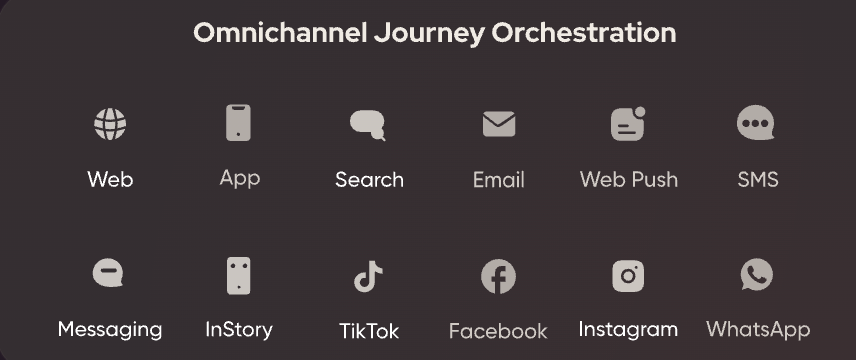
Insider One’s journey orchestration lets teams route each segment to its corresponding channel from a single workflow, rather than managing parallel campaigns for each channel.
Measuring and iterating: KPIs that prove segmentation value
Segmentation only proves its value when each segment has its own KPI, not a shared campaign-wide metric that hides which cohort actually moved.
Engagement rate by locale reveals whether language-based segmentation is working, and conversion rate by cohort exposes whether an income-based offer structure actually changes purchase behavior or just changes who opens the email.
Segments also decay, since a demographic model built years ago on assumptions about a customer base’s age distribution or income mix can quietly drift out of date as the customer base itself shifts.
Set a refresh cadence, quarterly for high-volume segments and twice yearly for smaller or slower-moving ones, and rerun the audit-and-prune step each cycle rather than assuming the original logic still holds.
Our guide on marketing automation segmentation covers cadence planning in more depth.
Conclusion
Demographic segmentation strategies still work in 2026, but only as an entry point. The brands seeing real revenue lift treat age, income, and life stage as filters that narrow a segment, then let behavioral and lifecycle data decide the message, timing, and channel.
Build the audit-to-activation habit now, and your segments will keep earning their place instead of quietly going stale.
See how Insider One’s customer data management layer unifies demographic, behavioral, and lifecycle signals into segments you can activate directly in journey orchestration.
Book a personalized demo to see your own customer base modeled into activation-ready segments within a live workspace.
FAQs
Demographic segmentation in marketing groups customers by shared traits, age, income, life stage, occupation, and language, then uses those traits to shape messaging, offers, and channel choice. It works best when paired with behavioral and lifecycle data rather than used as the only targeting layer.
The main types are age, income, life stage, occupation, and language-based segmentation. Life stage and income tend to predict behavior most reliably, while occupation and language work best as supporting filters tied to a specific product category or delivery requirement rather than standalone predictors.
Demographic segmentation groups customers by who they are, while behavioral segmentation groups them by what they do: browsing, purchase frequency, and engagement recency. Demographic traits set broad boundaries; behavioral signals narrow those groups into segments that actually predict near-term intent.
Retailers pairing locale and purchase-behavior segments with onsite personalization have seen measurable average order value gains, as shown in El Corte Inglés’s 37% increase and Intersport’s 4% lift, both built on Insider One segmentation rather than demographic data alone.
Refresh high-volume segments quarterly and smaller or slower-moving ones twice yearly. Rerun the audit-and-prune step each cycle, since customer bases shift and segments built on outdated income or age assumptions decay quietly, even when campaign volume stays the same.

Keep Reading
7 min.

Muharrem Derinkok
4 Jun 2026
11 min.

Chris Baldwin
2 Jun 2026
4 min.
Chris Baldwin
3 Feb 2026