

 Platform Overview

 Integration Hub

 Insider One AI™

 Customer Data Management

 Personalization

 Journey Orchestration

 Reporting & Data

 Behavioral Analytics

 Web
Web

 Email
Email

 Site Search

 Conversational CX

 WhatsApp

 Web Push

 InStory

 App
App

 SMS & RCS

 Join the $0 Migration Movement™

 The Insider One Difference

 Compare Vendors

 Switch to Insider One

 Success Story

 Retail & Ecommerce

 Financial Services

 Travel & Hospitality

 Beauty & Cosmetics

 Automotive

 Telecommunications

 Total Economic Impact™ Study

 Blog
Blog

 E-Books & Guides

 Glossary
How AI Customer Segmentation Turns Raw Behavioral Data into Revenue

Updated on 10 Aug 2026
9 min.
Table of Contents
- Summary
- Why rule-based segments break down at scale
- What AI actually does differently in customer segmentation
- The four signal types that power smarter AI segments
- Building an AI segmentation workflow that connects to activation
- Measuring whether your AI segmentation is actually working
- How Insider One turns behavioral signals into revenue
- Frequently asked questions
Most Popular


Summary
AI-powered segmentation continuously updates audiences based on real customer behavior, unlike static rule-based segments that quickly become outdated. By combining diverse behavioral and transactional signals with machine learning, it uncovers intent more accurately and keeps customer segments relevant without manual updates.
Segmentation has never been the hard part to justify. Every marketing leader knows that reaching the right customer with the right message at the right moment is the job.
The hard part is the gap between knowing segmentation matters and building an approach that stays accurate after the campaign launches, the list refreshes, and the data moves on. For teams running rule-based cohorts, that gap widens every week.
The shift toward artificial intelligence (AI)-driven customer segmentation is not about replacing analyst judgment with algorithms. It is about closing the operational lag that makes even well-designed static segments irrelevant by the time they reach activation.
When a customer’s intent signal changes on a Tuesday and your segment refresh runs on Friday, you are not personalizing, you are approximating.
The following sections break down what changes when AI takes over the logic, and how to build a workflow that connects smarter audiences directly to revenue.
Why rule-based segments break down at scale
The stale segment problem
A rule-based segment is a snapshot. You define the criteria, the query runs, and a list is produced. The moment a customer’s behavior shifts, that list is technically wrong. The faster your customer base moves, the faster your segments decay.
For brands with high purchase frequency or short consideration cycles, a segment refreshed weekly is operating on data that may already be three to five behavioral signals out of date.
The visible consequence is relevance score degradation: email open rates fall, ad click-through drops, and onsite personalization starts feeling generic. The invisible consequence is that your best-performing cohorts, the ones your team built on real behavioral patterns, gradually stop reflecting the customers inside them.
The analyst bottleneck
Beyond data freshness, there is an operational cost. Every cohort update requires someone to identify that the segment has drifted, define new criteria, rebuild the query, and push it back to the channel. In practice, that cycle takes days. For large teams running dozens of active segments, it takes longer.
The result is a feedback loop where segmentation perpetually lags actual customer behavior, and analysts spend their time maintaining audience lists rather than finding new growth opportunities.
This is the ceiling that mid-market and enterprise marketing segmentation teams hit first. The segmentation logic was sound when it was built. The data volume has grown. But the maintenance overhead has grown faster than the team’s capacity to manage it.
What AI actually does differently in customer segmentation
Propensity models and clustering
The two primary mechanisms behind AI-driven customer segmentation are supervised propensity models and unsupervised clustering.
Propensity models are trained on historical outcomes, such as purchase, churn, or upgrade, and then score every customer on their likelihood to take that action next.
The model surfaces patterns across hundreds of behavioral variables simultaneously, identifying combinations that no analyst would build a rule around because the signal is too subtle or too counterintuitive to spot manually.
Unsupervised clustering, including approaches like k-means and density-based methods, groups customers by behavioral similarity without a predefined outcome in mind.
These clusters often reveal audience structures that do not map to any demographic category but carry real commercial meaning: high-brow, low-convert visitors who share a specific content affinity, or lapsed customers whose re-engagement pattern predicts a second purchase window that standard winback timing would miss.
Dynamic segment membership
The structural difference that matters most is not the model type. It is that AI segmentation operates continuously. Customers enter and exit segments based on real-time or near-real-time signal updates, without a human triggering the refresh.
A customer who just made their third purchase in 30 days moves into a loyalty-tier segment automatically. A high-value customer whose session frequency has dropped two weeks in a row moves into a churn-risk segment without waiting for the next scheduled query run.
This is what journey orchestration systems need to function at their full potential. Static audiences passed into a journey builder are stale by design.
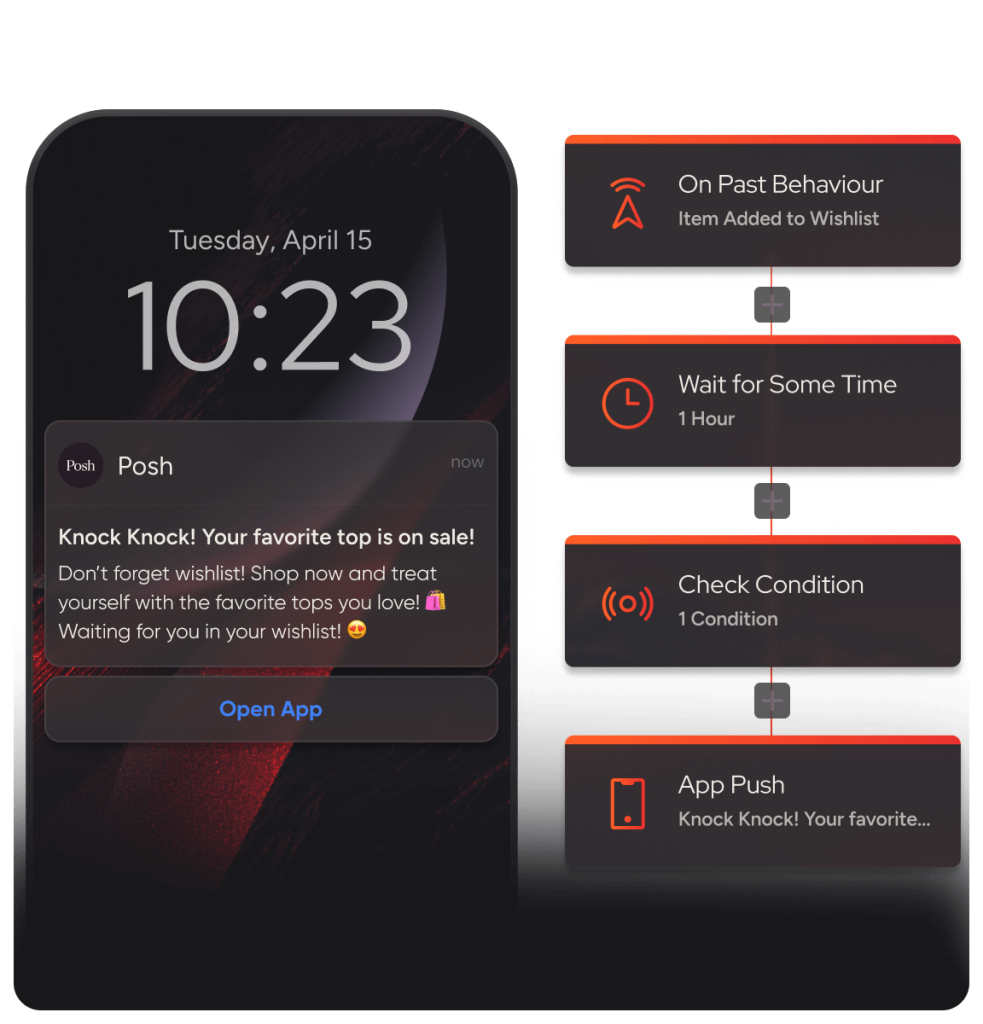
Dynamic segments fed by continuous AI inference mean the journey responds to where the customer actually is, not where they were when the list was last exported.
The four signal types that power smarter AI segments
Behavioral signals
Behavioral signals include page visits, product views, search queries, content consumed, and session depth. These are the highest-frequency signals in most customer profiles and the most predictive of short-term intent.
An AI model trained on behavioral data can identify browse patterns that precede a purchase within 48 hours, or drop-off patterns that indicate friction before a customer explicitly abandons a funnel.
Transactional signals
Purchase history, order value, category affinity, return behavior, and discount usage form the transactional layer. These signals feed upsell propensity and next-best-product models.
When combined with recency data, they also power the RFM (recency, frequency, monetary) segments that most teams already run, but with the added dimension of forward-looking prediction rather than backward-looking categorization.
Contextual signals
Contextual signals cover device type, location, time of day, traffic source, and referral context. They explain why the same customer behaves differently across sessions and why a segment that performs well on desktop underperforms on mobile.
Building contextual signals into the segmentation model means audiences are not just accurate about who a customer is, they are accurate about what that customer is ready to do right now.
Lifecycle signals
Lifecycle signals track where a customer sits in their relationship with the brand: new visitor, first-time buyer, repeat purchaser, at-risk, lapsed, or reactivated. These signals are critical for winback timing, onboarding sequence triggers, and loyalty program entry points.
AI models that read lifecycle signals continuously can identify the exact session where a reactivation window opens, rather than waiting for a fixed number of days since last purchase to trigger a winback flow.
Why signal diversity matters more than volume
The real predictor of segment quality is not how much data a model has access to, it is how many distinct signal types it can read simultaneously. A model built on behavioral data alone misses the transactional context that separates a high-browse researcher from a high-intent buyer.
This is why a unified customer profile, one that consolidates all four signal types into a single, continuously updated view, is the foundation that makes AI-based customer segmentation work.
Without it, even sophisticated models are reading from an incomplete picture. Insider One’s Customer Data Management layer is built specifically to consolidate these signals before they reach the segmentation layer.
Adidas achieved a 259% increase in average order value and a 13% conversion rate lift in a single month by combining behavioral and transactional signals to personalize at a level that broad demographic segments could not reach.

Building an AI segmentation workflow that connects to activation
The three-layer stack
An AI segmentation workflow that drives revenue rather than just producing audience lists operates across three layers.
The first is data unification: all behavioral, transactional, contextual, and lifecycle signals both online and offline must be consolidated into profiles before any model can read them.
The second is model inference: AI algorithms run continuously against the unified profiles, scoring customers and assigning segment membership in real time or near real time.
The third is channel sync: segment outputs flow directly into journey builders, ad platforms, and onsite personalization engines without requiring manual export or audience upload steps.
Where teams most often break this chain is between layers two and three. The model runs, the segments update, but the results sit in a reporting dashboard rather than flowing automatically to the channels where activation happens.
The practical fix is ensuring your AI segmentation layer has native integrations with the channels you activate, so that a segment update at the inference layer becomes a changed audience at the channel layer within minutes, not days.
Connecting segments to journeys and ads
AI-generated segments should plug directly into Architect, Insider One’s journey builder, so that audience entry conditions update dynamically rather than on fixed schedules.
The same logic applies to ad audiences: a predictive segment of users with high purchase propensity should sync to paid media targeting automatically as customers enter and exit that propensity threshold, not on the next manual upload cycle.
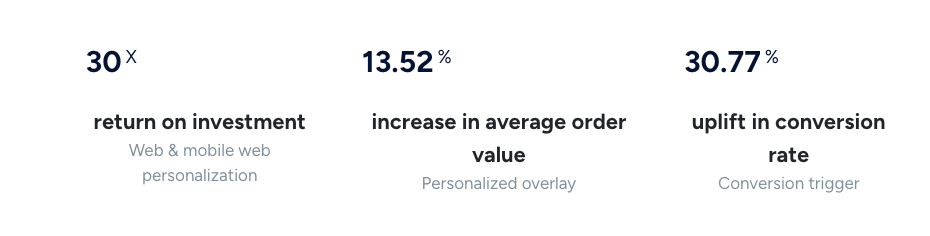
Martes Sport achieved 30X ROI by building AI-generated segments directly into their web personalization layer, removing the manual handoff step between audience building and onsite experience delivery.
Measuring whether your AI segmentation is actually working
The four metrics that matter
Four measures tell you whether your segmentation is genuinely adaptive. Segment decay rate tracks how quickly a segment’s predictive accuracy falls between model refresh cycles; a high decay rate signals that your refresh frequency is too slow for your customer base’s velocity.
Lift over control measures the revenue or conversion difference between customers targeted via AI segments versus an unseeded control group; this is the measure most teams already track.
Coverage breadth captures what percentage of your addressable audience falls into an actionable segment at any given moment; low coverage means the model is over-indexing on confident predictions at the expense of addressable reach.
Time-to-refresh measures the gap between a customer’s behavior changing and that change being reflected in their segment membership.
Most teams track lift over control and occasionally coverage breadth. Segment decay rate and time-to-refresh are almost always ignored, even though they are the leading indicators that explain why lift is degrading before you see it in campaign results.
A maturity framework for AI segmentation
The progression from rule-based to fully adaptive segmentation moves through three stages.
At the reactive stage, segments are manually defined and refreshed on a schedule; the team is aware of segment lag but has no structural mechanism to close it.
At the predictive stage, AI models score customers on propensity and segment membership updates more frequently, but activation still requires a manual handoff to channels.
At the autonomous stage, model inference, segment membership, and channel sync all operate continuously, and the team’s role shifts from maintaining audience lists to designing the strategic intent behind each segment.
The single lever most likely to move a team from reactive to predictive is replacing scheduled batch refreshes with event-triggered model updates. The lever from predictive to autonomous is native channel integration: eliminating the manual export step between segment update and campaign activation.
Insider One’s AI overview covers how Sirius AI™ and the platform’s segmentation infrastructure connect these layers in practice.
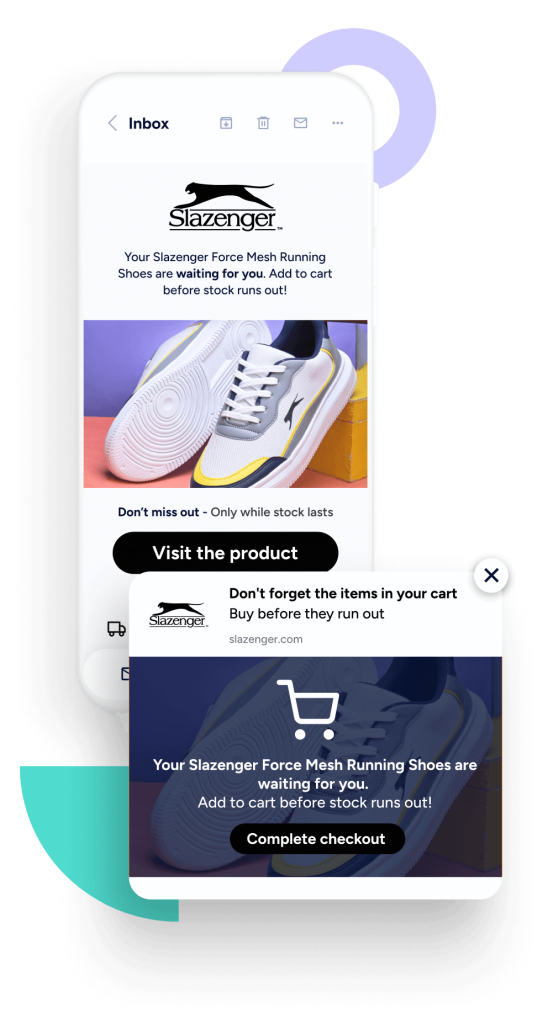
Slazenger gained 49X ROI in just eight weeks after moving from static cohort targeting to AI-driven omnichannel segments that updated continuously across channels.
How Insider One turns behavioral signals into revenue
Behavioral data only becomes revenue when the chain from signal to send holds. Insider One owns all three links.
Signal to profile. Behavioral, transactional, contextual and lifecycle signals land on one profile that updates in milliseconds, so the four signal types are readable together rather than sitting in four systems.
Profile to segment. Predictive attributes recompute as behavior changes. Churn risk, predicted lifetime value, discount affinity and category affinity are maintained by the platform, so membership shifts when the customer shifts, not when a query is next scheduled to run.
Segment to send. The segment is the audience. The same live definition is an entry condition in Architect, a personalization rule on your site, and a recipient set in email and WhatsApp at the same moment, because all of them read that one profile. Nothing is exported, so nothing goes stale in transit.
That unbroken chain is where the revenue sits. A churn-risk score that reaches a journey the same day is worth money. The identical score sitting in a dashboard until Friday is not.
Book a demo to trace one of your own segments from signal to send, or take the platform tour first.
Frequently asked questions
Not necessarily. AI segmentation requires that your key signal types are accessible and consolidated enough for a model to read them. A full CDP architecture is the most robust foundation, but teams can start by unifying behavioral and transactional signals even before a complete CDP deployment. The model quality will improve as more signal types are added over time.
Ad platform audiences are optimized for that platform’s bidding and delivery objectives. They do not reflect the full picture of your customer’s cross-channel behavior, and they cannot feed your email, onsite, or push campaigns. AI segmentation built on your own first-party data gives you portable, channel-agnostic audiences that activate anywhere in your stack.
This depends on the frequency of model inference and the speed of channel sync. In a well-integrated stack, segment membership can reflect a behavioral signal change within minutes. The gap between behavior and activation is one of the clearest ways to measure whether your segmentation infrastructure is truly adaptive or still operating on batch logic.
AI segmentation platforms like Insider One are built to run these models without requiring teams to train or maintain algorithms themselves. The model infrastructure runs at the platform level; the marketing team configures the segment intent and the activation rules.

Keep Reading
7 min.

Muharrem Derinkok
4 Jun 2026
11 min.

Chris Baldwin
2 Jun 2026
4 min.
Chris Baldwin
3 Feb 2026