

 Platform Overview

 Integration Hub

 Insider One AI™

 Customer Data Management

 Personalization

 Journey Orchestration

 Reporting & Data

 Behavioral Analytics

 Web
Web

 Email
Email

 Site Search

 Conversational CX

 WhatsApp

 Web Push

 InStory

 App
App

 SMS & RCS

 Join the $0 Migration Movement™

 The Insider One Difference

 Compare Vendors

 Switch to Insider One

 Success Story

 Retail & Ecommerce

 Financial Services

 Travel & Hospitality

 Beauty & Cosmetics

 Automotive

 Telecommunications

 Total Economic Impact™ Study

 Blog
Blog

 E-Books & Guides

 Glossary
RCS Campaigns for Customer Retention: Why They Work and How to Build Them

Updated on 7 Jul 2026
9 min.
Table of Contents
- Summary
- Why SMS and email are losing the customer retention battle
- What RCS actually changes about the customer relationship
- Mapping RCS campaigns to customer retention moments
- How engagement differs across channels: what RCS makes visible
- Building an RCS retention workflow inside a unified platform
- Frequently asked questions
Most Popular

Summary
RCS enhances customer retention with verified branding, interactive messaging, and two-way conversations that go beyond SMS. Combined with real-time behavioral triggers and unified customer data, it enables more engaging campaigns and better retention outcomes.
When a loyalty tier expires unannounced, a subscription lapses without a timely nudge, or a post-purchase message lands in an inbox that never gets opened, the churn that follows is rarely dramatic.
It simply accumulates across a quarter, quietly eroding cohort retention rates that looked solid on paper. The problem often isn’t the offer or the timing in isolation; it’s the channel infrastructure carrying the message.
Rich Communication Services (RCS) is not simply an upgraded version of SMS. It is a fundamentally different kind of messaging infrastructure, bringing verified brand identity, interactive media, and two-way conversation into the native messaging app on a customer’s phone, without requiring them to download anything or open a separate app.
For retention and lifecycle marketers, that combination matters because it shifts the customer relationship from passive broadcast to active engagement at exactly the moments when churn risk is highest.
Why SMS and email are losing the customer retention battle
The structural limits of plain-text SMS
SMS’s strength has always been delivery. Messages land in the native inbox, read rates are high, and no algorithm filters what your customers see. But those advantages come with a ceiling.
A plain URL in a text message carries no brand verification, and with phishing and smishing attacks increasingly common, customers have learned to treat unknown sender links with suspicion.
The result is rising opt-out rates precisely among the high-value segments, returning customers and loyalty members, who your retention program needs most.
Quick-reply flows, personalized carousels, and in-message action buttons don’t exist in standard SMS, so every post-purchase interaction, whether it’s a return initiation, a loyalty point redemption, or a reorder prompt, requires the customer to leave the message, open a browser, and complete the action manually.
Each step is friction, and each friction point is a conversion drop-off that copy or send-time optimization alone cannot recover.
Why email’s open-rate constraints compound churn risk
Email remains essential for retention, but its structural constraints are often underestimated. When a customer’s loyalty tier is expiring, their subscription is lapsing, or they haven’t purchased in 60 days, a message that doesn’t get opened doesn’t interrupt the churn path at all.
Subject line testing, send-time optimization, and deliverability improvements can move engagement at the margins, but they cannot fix the underlying dynamic that keeps a portion of every send invisible to its intended audience.
RCS doesn’t replace email in the retention mix; it fills the structural gaps that email and SMS leave exposed. The compounding effect over a 90-day window explains why retention teams doing everything right on email can still see cohort churn increase quarter over quarter.
What RCS actually changes about the customer relationship
Verified identity rebuilds trust at the point of engagement
One of RCS’s most consequential features for retention is sender verification. Customers see a brand logo, a verified checkmark, and a recognized sender name before they even open the message.
In fintech, where trust directly drives product adoption and renewal decisions, and in retail, where post-purchase confidence is the strongest predictor of repeat purchase, that visual trust signal does material work.
End-to-end encryption and carrier-level authentication mean RCS messages meet a higher security standard than standard SMS, which matters for regulated industries and for any brand where data trust is part of the value proposition.
Customers who feel confident that a message genuinely came from your brand are more likely to act on it and less likely to ignore or opt out of future messages.
Two-way interaction turns passive recipients into active participants
The interactivity available in RCS changes the structure of a retention conversation. Quick-reply buttons let customers respond with a single tap. Carousels let them browse products, loyalty offers, or service options without leaving the message thread.
In-message checkout flows, where supported, remove the redirect to a browser entirely. For the retention moments that matter most, such as a return initiation, a reorder from a previous purchase, a loyalty reward redemption, or a subscription renewal confirmation, removing that friction produces measurable lift.
This interactivity also generates data that standard SMS and email cannot provide. When a customer taps a specific product in a carousel, scrolls past several options before selecting one, or responds to a quick-reply prompt rather than ignoring it, that behavior is a signal.
It tells you what they’re interested in, what offers they’re responding to, and how close they are to a purchase decision. That signal feeds back into your segmentation and your next message, which is how a messaging channel becomes a retention infrastructure.
Mapping RCS campaigns to customer retention moments
Post-purchase sequences that reduce churn in the highest-risk window
The period immediately after a first or second purchase is the highest-churn window in most customer lifecycles. Customers who don’t hear from a brand in a meaningful way after purchase are significantly more likely to defect to a competitor before placing a second order.
RCS post-purchase sequences using rich cards and order-status carousels address this directly. Rather than a plain-text “Your order has shipped” link, an RCS message can show the item purchased, current delivery status, a one-tap return initiation button, and a personalized reorder prompt, all in a single branded interaction.
Reducing “Where is my order?” (WISMO) contacts through proactive RCS updates lowers support costs and reinforces the brand confidence that drives repeat purchase intent simultaneously. These aren’t separate outcomes; they reflect the same customer experience seen from two different angles.
Win-back campaigns that outperform SMS on lapsed-customer recovery
When a customer goes quiet, whether 60 days without engagement or 90 days without a purchase, the win-back message needs to do more than arrive. It needs to feel relevant and require minimal effort to act on.
Personalized product carousels built from a customer’s browsing and purchase history, combined with a one-tap call-to-action button and a time-limited incentive, are a fundamentally stronger reactivation mechanic than a plain-text SMS with a generic promo code.
The format itself signals that the brand knows who the customer is, not just that they’ve lapsed. Those carousels are populated by Smart Recommender, Insider One’s AI recommendation engine, which ranks each customer’s most relevant products from their browsing and purchase history, so the reactivation offer is matched to the individual rather than pulled from a generic bestseller list.
For retail brands running omnichannel retention programs, Adidas achieved a 259% increase in average order value and a 13% conversion rate lift in a single month using Insider One’s personalization capabilities, demonstrating how significantly purchase behavior can shift when messaging is built around individual customer data rather than segment averages.
Curious which retention moments would benefit most from RCS on your stack? Book a personalized demo and we’ll map post-purchase, win-back, and loyalty redemption flows against your actual customer data.
How engagement differs across channels: what RCS makes visible
RCS-native analytics go beyond what SMS and email can track
Standard SMS gives you delivery rate and, if you’re using tracked links, a click-through rate. Email adds open rate and some device-level data.
RCS gives you significantly more: read receipts, button tap rates, which carousel card was selected, how quickly the customer responded, and whether they completed an in-message action or dropped off partway through. This interaction-level data is not just useful for reporting; it’s the input your optimization cycle depends on.
Retention teams that connect RCS engagement data to their customer data platform (CDP) can close the loop between message behavior and downstream outcomes.
A customer who taps the “Renew subscription” button in an RCS message but doesn’t complete the flow is a different signal than one who ignores the message entirely. Treating those two customers identically in your next journey step wastes the data you just collected.
Connecting message-level metrics to downstream retention key performance indicators (KPIs)
The right KPI framework for RCS retention doesn’t stop at click-through rate. The metrics that earn stakeholder confidence connect RCS engagement to business outcomes: repeat purchase rate, subscription renewal rate, loyalty program activation rate, and 90-day churn delta by cohort.
Building that attribution model requires tracking from the message through the conversion event and into your revenue data. That is only practical when your messaging channel and your customer data layer are connected in the same platform rather than reconciled manually across separate tools.
Building an RCS retention workflow inside a unified platform
Real-time triggers require a connected data layer
A retention program built on RCS is only as good as the triggers feeding it. An RCS message about a loyalty tier upgrade is compelling when it arrives the day the tier changes; the same message three days later is irrelevant and may feel like noise.
Browse abandonment, loyalty-point accumulation, subscription-lapse signals, and repurchase-window timing all require real-time behavioral data flowing from your customer profiles into your messaging layer. Insider One supports RCS natively inside Architect, so rich cards, carousels, quick-reply buttons, and verified sender identity are built on the same canvas as your SMS and email, fired by the same real-time triggers and unified customer profiles rather than bolted on as a separate tool.
Standalone Communications Platform as a Service (CPaaS) tools can send RCS messages, but they typically cannot orchestrate these triggers without access to a live customer data layer.
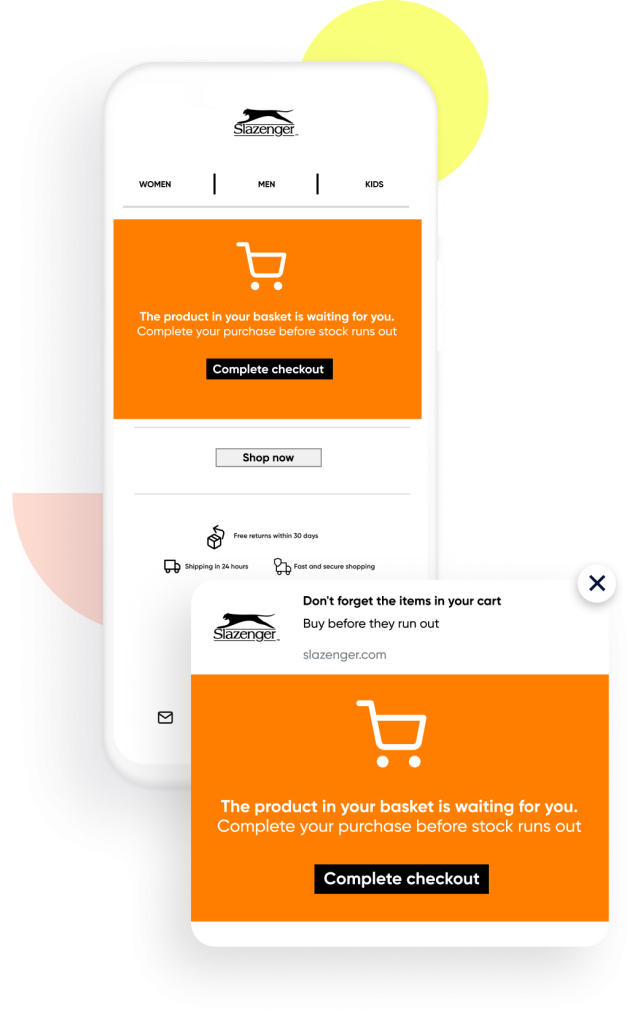
Slazenger achieved 49X return on investment in eight weeks using Insider One’s omnichannel marketing solution, a result that came from connecting behavioral triggers to personalized messaging across channels rather than running campaigns in isolation.
AI-powered optimization and SMS fallback close the reach gap
Not every customer’s device supports RCS. The practical answer is channel-preference scoring and automatic SMS fallback, so customers on unsupported devices receive a standard SMS version of the same campaign without requiring a duplicate workflow.
AI-powered journey orchestration, such as Insider One’s Journey Orchestration tools, handles this routing automatically, using send-time optimization and channel-preference data to determine when and how each customer receives the message.
For retention teams managing large segments across retail, fintech, and travel, that automation removes the operational overhead that makes scaling RCS feel like a manual lift.
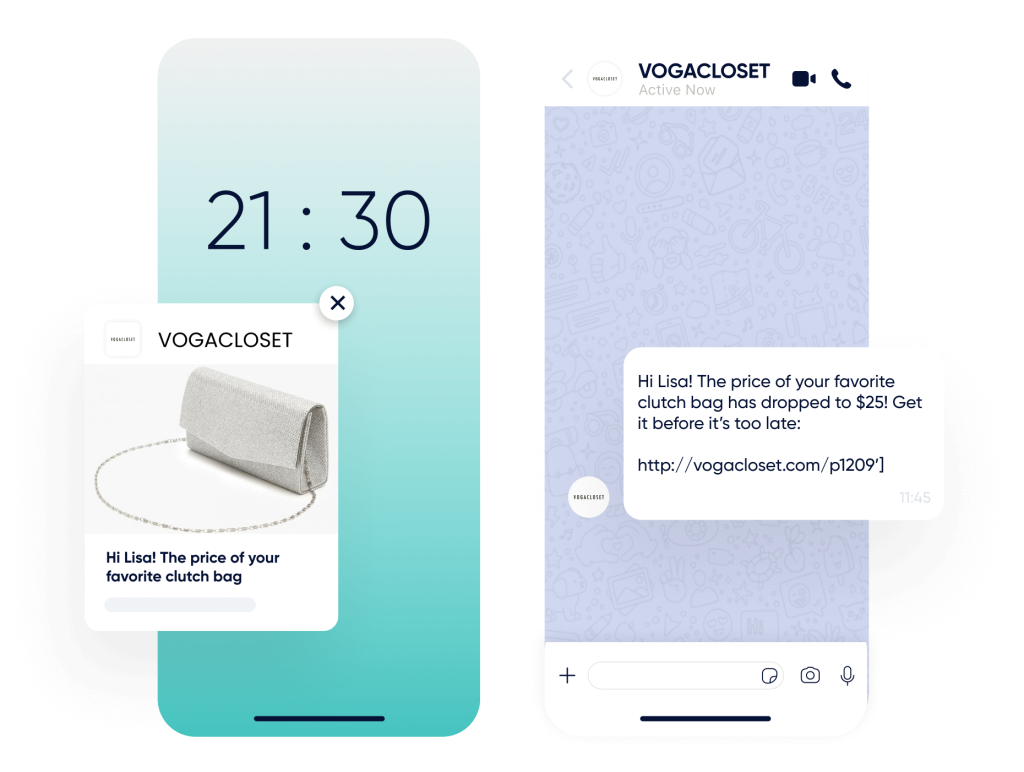
Vogacloset achieved 30X return on investment using Insider One’s unified customer profiles and personalized messaging, demonstrating how connected data and automated orchestration produce compounding retention value over time.
If you want to see how Insider One’s Customer Data Management, Architect, and AI personalization turn live customer data into coordinated, revenue-driving experiences, book a personalized demo to see the exact use cases, decision logic, and growth levers most relevant to your team.
Frequently asked questions
RCS availability depends on device hardware, operating system, and carrier support. Android devices support RCS broadly through Google Messages, and iOS added RCS support in 2024, expanding reach significantly.
For customers on unsupported devices or networks, SMS fallback ensures your campaign still delivers, so reach gaps are manageable with the right platform configuration.
SMS personalization is largely text-based: a name in the message, a product name in the copy.
RCS personalization can include a customer’s specific purchased products in a visual carousel, a loyalty balance displayed dynamically in the message, quick-reply options tailored to their last interaction, and product recommendations built from their browsing and purchase history. The format expands what personalization can do because the message itself has more surface area to work with.
Running RCS as a standalone channel alongside disconnected SMS and email tools creates the same data-silo problem that undermines most retention programs.
The most effective RCS retention setup routes all channels through a single omnichannel personalization and orchestration platform, so behavioral triggers, customer profiles, and campaign logic are shared across every channel rather than duplicated. That’s where the retention lift becomes compounding rather than marginal.
RCS campaigns are subject to the same opt-in and consent requirements as SMS in most markets, including the Telephone Consumer Protection Act (TCPA) in the United States and the General Data Protection Regulation (GDPR) in Europe.
Carrier-level authentication and verified sender badges help with deliverability and trust, but they don’t replace consent management. Your RCS program needs an explicit opt-in flow and a clear opt-out mechanism, just as your SMS program does.

Keep Reading
7 min.

Muharrem Derinkok
4 Jun 2026
11 min.

Chris Baldwin
2 Jun 2026
4 min.
Chris Baldwin
3 Feb 2026