

 Platform Overview

 Integration Hub

 Insider One AI™

 Customer Data Management

 Personalization

 Journey Orchestration

 Reporting & Data

 Behavioral Analytics

 Web
Web

 Email
Email

 Site Search

 Conversational CX

 WhatsApp

 Web Push

 InStory

 App
App

 SMS & RCS

 Join the $0 Migration Movement™

 The Insider One Difference

 Compare Vendors

 Switch to Insider One

 Success Story

 Retail & Ecommerce

 Financial Services

 Travel & Hospitality

 Beauty & Cosmetics

 Automotive

 Telecommunications

 Total Economic Impact™ Study

 Blog
Blog

 E-Books & Guides

 Glossary
Email Subject Line Best Practices to Boost Open Rates in 2026

Updated on 26 Jun 2026
13 min.
Table of Contents
- The high-stakes role of email subject lines
- What makes an email subject line high-performing in 2026
- Proven subject line formats and when to use them
- Subject line strategies by industry
- 12 email subject line best practices to maximize open rates
- 1. Incorporate personalization
- 2. Inspire trust and confidence
- 3. Create a curiosity gap
- 4. Tap into urgency or scarcity
- 5. Use emojis strategically
- 6. Focus on offering value
- 7. Write thoughtful email previews
- 8. Minimize use of punctuation
- 9. Embed power words or emotional triggers
- 10. Optimize for devices
- 11. Invest in the right tools
- 12. Test, test, test
- Signed, sealed, and delivered
- FAQs
Most Popular
Your subject line is the moment of truth for every email you send. It’s the first thing people see, and often the only thing they use to decide whether your message is worth their time.
Data makes this even clearer. Average open rates sit around 21%, which means a majority of emails still go unopened. At the same time, 69% report emails as spam for that very reason. One line can pull someone in or push them away.
Getting this right is even harder in 2026. Gmail categories sort email before users even see them. Most people scan on mobile, where only a few words are visible. That’s why vague or generic subject lines no longer hold up. Relevance has to be obvious, instantly.
In this article, we’ll break down email subject line best practices, formats that consistently perform, and practical ways to improve your open rates.
The high-stakes role of email subject lines
Subject lines are the first filter in a crowded inbox, driving quick decisions on what users open or ignore. They directly influence deliverability, ROI, and engagement. Here’s why email subject lines matter.
Inbox overload is real
The average professional now handles 100+ emails a day, and most are never fully read. People skim subject lines in seconds, often on mobile, where only 30-40 characters are visible. Research shows that subject line length and structure directly affect whether an email even gets noticed. Short and clear email subject lines with 6-10 words consistently drive higher opens, reinforcing that the subject line is the first and most important filter in a crowded inbox.
Subject lines directly influence revenue
Subject lines shape both curiosity and outcomes. In 2025, emails with personalized subject lines saw open rates as high as 46%, compared to 18-35% for generic ones. That lift doesn’t stop at the open. Behavior-triggered emails, often paired with highly relevant subject lines, deliver up to 3x more revenue than batch campaigns. When the subject line aligns with intent, it improves not just visibility but clicks, conversions, and revenue efficiency.
Inboxes reward relevance and punish shortcuts
AI-powered inboxes like Gmail’s categories, Outlook’s Focused Inbox, and Apple’s Mail Privacy Protection actively decide what gets seen. With over 361 billion emails sent daily, filtering is aggressive by design. Generic messaging struggles in this environment. However, segmented campaigns get up to 14% higher open rates than broad sends. Plus, modern inboxes reward clear, relevant emails over ones with vague or gimmicky subject lines.
Weak subject lines waste everything that follows
Even well-crafted emails fail if they aren’t opened. The average open rate across industries sits around 21%, meaning nearly 4 out of 5 emails go unseen. This gap represents lost reach, wasted spend, and missed conversions. Over time, low engagement signals also hurt sender reputation, making it difficult for future campaigns to land in the inbox. A weak subject line doesn’t just underperform once. It compounds into long-term issues with deliverability and performance.
Now, let’s unpack the building blocks of subject lines that drive opens and engagement.
What makes an email subject line high-performing in 2026
High-performing subject lines are clear, concise, and instantly relevant. They balance context, authenticity, and emotional pull to drive opens while maintaining trust and deliverability.
Clarity first
A high-performing subject line tells the reader what the email is about without making them work for it. In fact, 34% of users look at the subject line first before opening an email. Clear language lowers friction and helps the email feel worth opening right away. Use specific nouns, concrete outcomes, or direct next steps.
Brevity matters
Short subject lines still have an edge, but the real lesson is efficient wording. A study found that the average subject line length is 6 words, and the best-performing ones are even shorter at 2-4 words. Another study shows that email subject lines with 7 words drive roughly 30% open rates. Consider writing the core idea first, keeping the strongest words up front, and letting the preview text carry the second half of the message.
Relevance is everything
Relevance decides whether someone opens your email or ignores it. Gmail automatically places messages into tabs like Promotions and Updates, while Outlook splits mail into Focused and Other. That’s why it’s important to use subject lines that reflect recent behavior, lifecycle stage, or known interest. A research study shows that journey-based emails reach a 26% open rate and perform 2.89x better than broadcast emails. Insider One’s predictive lifecycle segments make this targeting directly actionable, automatically classifying customers by stage so marketers can match subject line messaging to where each person is in their journey, without manual list-building.
Authenticity builds trust
A strong subject line makes a promise the email actually keeps. Today, spam filters review everything from subject lines to formatting, and more compelling, personalized emails can improve deliverability. A recent study shows how strict inbox placement can be, with Microsoft mailboxes averaging just 75.6% inbox placement. Avoid fake urgency, bait-y curiosity, or misleading offers.
Personalization for connection
Industry data shows that most brands still rely on first-name personalization alone, a tactic that has become table stakes rather than a differentiator. The more impactful opportunity lies in personalizing around behavior, product interest, lifecycle stage, and predicted intent. This requires connecting subject line decisions to a richer data layer than most email tools provide on their own.
Emotional impact
The best subject lines do more than inform. They create just enough feeling to make someone click. Across studies, the emotional patterns that keep showing up are curiosity, urgency, scarcity, credibility, and direct value, but only when they feel honest. So instead of pushing drama, attach emotion to something real: a deadline, a benefit, a question, or a problem the email will solve.
Proven subject line formats and when to use them
Not all subject lines work the same way. The format you choose should match your goal, audience, and where the user is in their journey. Behavior-driven, value-led, and urgency-based subject lines consistently outperform generic ones because they align with intent and timing.
Here are a few proven email subject line formats and when to use each.
- Fear of missing out (FOMO): Creates urgency by highlighting scarcity or deadlines. Time-bound language can lift conversions in promotional campaigns, especially in retail and events. Use this when there’s a real deadline or limited inventory.
- Teasers: Spark curiosity by hinting at value without fully revealing it. These work well for newsletters, launches, and content-driven emails where the goal is discovery. Keep it specific enough to feel relevant.
- Funny: Humor increases recall and helps your email stand out in crowded inboxes. It works best for B2C or brand-led communication where tone allows flexibility.
- Benefit-driven: Lead with a clear outcome or value. This format performs consistently in B2B and SaaS because it answers ‘what’s in it for me’. Use numbers, outcomes, or timelines to make the benefit tangible.
- Retargeting-based: Tie emails to user behavior like abandoned carts, viewed pages, or incomplete actions. These emails often see higher open and conversion rates because they feel timely and relevant.
- Social proof: Build trust by showing others are already using or benefiting from your product. These email subject lines work especially well in SaaS, apps, and communities where credibility matters.
- Story-driven: These subject lines open a loop by starting a narrative. They work well for newsletters, founder stories, or case studies where engagement matters more than immediate clicks. Make the story feel personal and grounded.
- Question-based: Prompt the reader to reflect on a problem or need. This format works across industries because it pulls readers into the conversation. Keep the question specific and tied to a real pain point.
- Shock value: Use a contrarian or surprising statement to grab attention. These email subject lines can work well in crowded niches but need restraint. If it feels like clickbait, it can hurt trust and long-term engagement.
Matching the format to intent is key to engaging users. A flash sale leans on urgency, while a SaaS nurture email may perform better with benefits or social proof.
Subject line strategies by industry
While the underlying principles are consistent, the highest-performing subject line strategies differ by vertical. Here are examples of how behavior-driven personalization plays out across key industries.
Retail and eCommerce: Urgency and inventory signals drive strong performance. Subject lines tied to cart abandonment, price drops, or back-in-stock alerts consistently outperform broadcast promotions because they reflect a real, recent action. Example: “The item in your cart just dropped in price.”
Travel: Time-sensitivity is the natural lever. Subject lines that reference a destination the customer previously searched, paired with fare or availability signals, create relevance that generic promotional emails can’t match. Example: “Prices just changed for your Barcelona trip.”
Finance and insurance: Trust and clarity outperform urgency. Subject lines that are direct, jargon-free, and specific to the customer’s account or product stage tend to drive stronger engagement in regulated categories. Example: “Your renewal summary is ready to review.”
Beauty and lifestyle: Affinity and loyalty signals work well. Subject lines referencing a customer’s known product preferences, past purchases, or loyalty tier feel personal without being intrusive. Example: “Back in stock: your favorite foundation shade.”
In each case, the subject line is most effective when it reflects something true about the recipient — which depends on having unified behavioral data to draw from.
12 email subject line best practices to maximize open rates
Here are 12 email subject line best practices you can use to create meaningful lifts in opens, clicks, and revenue.
1. Incorporate personalization
Email campaigns using behavior-based triggers outperform standard campaigns in both opens and revenue. What’s changed is depth. High-performing brands use signals like browsing history, past purchases, and lifecycle stage to shape subject lines.
For example, “Still thinking about that CRM you explored?” feels specific because it is tied to a real action.
Platforms like Insider One make this possible by unifying behavioral signals, browsing history, purchase data, app activity, and in-store interactions into a single customer profile. Rather than relying on disconnected data sources, marketers can trigger subject lines based on a complete, real-time view of each individual. Insider One’s predictive segments go further, using AI to identify lifecycle stage, purchase propensity, and churn likelihood, so subject lines can be tailored not just to what someone did, but to where they are in their journey.
How to use it: Focus on contextual personalization, reference actions, and trigger emails based on behavior.
2. Inspire trust and confidence
Trust directly impacts whether your email even lands in the inbox. Credibility signals matter even more now since inbox placement rates vary widely across providers. Subject lines that feel exaggerated or inconsistent with your brand voice raise red flags for both users and spam filters.
How to use it: Keep the tone consistent. Avoid all caps and aggressive language. Use a recognizable sender name and domain so users build familiarity over time.
3. Create a curiosity gap
Curiosity still works, but only when it’s grounded in value. Email subject lines that hint at a benefit without fully revealing it tend to outperform fully explicit ones in content-driven campaigns.
For example, “The one growth lever most teams ignore” works because it opens a loop.
How to use it: Leave a gap, but anchor it in relevance. Pair intrigue with a clear outcome so it doesn’t feel like clickbait.
4. Tap into urgency or scarcity
Urgency drives action when it’s real. Retail and event campaigns consistently show higher conversion rates when deadlines or limited availability are clearly stated. However, overuse reduces impact. If every email feels urgent, none of them are.
How to use it: Use urgency sparingly. Tie it to real constraints like time, inventory, or access. Make deadlines specific.
5. Use emojis strategically
Emojis can improve visibility in crowded inboxes, especially on mobile. They can lift open rates in some contexts, but performance depends heavily on audience and industry.
How to use it: Use one relevant emoji at most. Match it to context (🚚 for delivery, 🎉 for offers). Always test performance across devices.
6. Focus on offering value
Users open emails when the value is clear upfront. Benefit-led subject lines outperform feature-led ones, especially in B2B and SaaS.
For example, “Save 5 hours a week on reporting” works because it speaks to a real outcome.
How to use it: Lead with the benefit. Tie it to time saved, money earned, or problems solved. Avoid generic product announcements.
7. Write thoughtful email previews
Subject lines don’t work alone. The preview text plays a critical role in reinforcing the message. Research shows that combining subject lines with complementary preview text improves engagement significantly. Yet many brands waste this space by repeating the same words.
How to use it: Use the preview to expand the story. Add context, detail, or a second hook that supports the subject line.
8. Minimize use of punctuation
Excessive punctuation is often associated with spam. Modern filters evaluate patterns, and overuse of symbols like !!! can hurt deliverability and credibility. Clean subject lines tend to perform better because they feel more trustworthy.
How to use it: Stick to minimal punctuation. Use it only when it adds meaning. Let clarity and wording carry the impact.
9. Embed power words or emotional triggers
Words that trigger emotion or action still play a strong role in performance. Studies show that urgency, exclusivity, and curiosity-driven language can improve open rates when used correctly. But overuse weakens the effect.
How to use it: Choose words that match intent. Use urgency for deadlines, curiosity for content, and reassurance for trust-building emails.
10. Optimize for devices
A majority of emails are opened on mobile devices, where subject lines are truncated quickly. If key information is buried at the end, it may never be seen.
How to use it: Front-load important words. Keep subject lines concise. Test how they appear across devices and inboxes.
11. Invest in the right tools
Modern email marketing relies on data, AI, and the ability to act on both at speed. The right platform removes guesswork from subject line decisions and replaces it with a repeatable, data-driven process.
Insider One is built for exactly this. Its AI capability – Insider One AI, can generate subject line variants based on campaign goals, audience segment, and brand tone, reducing the time spent on manual copywriting while increasing the range of ideas tested. From there, Insider One’s native A/B and multivariate testing tools let you run experiments directly within the platform and surface statistically significant winners without switching tools.
Send Time Optimization goes beyond segment-level averages. Insider One calculates the optimal send time for each individual recipient based on their personal engagement history, improving the chances that your subject line lands when attention is highest.
All of this connects back to Insider One’s Actionable CDP and the Golden Profile it builds, a single deduplicated record of each customer’s behavioral, transactional, and channel data. Because subject line personalization in Insider One draws on cross-channel behavioral data, not just email history, the relevance of each message reflects a fuller picture of the customer. That’s what separates surface-level personalization from the kind that drives measurable lifts in open rates and revenue.
How to use it: Use Insider One AI to generate and test subject line variants at scale. Let Send Time Optimization handle delivery timing per individual. Use Insider One’s predictive segments to match subject line strategy to lifecycle stage, not just list membership.
12. Test, test, test
Even strong subject lines perform differently across audiences. A/B testing remains one of the most reliable ways to improve results. Brands that test consistently see measurable lifts in open rates and engagement over time.
Insider One’s built-in A/B and multivariate testing lets you run subject line experiments without leaving the platform. You can test length, tone, emoji use, personalization tokens, or entirely different framings simultaneously, and Insider One’s Auto-Winner Selection, built into Architect, automatically routes traffic to the winning variant once statistical confidence is reached, no manual intervention required. For teams running high send volumes, this removes the manual overhead of interpreting results and re-segmenting lists.
The common thread across all these practices is simple: relevance, clarity, and trust drive performance. The more your subject lines align with real user intent, the more consistently they deliver results.
How to use it: Test one variable at a time. Compare length, tone, personalization, or emoji use. Scale only after reaching statistical confidence.
Signed, sealed, and delivered
Subject lines still carry disproportionate weight in email performance. Average open rates across industries sit around 21%, meaning nearly 4 in 5 emails go unopened, and the subject line is often the only thing standing between your message and the trash. That gap is where subject lines matter most.
What consistently works is a combination of relevance, trust, and clarity, supported by continuous testing. Personalization tied to behavior drives stronger engagement. At the same time, misleading or generic subject lines hurt both opens and long-term deliverability.
The shift ahead is toward AI-driven optimization. Platforms now use predictive models to test, score, and personalize subject lines in real time based on user signals.
If you want to move beyond guesswork, Insider One turns subject line decisions into a data-driven process. Insider One AI generates and scores subject line variants based on your audience and goals. Send Time Optimization calculates the optimal send window per individual contact based on their personal engagement history — not segment-level averages, ensuring your subject line lands when attention is highest. And because Insider One’s personalization draws on a Unified Customer Profile built from cross-channel behavioral data, the relevance of every subject line reflects a complete picture of the customer, not just their last email click.
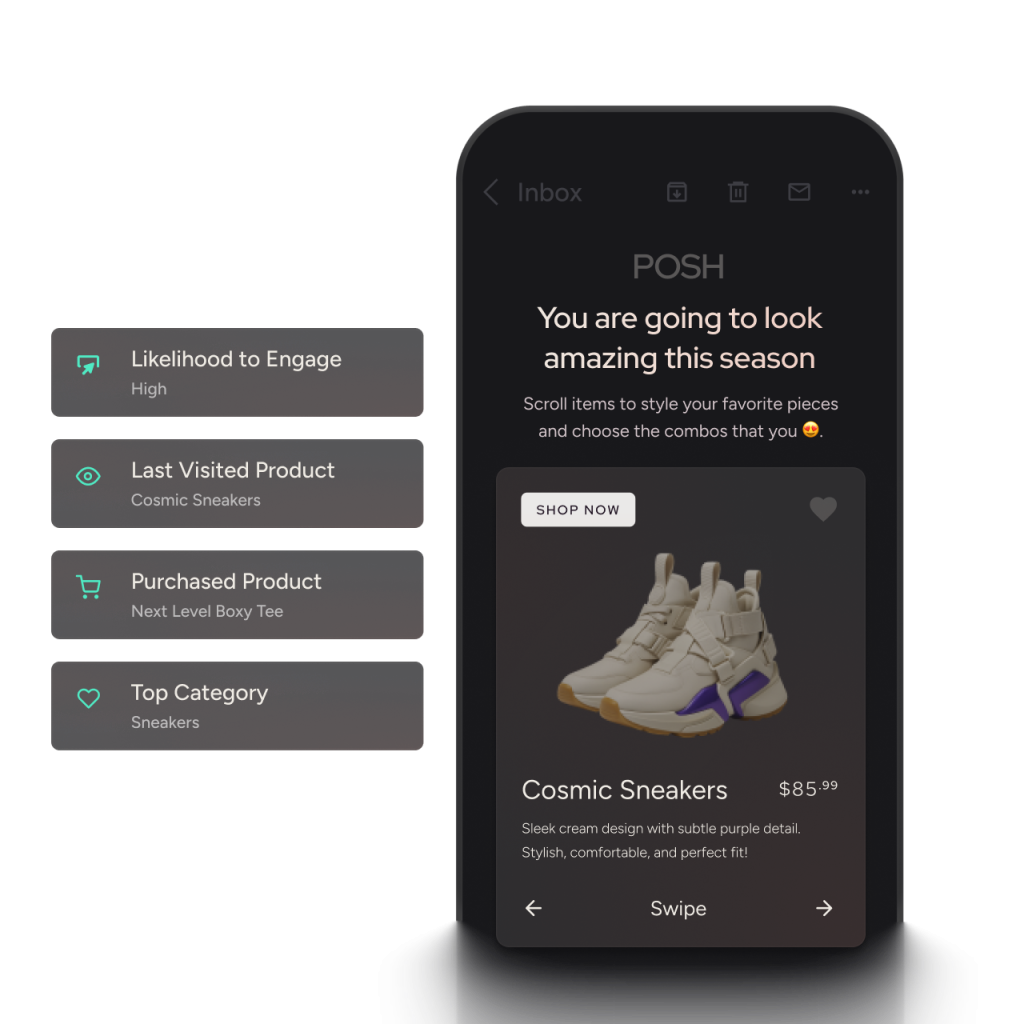
For teams evaluating platforms, Insider One’s combination of AI-generated content, predictive segmentation, and native testing tools means subject line optimization is built into the workflow rather than bolted on as an afterthought.
FAQs
The ideal subject line is typically 6-10 words or around 30-45 characters. This length ensures it remains fully visible on most mobile devices while still conveying enough value to prompt an open.
You should test email subject lines in every campaign because performance varies based on audience, timing, and context. In addition, it’s useful to run broader tests on tone, format, and personalization strategies every quarter to identify patterns that consistently improve results over time.
Emojis can improve open rates when they are relevant and aligned with the message, as they help subject lines stand out in crowded inboxes. However, overusing them or using emojis that don’t match the context can reduce trust and make the email feel less professional.

Keep Reading
7 min.

Muharrem Derinkok
4 Jun 2026
11 min.

Chris Baldwin
2 Jun 2026
4 min.
Chris Baldwin
3 Feb 2026