

 Platform Overview

 Integration Hub

 Agent One™

 Agent One™ Teams

 Customer Data Management

 Personalization

 Journey Orchestration

 Reporting & Data

 Behavioral Analytics

 Web
Web

 Email
Email

 Site Search

 Conversational CX

 WhatsApp

 Web Push

 InStory

 App
App

 SMS & RCS

 Join the $0 Migration Movement™

 The Insider One Difference

 Compare Vendors

 Switch to Insider One

 Success Story

 Retail & Ecommerce

 Financial Services

 Travel & Hospitality

 Beauty & Cosmetics

 Automotive

 Telecommunications

 Total Economic Impact™ Study

 Blog
Blog

 E-Books & Guides

 Events

 Glossary
Top 5 AI Tools for Marketing Campaign Automation in 2026

Updated on 7 Oct 2026
9 min.
Table of Contents
- Top 5 AI Tools for Marketing Campaign Automation
- 1. Insider One: AI-Driven Campaign Automation with Predictive Personalization
- 2. HubSpot AI: Automated Workflows with AI-Powered Segmentation and Content
- 3. Adobe Marketo Engage: Predictive Campaigns, Lead Scoring, AI-Powered Triggers
- 4. Salesforce Agentforce Marketing: Personalized Multichannel Automation with Predictive Insights
- 5. Braze: Real-Time AI Automation for Cross-Channel Marketing Campaigns
- Benefits of Using AI for Marketing Campaign Automation
- Tips for Choosing the Right AI Marketing Automation Tools
- Key Trends in Marketing Campaign Automation 2026
- Final Takeaways: Harnessing AI for Smarter Marketing Campaigns
- FAQs
Most Popular
Marketing teams in 2026 face higher expectations and greater operational demands than ever before. Buyers expect brands to know who they are, anticipate what they need, and reach them at the right moment. And at the same time, campaigns have grown more complex with more data, more channels, and less margin for error.
AI helps make it possible to keep up, and the business case for AI is no longer theoretical; companies using AI-driven marketing automation often report higher revenue, more leads, and stronger conversion rates compared with manual approaches.
The benefits are consistent across teams that make the switch: greater efficiency from automating repetitive tasks, sharper predictive targeting that identifies the right audiences before a campaign launches, and personalization at scale that would be impossible to achieve manually.
This article covers five leading tools for AI-driven marketing automation in 2026: Insider One, HubSpot AI, Adobe Marketo Engage, Salesforce Agentforce Marketing, and Braze. You’ll learn what each tool can do for your workflow, targeting, and ROI.
Why AI Is Transforming Marketing Campaign Automation
AI-powered marketing automation does four things that manual or rule-based systems can’t:
- Uses predictive segmentation to identify who is most likely to convert or churn.
- Dynamically personalizes content and offers for each user in real time.
- Executes campaigns simultaneously across email, SMS, push, web, and more without separate manual workflows.
- Runs lifecycle journeys (abandonment, onboarding, re-engagement, etc.) automatically and around the clock.
These capabilities drive measurable improvements across the metrics that matter most: smarter segmentation and personalization lift engagement, predictive targeting improves conversion rates and ROI, and automated workflows drive scalability.
The results that Insider One customers have achieved help illustrate what’s possible:
- Slazenger used automated cross-channel journeys (email, web push, SMS) and AI segmentation to achieve a 49x ROI in eight weeks and 30% productivity gains through AI-powered journey creation and optimization
- Flyadeal used predictive audiences and real-time segmentation to tailor website experiences, email and web push journeys, and WhatsApp campaigns. This strategy achieved a 378x ROI and a 30% increase in conversion rate by delivering the right content at the right time.
- MAC Cosmetics used AI-powered personalization and gamification tools to generate 17.2x ROI and 53,000 new leads in two days, increase conversion rates by up to 4.78%, and grow average order value by 7.28%.
Top 5 AI Tools for Marketing Campaign Automation
1. Insider One: AI-Driven Campaign Automation with Predictive Personalization
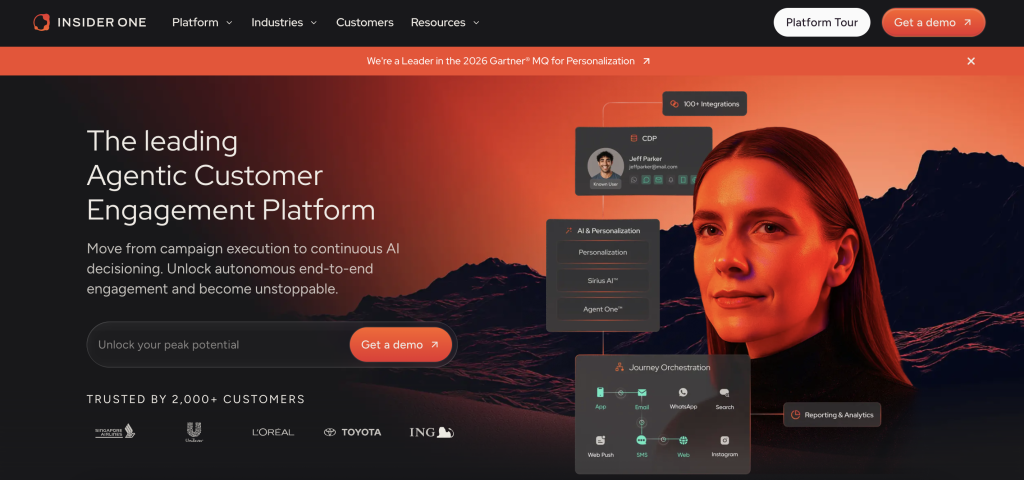
Insider One is an AI-native customer engagement platform with an integrated customer data platform (CDP), built for mid-market to enterprise brands. It unifies CDP, AI-powered personalization, journey orchestration, and cross-channel execution in a single platform to reduce the complexity of fragmented martech stacks and help teams move faster.
Key Features: Predictive segmentation based on behavioral signals and purchase likelihood; real-time personalization across email, SMS, web push, in-app, WhatsApp, and more; Architect for designing complex lifecycle journeys; Agent One™, purpose-built agentic AI including Shopping Agent, Support Agent, and Insights Agent for autonomous customer engagement; and built-in reporting tied directly to revenue outcomes.
Use Cases: Any brand managing multi-segment, multi-channel customer journeys at scale, including those in the e-commerce, travel and hospitality, retail, and financial services industries.
Unique Selling Point: The only platform in this comparison with a native CDP, AI-powered journey orchestration (Architect), and agentic AI (Agent One™) in a single integrated stack, eliminating the data fragmentation and integration overhead that affects all four competitors listed here.
Limitation: Insider One is designed for brands with growing data and channel complexity, so very small teams with simple use cases may find its full capabilities more than they need today.
Pricing: MTU-based pricing with no hidden charges for data, storage, or duplicated events. Contact Insider One for a demo or product tour.
Recognition: Leader in the 2026 Gartner Peer Insights™ Customers’ Choice for Personalization Engines; recognized in the Forrester Wave™ for Cross-Channel Campaign Management; and named a Leader in the IDC MarketScape for Worldwide AI-Enabled Marketing Platforms for Enterprise Companies 2025.
2. HubSpot AI: Automated Workflows with AI-Powered Segmentation and Content
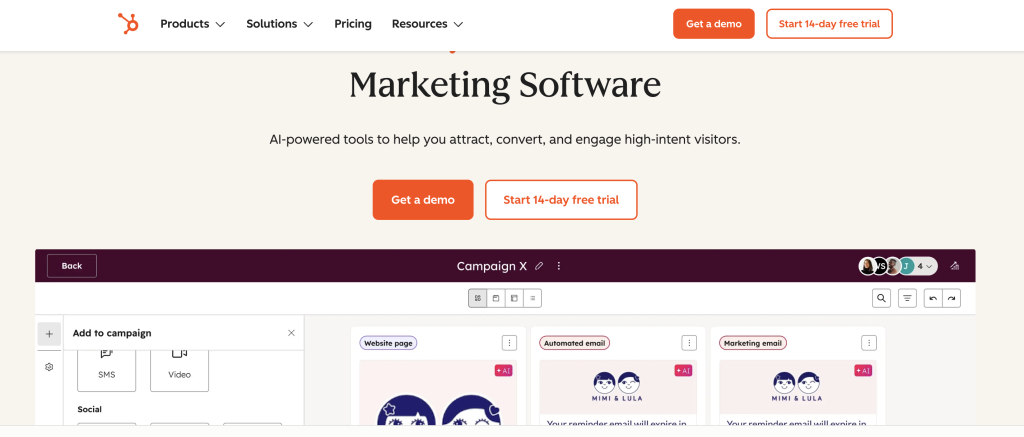
HubSpot’s AI layer, Breeze, is embedded throughout Marketing Hub, bringing AI-driven capabilities to a widely used marketing automation platform.
Key Features: Breeze Copilot uses CRM data to generate content, research contacts, and summarize records. Breeze Agents automate content creation, social media, and prospecting. For marketers, Breeze enables AI-powered lead scoring, lookalike audience building, send-time optimization, and email personalization at scale.
Use Cases: Inbound marketing teams, SMB and mid-market B2B organizations, and revenue teams wanting marketing, sales, and service unified in one platform.
Unique Selling Point: Breeze draws on your actual CRM data rather than generic templates, making recommendations more relevant than standalone AI tools. Some analyses estimate that HubSpot leads the marketing automation category with a significant share of the market, reflecting its broad adoption among B2B and SMB teams.
Limitation: Teams outside the HubSpot ecosystem won’t benefit from the deep integrations Breeze relies on.
Pricing: Free tools available. Monthly fees range from $20 up to $3,600 (for Enterprise).
3. Adobe Marketo Engage: Predictive Campaigns, Lead Scoring, AI-Powered Triggers
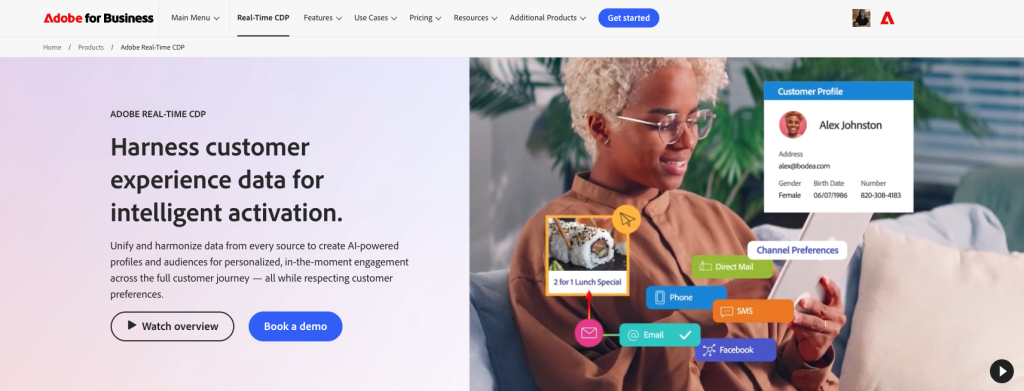
Adobe Marketo Engage is a comprehensive AI-powered marketing automation platform built for mid-market to enterprise B2B organizations.
Key Features: AI-driven predictive lead scoring, journey orchestration, dynamic content personalization, and Dynamic Chat. Multi-touch revenue attribution via Marketo Measure ties marketing activity directly to the pipeline.
Use Cases: Enterprise B2B teams managing complex buyer journeys, organizations running ABM strategies, and regulated industries like healthcare and financial services.
Unique Selling Point: Strong ABM capabilities and deep integration with both Salesforce CRM and the Adobe Experience Cloud.
Limitation: Marketo has a steep learning curve and typically requires a dedicated marketing operations team member to run effectively.
Pricing: Custom pricing with four different packages, each based on database size.
4. Salesforce Agentforce Marketing: Personalized Multichannel Automation with Predictive Insights
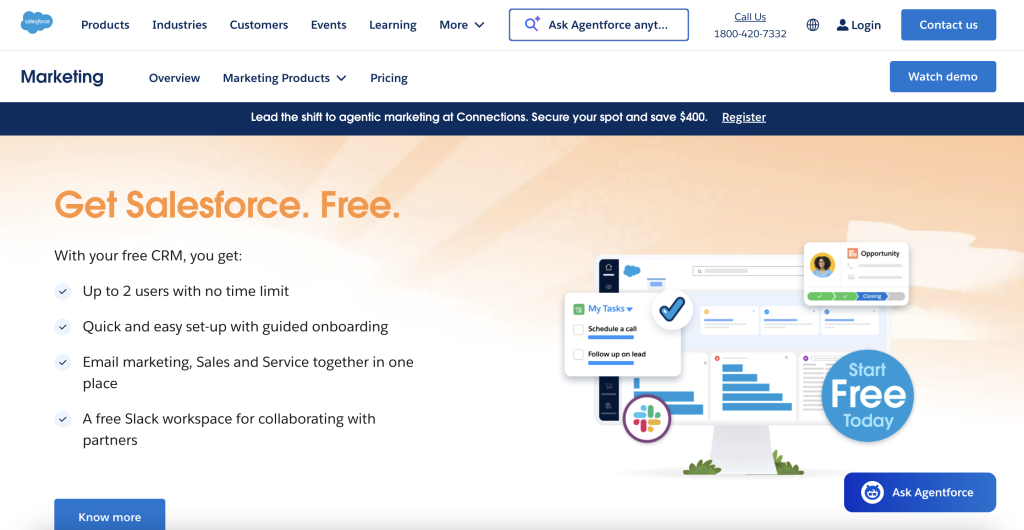
Salesforce began rebranding parts of Marketing Cloud under the Agentforce umbrella in 2025, reflecting a broader shift toward agentic AI across its platform. The tool delivers enterprise-grade multichannel automation for organizations deeply embedded in the Salesforce ecosystem.
Key Features: Einstein engagement scoring predicts likelihood to open, click, or convert; send time optimization improves deliverability; predictive audiences build smarter segments; and generative AI tools accelerate content creation across email and web. The Salesforce Data Cloud pulls customer data together across the platform to power Einstein’s predictions.
Use Cases: Large enterprises with existing Salesforce deployments running omnichannel B2C or B2B campaigns that need CRM, marketing, and service integration.
Unique Selling Point: Unmatched integration depth within the Salesforce ecosystem.
Limitation: Einstein’s effectiveness is critically dependent on data residing inside Salesforce, as external data requires significant integration overhead to activate.
Pricing: Varies greatly ($25 to $20,000+ per month), based on needs and size of team.
5. Braze: Real-Time AI Automation for Cross-Channel Marketing Campaigns
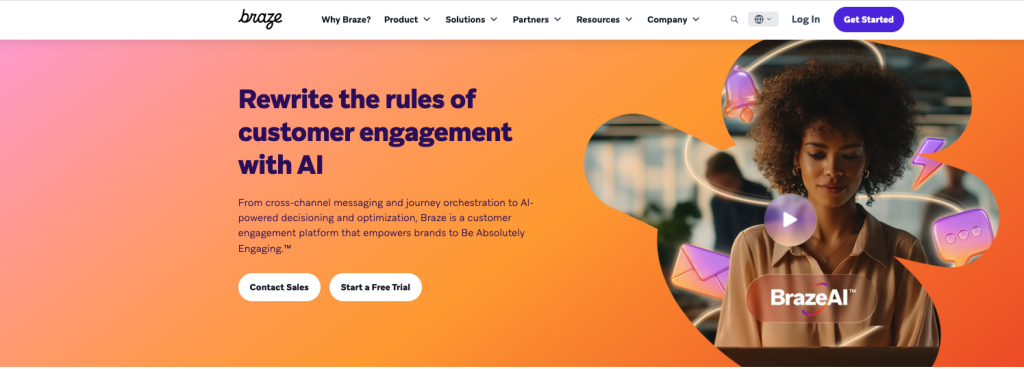
Braze is known for strong real-time data activation and acting on behavioral signals as they happen, rather than relying primarily on batch processing.
Key Features: BrazeAI combines predictive, generative, and agentic AI. BrazeAI Decisioning Studio allows teams to set a business KPI and let AI continuously test and optimize journey decisions (channel, message, offer, and timing) at the individual level without rewriting logic. Canvas Flow handles cross-channel orchestration across email, push, in-app, SMS, and WhatsApp.
Use Cases: Consumer brands in e-commerce, media, travel, and gaming; mobile-first companies; any team where real-time responsiveness to customer behavior is critical.
Unique Selling Point: Braze’s real-time data activation is genuinely differentiated; it acts on behavioral signals as they happen rather than through batch processing.
Limitation: Steep learning curve and premium pricing.
Pricing: Public pricing is not available, but investment is based on number of active users and volume of messages.
Benefits of Using AI for Marketing Campaign Automation
Efficiency and Time Savings
AI automates repetitive work for marketing teams and frees up more time for strategy and creative work. This work can include segmentation, scheduling, A/B testing, reporting, and building automated email and cross-channel campaigns. What once took days of manual setup can now run continuously in the background.
Improved Targeting and Personalization
Predictive marketing AI goes beyond demographic categorization, updating models in real time as new data comes in. This allows campaigns to feel genuinely relevant to each recipient.
Scalability
AI makes it possible to run sophisticated, individualized campaigns at enterprise scale without needing to grow headcount at the same pace.
Data-Driven Insights
Modern platforms deliver real-time analytics, predict future outcomes, and use those insights to continuously optimize campaign performance.
Higher ROI
Personalized, well-timed campaigns consistently outperform generic ones. When the right message reaches the right person at the right moment, engagement and conversion follow.
Tips for Choosing the Right AI Marketing Automation Tools
Integration: Choose tools that connect seamlessly with your existing CRM, eCommerce, analytics, and/or email platforms. For example, a tool that syncs with your Shopify or Salesforce instance ensures customer data drives AI recommendations.
Scalability: Evaluate how the platform handles growing audiences and campaign complexity without a drop in performance. Ask vendors to demonstrate performance at scale, not just at your current size.
Data Privacy and Compliance: Ensure that automation tools handling personal customer data adhere to GDPR, CCPA, and other relevant regulations.
AI Sophistication: Evaluate the prediction accuracy, personalization depth, and cross-channel capability of all AI options. Also, distinguish between generative AI (content creation), predictive AI (segmentation and scoring), and agentic AI (autonomous decision-making), not all platforms offer all three. Insider One is the only platform in this comparison with all three natively integrated. Also, make sure that the AI can recommend the right product across email, push, and in-app messaging.
Cost and ROI: Don’t just evaluate the price tag, but also think about the full picture. What’s the expected business impact? What’s the potential revenue uplift? A platform that costs more but delivers measurable ROI is often the better investment.
Testing and Validation: Run a pilot campaign, do A/B testing, or have limited rollouts before full adoption. This will help you validate the platform’s performance in your specific environment.
Performance Evaluation: Monitor AI recommendation relevance, adaptability over time, and campaign performance metrics to ensure effectiveness. The best marketing AI software improves with use.
Key Trends in Marketing Campaign Automation 2026
Several trends are shaping the next generation of marketing automation tools and might impact your choice of AI tools and how effective the tool is for your business:
- Predictive analytics has become a baseline capability, with platforms using AI to orchestrate entire omnichannel campaigns: optimizing channel sequencing, timing, and messaging for each customer.
- AI-driven content generation and messaging optimization accelerates campaign execution, allowing teams to create and test more variations with far less manual effort.
- Real-time personalization across email, SMS, push, and social is now the standard, with the most advanced platforms reacting to behavioral signals within seconds (rather than relying on batch processing).
- Integration with customer data platforms is essential for the most unified insights and makes everything else possible. A CDP that consolidates behavioral, transactional, and contextual data can help give the AI the complete picture it needs.
Final Takeaways: Harnessing AI for Smarter Marketing Campaigns
AI-driven marketing automation is no longer an early-adopter advantage; today, it is a competitive necessity. In 2026, the key decision is which AI marketing automation platform gives your team the capabilities and speed to value you need.
Each tool has a distinct profile: different strengths, trade-offs, and ideal use cases. The right choice depends on your stack, channel mix, and how quickly you need results.
If you’re looking for a platform that unifies CDP, AI personalization, and multichannel orchestration, with a proven track record of rapid, measurable ROI, Insider One is worth a close look.
FAQs
AI marketing automation uses artificial intelligence to plan, execute, and optimize marketing campaigns across channels, helping to reduce manual effort and delivering more personalized experiences at scale.
AI analyzes customer data in real time to predict behavior, personalize content, and optimize delivery, resulting in higher engagement and better ROI.
eCommerce, retail, travel, financial services, and media are among the biggest beneficiaries, though any brand managing large customer bases across multiple channels stands to gain.
The biggest benefits are efficiency, smarter targeting, personalization at scale, and measurable improvements in conversion rates and ROI.
Start by evaluating how well the tool integrates with your existing stack, how sophisticated its AI is, and whether the pricing aligns with your expected business impact.

Keep Reading
4 min.

Chris Baldwin
3 Feb 2026
8 mins.
Chris Baldwin
8 Oct 2026
8 mins.
Chris Baldwin
8 Oct 2026