

 Platform Overview


 Integration Hub


 Agent One™


 Agent One™ Teams


 Customer Data Management


 Personalization


 Journey Orchestration


 Reporting & Data


 Behavioral Analytics


 Web


 Email


 Site Search


 Conversational CX


 WhatsApp


 Web Push


 InStory


 App


 SMS & RCS


 Join the $0 Migration Movement™


 The Insider One Difference


 Compare Vendors


 Switch to Insider One


 Success Story


 Retail & Ecommerce


 Financial Services


 Travel & Hospitality


 Beauty & Cosmetics


 Automotive


 Telecommunications


 Total Economic Impact™ Study


 Blog


 E-Books & Guides


 Events


 Glossary
How to Personalize SMS Campaigns Based on Purchase History and Cart Behavior

Updated on 19 Nov 2026
15 mins.
Table of Contents
- Summary
- What is SMS personalization based on purchase history?
- Why purchase and cart data make SMS more effective
- The purchase and cart data that powers SMS personalization
- How to segment SMS audiences using purchase history
- 8 personalized SMS flows based on purchase history and cart behavior
- How to build a cart recovery SMS sequence
- How to write personalized SMS that reads naturally
- Guardrails that keep SMS personalization from feeling intrusive
- How to measure personalized SMS performance
- How Insider One helps personalize SMS with purchase and cart data
- Conclusion
- Frequently Asked Questions
Most Popular
Summary
- SMS personalization based on purchase history and cart behavior means using what a customer bought, viewed and left behind to decide who gets a text, what it says and when it arrives.
- The most useful signals are cart contents, recently viewed products, purchase recency, frequency and value, category affinity and replenishment cycles.
- Eight flows cover the main opportunities: cart abandonment, browse abandonment, price drop, back in stock, post-purchase cross-sell, replenishment, VIP early access and win-back.
- Good personalization depends on fallbacks for missing data, single-segment copy, frequency caps across flows and suppression the moment a customer buys.
- Measure personalized SMS against a holdout group, so the program is judged on incremental revenue, not on sales that would have happened anyway.
Most shoppers who add products to a cart leave without buying. Baymard Institute puts the documented average cart abandonment rate at 70.22%, based on 50 studies, in its cart abandonment research. At the same time, customers expect brands to recognize them.
In McKinsey’s Next in Personalization report, 71% of consumers said they expect personalized interactions and 76% said they get frustrated when it doesn’t happen.
Every abandoned cart is a shopper who has already picked products and stopped one step short of buying, which makes it a sales opportunity rather than a lost sale. SMS is well placed to win those sales back.
A text reaches the customer directly on their phone, and purchase and cart data give the brand a relevant reason to send it. This guide explains which data to use, how to segment SMS audiences, eight flows with sample copy, how to build a cart recovery sequence, the guardrails that keep personalization from feeling intrusive and how to measure results.
What is SMS personalization based on purchase history?
SMS personalization based on purchase history and cart behavior uses each customer’s shopping data to tailor text messages. Instead of sending the same promotion to every subscriber, the brand sends messages triggered by what a customer did, such as leaving a cart or running low on a product they buy regularly, and fills each message with details that matter to that customer, such as the product name, size or a link back to their cart.
Personalization works at three levels:
- Who receives the message: segments built from purchase and browsing behavior.
- When it arrives: triggers based on real-time actions or predicted timing, such as a replenishment date.
- What it says: dynamic fields such as product names, categories, prices and personalized links.
Why purchase and cart data make SMS more effective
Behavior-triggered texts reach customers when intent is highest. A reminder about a product the customer left in the cart an hour ago is far more relevant than a generic promotion sent to the whole list.
McKinsey’s research found that personalization typically drives a 10% to 15% revenue lift, with company-specific results ranging from 5% to 25%. Purchase and cart data make that lift possible in SMS, where a short message has to be relevant at a glance.
The purchase and cart data that powers SMS personalization
Each data point answers a different question about the customer and supports a different type of message.
| Data signal | What it shows | SMS it powers |
| Cart contents and cart value | Products the customer intended to buy | Cart abandonment reminders |
| Recently viewed products and categories | Active interest before the cart | Browse abandonment and price drop alerts |
| Wishlist and out-of-stock views | Demand for specific items | Back-in-stock alerts |
| Last purchase date (recency) | How engaged the customer is | Post-purchase and win-back messages |
| Number of orders (frequency) | Loyalty and habit | Repeat-buyer and VIP offers |
| Total and average spend (value) | Customer worth and price sensitivity | Incentive levels and VIP access |
| Category and brand affinity | What the customer prefers | Cross-sell and new arrival alerts |
| Product consumption cycle | When a consumable runs out | Replenishment reminders |
| Discount usage | Response to promotions | Whether to include an offer at all |
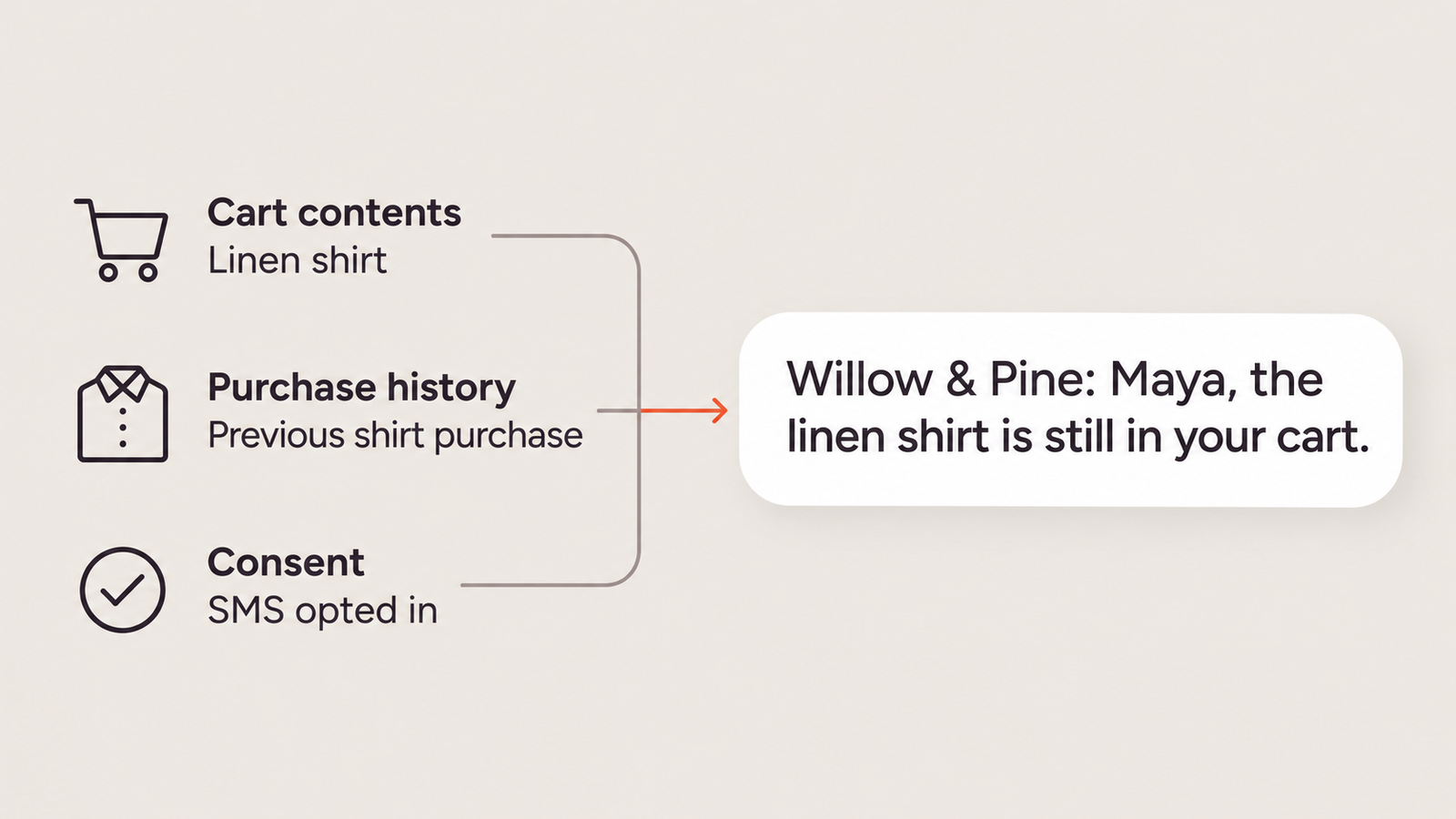
This data is only useful if it is connected and current. Purchase records from the ecommerce platform, browsing events from the site and app, and SMS consent need to sit in one profile, which is the job of customer data management. If the profile updates in real time, a customer who completes a purchase stops receiving cart reminders right away.
How to segment SMS audiences using purchase history
Segments decide who receives campaigns and which version of a flow each customer gets. A practical starting set combines recency, frequency and value with category data:
| Segment | Definition example | SMS approach |
| New buyers | First order in the last 30 days | Onboarding, product tips, second-purchase offer |
| Repeat buyers | Two or more orders in the last 6 months | New arrivals in favorite categories, loyalty updates |
| VIP customers | Top 10% by spend in the last 12 months | Early access, no-discount exclusives, service messages |
| Category loyalists | Most orders in one category | Launches and restocks in that category |
| Replenishment buyers | Repeat purchases of a consumable | Reminders timed to the usual reorder interval |
| At-risk customers | No order for longer than their usual buying gap | Personalized reminders of past favorites |
| Lapsed customers | No order in 6 to 12 months | Win-back offer, then reduce frequency if there is no response |
The thresholds depend on the business. A grocery brand might treat 30 days without an order as at risk, while a furniture retailer might use a year or more. Predictive segments, such as likelihood to purchase or churn, can replace fixed rules once enough data is available.
8 personalized SMS flows based on purchase history and cart behavior
The sample messages below use placeholders in curly brackets and are written to fit a single 160-character SMS (one GSM-7 segment) where possible. Each should end with the brand’s opt-out language where required.
1. Cart abandonment
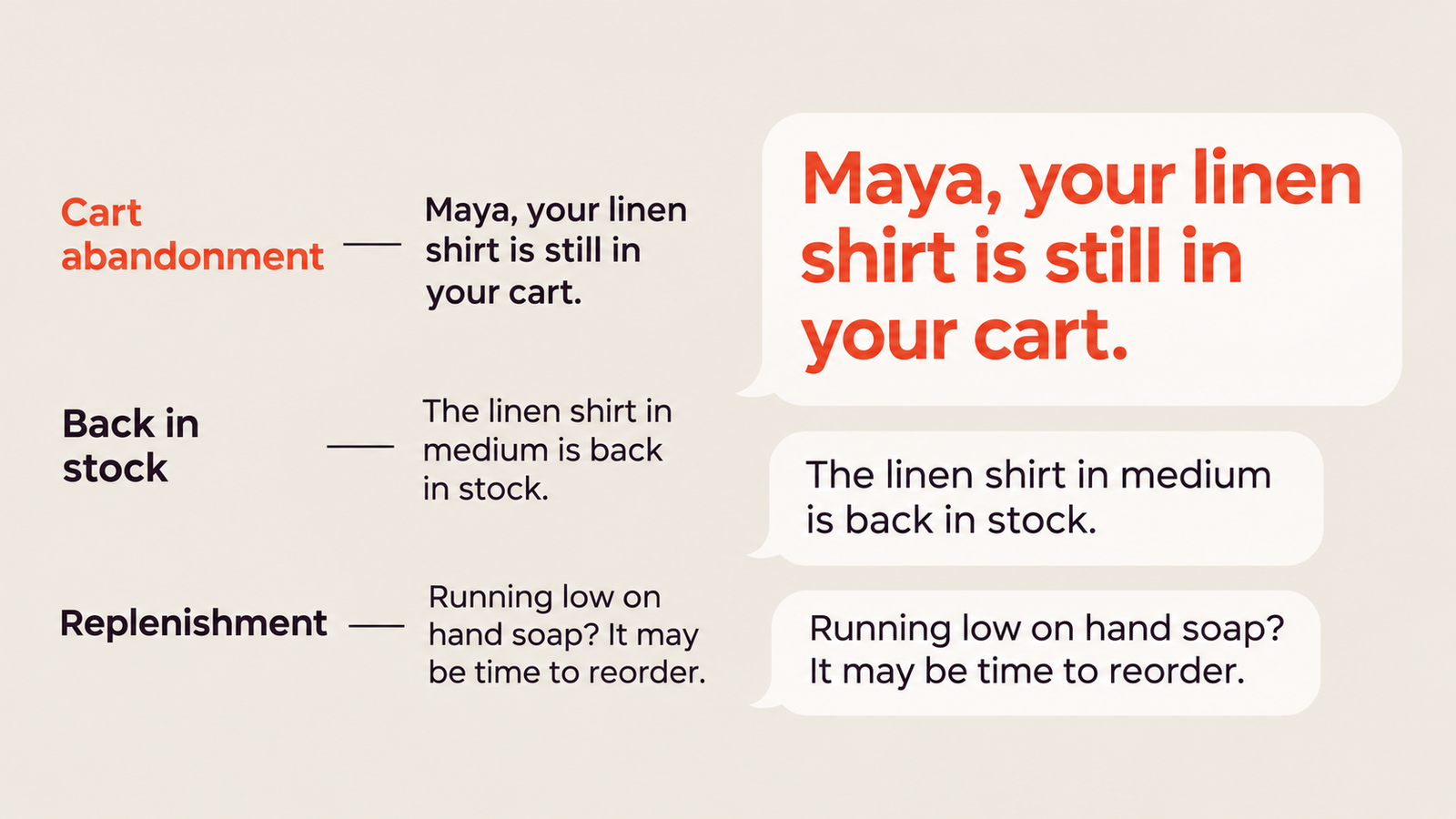
Triggered when a customer adds products to the cart and doesn’t check out. Use the product name and a direct link back to the saved cart.
Sample: “{Brand}: {first_name}, the {product_name} is still in the cart. Checkout takes a minute: {cart_link}”
2. Browse abandonment
Triggered when a known subscriber views a product or category several times without adding to cart. Keep the tone light, since intent is lower than for a cart.
Sample: “{Brand}: Still thinking about the {product_name}? Reviews and sizes here: {product_link}”
3. Price drop
Triggered when a product the customer viewed, wishlisted or left in the cart drops in price. The lower price is the reason to text, so no extra discount is needed.
Sample: “{Brand}: Good news, the {product_name} is now {new_price} (was {old_price}). See it: {product_link}”
4. Back in stock
Triggered when an item the customer viewed or requested while out of stock becomes available again. Send it quickly, since popular items can sell out again.
Sample: “{Brand}: The {product_name} in {size} is back in stock. Limited quantities: {product_link}”
5. Post-purchase cross-sell
Triggered after delivery, not straight after the order, so the customer has the product before the next suggestion arrives. Recommend items that complement the purchase.
Sample: “{Brand}: Enjoying the {purchased_product}? Customers often pair it with the {recommended_product}: {product_link}”
6. Replenishment reminder
Triggered shortly before a consumable product is likely to run out, based on product size or the customer’s own reorder interval.
Sample: “{Brand}: Time to restock {product_name}? Reorder in one tap: {reorder_link}”
7. VIP early access
Sent to top customers by spend or loyalty tier before a sale or launch. Recognition matters more than a discount for this group.
Sample: “{Brand}: {first_name}, as one of our top customers, early access to the {collection_name} starts now: {link}”
8. Win-back
Sent when a customer passes their usual buying gap without ordering. Reference a past favorite category, and add an offer only if the first message gets no response.
Sample: “{Brand}: New in {favorite_category} since the last visit, {first_name}. Take a look: {category_link}”
Insider One’s guide to SMS automation strategies covers how to set up and prioritize these flows.
How to build a cart recovery SMS sequence
Cart recovery deserves the most care, because these customers have already chosen products and shown clear intent to buy. A well-built sequence includes:
1. A clear trigger and delay: wait long enough for the customer to finish on their own, but not so long that intent fades. A practical starting point is to test a first message within a few hours, then adjust based on results.
2. Channel order: decide whether email or push goes first and when SMS steps in. Reserving SMS for higher-value carts or for customers who don’t open email keeps costs in check.
3. Incentives tied to cart value and margin: lead with the product and the link. If a second message is needed, consider free shipping or a small discount only for carts above a set value, since added costs are the most common reason for abandonment in Baymard’s research (cited by 40% of shoppers who abandoned for a reason other than browsing).
4. Immediate suppression: stop the sequence the moment the customer buys, through any channel or store.
5. A limit on reminders: limiting each abandoned cart to one or two SMS protects the subscriber list, and frequency caps across all flows stop one customer from receiving a cart, price drop and browse reminder on the same day.
How to write personalized SMS that reads naturally
Personalized fields can break a message if the data is missing or too long. A few rules prevent most problems:
- Set fallbacks for every field: if the first name is missing, drop it rather than writing “Hi there.” If a product name is missing, use the category or “the items in the cart.”
- Check length with real data: long product names can push a message into a second segment. A standard SMS holds 160 characters, but one emoji or non-Latin character switches the message to Unicode, where the limit is 70, according to Twilio.
- Shorten links: use a branded or platform short link, which saves characters and lets the brand track clicks.
- Name the brand first: customers should know who is texting from the first words.
- Use one call to action: one product or one link per message.
Insider One’s SMS vs MMS guide explains when a product image justifies sending MMS instead.
Guardrails that keep SMS personalization from feeling intrusive
Using purchase data in a channel as personal as SMS calls for care. Brands should:
- Avoid referencing sensitive purchases: health, pregnancy, intimate and similar products should not appear by name in a text that others might see on a lock screen.
- Only use data customers expect the brand to have: purchases and site activity, not inferred personal traits.
- Respect consent and quiet hours: marketing texts need opt-in consent, a clear opt-out and local-time sending. Insider One’s SMS marketing rules guide covers US requirements.
- Cap frequency across flows: personalization increases the number of possible triggers, so a shared cap matters more, not less.
How to measure personalized SMS performance
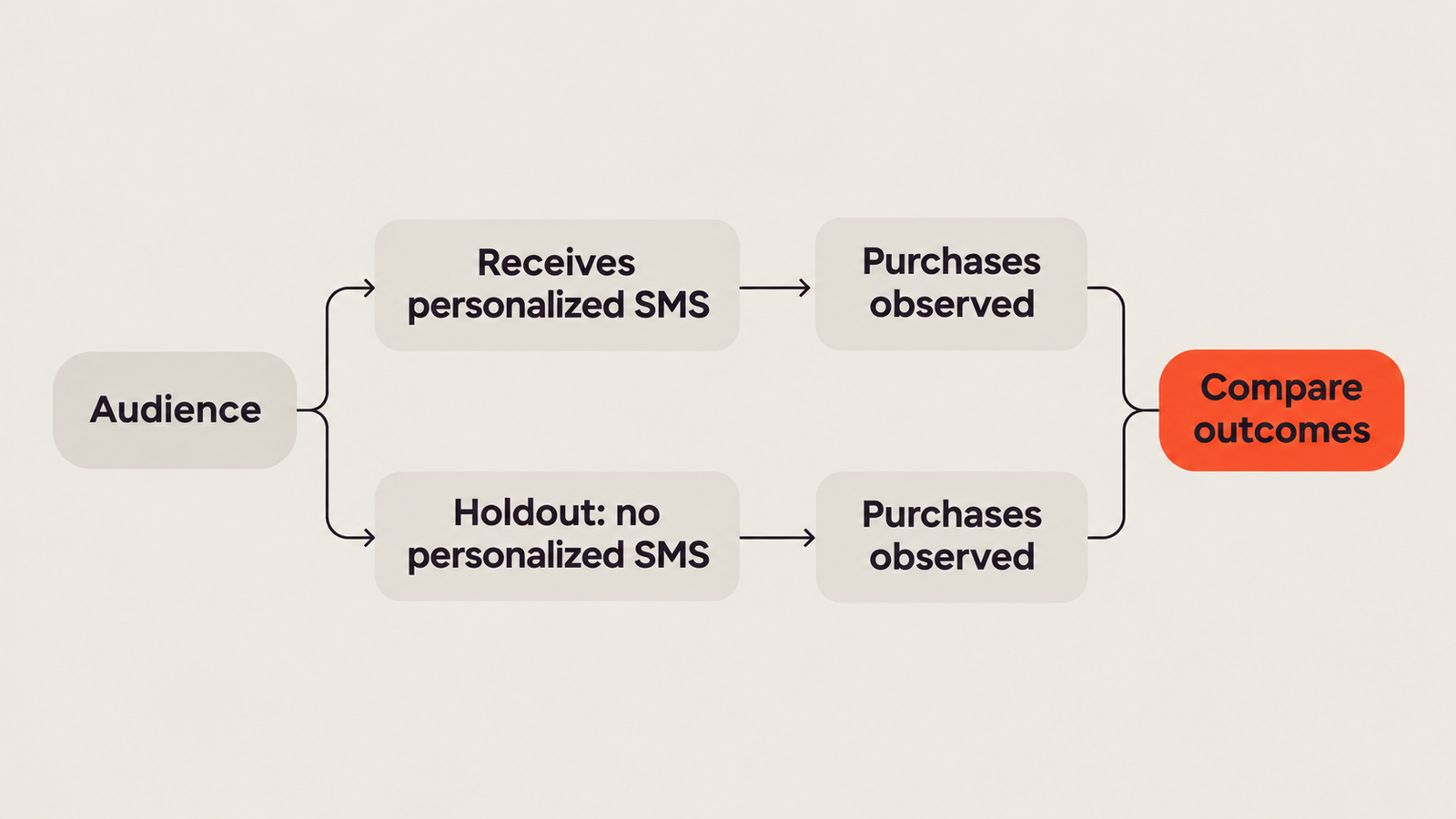
Attributed revenue overstates results, because some customers would have bought anyway. The reliable approach is a holdout: a random group of eligible customers who don’t receive the flow. The difference in revenue per customer between the two groups shows the lift the flow created. Insider One’s guide to measuring incremental lift explains the method.
Alongside lift, track for each flow:
- Click-through and conversion rate.
- Revenue per message, after SMS cost.
- Opt-out rate, as a signal of fatigue or irrelevance.
- Recovered revenue for cart flows, net of any discount given.
To test the value of personalization itself, compare a personalized version with a generic one on the same trigger, such as a cart reminder with and without the product name.
How Insider One helps personalize SMS with purchase and cart data
Insider One brings purchase, browsing and cart data together in one real-time customer profile, so every cart reminder, recommendation and win-back message works from the same up-to-date view of the customer. That profile is shared across SMS and RCS, email, push, WhatsApp and web. Key capabilities include:
- Cart Reminder SMS: an automated cart recovery message with dynamic attributes such as the last abandoned product URL, fallback values, frequency capping, silent hours, a Switch to GSM-7 option to avoid extra segments and URL shortening, as described in the Insider One Academy cart reminder guide.
- Recommendations in SMS: In Architect, Insider One’s customer journey orchestration solution, journeys can add recommended product names, categories and URLs to SMS, based on each user’s historical behavior, according to the Academy recommendations guide.
- Real-time triggers and predictive segments: journeys can start from customer actions such as adding to cart, and audiences can use predictive signals such as likelihood to purchase. Insider One’s overview of AI-powered SMS marketing covers these capabilities in more detail.
- Agent One: Agent One, Insider One’s self-optimizing intelligence system for customer engagement, brings live customer context and campaign performance into SMS to make messages, audiences, timing and journeys more relevant. Marketing teams set the outcome and choose how far Agent One works on its own, from assisted execution to full autonomy, as described on the Agent One page.
Sports brand Slazenger used Architect and its AI assistant, Journey Agent, to build a cart abandonment journey across email, web push and SMS, with SMS delivering coupon codes. A single cart abandonment campaign recovered 40% of abandoned revenue, and Slazenger reported 49X ROI within eight weeks, according to the Slazenger case study.
Conclusion
Purchase history and cart behavior give SMS its most useful triggers and its most relevant content. The brands that get the most from this data keep it in one profile, build flows around real customer actions, write copy that still reads well when a field is empty, and judge each flow by the revenue it adds against a holdout group. Done this way, SMS becomes a dependable revenue channel without overwhelming subscribers. For the wider program plan, see Insider One’s guide to SMS marketing strategy.
To see how Insider One personalizes SMS with real-time purchase and cart data, take the interactive platform tour or book a personalized demo.
Frequently Asked Questions
Connect order data to each subscriber’s profile, segment customers by recency, frequency, value and category, and trigger messages such as cross-sell, replenishment and win-back texts that reference products or categories the customer has bought.
There is no single best delay. A practical approach is to test a first reminder within a few hours of abandonment and a second within a day or two, then adjust based on conversion and opt-out rates. The sequence should stop as soon as the customer buys.
No. Leading with the product and a link to the cart gives shoppers an easy way back to checkout. Discounts are best reserved for a later message, higher-value carts or customers who have not responded, so margin isn’t given away to shoppers who would have bought anyway.
At minimum: SMS consent, phone number, cart contents and order history. Browsing events, product catalog data such as names, prices and stock levels, and loyalty status make deeper personalization possible.
Yes, for most products, since customers expect a brand to know what they bought from it. Brands should avoid naming sensitive purchases, such as health or intimate products, in messages that may appear on a lock screen.
It depends on the audience and the brand, but frequency caps should apply across all flows and campaigns combined. Rising opt-out rates are the clearest sign that volume is too high.
Yes. Platforms that support recommendations in SMS can insert a recommended product’s name and link based on each customer’s behavior. Because SMS is text only, one recommendation per message usually works best; MMS or RCS can show product images.

Keep Reading
4 min.

Chris Baldwin
3 Feb 2026
13 mins.

Nicolas Algoedt
19 Nov 2026
10 mins.
Chris Baldwin
18 Nov 2026