

 Platform Overview


 Integration Hub


 Agent One™


 Agent One™ Teams


 Customer Data Management


 Personalization


 Journey Orchestration


 Reporting & Data


 Behavioral Analytics


 Web


 Email


 Site Search


 Conversational CX


 WhatsApp


 Web Push


 InStory


 App


 SMS & RCS


 Join the $0 Migration Movement™


 The Insider One Difference


 Compare Vendors


 Switch to Insider One


 Success Story


 Retail & Ecommerce


 Financial Services


 Travel & Hospitality


 Beauty & Cosmetics


 Automotive


 Telecommunications


 Total Economic Impact™ Study


 Blog


 E-Books & Guides


 Events


 Glossary
Personalization At Scale: What It Is and How to Achieve It in 2026

Updated on 6 Oct 2026
10 min.
Table of Contents
Most Popular
Summary
- Personalization at scale uses unified data to deliver individualized experiences across channels.
- The biggest barriers are fragmented data, limited channel reach, and inconsistent measurement.
- Start with unified data, then activate across channels, add AI and automation, and measure incremental revenue.
- You can start with basic signals such as browsing, purchases, website actions, and location. Anonymous visitors can also be personalized without requiring an email.
- With third-party cookies still supported in Chrome, focus on consent and browser differences rather than a fixed deprecation deadline.
- Insider One combines CDP, AI decisioning, and native execution across web, app, email, SMS, WhatsApp, and site search.
Basic personalization is easy now. Adding a name, a birthday or a last-viewed product to an email takes minutes, and customers have stopped noticing. What they notice is an experience that stays relevant across every channel, which is a much harder problem.
This guide is for marketing, ecommerce and customer relationship management (CRM) leaders trying to move from campaign-level personalization to something that works across thousands of customers and several channels at once. You will get a definition, the real obstacles, a four-step approach, and three brand examples with the results they reported.
What is personalization at scale?
Personalization at scale is the process of using reliable data, including purchase history, on-site actions and survey responses, to deliver individualised experiences to a large number of customers across multiple channels.
You can see it across industries. Ecommerce stores such as Amazon show different products to each visitor based on browsing and purchase history. Streaming services such as Netflix recommend different titles based on what someone has watched. Brands with both digital and physical presence connect the two, so an online signal shapes an in-store experience.
When it spans online and offline channels, this is usually called omnichannel personalization, and it needs infrastructure that can unify customer data, segment and analyse audiences, and build and automate campaigns from one place.
The benefits are consistent: higher conversion rates, a more engaged customer base, and higher customer lifetime value (CLTV) and retention, because customers who feel understood come back more often.
Why is personalization at scale so hard?
Data silos. Customer data usually sits across CRMs, content management systems, channel-specific point solutions and legacy systems. Nobody has a complete view, so campaigns misfire in ways customers notice, and teams rebuild the same audience in three platforms.
Stack sprawl. Each additional platform arrives with its own interface, credentials, data model, pricing and renewal date. Beyond a certain point the stack costs more to coordinate than it returns.
Measurement. Once personalization spans several channels, attributing results gets genuinely difficult, and campaigns that cannot be measured cannot be defended in a budget review.
Worth correcting one obstacle that appears on most pages about this topic, including the previous version of this one. Third-party cookies are not disappearing from Chrome. Google confirmed in April 2025 that it will not deprecate them and will not introduce a standalone choice prompt. The signal loss is real, but it comes from Safari and Firefox defaults, consent rates and regulation, so plan for those rather than for a deprecation date.
How do you make personalization work at scale?
1) Set the foundation with unified customer data
You cannot personalize successfully without reliable customer data, and for most brands that data is scattered across disconnected systems.
The usual fix is a customer data platform, built specifically to aggregate customer data from online and offline sources into one database. Insider One includes one that ingests data from CRMs such as Salesforce, Pipedrive and Microsoft Dynamics, point solutions such as Mailchimp and ActiveCampaign, analytics and attribution platforms such as Mixpanel, Amplitude and AppsFlyer, marketing automation platforms, live chat software, and other sources through customer data integration.
It resolves identities into 360-degree customer profiles holding demographics, purchase history, channel reachability, last purchased and abandoned products, predictive characteristics such as likelihood to purchase, interactions across site, app, email, SMS and push, and survey responses.
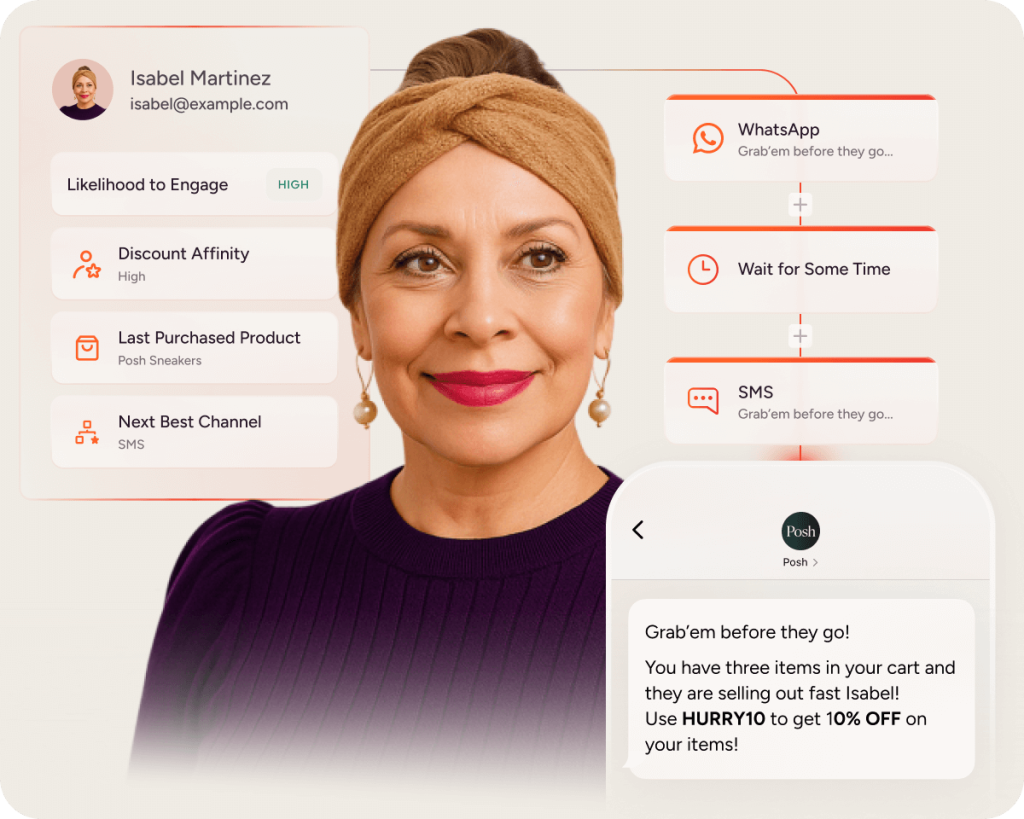
Start smaller than you think. You do not need all of that to begin. Website actions, browsing and purchase history and location are enough for a first set of campaigns, and the profile fills in as you generate results.
Do not limit this to known customers. Insider One’s CDP also profiles visitors who have shared no contact information, capturing what they browse, which attributes they favour such as price, colour and size, and what they add to cart. That makes anonymous visitor personalization possible: tailoring content and recommendations in real time, and bringing visitors back with personalized web push notifications. Since most traffic never identifies itself, this is usually the largest single opportunity on the list.
2) Deliver personalized content, messaging and recommendations
Data is only half of it. You also need to activate that data across channels, and the common approach, one platform per channel, is what produces stack sprawl.
The alternative is a unified platform. Insider One personalizes across web, app, email, SMS, RCS, WhatsApp, web push and site search from one place.
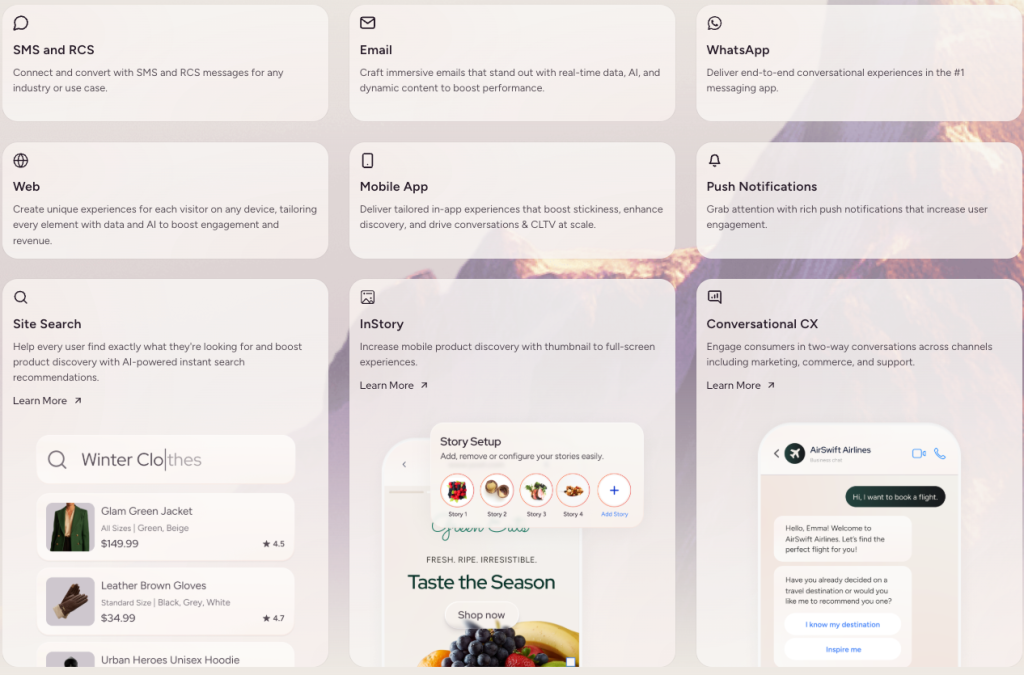
Website and app. The Web Personalization Suite tailors banners, categories, content and recommendations. The product recommendation engine offers strategies including viewed together, recently viewed, purchased together, location-based top sellers, checkout recommendations and last purchased. Widgets are built in a drag-and-drop editor, so campaigns ship without waiting on IT, and a template library covers gamified lead capture, social proof and purchase progress bars.
Site search. This is where high-intent shoppers state exactly what they want, and where poor product discovery loses them. Eureka delivers personalized search results with faceted filters across price, category, brand and ratings.
Email. Extend recommendations into campaigns rather than stopping at names and birthdays. AMP for email supports interactive, web-like experiences inside the message, though plan a full HTML fallback: AMP renders only in Gmail, Yahoo Mail and Mail.ru, so Outlook and Apple Mail recipients need the standard version.
Messaging channels. Reach customers on SMS, WhatsApp, Facebook Messenger and LINE, personalized from the same unified profile, for cross-sells on frequently paired products, price drop alerts and event reminders.
Online ads. Build segments and target them across Google, Meta and TikTok. Pierre Cardin used this approach and reported a 67% reduction in cost per acquisition, a 445% conversion rate uplift and a 164% improvement in return on ad spend.
3) Apply AI, machine learning and automation
Customer journey builders exist to unify touchpoints into one coherent experience and automate the complexity with no-code editors. Insider One’s is called Architect.
Send-time optimisation triggers each message when that recipient is most likely to engage, based on their own behavioural patterns.
Next-best-channel prediction identifies the right touchpoint per customer. You add your channels to the journey and the feature analyses past behaviour to choose between them, which is useful precisely when you cannot decide how a journey should continue.
A/B test winner autoselection removes the lag between a test concluding and the change going live. You set a duration and a winning metric such as open rate, conversions or revenue, and users are routed to the winning variant automatically.
Generative segment and content creation. Describe the goal in a prompt, such as driving purchases or reducing churn, and the segment is built for you. You can then refine it with traits across three audience types: standard attributes such as device, location and operating system; predefined audiences such as leads, cart abandoners and app users; and predictive audiences such as likelihood to purchase, discount affinity and spending potential.
Generative features also draft campaign copy and images, and Agent One Audiences applies the same approach to intent, building and maintaining the predictive segments rather than waiting to be asked. For the full picture, see Agent One, which brings generative, predictive, conversational and agentic capability together.
4) Decide how you will measure it
Scale makes measurement harder, not easier, so settle this before launch rather than after. Hold back a control group, agree the baseline, and report incremental conversion rate, average order value (AOV), retention and CLTV against that control. The question worth asking early is how much of the personalized revenue would have arrived anyway, because that is the question finance will ask later.
Three examples of personalization at scale
Adidas: A 259% increase in AOV
Adidas, founded in 1949 and headquartered in Herzogenaurach, is Europe’s largest sportswear manufacturer and the second largest worldwide. During the pandemic lockdowns its site traffic climbed faster than the team could engage and retain it, so it partnered with Insider One to personalize at scale.
The team built segments of new and returning visitors and served each a different side-menu coupon, A/B testing versions to find the strongest performers. They reported a 259% increase in AOV among new users within one month and a 35.5% conversion rate increase among returning users.
They then extended personalization across the site. Category Optimizer tailored how categories were presented on smaller screens, reported at a 50.3% increase in mobile conversion rate. Smart Recommender surfaced relevant products based on browsing history, intent and behaviour, reported at a 13% conversion rate increase on the homepage and 7% on product pages within a month.
Sapphire: A 53x return on investment
Sapphire is a leading Pakistani fashion retailer with more than 40 stores and around 5,000 employees, selling in-store and online.
Its marketing team wanted to personalize the on-site experience without depending on developer or IT support, and chose Insider One for the no-code template library. They launched ready-made personalized homepage banners reflecting product launches, national holidays and peak-season campaigns, varying by time of year and customer location. Reported results: a 244% increase in conversions, a 93% increase in AOV and a 53x return on investment.
Product discovery came next. With thousands of products online, customers were relying heavily on the search bar or bouncing. Our team suggested adding Smart Recommender to every product page to surface related items aligned to customer interest, which the team reported generated a 12x return on investment on its own.
Sapphire is now extending into email and SMS through Architect. Read the Sapphire case study.
Samsung: A 275% conversion rate uplift
Samsung is a global consumer electronics manufacturer headquartered in South Korea and one of the two largest smartphone vendors in the world by shipments.
During a Galaxy Note launch, Samsung needed to stand out in a crowded market. Our team recommended a personalized omnichannel messaging strategy targeting people who had shown interest in competitor devices and routing them to a dedicated landing page, built in Architect. Users who showed interest or added the device to their cart received web push notifications encouraging them back to complete the purchase. Reported results: a 14% increase in click-through rate and a 24% increase in conversion rate.
The team also saw conversions dropping off on product and category pages. Web Overlays and Category Optimizer were used to make discovery easier, with category optimization reported at a 10% conversion rate increase for the campaign, and web overlays credited with 9% of total sales. Combined, the tactics were reported at a 275% conversion rate increase.
How does Insider One support personalization at scale?
Insider One suits enterprise and mid-market companies personalizing across a large customer base and multiple channels. It aggregates customer data into an accurate 360-degree view, unifies the stack so campaigns are built, automated and analysed in one platform, predicts behaviour with the AI intent engine including purchase likelihood, channel affinity and discount affinity, and improves the metrics that move the bottom line: retention, AOV, CLTV and acquisition cost. Customisable templates mean campaigns launch without technical dependency, which shortens time to value.
On third-party validation, Insider One was named a Leader in the 2026 Gartner Magic Quadrant for Personalization Engines, the fifth time as a Leader, and scored 4.07 out of 5.00 for the digital commerce use case in the accompanying Critical Capabilities report. It also topped G2’s Fall ’26 reports across 14 categories, and a commissioned Forrester Total Economic Impact study put its return on investment at 449%, with $10.2M in attributed revenue for the composite organisation.
Conclusion
Personalization at scale is a sequencing problem more than a technology problem. Unify the data, activate it across channels from one platform, apply AI to the decisions currently made by guesswork, and design the measurement before you launch.
Teams that fix the data layer first tend to compound their returns, because each new channel inherits a profile that already works. Teams that start with tactics tend to relaunch the same programme a year later with better slides.
Book a demo to work through your data, channels and use cases with the Insider One team.
Frequently Asked Questions
Rule-based personalization uses predefined rules and segments, such as recommending products based on a last purchase or a demographic attribute. AI-driven personalization uses machine learning and predictive models to anticipate intent and deliver individualised experiences in real time across channels. Most mature programmes run both.
Personalization is brand-driven: the platform uses data and algorithms to tailor content or recommendations automatically. Customization is user-driven: the customer selects preferences or adjusts the experience themselves. Preference centres and wishlists are customization, and the data they generate makes personalization more accurate.
Personalization at scale is difficult because it requires:
1. Integrating and unifying customer data from multiple siloed sources.
2. Delivering consistent, individualized experiences across thousands or millions of customers and multiple channels.
3. Managing privacy restrictions and data accuracy.
4. Automating complex campaigns that adapt in real time without overwhelming marketers.
There are several benefits of delivering personalization at scale:
1. Higher conversion rates by showing customers relevant products and offers.
2. Increased customer engagement and satisfaction through tailored experiences.
3. Improved customer lifetime value (CLTV) and retention due to more relevant interactions.
4. Better marketing ROI by reducing wasted spend on irrelevant messaging.
You need to unify customer data with a customer data platform (CDP) to build accurate 360-degree profiles. Using a unified marketing platform like Insider One that allows seamless personalization across channels (web, email, SMS, push, ads). Leverage AI and machine learning to automate dynamic content, predictive recommendations, and campaign optimization.
Start small with key data points and iterate based on real results, continually testing and refining campaigns. Empower marketers with easy-to-use templates and no-code campaign builders to scale without heavy IT reliance.

Keep Reading
3 min.

Muharrem Derinkok
13 Oct 2025
8 min
Muharrem Derinkok
13 Jan 2025
9 min
Muharrem Derinkok
13 Jan 2025