

 Platform Overview

 Integration Hub

 Insider One AI™

 Customer Data Management

 Personalization

 Journey Orchestration

 Reporting & Data

 Behavioral Analytics

 Web
Web

 Email
Email

 Site Search

 Conversational CX

 WhatsApp

 Web Push

 InStory

 App
App

 SMS & RCS

 Join the $0 Migration Movement™

 The Insider One Difference

 Compare Vendors

 Switch to Insider One

 Success Story

 Retail & Ecommerce

 Financial Services

 Travel & Hospitality

 Beauty & Cosmetics

 Automotive

 Telecommunications

 Total Economic Impact™ Study

 Blog
Blog

 E-Books & Guides

 Glossary
How Agent-Based Personalization Turns Real-Time Intent into Revenue

Updated on 10 Aug 2026
8 min.
Table of Contents
Most Popular

Most marketing teams don’t fail at personalization because they lack ambition. They fail because the tools they’re using were designed for a world where customers moved predictably through linear funnels. Today’s customer doesn’t do that.
They research on mobile, abandon on desktop, re-engage through email, and convert via a push notification, all in the same afternoon. Rule-based systems weren’t built for that kind of motion.
The shift toward agent-based personalization is a response to a structural problem: the gap between when intent is expressed and when a relevant experience is delivered.
That gap has always existed, but autonomous agents can now close it in real time, without waiting for a marketer to build a new rule, redefine a segment, or manually test an alternative. Understanding exactly how that happens, and what it requires, is what this piece covers.
Why rule-based personalization hits a ceiling
Static logic breaks on contact with real behavior
The “if-this-then-that” structure that underpins most journey builders works well in a controlled environment. In practice, customers deviate constantly. They skip steps, revisit pages they’ve already converted on, change channels mid-journey, and behave differently across devices.
Every deviation that falls outside a predefined rule produces either a generic experience or no experience at all, and both outcomes erode the relationship over time.
The deeper problem is that rule-based systems require someone to anticipate every meaningful variation in advance and encode it into logic. That’s a manageable task for three customer types.
It becomes structurally impossible for thousands of behavioral patterns, which is the operational reality most enterprise teams face. The system can’t scale to meet individual behavior, so the marketer ends up scaling the rules instead, a losing race by design.
Segment-level targeting makes individual personalization structurally difficult
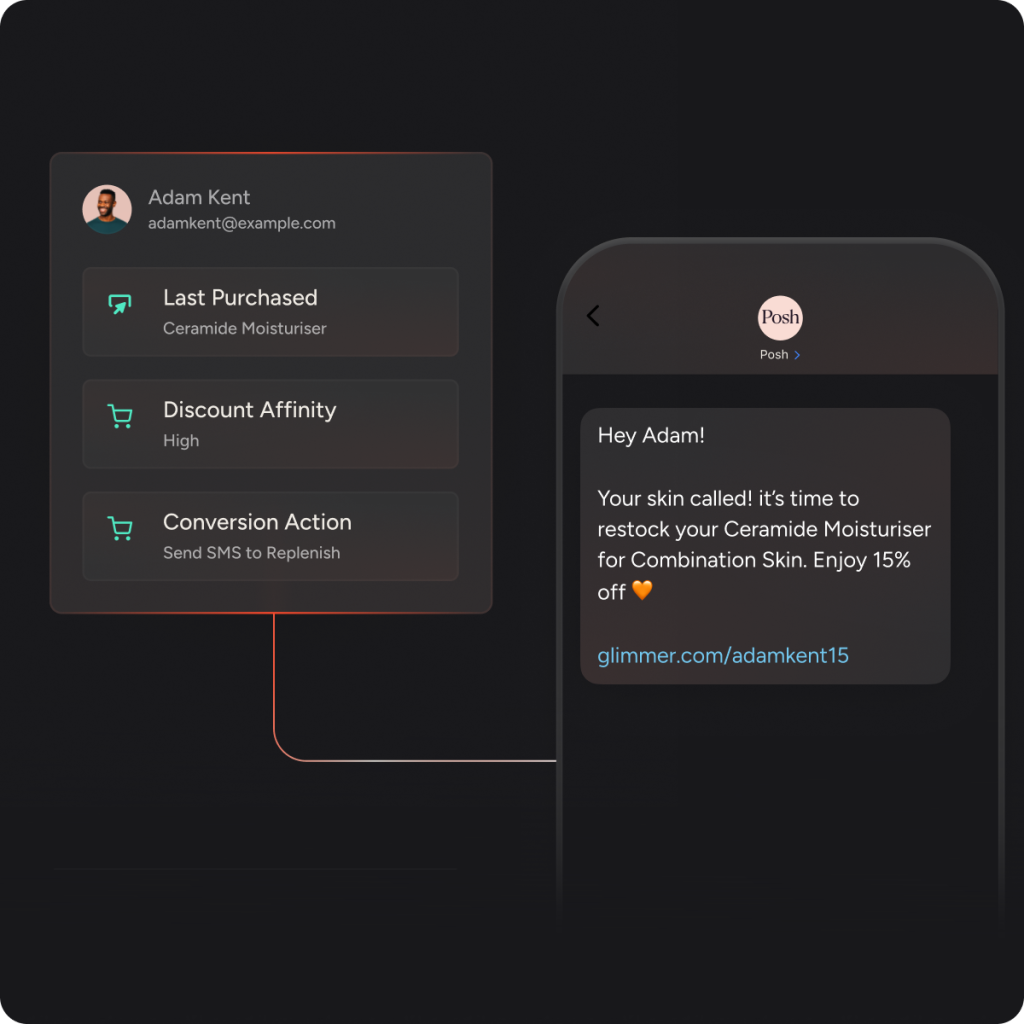
Segmentation is a compression tool. It takes a complex population and groups it into something actionable. The tradeoff is resolution: within any segment, individuals differ meaningfully, and those differences are precisely where personalization earns its value.
Sending the same message to everyone in a “high-intent, lapsed” segment is targeted broadcasting, not personalization.
True individual-level personalization requires decisioning in the moment, based on each person’s specific context. Segments can help you get close, but closing the last mile requires autonomous systems that make individual decisions without a human approving each one. That is where AI personalization separates from conventional targeting.
What makes agent-based personalization different
Agents interpret intent, not just actions
Standard real-time personalization reacts to observable behavior: a click, a page view, a search query. An AI agent does something structurally different. It attempts to answer a harder question: why is this person doing this? A customer browsing three different running shoes in a single session after clicking a marathon training email isn’t just “browsing footwear.”
They’re signaling purchase intent within a specific motivational context, and the right response is entirely different from what a generic product recommendation would deliver.
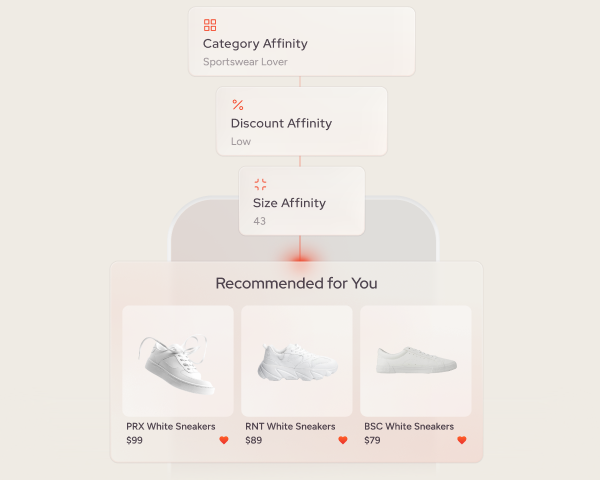
Agent-based systems derive composite intent by combining behavioral signals, natural language inputs, purchase history, and real-time context simultaneously. They don’t wait for a threshold trigger.
They form an inference, act on it, and update that inference as new signals arrive within the same session. That continuous loop is what separates agentic AI marketing from traditional personalization engines.
Agents plan and execute rather than simply respond
This is the distinction that matters most for marketing leaders evaluating platforms. A rule-based system responds to input. An AI agent pursues a goal, and the operational difference is substantial.
An agent given the goal “move this user to checkout” will plan sub-tasks: identify the most relevant product, select the highest-engagement channel, determine the right message cadence, test an alternative offer if the first doesn’t land, and feed all of that back into the next decision cycle.
A human didn’t prompt each step; the agent inferred them from context and outcome data. This goal-seeking architecture is also why hyper-personalization at scale becomes feasible with agents in a way it simply isn’t with rule-based tools.
The architecture behind autonomous personalization
Four layers that must work together
A functioning agent-based personalization stack isn’t a single product. It’s four distinct capabilities working in concert, and the absence of any one of them produces a system that underperforms.
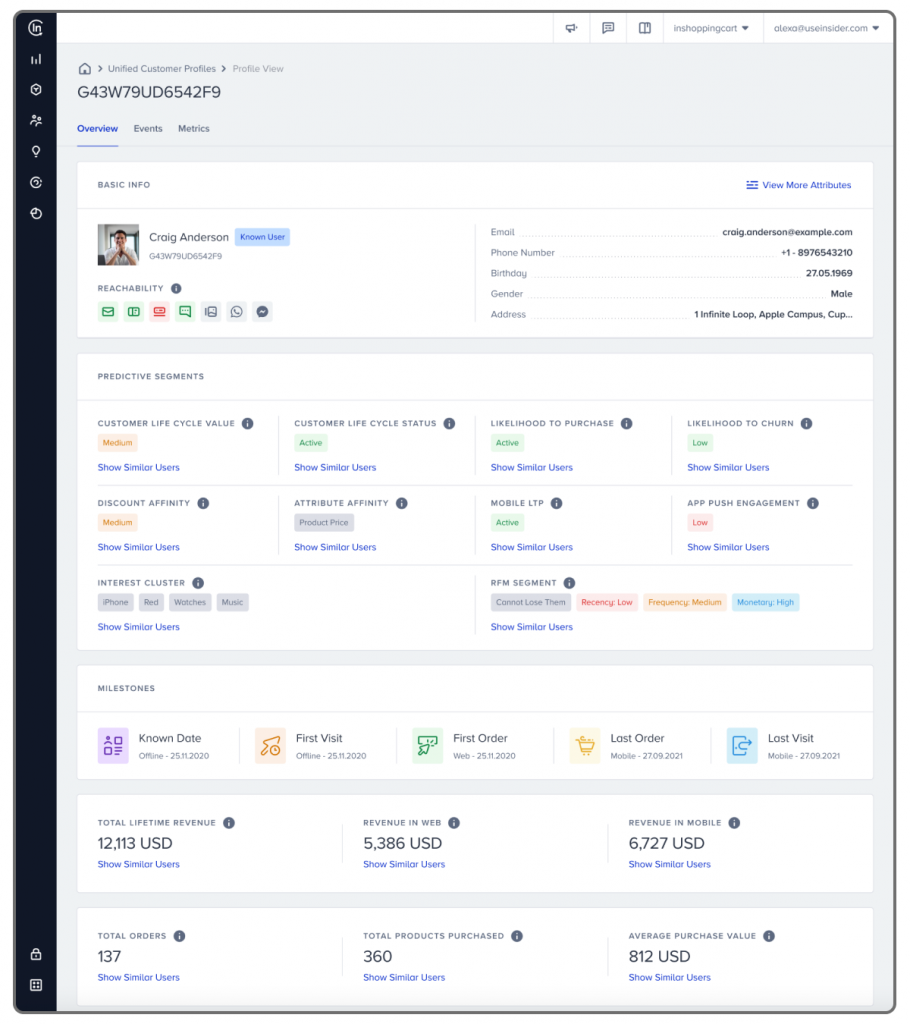
Unified real-time customer profiles
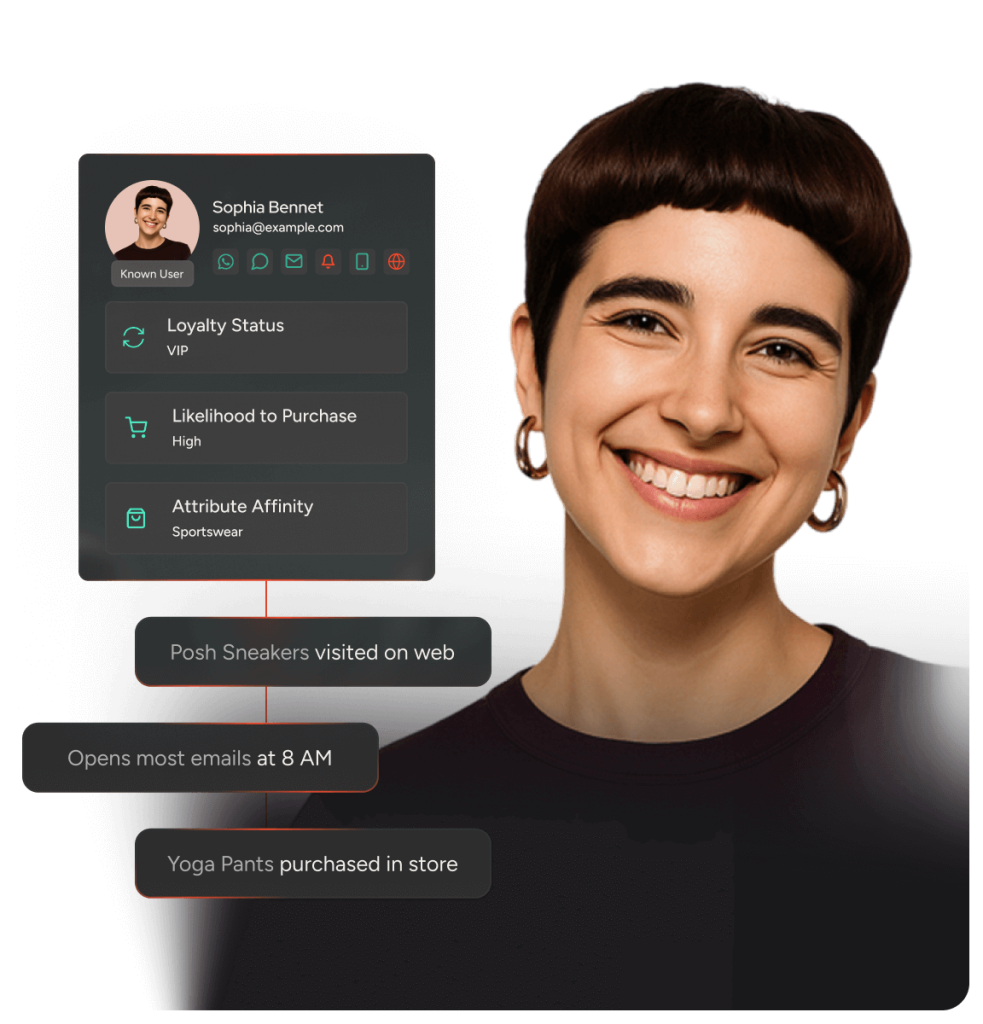
The agent needs to know who this person is across every channel and device they’ve used, with profiles updated continuously as new signals arrive. Without this, the agent is making decisions on partial information, which often means making the wrong ones confidently.
A customer data platform (CDP) that resolves identity across sources and feeds a single profile to the decisioning engine is the starting point, not an optional enhancement.
Intent inference
This is the reasoning engine that interprets why a customer is behaving as they are. Natural language processing, predictive modeling, and behavioral analysis converge here. The quality of this layer directly determines the quality of every experience the agent delivers.
Multi-channel execution
Intent inference is only valuable if the agent can act on it across email, Short Message Service (SMS), push, web, app, and conversational interfaces simultaneously and coherently. Siloed execution engines break the agent’s ability to deliver a consistent experience across the customer’s actual journey.
A self-updating feedback loop
The agent needs to close attribution back to its own decisions: which actions produced outcomes, which inferences were wrong, and how to weight signals differently next time.
Without this, the system doesn’t improve; it just repeats. Insider One’s journey orchestration capabilities are built around this model, connecting real-time signals to multi-channel execution so that outcomes inform the next round of decisioning.
Identity resolution is a prerequisite
The quality of an agent’s decisions is bounded by the quality of the profiles it reasons over. If a customer has three unresolved identity records across your systems, an agent will make three separate sets of decisions, each based on an incomplete picture.
The result isn’t bad personalization in the traditional sense; it’s systematically wrong personalization, delivered faster and at greater scale than any human-operated system could achieve.
Identity resolution and data hygiene aren’t implementation details you address after going live. They’re the foundation that determines whether your agent infrastructure creates value or amplifies existing data problems.
Insider One’s Customer Data Management layer is designed to resolve identity across sources before those profiles reach the decisioning engine, which is the correct sequence.
Use cases that demonstrate the model in practice
Adaptive onboarding that adjusts to individual activation signals
One-size-fits-all onboarding sequences share a structural flaw: they assume every new user needs the same information, in the same order, on the same timeline.
Most don’t. An adaptive onboarding agent tracks individual activation signals, such as which features a new user has engaged with, where they’ve hesitated, and what channel they’ve responded to in prior sessions, then uses those signals to restructure the onboarding sequence in real time.
The practical outcome is that users reach their first meaningful value moment faster, which is where retention is actually won.
Onboarding sequences that lose users to irrelevance before they reach value are among the highest-leverage problems an agent can address, because the cost of those early drop-offs compounds across the entire customer lifetime.
Intent-driven commerce from discovery to checkout
Conversational commerce demonstrates the full potential of agentic personalization most clearly. When a customer types “anniversary gift under $500,” they’re providing a signal that a keyword search can’t meaningfully parse, but a well-designed agent can.
Agent One™ processes natural-language inputs to surface contextually relevant options, guide a back-and-forth exchange, and move the customer toward a decision, all within a single interaction.
For context on what personalization improvements can deliver in a retail environment, the Adidas case study illustrates the scale of impact that better intent interpretation and individual-level decisioning can produce for a global brand.

How to evaluate agent-based personalization platforms
Shared intelligence across channels is the real differentiator
Every platform worth considering has “AI” somewhere in its positioning. The operative question is whether that AI operates from a shared intelligence layer or whether each channel’s AI is making decisions independently. When signals are siloed, the agent can’t do its job effectively.
A customer who searches for winter boots on your site, abandons the cart, and then opens a push notification will receive a relevant experience only if the agent’s reasoning about that push notification knows what happened during the site session.
That requires a unified profile, shared intent inference, and connected execution, not three separate channel tools each running their own logic.
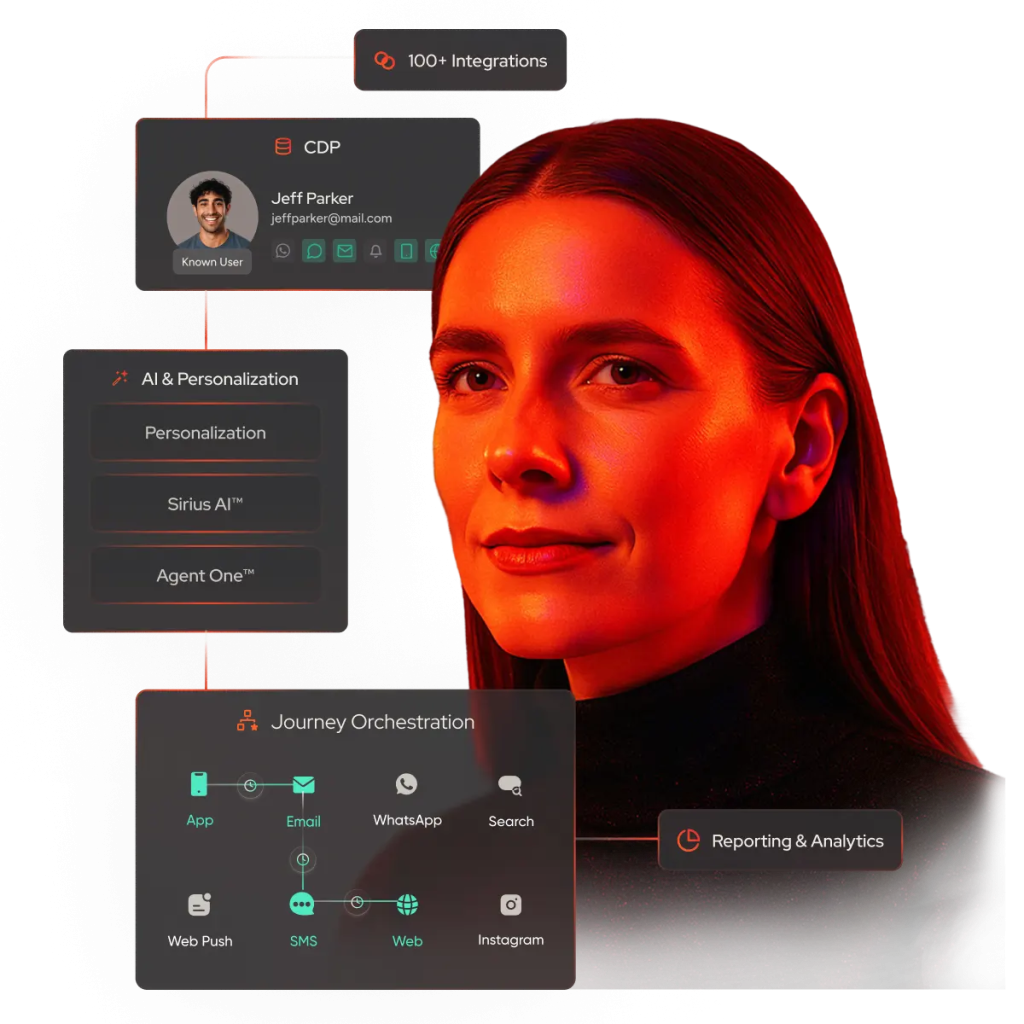
Insider One’s platform is built on this principle: Insider One AI operates as a shared intelligence layer across channels, so behavioral signals captured in one context inform decisions made in every other context, without manual data stitching between tools.
You can explore how that interconnected architecture functions across personalization use cases or review the full integration ecosystem to understand how existing stack components connect.
Governance and observability are not optional
Autonomous agents introduce a new category of operational risk that governance frameworks in most marketing organizations aren’t yet designed to handle.
When an agent makes thousands of individual decisions per hour, you need the ability to audit why specific decisions were made, identify where the agent’s reasoning diverged from intended behavior, and apply corrections without retraining the entire model.
This requires lineage tracking at the decision level, not just aggregate reporting on campaign performance.
Before deployment, teams should define explicit goal guardrails that constrain the agent’s action space, establish escalation rules that route edge cases to human review, and set frequency and suppression logic that prevents agents from over-messaging users who haven’t responded.
Capability without observability doesn’t produce better personalization; it produces personalization that’s wrong in ways you may not notice until real damage has been done.
Why Insider One for agent-based personalization
Autonomous decisioning only produces revenue if every sub-decision is genuinely automated. An agent pursuing a goal like moving a customer to checkout has to choose the product, the channel, the timing and the offer, then learn from the outcome. In Insider One each of those is a shipping capability:
- Product: Smart Recommender strategies and Eureka’s intent modeling select what to surface, using the same models that drive on-site discovery
- Channel: Next Best Channel routes to the channel that individual actually responds to, rather than the one the campaign was built in
- Timing: Send Time Optimization sets the hour per person, while profile-level frequency capping stops the agent over-messaging
- Offer: A/B Winner Auto-Selection resolves the alternative test and shifts volume to the winner without waiting for a marketer to check results
- Learning: Insights Agent monitors outcomes across channels, flags journeys losing momentum, and replicates what works
All of it reads from one profile updating in milliseconds, and Insider One AI is a single decisioning layer across 12+ native channels rather than separate models per channel. That is what keeps a push decision informed by the web session that preceded it.
The guardrails sit at platform level too: consent-driven action limits for Support Agent, suppression and frequency applied to the whole profile, and escalation to a human with full conversation context when an interaction needs it.
Braun Shop reports that Shopping Agent influenced 18% of its ecommerce revenue within eight months.
Book a demo to walk the decision logic against your own data, or take the platform tour first.
FAQs
Real-time personalization typically triggers a predefined response when a specific behavioral threshold is crossed. Agent-based personalization interprets composite intent across multiple signals simultaneously, forms a goal-oriented plan, and executes across channels adaptively. The agent updates its decisions as new signals arrive; a trigger-based system waits for the next threshold.
Not necessarily, but it depends on whether your current stack supports real-time profile unification and cross-channel execution. If customer profiles are unified and channels are accessible via APIs in real time, an agent layer can be added without re-platforming. If data is fragmented or channels are siloed, resolving those issues first is more effective than layering agents on top of a broken foundation.
Through governance design rather than operational throttling. Clear decision boundaries should define what actions agents can take, which segments require human review, frequency limits, and anomaly triggers. These guardrails allow autonomy within safe limits while ensuring exceptions are surfaced without interrupting core execution.
Because agent quality is constrained by data quality. If customer identities are fragmented, the agent builds decisions on incomplete or conflicting information. This leads to incorrect outcomes at scale. Identity resolution ensures the agent operates from a single, accurate view of each customer before making decisions.

Keep Reading
7 min.

Muharrem Derinkok
4 Jun 2026
11 min.

Chris Baldwin
2 Jun 2026
4 min.
Chris Baldwin
3 Feb 2026