

 Platform Overview


 Integration Hub


 Agent One™


 Agent One™ Teams


 Customer Data Management


 Personalization


 Journey Orchestration


 Reporting & Data


 Behavioral Analytics


 Web


 Email


 Site Search


 Conversational CX


 WhatsApp


 Web Push


 InStory


 App


 SMS & RCS


 Join the $0 Migration Movement™


 The Insider One Difference


 Compare Vendors


 Switch to Insider One


 Success Story


 Retail & Ecommerce


 Financial Services


 Travel & Hospitality


 Beauty & Cosmetics


 Automotive


 Telecommunications


 Total Economic Impact™ Study


 Blog


 E-Books & Guides


 Events


 Glossary
Personalization Engines: What They Are and The 7 Best Options for 2026

Updated on 6 Oct 2026
17 min.
Table of Contents
Most Popular
Summary
- A personalization engine analyses customer data and decides what each individual should see next, then delivers that decision to the channels you have connected.
- Compare them on five things: which data sources they read, how long setup takes, whether the personalization capabilities are native to the engine, how well the wider platform integrates, and how many channels it can execute on without a second vendor.
- The distinction that matters most in practice is engine versus platform. An engine that produces insight you cannot act on natively pushes the work back onto your team.
- Insider One combines the engine, the customer data platform (CDP) and native execution across web, app, email, SMS, Rich Communication Services (RCS), WhatsApp, web push and site search, and was named a Leader in the 2026 Gartner Magic Quadrant for Personalization Engines, the fifth time as a Leader.
- Braze and CleverTap lead with lifecycle messaging, Dynamic Yield with on-site experimentation, and Salesforce and Adobe make sense mainly if you already run those suites.
- Ask every vendor the same two questions: can it personalize for a visitor who has never identified themselves, and what does it cost to add the second and third channel.
Marketers hold more customer data than ever: devices, behaviours, purchase histories, preferences, service interactions. The problem is no longer collection. It is deciding what to do with any of it in the moment that matters.
That is the job of a personalization engine. This guide is for marketing, ecommerce and customer relationship management (CRM) leaders building a shortlist. You will get a working definition, the five factors that actually separate these platforms, a side-by-side comparison, and detail on the seven worth considering in 2026.
What is a personalization engine?
A personalization engine is software that analyses customer data and produces the decisions marketers need to create personalized experiences for each individual.
Most engines can process demographic data, on-site interactions, purchase history, service conversations and loyalty data. That data usually arrives from separate systems: analytics platforms, CRMs, service software and application programming interfaces. The engine’s job is to make sense of it, usually with artificial intelligence (AI), and to decide what each person should see.
Worth separating from a related term. A recommendation engine suggests products. A personalization engine decides the whole experience, including content, layout, messaging, channel and timing, and usually contains a recommendation engine inside it.
The 6 best personalization engines at a glance
| Platform | Best for | Native channels | Engine strength | Consideration |
| Insider One | Brands wanting engine, data and execution in one platform | Web, app, email, SMS, RCS, WhatsApp, web push, site search, ads | Predictive intent, generative and agentic AI, anonymous visitor profiling | Broadest value when it replaces several point solutions |
| Braze | App-first lifecycle messaging | SMS, email, WhatsApp, push, in-app and in-browser | Strong cross-channel orchestration and analytics | On-site personalization is narrower than a web-first engine |
| Dynamic Yield | On-site and in-app experimentation | Web, app, email, ads | Long-running Gartner Magic Quadrant Leader | No native SMS, WhatsApp or Messenger |
| CleverTap | Mobile-led engagement | Email, SMS, WhatsApp, push, in-app, web | Mobile behavioural analytics and segmentation | Web personalization is lighter than mobile |
| Salesforce | Teams standardised on Salesforce CRM | Email, SMS, push, social, web | Native CRM and service data | Two overlapping personalization products to choose between |
| Adobe Experience Cloud | Enterprises already invested in Adobe | Web, app, email, ads, by product | Deep enterprise data and analytics stack | Full personalization usually needs several products licensed |
Which five factors separate personalization engines?
Data sources. The more relevant data an engine can read, the better its decisions, provided that data is clean. Start by checking whether it connects to every source that matters to you, including offline and legacy systems.
Setup. The hardest part of personalization is usually getting the right data out of your systems and into the engine. Flexible setup options and a support team that does the work with you decide whether you see value in weeks or quarters.
Native personalization capabilities. These are what you actually use to build experiences. If they are built into the engine rather than bolted on, you avoid stitching third-party systems together and adding complexity to your stack.
Platform integration. Engines usually sit inside a broader platform, and it is the platform’s job to keep data flowing between your storefront, offline systems and legacy tools. Weakness here shows up later as reconciliation work.
Native channels. An engine produces decisions but cannot act on them alone. The more channels you can reach natively, without a separate vendor, the further personalization actually travels.
#1 Insider One
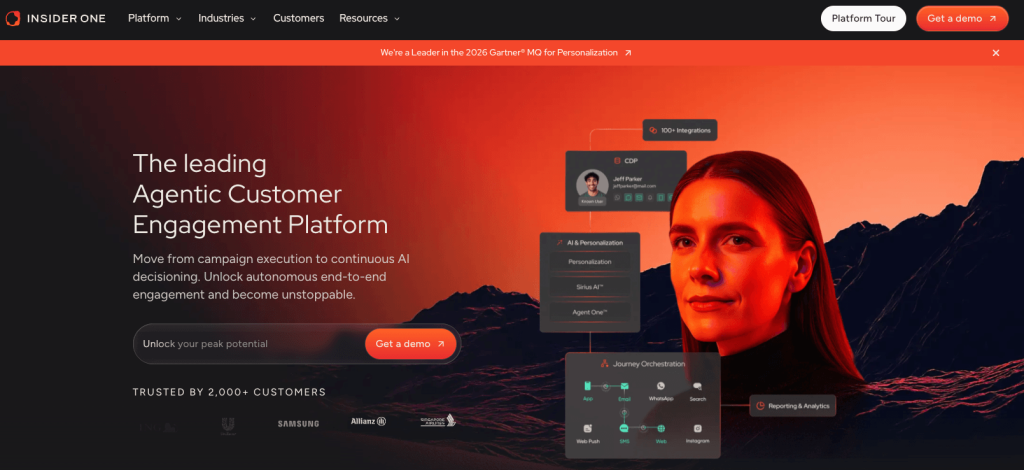
Best for: brands that want the engine, the customer data and channel execution in one platform.
Insider One brings together personalization for websites and mobile apps alongside email, SMS, web, app, WhatsApp, web push and site search. Brands including MAC Cosmetics use it to reduce acquisition costs, lift conversion rates and grow revenue by personalizing each touchpoint.
Clients typically use it to consolidate customer data into a 360-degree view, build and automate cross-channel campaigns, reach the right audiences on the right channel at the right time, and replace several point solutions with one platform.
How does the data foundation work?
Personalization is only as good as the data behind it, and consolidating that data is usually the slowest part of any implementation.
Insider One addresses this with flexible setup options, a support team that helps you do it, and an Actionable CDP that unifies data from any online or offline source, including CDPs, content management systems, application programming interfaces, analytics platforms and point-of-sale devices.
In practice, setup for an ecommerce store starts with installing our JavaScript tag, which begins capturing behavioural data and can build a product catalogue automatically, though you can also submit a product feed by file or API. Our team then helps connect the rest of your stack, and will migrate existing journeys such as confirmation flows, upsell campaigns and cart recovery notifications rather than leaving you to rebuild them.
The CDP produces unified profiles covering contact details, channel reachability, purchase history and interactions across site, app, email, SMS and push. It also creates profiles for anonymous visitors, holding no personal information but recording what they click, which categories they browse and which products they abandon. That is what makes real-time personalization possible before someone identifies themselves.
If you already have a CDP you are happy with, Insider One can connect to it instead.
How far does personalization reach?
On-site and in-app. Our AI-powered Smart Recommender delivers product recommendations across all pages, product and article pages, category pages and cart pages. Strategies include most popular, most searched, frequently viewed or purchased together, manual merchandising, and a user-based strategy where the algorithm matches recommendations to each individual.
Beyond recommendations, Insider One personalizes banners, categories and content elements. Yves Rocher used personalized content to report a conversion rate uplift of 18.36%. InStory adds story-format product discovery, and Dover Saddlery reported $1.7 million in incremental revenue from personalized stories. Eureka personalizes site search results against past actions, purchase history and predicted behaviour, which matters because search is where high-intent shoppers state exactly what they want.
Philips applied these capabilities on their site and reported a 40.11% conversion rate uplift and a 35% increase in average order value (AOV). Read the Philips case study.
Messaging and ads. Email personalisation covers subject lines, body content, images and recommendations through a drag-and-drop editor. SMS and RCS messages personalize the same way and coordinate with email in one journey. Web and app push carry no per-message cost, which makes them efficient for product discovery and cart recovery. WhatsApp supports promotional messages, price drop alerts, and conversational commerce flows that complete a purchase inside the thread.
Can it personalize for anonymous visitors?
Yes, and this is the capability most engines lack. Many require an email address or phone number before they can profile anyone, which excludes most first-time traffic.
Insider One builds a profile from the first pageview, recording clicks, product interest, price ranges and last viewed items, then personalizes content and recommendations in the same session. An exit-intent prompt collects web push consent without asking for personal data, which is a smaller commitment and converts better. From there, push notifications personalized by category, product and price range bring visitors back without paid retargeting. Lenovo used this to reduce cart abandonment by more than 10%.
How does orchestration and automation work?
Architect is our cross-channel journey builder. Journeys trigger on events such as category visits, cart abandonment or repeat purchase, plus restocks and price drops, and you choose the audience from pre-built segments, predictive audiences or attribute filters covering device, location and demographics.
Three AI capabilities remove manual work. Next-best-channel prediction analyses each customer’s preferred touchpoints and routes the message accordingly. Send-time optimisation decides when each message goes out based on individual engagement patterns. A/B test winner autoselection promotes the winning path automatically against a metric you choose, over a calculation window you set, which suits finding the best combination of channel, content and recommendations, and identifying the right frequency through optimal wait times.
Campaign results are visible inside Architect, showing how many users entered a flow and how far they progressed, and a template library of proven cross-channel journeys means most campaigns start from a working pattern.
What do analysts and customers say?
Insider One was named a Leader in the 2026 Gartner Magic Quadrant for Personalization Engines, the fifth time as a Leader, and scored 4.07 out of 5.00 for the digital commerce use case in the accompanying Critical Capabilities report. It also topped G2’s Fall ’26 reports across 14 categories, including personalization software and CDP, and a commissioned Forrester Total Economic Impact study put its return on investment at 449%, with $10.2M in attributed revenue for the composite organisation.
#2 Braze
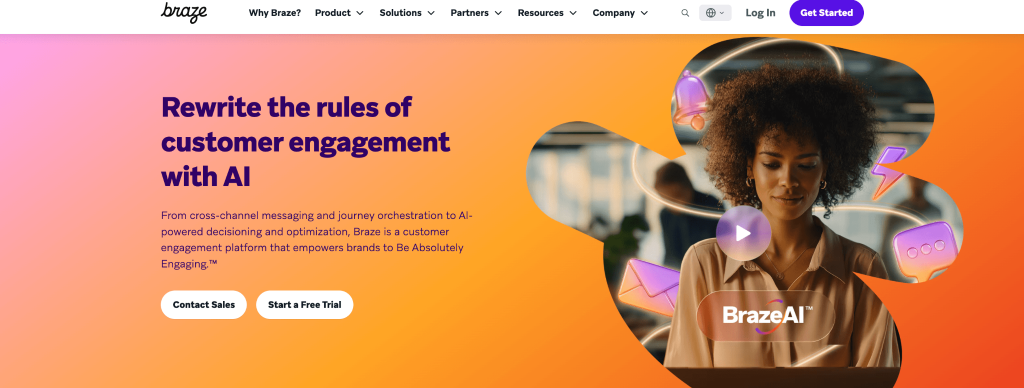
Best for: app-first lifecycle messaging.
Braze is a customer engagement platform covering SMS, email, WhatsApp, push notifications and in-app and in-browser messaging, with orchestration and analytics capabilities alongside. Its strength is lifecycle messaging at high volume across mobile and email.
For teams whose priority is on-site personalization rather than messaging, a web-first engine will usually go deeper on the website itself.
See how Braze compares to Insider One and read our guide to Braze competitors and alternatives.
#3 Dynamic Yield
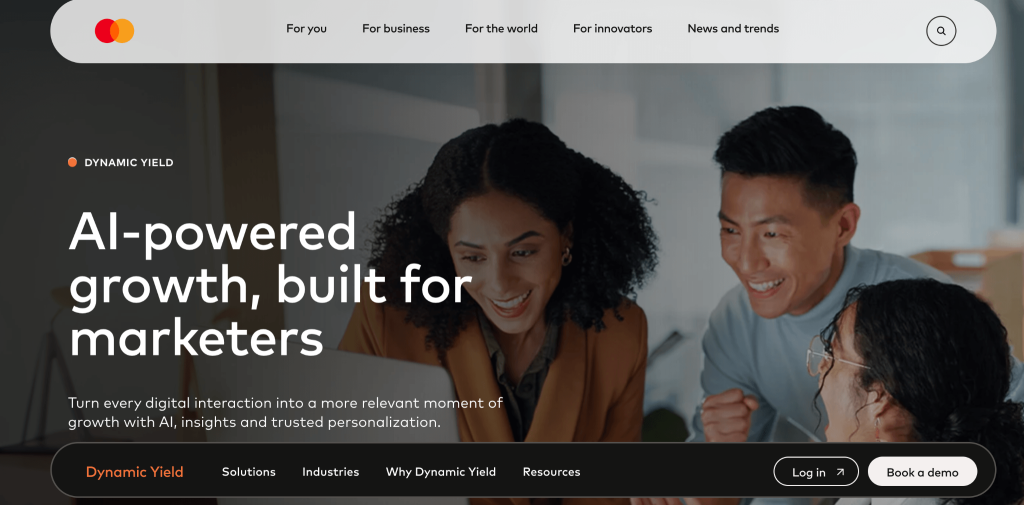
Best for: on-site and in-app experimentation.
Dynamic Yield, owned by Mastercard, specialises in tailored on-site experiences and also supports in-app, email and ad personalization. It connects to data sources including CRMs, application programming interfaces and point-of-sale devices, and builds segments from behavioural data, journey stage and offline purchase history.
The gap for omnichannel retailers is messaging: SMS, WhatsApp and Messenger are not native, so those channels need a second platform.
#4 CleverTap
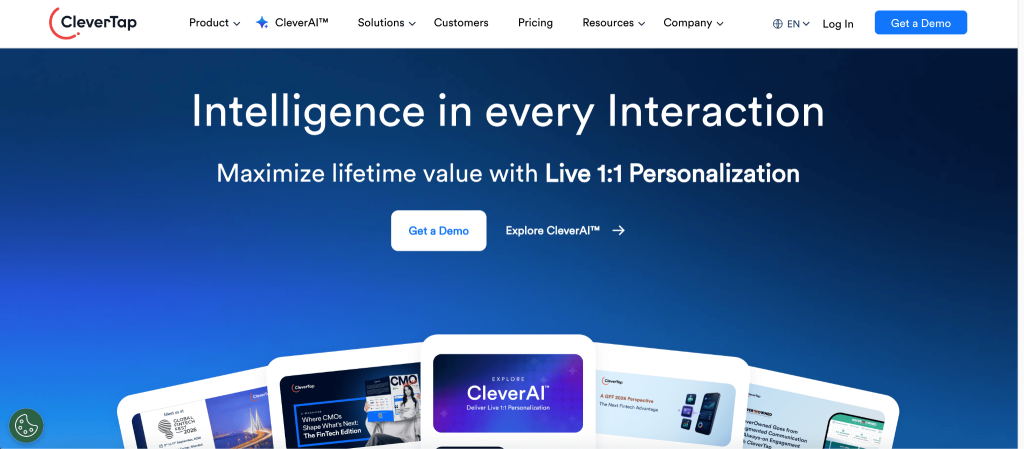
Best for: mobile-led engagement.
CleverTap is a customer engagement platform covering email, SMS, WhatsApp, push notifications, in-app messaging and web messaging. Its heritage is mobile marketing, engagement and analytics, and it uses AI to build segments, generate content and support experimentation.
#5 Salesforce
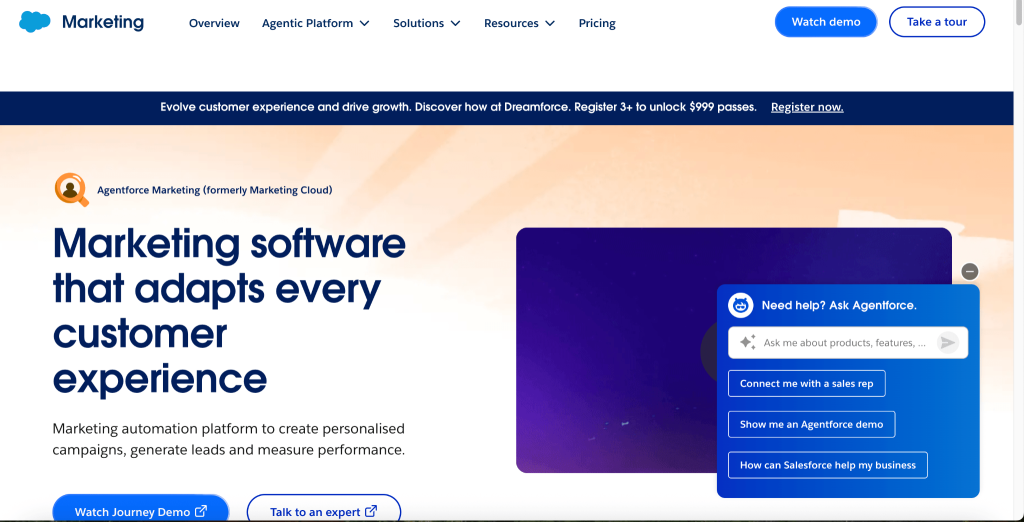
Best for: teams standardised on Salesforce CRM.
Salesforce approaches personalization through several products. Marketing Cloud handles cross-channel campaign automation across email, SMS, push and social. Marketing Cloud Personalization, formerly Interaction Studio and originally Evergage, is the real-time interaction management product. Salesforce Personalization is the newer product built natively on the Salesforce data platform. There are also adjacent products for account-based marketing and loyalty management.
Two things to check. The two personalization products overlap and are also sold as a combined edition, so confirm which one your use cases need. Salesforce has also made Advertising Studio subscriptions non-renewable from August 2026, so validate the roadmap for any ad personalization you depend on.
See how Salesforce compares to Insider One and read our guide to Salesforce Marketing Cloud competitors and alternatives.
#6 Adobe Experience Cloud
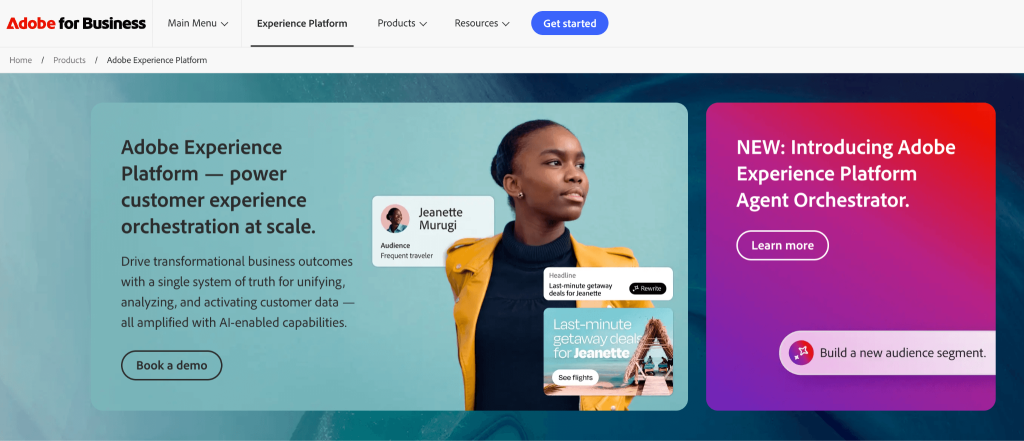
Best for: enterprises already invested in Adobe.
Adobe Experience Cloud combines several products: Adobe Target as the personalization engine and testing product, Marketo Engage for marketing automation, Adobe Experience Manager for content and digital asset management, and Adobe Journey Optimizer and Adobe Campaign for campaign orchestration.
Gartner’s evaluation notes that complementary Adobe products carry an additional charge, so a complete personalization stack usually means licensing several together.
See how Adobe compares to Insider One.
How should you choose?.
- Your priority is lifecycle messaging on mobile: Braze or CleverTap or Dynamic Yield.
- You want the engine, the data layer and every channel in one place: Insider One.
- The decision is really a suite decision: Salesforce or Adobe, matched to what you already run.
- Most of your traffic is anonymous: prioritise engines that profile before identity, which rules out anything requiring personal data to segment.
Conclusion
The label “personalization engine” now covers products that do quite different jobs, from on-site testing to full cross-channel orchestration. The useful question is not which engine is most advanced, but how far its decisions can travel before you need a second vendor to act on them.
Insider One suits mid-market and enterprise companies personalizing the whole journey: unify data from CRMs, content systems, analytics and offline sources; track behaviour to uncover interests and preferred channels; predict churn and purchase likelihood with the AI intent engine; and deliver individualised experiences across web, app, email, SMS, WhatsApp and Messenger. Setup support, an experienced services team and a large template library shorten time to value, and the $0 Migration Movement covers the cost of switching.
Book a demo to work through your data sources, channels and use cases with our team.
Frequently Asked Questions
Software that collects and analyses customer data, including browsing behaviour, purchase history and engagement signals, then decides which content, messaging and product recommendations each individual should see across digital touchpoints in real time. It uses AI and machine learning, and the better engines work for anonymous as well as known visitors.
A recommendation engine suggests relevant products or content based on behaviour. A personalization engine decides the whole experience, including messaging, layout, channel and timing, and usually contains a recommendation engine as one component. The distinction matters when comparing vendors, since some sell the narrower capability as the broader one.
It can, because relevance sustained across the lifecycle is what keeps customers engaged. Delivering content and offers matched to preference and lifecycle stage reduces friction and churn. Validate it with a holdout group, since retention improvements are easy to claim and harder to attribute.
Generally yes, though the returns arrive fastest in ecommerce and consumer-facing brands where behavioural signals are abundant and purchase cycles are short. Financial services, travel and telecommunications also benefit. Effectiveness depends on data quality and a clear strategy far more than on the engine’s feature list.
Modern engines integrate with multiple data sources and channels, but the important question is which channels are native. Every channel that requires a separate vendor adds an integration and a place for data to diverge, which is why native channel count is one of the five comparison factors above.
It depends almost entirely on your data, not the vendor’s software. Getting clean data out of existing systems is the long pole, so ask each vendor what they do for you during setup, whether existing journeys are migrated, and what the first live use case looks like in week one.

Keep Reading
4 min.

Chris Baldwin
3 Feb 2026
9 min.
Chris Baldwin
22 Oct 2026
8 mins.
Chris Baldwin
8 Oct 2026