

 Platform Overview


 Integration Hub


 Agent One™


 Agent One™ Teams


 Customer Data Management


 Personalization


 Journey Orchestration


 Reporting & Data


 Behavioral Analytics


 Web


 Email


 Site Search


 Conversational CX


 WhatsApp


 Web Push


 InStory


 App


 SMS & RCS


 Join the $0 Migration Movement™


 The Insider One Difference


 Compare Vendors


 Switch to Insider One


 Success Story


 Retail & Ecommerce


 Financial Services


 Travel & Hospitality


 Beauty & Cosmetics


 Automotive


 Telecommunications


 Total Economic Impact™ Study


 Blog


 E-Books & Guides


 Events


 Glossary
AI-Powered Hyper-Personalization: The Future of Customer Engagement

Updated on 5 Oct 2026
8 min.
Table of Contents
- Summary
- What is hyper-personalization?
- Which technologies make hyper-personalization possible?
- What are the benefits of hyper-personalization?
- What does hyper-personalization look like in practice?
- How do you implement hyper-personalization?
- What about privacy and consent?
- How does Insider One support hyper-personalization?
- Conclusion
- FAQs
Most Popular
Summary
- Hyper-personalization uses real-time behavior and AI to tailor content, offers, and timing to each individual.
- It relies on unified data, real-time decisioning, and channels that can act without developer support.
- The main benefits are higher conversions, stronger retention, and less wasted spend.
- Build in consent and transparency from the start, especially when using first-party data.
- Treat personalized pricing carefully due to disclosure requirements in some markets.
- Insider One supports hyper-personalization across web, app, email, SMS, WhatsApp, and site search.
Generic campaigns are losing ground. Customers now expect brands to recognise what they need in the moment and to reach them through the channel they actually use. Hyper-personalization is the practice of meeting that expectation at scale, using AI and real-time data rather than manual segment building.
This article is for marketing, ecommerce and customer relationship management (CRM) leaders deciding what hyper-personalization should mean for their 2026 roadmap. You will get a working definition, the technologies it depends on, what it looks like in retail and financial services, an implementation sequence, and the privacy questions to settle before you start.
What is hyper-personalization?
Hyper-personalization is a data-driven approach that uses AI, machine learning and real-time behavioural data to tailor personalized marketing messages, content and product recommendations to each individual customer.
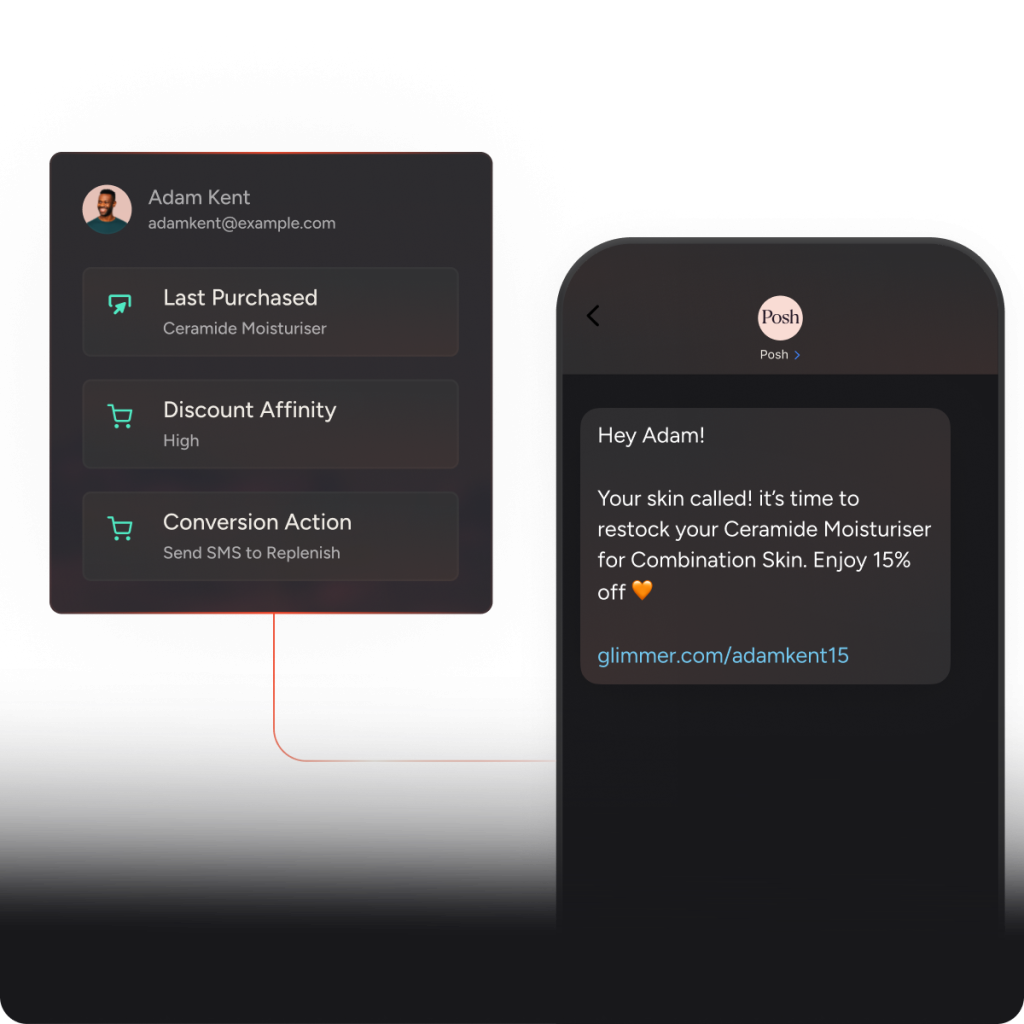
Traditional personalization might use a customer’s first name in an email or recommend products related to a past purchase. Hyper-personalization goes further by reading signals across touchpoints, including on-site browsing, app behaviour, purchase history and location, then predicting what that person is likely to want next and acting on it while the intent is still live.
The practical shift is from one message per segment to one decision per person, made continuously rather than at campaign planning time.
How does it differ from traditional personalization?
| Traditional personalization | Hyper-personalization | |
| Data used | Static attributes: name, past purchases, declared preferences | Live behaviour, predicted intent, context such as device and location |
| Unit of targeting | Segment or list | Individual profile |
| Timing | Campaign schedule | Real time, triggered by behaviour |
| Channel choice | Set by the marketer | Chosen per person based on engagement history |
| Content | A handful of variants | Assembled per profile, often generated |
| Requirement | An email platform and a list | Unified data, decisioning models and connected channels |
Which technologies make hyper-personalization possible?
Three layers have to work together.
Unified customer data. Profiles need to consolidate web, app, CRM, point of sale, service and offline data into one record per person. Without that, every channel personalizes from a partial view. Recent additions to this layer include warehouse-native activation such as Zero Copy Segmentation with Snowflake, which lets teams build audiences without duplicating data.
AI that decides. Predictive models score likelihood to purchase, discount affinity and churn risk. Generative models produce the content variant, subject line or image. Agentic AI executes defined tasks, such as answering a product question or assembling a campaign, without a marketer building each step.
Channels that execute. A decision is only worth making if something can act on it. That means web and app personalization, email, SMS, WhatsApp, web push and site search all read from the same profile.
Context matters as much as identity. Not every useful signal sits on the user profile, which is why contextual data such as lookup tables has become part of the stack, holding details like store opening hours or local promotions that shape what an individual should see.
What are the benefits of hyper-personalization?
Better customer experience
When content and offers match what someone is actually shopping for, the experience feels considered rather than intrusive.
Higher conversion rates
Relevance lifts response, and channel choice compounds it. Next Best Channel predictions route each message through the channel that individual engages with most, which reduces the volume needed to produce the same number of conversions.
Stronger retention and lifetime value
Consistent relevance builds trust, and trust drives repeat purchase. Media and subscription brands apply this to curated content feeds and targeted notifications, where the metric to watch is repeat visit frequency rather than a single conversion event.
Less wasted spend
Predictive segmentation narrows paid audiences to people who are likely to convert, and suppresses those who would have bought anyway. Both moves improve return on ad spend, and the second one is the easier of the two to prove with a holdout group.
What does hyper-personalization look like in practice?
Retail and eCommerce
A retailer recognises a returning visitor’s category and price-band affinity within a few pageviews, reorders the homepage and navigation to match, recommends complementary products in-session, then follows up on the channel that visitor engages with most. Nothing here depends on knowing the person’s name.
A note of caution on a common example. Individualised pricing is frequently described as hyper-personalization, but it is a different practice with its own risks. Consumer-protection rules in several markets, including the European Union, require traders to tell consumers when a price has been personalised through automated decision-making. Confirm the position with legal before treating price as a personalization lever, and use offers, bundles and content instead.
Financial services
Banks and insurers apply hyper-personalization to transaction data and stated financial goals, surfacing relevant products, repayment nudges and savings prompts at the moment they are useful. The constraint is heavier than in retail: regulated advice, consent scope and explainability all limit which signals can be used and how a decision must be justified.
How do you implement hyper-personalization?
Start with unified customer data
The foundation is a customer data platform (CDP) that resolves identity across web, app, CRM and offline sources into one profile per person. Get identity resolution right first. Every downstream model inherits the quality of this layer, and no amount of AI compensates for a fragmented profile.
Put AI where a decision gets made
Once data is unified, apply AI to the points where a choice happens: who to target, what to show, which channel to use and when to send. Funnel and flow analytics show where journeys break, Send Time Optimization decides the moment, and geo-fence triggers bring physical location into the same customer journey.
Build content that can adapt
Hyper-personalization fails quietly when the content library cannot keep up. Plan variants by journey stage and by intent, not by persona alone, and use generative AI to produce the long tail of variants that no team would write by hand. New versus returning visitors is the simplest split worth building first.
Automate conversations with agentic AI
Agentic AI takes conversational commerce beyond scripted chatbots. A shopper can ask a product question and get a specific answer based on your catalogue, customer context, and policies instead of navigating a fixed menu.
AI agents can answer sizing and shipping questions, recommend relevant products, suggest alternatives, and guide shoppers toward a purchase. Test them with real, difficult customer questions before launch, because the difference between a scripted bot and a capable AI agent becomes clear when shoppers ask questions you did not anticipate.
Decide how you will measure it
Agree the metric and the baseline before the first campaign goes live. Use holdout groups rather than pre-and-post comparisons, and separate incremental revenue from revenue that would have arrived anyway. For a channel-level view of what to instrument, see our guide to eCommerce personalization strategy.
What about privacy and consent?
Hyper-personalization runs on personal data, so consent design is part of the architecture. Three rules keep it defensible.
Collect first-party data with a clear exchange of value, since inferred and third-party signals are the first to break as rules tighten. Record consent per channel and honour it in the journey logic rather than in a spreadsheet. Keep decisions explainable, so you can say why someone received a particular message.
Transparency also performs better commercially. Customers who understand why they are seeing something relevant tend to accept it. Customers who cannot explain it experience the same message as surveillance.
How does Insider One support hyper-personalization?
Insider One brings the three layers into one platform. Customer data management unifies profiles across your stack. Insider One AI combines predictive, generative, conversational and agentic AI. Execution runs across web, app, email, SMS, WhatsApp, web push and site search, orchestrated in Architect.
On third-party validation, Insider One was named a Leader in the 2026 Gartner Magic Quadrant for Personalization Engines, the fifth time as a Leader, and scored 4.07 out of 5.00 for the digital commerce use case in the accompanying Critical Capabilities report. It also topped G2’s Fall ’26 reports across 14 categories, and a commissioned Forrester Total Economic Impact study put its return on investment at 449%, with $10.2M in attributed revenue for the composite organisation.
Conclusion
Hyper-personalization has moved from differentiator to baseline expectation, but the work is less about AI ambition than about foundations. Unified profiles, decisions made at the right moment, channels that can act on them, consent recorded properly, and a measurement design that separates incremental revenue from noise.
Teams that get those five things right can personalize continuously rather than campaign by campaign. Teams that start with the AI and leave the data model until later tend to produce impressive demonstrations and flat results.
Book a demo to walk through your data, channels and use cases with the Insider One team.
FAQs
Hyper-personalization uses AI and real-time data to deliver tailored experiences, whereas traditional personalization typically relies on static data like names or past purchases.
Businesses need a robust CDP, AI-driven tools, and a detailed understanding of customer data to implement hyper-personalization successfully.
Brands must prioritize transparency, ethical data usage, and compliance with data regulations to ensure customer trust.
Success can be measured through KPIs such as customer engagement, conversion rates, and customer lifetime value, alongside traditional metrics like ROI.
Retail and eCommerce see the fastest returns because behavioural signals are abundant and the purchase cycle is short. Financial services, travel and telecommunications also benefit, though regulated advice, consent scope and explainability requirements shape which signals can be used and how decisions are justified.

Keep Reading
4 min.

Chris Baldwin
3 Feb 2026
10 min.
Chris Baldwin
28 Oct 2026
10 mins.

Nicolas Algoedt
28 Oct 2026