

 Platform Overview


 Integration Hub


 Agent One™


 Agent One™ Teams


 Customer Data Management


 Personalization


 Journey Orchestration


 Reporting & Data


 Behavioral Analytics


 Web


 Email


 Site Search


 Conversational CX


 WhatsApp


 Web Push


 InStory


 App


 SMS & RCS


 Join the $0 Migration Movement™


 The Insider One Difference


 Compare Vendors


 Switch to Insider One


 Success Story


 Retail & Ecommerce


 Financial Services


 Travel & Hospitality


 Beauty & Cosmetics


 Automotive


 Telecommunications


 Total Economic Impact™ Study


 Blog


 E-Books & Guides


 Events


 Glossary
AI Personalization with Purchasing History: How Browsing, Purchases, and Identity Work Together

Updated on 18 Nov 2026
10 mins.
Table of Contents
- Summary
- How AI personalization combines purchasing history, browsing, and identity
- How identity resolution connects anonymous browsing to purchase history
- Turning combined customer data into a personalization decision
- What to do when browsing and purchase history disagree
- How personalization changes across the customer lifecycle
- Privacy, consent, and the line between relevant and invasive
- How to measure whether combined personalization is working
- How Insider One brings browsing, purchases, and identity together
- See how your customer data comes together
- Frequently Asked Questions
Most Popular
Summary
- Browsing behavior reveals current intent, while purchasing history shows proven preferences. AI personalization combines both to understand what customers are likely to want next.
- Customer identity connects these signals into one profile. Identity resolution links anonymous browsing sessions, cross-device activity, and purchase records so personalization reflects the same customer across channels.
- Recent behavior and historical purchases need different weights depending on context. On-site recommendations should prioritize current browsing intent, while replenishment, retention, and win-back campaigns often rely more heavily on purchase history.
- Insider One brings browsing, purchasing, and identity together through unified customer profiles, real-time and predictive segments, and AI-powered product recommendations across web, app, and messaging channels.
- Measure data quality alongside business results. Identification rates, duplicate profiles, data freshness, and incremental revenue against a control group help determine whether personalization decisions are actually improving.
- Consent and customer preferences must guide every decision. Make sure the data used for personalization is permitted for the intended purpose and channel, with appropriate retention and frequency controls.
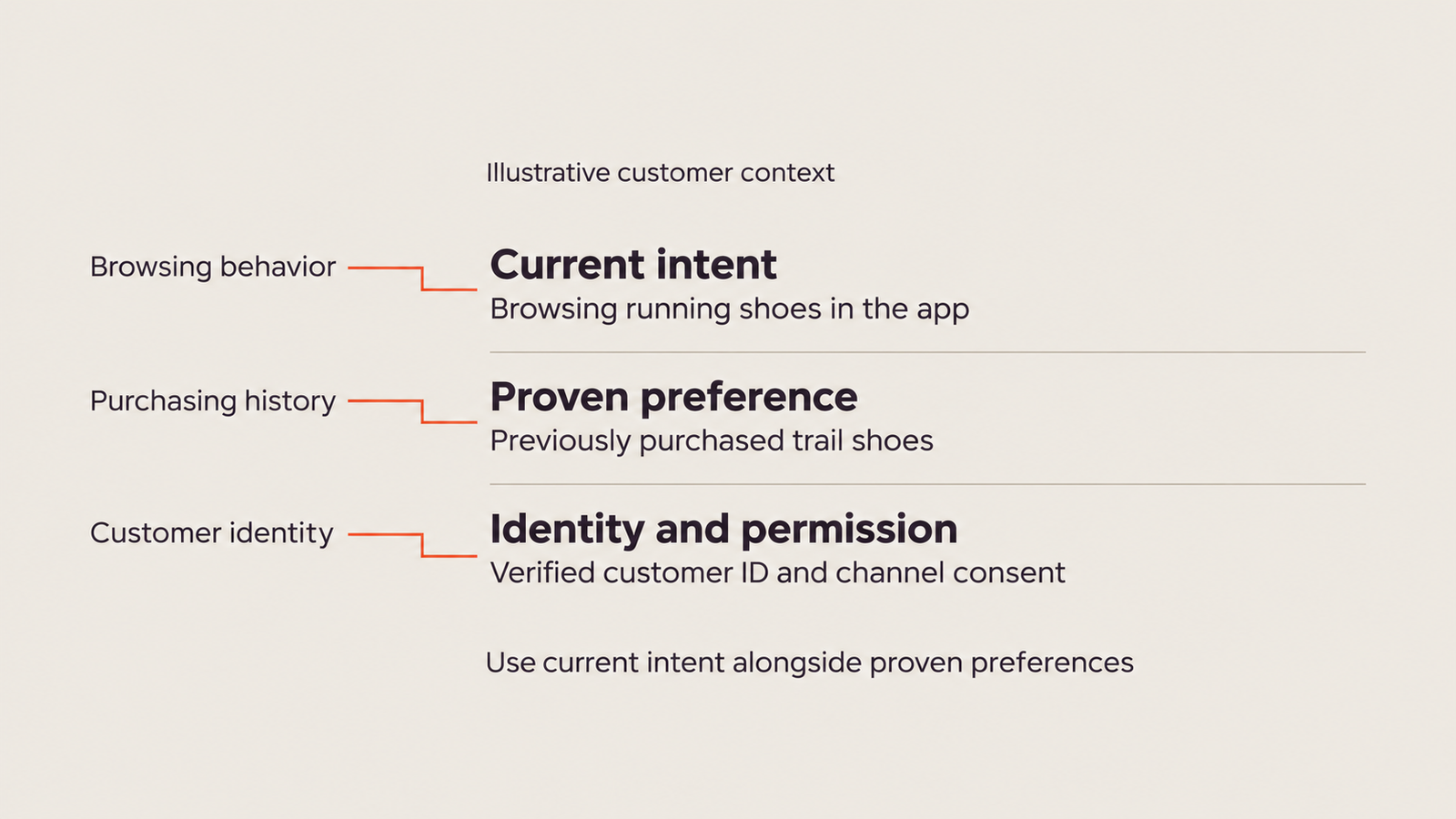
A shopper browses running shoes on your app, bought trail shoes from you eight months ago, and reads your newsletter on a work laptop. To many systems, that is three different people. AI personalization based on purchasing history only works when those records are recognized as one customer, and when the model knows how much weight to give what someone bought before versus what they are looking at now.
This guide explains how AI personalization combines browsing behavior, purchase history, and customer identity into one decision. It covers what each data source contributes, how identity resolution connects anonymous sessions to known buyers, how to handle signals that contradict each other, and how to measure whether the approach is working.
How AI personalization combines purchasing history, browsing, and identity
AI personalization works through a sequence. It collects behavioral events and transactions, resolves them to a single customer profile, turns that profile into features such as category affinity and purchase frequency, scores what the customer is likely to want next, and then selects the product, content, offer, or channel to use. Each data source answers a different question.
| Data source | Question it answers | Typical signals | Strength | Limitation |
| Browsing behavior | What is this person interested in right now? | Product and category views, site searches, add-to-cart events, time on page, device | Fresh and available for anonymous visitors | Short-lived; can reflect research or gift shopping |
| Purchasing history | What has this person valued enough to pay for? | Products and categories bought, order value, purchase frequency, time since last order, discount use, returns | High-confidence signal of preference and value | Backward-looking; can over-promote items the customer no longer needs |
| Customer identity | Who is this, and what are we allowed to do? | Email, phone number, customer or loyalty ID, app and device IDs, attributes, consent, stated preferences | Connects channels and devices into one record | Only as accurate as the identifiers collected and the merge rules |
Browsing behavior: Real-time intent
Browsing is the only signal available from the first page view, which makes it the foundation for personalizing anonymous traffic. A few category views in one session say more about immediate intent than a purchase from last year. The signal fades quickly, though, and a single session can mislead: someone comparing laptops for a parent looks the same as someone shopping for themselves.
Purchasing history: Proven preference and value
Purchase data is the highest-confidence signal most brands own because it reflects money spent, not curiosity. The useful features go well beyond a list of past orders:
- Recency, frequency, and monetary value (RFM)
- Category and brand affinity across orders
- Price band and discount sensitivity
- Typical time between purchases, which reveals replenishment cycles
- Returns, which show what not to recommend again
These features let a model separate a loyal full-price buyer from an occasional deal-driven shopper, even when both browse the same product today.
Customer identity: The record that connects everything
Identity is the set of identifiers (email address, phone number, customer or loyalty ID, app and device IDs), together with attributes and consent status, that link activity to one person. It does not personalize anything by itself. Its job is to make sure the session on a phone and the order placed on a laptop end up in the same profile, and that each channel only uses data the customer agreed to share.
How identity resolution connects anonymous browsing to purchase history
Many visitors browse without logging in, so a large share of the behavioral data you collect starts out anonymous. Identity resolution is the process that turns that activity into part of a known customer’s history:
1. Anonymous profile: When someone browses without identifying themselves, the platform creates an anonymous profile and records events against it.
2. Identification: The visitor shares an identifier, for example by logging in, checking out, subscribing to a newsletter, or clicking a link in a tracked email.
3. Matching: The identifier is checked against existing profiles. Deterministic matching relies on exact identifiers such as a verified email address or customer ID. Probabilistic matching infers likely matches from device and behavior patterns and carries a higher risk of joining the wrong records.
4. Merging: When a match is found, the anonymous session history joins the known profile, so browsing that happened before login now sits next to the customer’s purchase history.
In Insider One, an anonymous profile is created when someone browses as a guest. When the user later provides an identifier such as an email address, it is matched against the Unified Customer Database, matching profiles are merged, and the merged profile’s events are carried over with their original timestamps, please see Insider One Academy documentation on Identity Resolution Management for further reading.
Identity mistakes that weaken personalization
- Using a shared or placeholder value as an identifier: Insider One’s guide to how identifiers work gives the example of a hardcoded placeholder email in a faulty integration, which could merge many users into one profile. It recommends a unique, non-guessable ID generated by your own system as the top-priority identifier.
- Collecting identifiers late: If the first identifier appears at checkout, every earlier session from a new customer stays anonymous until then. Newsletter sign-ups, wishlists, and back-in-stock alerts give visitors earlier reasons to identify themselves.
- Leaving offline purchases out: Store and call-center orders that never reach the profile make purchase history look thinner than it is and lead to recommendations for items the customer already owns.
- Treating households as individuals: Shared accounts and devices mix several people’s preferences into one profile. Signals such as widely different size or age-group purchases are worth checking before a model treats them as one person’s taste.
Turning combined customer data into a personalization decision
Once identity is in place, the decision itself follows a repeatable framework:
1. Collect events and transactions in one place: Stream web and app events in real time and bring in orders from your ecommerce platform, point-of-sale system, and data warehouse.
2. Resolve identity so all of that activity attaches to one profile.
3. Compute features such as RFM scores, category affinity, discount affinity, and days since last purchase compared with the customer’s usual cycle.
4. Score likely outcomes. Propensity models predict actions such as purchase or churn. Recommendation models (collaborative filtering, product similarity, frequently bought together) predict which items fit.
5. Apply business rules. Exclude out-of-stock products, items the customer is unlikely to rebuy, and any use of data that consent does not cover.
6. Activate in the right channel: on-site and in-app recommendations, search results, email, push notifications, SMS, or WhatsApp.
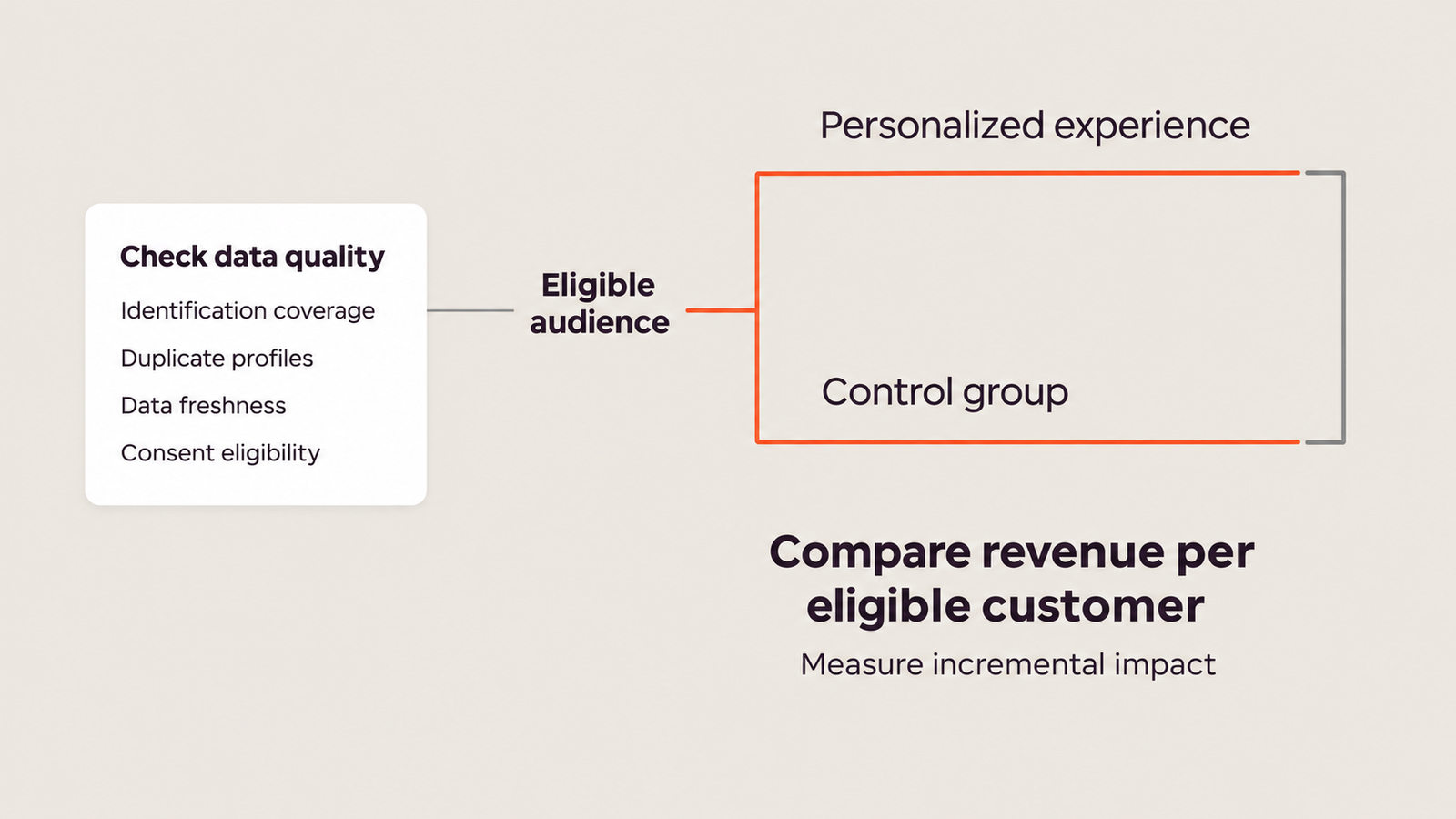
7. Measure against a holdout group and feed results back into the models and rules.
This mirrors what McKinsey’s personalization research describes among outperformers: they use behavioral, transactional, and engagement data, apply propensity and next-best-action models to decide what to serve, and measure the impact of each intervention. The same 2021 report found that personalization most often drives a 10 to 15 percent revenue lift, with company-specific results ranging from 5 to 25 percent depending on sector and execution.
What to do when browsing and purchase history disagree
Most guides treat browsing and purchase data as signals that point the same way. In practice they often conflict, and a model left to resolve every conflict on its own can produce recommendations that feel off. These are common scenarios and a sensible default for each:
| Scenario | What the signals say | Better approach |
| Recent durable purchase | Bought a refrigerator last week and is still browsing refrigerators | Suppress the category for a set period and recommend accessories, care products, or warranties. The browsing may be post-purchase comparison or a return in progress. |
| Replenishment due | Bought a 30-day skincare product 26 days ago, with no recent browsing | Let purchase cadence lead. Send a reminder near the customer’s usual reorder point. |
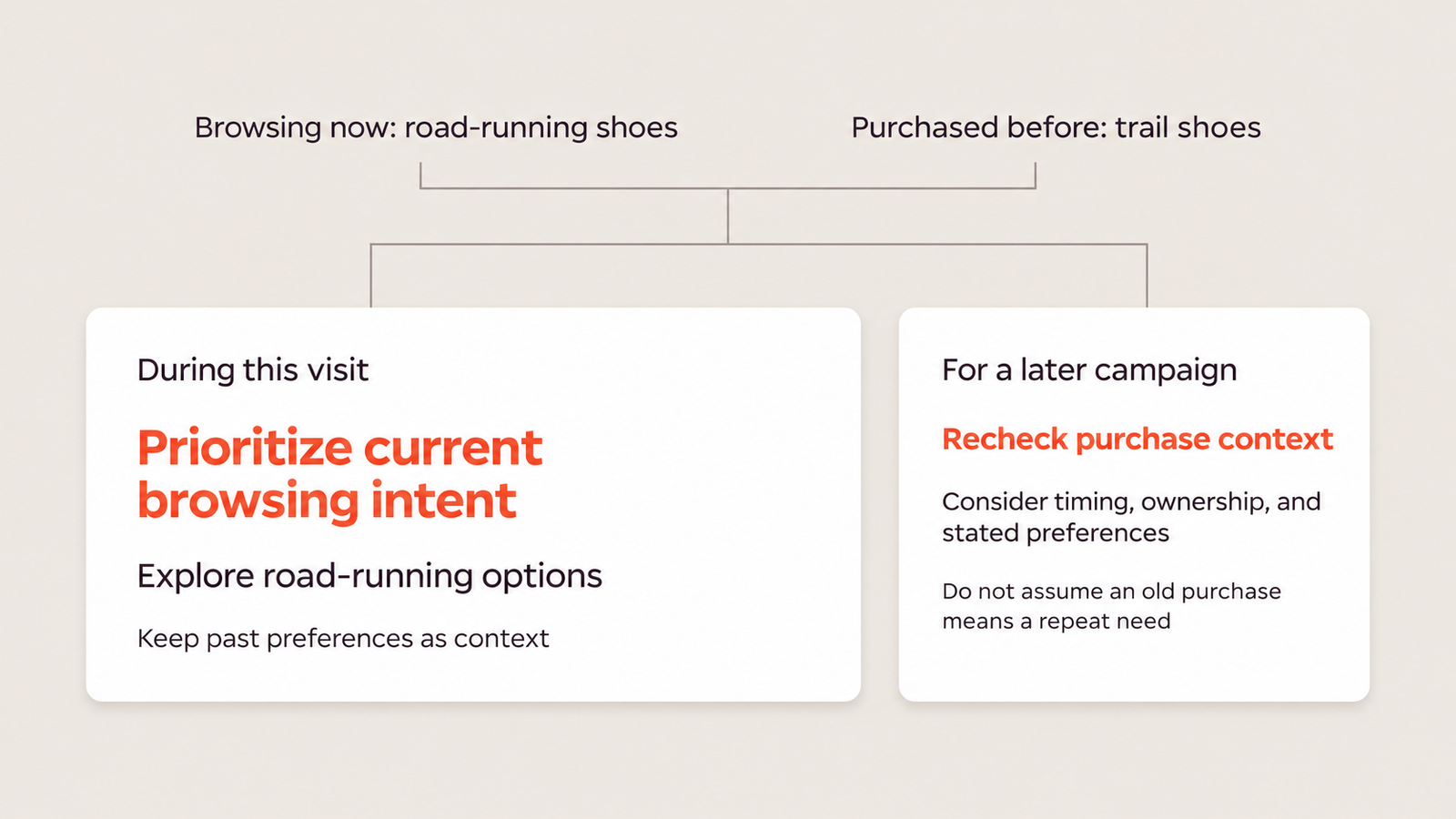
| Gift shopping | Years of menswear purchases, now browsing toys | Weight the current session heavily for on-site recommendations, but do not rewrite long-term affinity from one visit. |
| Lasting category shift | Several sessions over a few weeks in a new category | Let repeated browsing update category affinity and blend it with purchase history. |
| Price mismatch | Usually buys on promotion, now browsing full-price premium items | Show the browsed items, then test whether a targeted incentive or a lower-priced alternative converts better. |
| Returned item | Returned a product and is browsing similar ones | Exclude the returned item and close substitutes in size- or fit-sensitive categories, and show alternatives. |
A practical default is recency weighting by use case. In-session behavior carries the most weight for on-site and in-app recommendations, while purchase history carries more weight for retention messages such as replenishment and win-back. Write the exceptions above as explicit rules the team can review, rather than leaving them hidden inside a model.
How personalization changes across the customer lifecycle
The data available about a customer grows over time, and the personalization approach should grow with it.
| Lifecycle stage | Data available | Personalization approach |
| First visit, anonymous | Session browsing, referral source, device | Best sellers and trending items that adapt to in-session clicks |
| Returning, still anonymous | Browsing across sessions on the same device | Recently viewed items, a category-led homepage, prompts to sign up or save items |
| Identified, no purchase yet | Browsing plus an identifier and consent | Browse-abandonment email or push, price-drop and back-in-stock alerts |
| First-time buyer | One order plus browsing | Frequently bought together, product onboarding content, a second-purchase incentive tested against no incentive |
| Repeat customer | Full purchase history | Replenishment reminders, loyalty offers, new arrivals in preferred categories |
| Lapsing customer | Purchase history with declining activity | Win-back messages based on past categories and price band, with frequency limits |
Adidas applied this staged logic on its homepage with Insider One’s Smart Recommender. New users saw best sellers, frequent browsers received recommendations based on their browsing behavior and preferences, and recent purchasers saw frequently-bought-together products. Adidas reported an 18.8% increase in revenue per user in one month and a 13% lift in homepage conversion rate. In the same case study, Category Optimizer reordered the mobile menu based on browsing history, increasing products viewed per session on mobile by 67.3%.
Philips took a similar approach on product pages, showing visitors recommendations based on their past behavioral data and preferences with Smart Recommender, and reported a 40.1% increase in conversion rate.
Privacy, consent, and the line between relevant and invasive
Customers expect brands to use what they know. McKinsey’s 2021 survey found that 71% of consumers expect personalized interactions, 76% get frustrated when they do not get them, and 72% expect the businesses they buy from to recognize them as individuals and know their interests. Expectation is not the same as permission, so the way purchase and browsing data is used matters as much as the model.
- Store consent with the profile and check it before activation in every channel, not only at collection.
- Use data customers would expect you to have. Recommending accessories for a product someone bought from you is expected. Inferring sensitive circumstances, such as health, pregnancy, or financial difficulty, from purchases is where personalization starts to feel intrusive. Exclude sensitive categories from inference.
- Set retention periods for event and profile data instead of keeping everything indefinitely.
- Cap frequency across channels, so a strong purchase signal does not turn into the same offer arriving by email, SMS, and push on the same day.
- Check data quality before blaming the model. In Twilio Segment’s State of Personalization Report 2024, 61% of companies said they were concerned that inaccurate data compromises the effectiveness of AI and machine learning for personalization.
Rules differ by market. Regulations such as the GDPR in the EU and the CCPA in California set requirements for consent, transparency, and opt-outs, so confirm your approach with your legal and privacy teams.
How to measure whether combined personalization is working
Track two groups of metrics. Business metrics show whether personalization pays off. Data health metrics show whether the profile underneath is reliable enough to trust those results.
Business metrics:
- Revenue per user or per visitor
- Conversion rate and average order value
- Repeat purchase rate and time between orders
- Customer lifetime value
Data health metrics:
- Identification rate: the share of sessions, or of revenue, tied to a known profile
- Duplicate profile rate: how often one customer appears as several profiles
- Order linkage: the share of orders, including offline orders, attached to a profile that also has browsing history
- Recommendation coverage: the share of visitors who receive personalized recommendations rather than fallbacks
- Data freshness: the time from an event happening to it being available for decisions
If business metrics stall while the identification rate is low, the fix usually sits in data collection and identity rules, not in the model.
How Insider One brings browsing, purchases, and identity together
Insider One connects these layers on one platform, so the profile that collects behavior is the same one that powers decisions and messages.
- Customer Data Management builds unified customer profiles from 100+ integrations and bidirectional data warehouse connections, with flexible identity resolution management, consent management, and adjustable data retention.
- AI personalization provides real-time and predictive segments, 120+ rules and attributes, and Smart Recommender with 20+ recommendation strategies, including bought together and user-based, that combine product attributes with user affinity.
- Site search personalizes results based on past and predicted behaviors.
- Journey Orchestration uses the same profile to coordinate messages across email, SMS, WhatsApp, push, and on-site experiences.
For related approaches, see our guides to predictive personalization, cross-channel personalization, and AI decisioning.
See how your customer data comes together
Personalization based on purchasing history is only as strong as the profile behind it. To see how your browsing events, order data, and identifiers would come together in Insider One, request a demo and review your data sources and identity setup with our team. If you prefer to explore on your own first, the Product Demo Hub offers self-guided tours with no forms.
Frequently Asked Questions
Common inputs include product and category views, site searches, cart activity, email and push engagement, app usage, device and location context, and preferences customers state directly, such as favorite categories or sizes. Customer service interactions and loyalty status can also be used when those systems are connected to the profile.
This is known as the cold-start problem. Models rely on session behavior, referral source, device, and product popularity, and update recommendations with each click in the session. Giving visitors early reasons to identify themselves, such as saving items or signing up for alerts, shortens the time until purchase history can be used.
There is no fixed threshold. A single order is enough for frequently-bought-together recommendations, while replenishment timing needs several orders from the same customer to establish a cycle. Predictive models learn from historical data across your whole customer base, so a customer with one order still benefits from patterns found in similar customers.
It depends on the product. Exclude durable items such as appliances or furniture for a period after purchase, promote consumables near their reorder point, and allow repeat recommendations in categories where customers often rebuy the same item, such as basics or favorite foods.
Yes, if store transactions carry an identifier such as a loyalty ID, phone number, or email receipt, and are sent to the customer profile through an API or data warehouse connection. Without an identifier, offline purchases cannot be linked to online behavior.
Identity resolution is one capability: matching and merging identifiers so activity belongs to the right person. A customer data platform (CDP) includes identity resolution, but also collects data from many sources, maintains unified profiles, builds segments, and makes those profiles available for activation in other systems and channels.
Personalization with first-party purchase data is widely used, but what is permitted depends on the jurisdiction, the legal basis for processing, and how consent and transparency are handled. Laws such as the GDPR and the CCPA include rights to access, delete, and opt out. Confirm your approach with your legal team.

Keep Reading
4 min.

Chris Baldwin
3 Feb 2026
10 mins.
Chris Baldwin
18 Nov 2026
10 mins.

Nicolas Algoedt
18 Nov 2026