

 Platform Overview


 Integration Hub


 Agent One™


 Agent One™ Teams


 Customer Data Management


 Personalization


 Journey Orchestration


 Reporting & Data


 Behavioral Analytics


 Web


 Email


 Site Search


 Conversational CX


 WhatsApp


 Web Push


 InStory


 App


 SMS & RCS


 Join the $0 Migration Movement™


 The Insider One Difference


 Compare Vendors


 Switch to Insider One


 Success Story


 Retail & Ecommerce


 Financial Services


 Travel & Hospitality


 Beauty & Cosmetics


 Automotive


 Telecommunications


 Total Economic Impact™ Study


 Blog


 E-Books & Guides


 Events


 Glossary
How to prevent over-messaging in omnichannel marketing without losing reach

Updated on 11 Nov 2026
9 mins.
Table of Contents
Most Popular
Summary
- Over-messaging happens when email, push, SMS, and in-app teams each hit their own targets without visibility into what other channels already sent
- A defensible frequency cap comes from your own unsubscribe and opt-out trends, not a flat industry rule
- As a governance practice, sequence messages deliberately and choose the most appropriate channel for the context instead of broadcasting everywhere; validate any next-best-channel automation during implementation
- Frequency drift needs a named owner with authority to enforce limits across teams, not just a shared spreadsheet
- Track click-through stability, opt-out rate, and re-engagement after a pause, then re-test caps on a quarterly review cadence
Over-messaging in omnichannel marketing is what happens when email, push, SMS, and in-app teams each hit their own weekly send target without knowing the same customer already received three messages from someone else’s channel that day. No single team did anything wrong by their own metrics, yet the customer experienced a pile-up.
This article is for lifecycle, customer relationship management (CRM), and marketing operations leaders running email, push, SMS, and in-app campaigns through a customer data platform (CDP) or engagement platform, where channel teams operate with real but incomplete autonomy.
You’ll learn why treating frequency capping as a single number misses the real problem, how to set a cap your customers will actually tolerate, how suppression and sequencing rules work alongside that cap, and how Insider One brings unified customer profiles, audience segmentation, cross-channel personalization, journey orchestration, messaging, and analytics together to support coordinated engagement.
Why adding channels quietly turns into noise
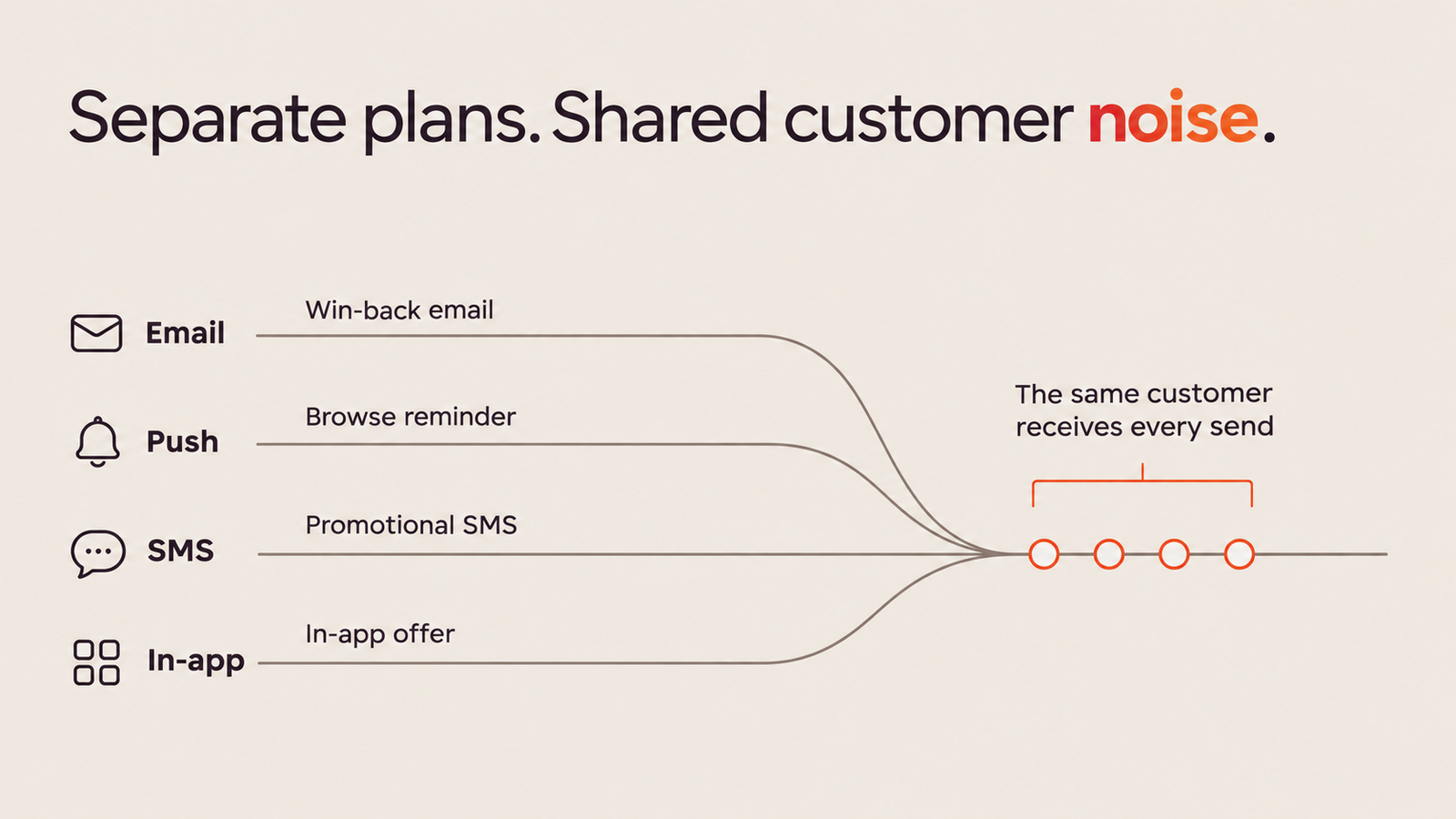
Adding a new channel rarely causes over-messaging by itself. The problem starts when each channel team manages its own send calendar, its own triggers, and its own success metric, with no shared view of what the customer is receiving everywhere else at the same time.
How siloed ownership stacks overlapping sends
Email teams optimize for open rate, push teams optimize for click-through, and SMS teams optimize for conversion, so each group schedules sends that look reasonable in isolation. A customer who qualifies for a win-back email, a browse-abandonment push, and a promotional SMS on the same day can receive all three, because no team owns the view across channels that would catch the overlap before it ships.
Why single-channel dashboards hide cumulative fatigue
A channel-level engagement report can look healthy even as a customer is quietly disengaging across the account. Email open rates might hold steady while push opt-outs climb, because the real driver is cumulative volume, not any one channel’s creative or timing.
Fatigue only becomes visible once you look at total touches per customer, across every channel, over a rolling window rather than a single send.
Setting a frequency cap customers will actually tolerate
The right starting cap comes from your own customer behavior, not a number borrowed from a blog post or a competitor’s documentation. Opt-out and unsubscribe trend lines tell you where tolerance actually breaks, which is a more honest signal than any flat industry benchmark.
Use your own unsubscribe and opt-out trends, not a benchmark
Plot opt-out rate against total weekly touches per customer segment, and look for the volume threshold where the curve bends upward. That inflection point, not an arbitrary round number, is your defensible starting cap. See the linked Mediamarkt customer story for context on push notification timing and volume.
Global caps and channel-specific caps need to coexist
A global cap across all channels can help prevent the cumulative pile-up described above, but it cannot replace channel-specific governance because email, push, and SMS carry different fatigue thresholds and regulatory expectations. Journey Orchestration uses unified customer data to support cross-channel journeys; teams should validate their chosen cap and channel-governance controls during implementation rather than assume a specific global-plus-channel configuration.
Building suppression and sequencing rules between channels
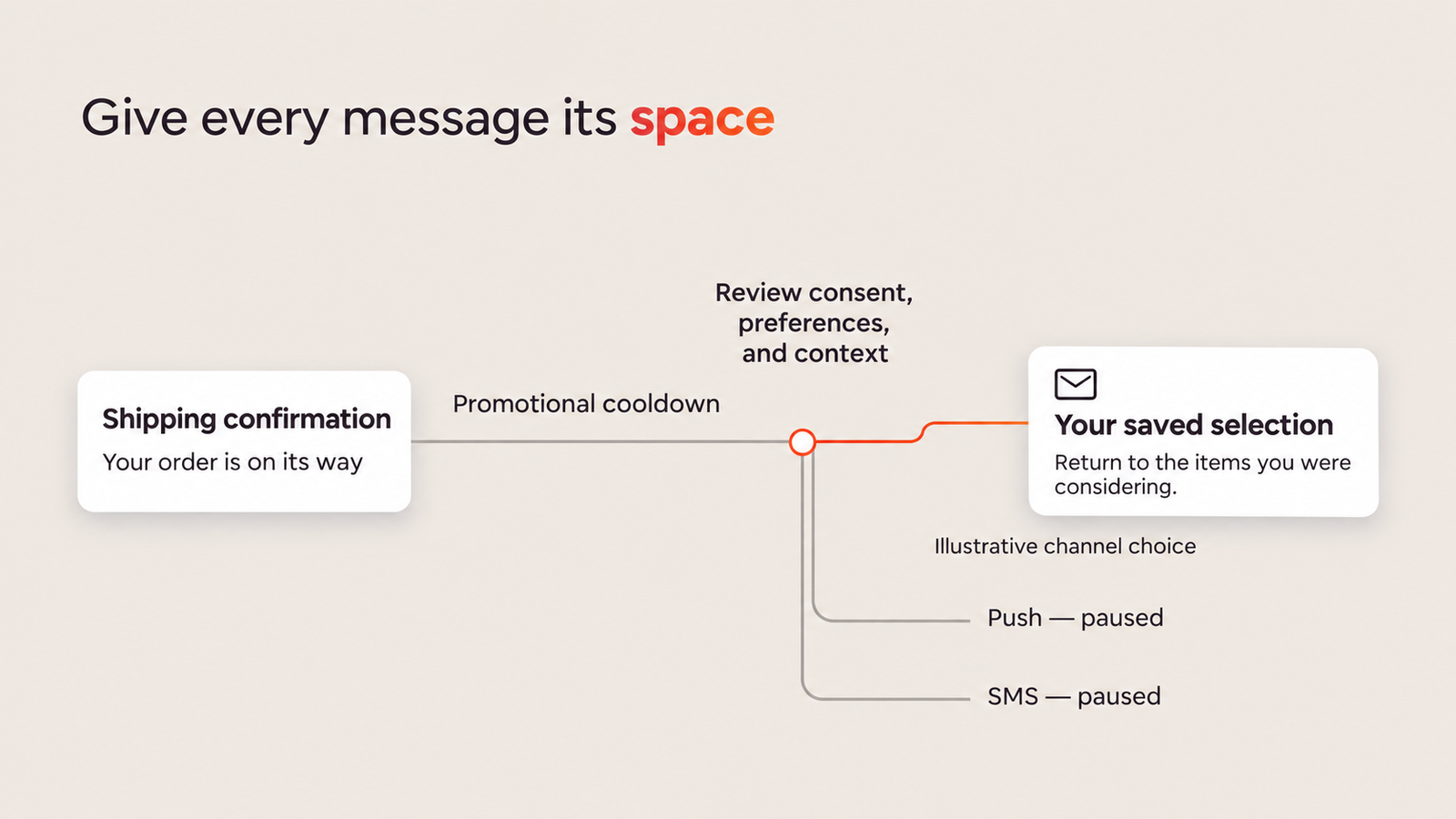
Capping frequency controls how often a customer hears from you. Suppression and sequencing control what they hear and in what order, which is where most of the real fatigue reduction actually happens, well before you ever touch the cap number itself.
Cooldown windows after transactional messages
A shipping confirmation or payment receipt is not a marketing opportunity, and stacking a promotional send directly on top of one reads as tone-deaf regardless of how relevant the offer is.
Building a short cooldown window, typically a few hours to a full day depending on the channel, after any transactional message keeps promotional volume from compounding on top of service communications the customer actually needed.
Next-best-channel logic instead of broadcasting everywhere
Instead of sending the same abandoned-cart message across email, push, and SMS simultaneously, teams can use customer attributes, events, consent signals, and journey context to choose an appropriate channel and define which other sends should be paused under their governance policy. See the linked Aramex customer story for cross-channel targeting work.
Consent and preference signals should be incorporated into communication-governance policies. When a customer opts out of SMS, teams should review how that preference affects overlapping journeys on other channels, subject to channel-specific consent requirements and configuration.
Who actually owns the global send policy
Frequency caps drift back upward almost every time, not because anyone decides to break the rule, but because no single person has the authority to say no when a new campaign request threatens to exceed it. That gap is organizational, not technical.
Frequency drift is an organizational gap, not a technical one
A cap set in a platform configuration screen holds only as long as every team respects it, and respect fades under quarterly pressure to hit a revenue number. The fix is a named governance owner, typically a lifecycle or CRM lead, with explicit authority to reject or delay a campaign that would push a customer segment over its limit, regardless of which team requested it.
A centralized view catches creep before it hits unsubscribe rates
That owner needs a consistent review process for messaging patterns, campaign impact, and opt-out trends across channels, updated often enough to catch creep before it shows up in customer feedback.
Reporting and analytics tools help teams measure campaign impact and examine cross-channel messaging patterns, while teams validate the reporting views available for their implementation. For additional background on AI-assisted marketing, consult the AI decisioning guide.
Proving the fix is working instead of just assuming it is
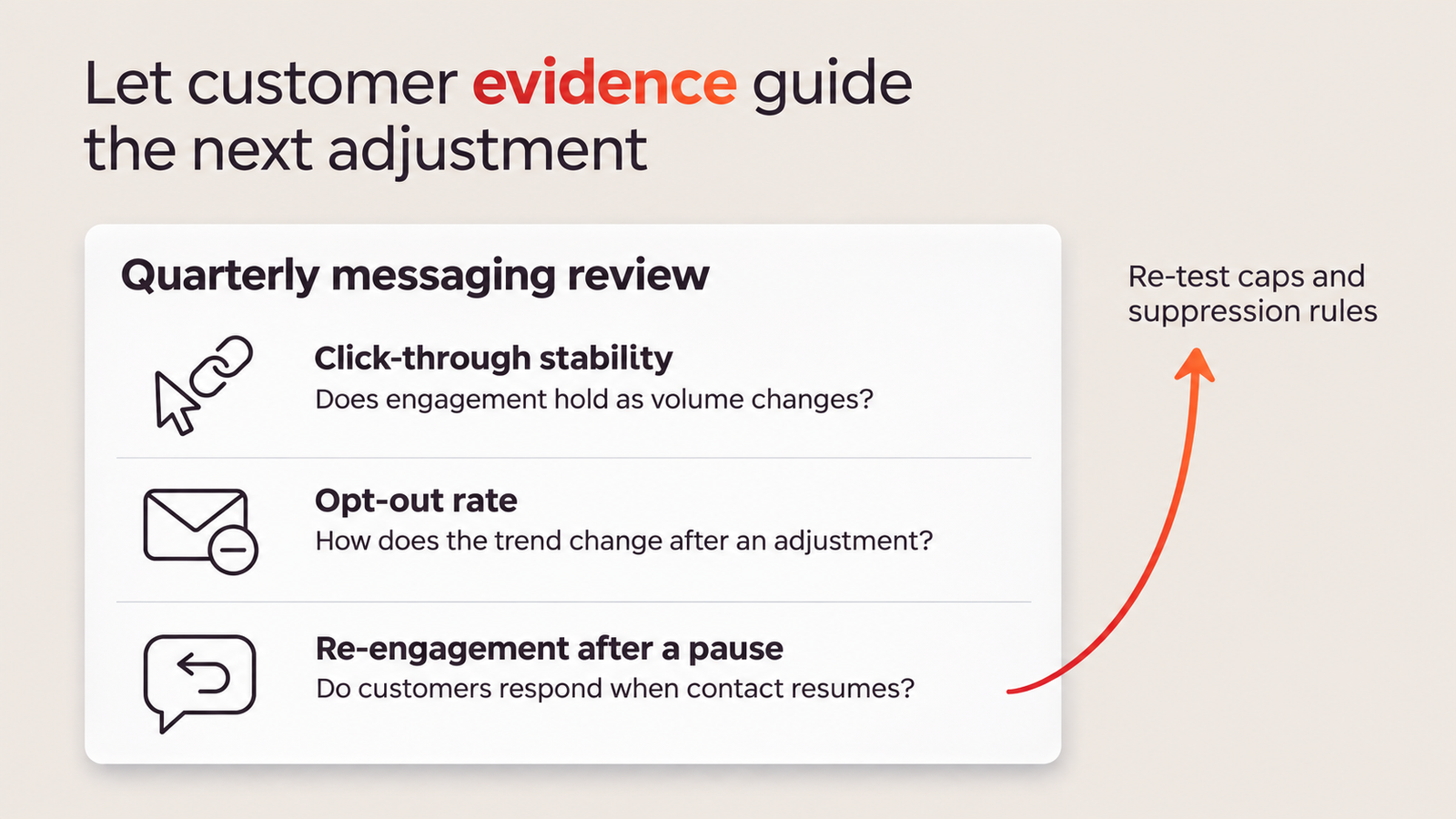
Lowering a cap and calling it solved is a common mistake, because the only way to know whether a cap and its suppression rules are actually calibrated is to watch what customer behavior does afterward, not just what the campaign calendar looks like.
Watch click-through stability, opt-out rate, and re-engagement after a pause
Three signals matter more than any single open-rate number: whether click-through rate holds steady as volume changes, whether opt-out rate trends down after a cap adjustment, and whether customers who went quiet for a few weeks re-engage once contact resumes. If re-engagement after a pause is strong, the pause length was probably right. If it’s weak, the gap was likely too long.
Run a structured review cadence as channel mix changes
Caps and suppression rules calibrated for three channels stop being accurate the moment a fourth channel launches or campaign volume doubles for a seasonal push. A quarterly review, owned by the same person accountable for the global policy, should re-test thresholds against current opt-out and engagement data rather than assuming last year’s numbers still hold.
See the linked Slazenger customer story for omnichannel engagement.
Conclusion
Over-messaging is a governance problem wearing a technical disguise. Raising or lowering a send-limit number without assigning ownership, suppression logic, and a review cadence just moves the same fatigue somewhere else. The brands that keep reach without burning out their list treat frequency as a shared policy, not a per-channel setting.
To evaluate the fit of Journey Orchestration and customer data management for your use case, book a personalized demo to review your goals, data requirements, and implementation constraints with the Insider One team.
Frequently Asked Questions
Frequency capping limits how many messages a customer can receive in a given period. Suppression rules are governance policies that determine which messages should be paused based on context, such as a recent transactional email or a consent and preference signal, subject to channel configuration. Caps control volume; suppression controls relevance and sequencing between channels.
Review caps at least quarterly, and immediately after adding a new channel or significantly increasing campaign volume. Caps calibrated for one channel mix stop reflecting reality once a brand’s communication footprint changes, so a fixed cadence catches drift before opt-out rates reveal the problem.
A lifecycle or CRM lead with explicit authority to reject or delay campaigns that would exceed agreed limits, regardless of which team submitted them. Ownership without enforcement authority tends to fail, since individual channel teams will keep prioritizing their own targets without a shared check.
Not reliably on its own. Opt-outs often respond more to message relevance and timing, such as sends stacking right after a transactional message, than to the raw number of touches. Suppression and sequencing rules frequently reduce fatigue more than tightening the cap number alone.
It’s considerably harder, because coordinated suppression and sequencing policies depend on shared customer data, including relevant attributes, events, and channel context. Without that shared customer data layer, teams typically find out about overlapping sends after the fact rather than preventing them in the first place.

Keep Reading
4 min.

Chris Baldwin
3 Feb 2026
11 mins.
Chris Baldwin
11 Nov 2026
8 min.
Chris Baldwin
10 Nov 2026