

 Platform Overview


 Integration Hub


 Agent One™


 Agent One™ Teams


 Customer Data Management


 Personalization


 Journey Orchestration


 Reporting & Data


 Behavioral Analytics


 Web


 Email


 Site Search


 Conversational CX


 WhatsApp


 Web Push


 InStory


 App


 SMS & RCS


 Join the $0 Migration Movement™


 The Insider One Difference


 Compare Vendors


 Switch to Insider One


 Success Story


 Retail & Ecommerce


 Financial Services


 Travel & Hospitality


 Beauty & Cosmetics


 Automotive


 Telecommunications


 Total Economic Impact™ Study


 Blog


 E-Books & Guides


 Events


 Glossary
Omnichannel Retail Marketing: What It Really Takes to Unify the Experience

Updated on 11 Nov 2026
11 mins.
Table of Contents
- Summary
- What omnichannel retail marketing actually means (and why multichannel isn't the same)
- The omnichannel execution gap: why retailers think they're further along than they are
- The technology backbone: customer data platform, identity resolution, and cross-channel orchestration
- Best practices that separate omnichannel leaders from laggards
- Proving ROI: Metrics, benchmarks, and a phased rollout plan
- Conclusion
- Frequently Asked Questions
Most Popular
Summary
- True omnichannel retail marketing needs a single customer identifier, timely availability and order signals from connected retail systems, and consistent messaging across channels, not just parallel campaigns running at the same time.
- Multichannel programs operate channels independently; omnichannel programs connect them so a customer’s history follows them from app to store to inbox
- The real gap sits in data and orchestration maturity behind the scenes, not in how many channels a brand has switched on
- A customer data platform (CDP) paired with cross-channel journey orchestration provides the connected data and coordination needed for more relevant customer experiences instead of isolated channel decisions.
- A phased pilot-measure-expand rollout proves return on investment faster and with less risk than a full platform relaunch
A retailer can run email, SMS, app push, and in-store promotions every week and still fall short of omnichannel retail marketing if those channels do not share one customer record and timely signals from connected commerce, inventory, loyalty, and point-of-sale systems.
Omnichannel retail marketing means every touchpoint, digital or physical, can use a unified customer profile and connected customer signals, rather than operating as separate campaigns that happen to launch in the same quarter.
This matters because customers notice the seams: a loyalty tier that resets at checkout, an offer that contradicts the in-store price, a support agent with no visibility into a recent online order.
This article is for retail and ecommerce marketing leaders, lifecycle and customer relationship management (CRM) managers, and chief marketing officers evaluating or scaling an omnichannel program with an AI-powered Growth
Management Platform that brings unified customer data, personalization, journeys, recommendations, experimentation, analytics, conversational CX, and agentic AI capabilities together.
You’ll get a clear definition that separates omnichannel from multichannel, a framework for diagnosing where your own stack actually sits on the maturity curve, and a rollout sequence that builds proof before you commit to a full-scale relaunch.
What omnichannel retail marketing actually means (and why multichannel isn’t the same)
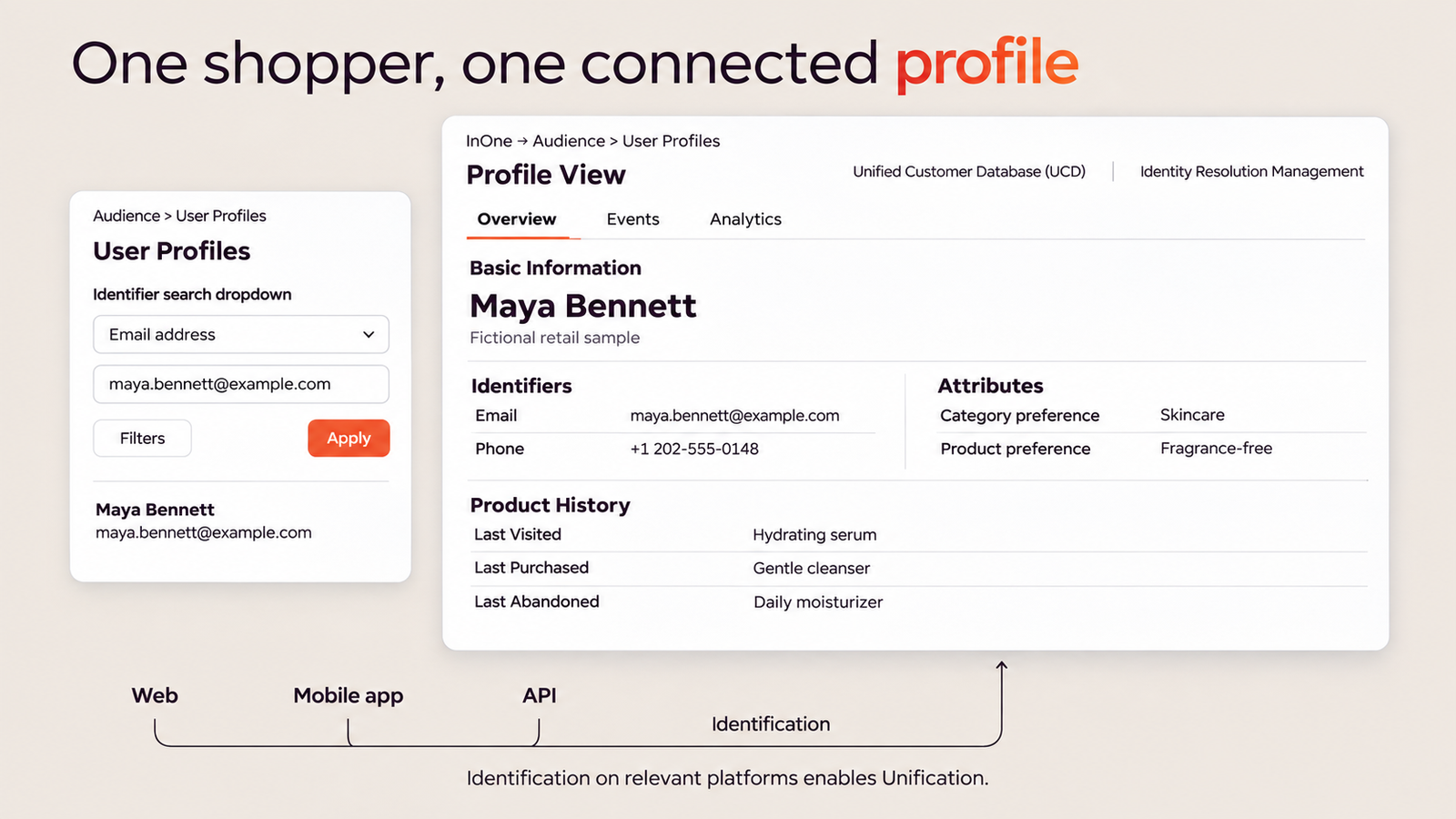
Omnichannel retail marketing means a customer’s identity, behavior, and transaction history can inform coordinated experiences across channels through a unified customer profile and connected data. Multichannel marketing means a brand is present on multiple channels, but each one operates with its own data, rules, and cadence.
The difference shows up fast in practice: a multichannel retailer sends an app push and an email about the same promotion without using a connected purchase signal to recognize that the customer already bought the item in-store. An omnichannel retailer can use a timely purchase signal from connected systems to suppress that message and begin a more relevant follow-up journey.
Multichannel vs. omnichannel vs. cross-channel, in practice
Concrete retail scenarios make the distinction clearer than definitions alone:
- Buy online, pick up in store (BOPIS) works best when timely inventory, order-status, and loyalty signals from ecommerce and point-of-sale systems inform the experience
- A connected commerce experience can let a shopper add an item on mobile and complete the purchase on desktop while preserving cart contents or applied discounts when the underlying systems support it.
- Consistent cross-channel pricing depends on connected commerce and pricing systems providing aligned promotional information across email, app, store, and checkout experiences.
Our guide on omnichannel vs multichannel marketing goes deeper into how these models diverge operationally, not just conceptually.
The three non-negotiables
Three capabilities separate genuine omnichannel execution from channel sprawl dressed up with a strategy deck. A retailer needs a single customer identifier that unifies behavior across devices and touchpoints, timely availability and order signals from connected retail systems so customer-facing promises stay accurate, and consistent messaging logic that prevents one channel from contradicting another.
Without all three working together, additional channels add noise rather than value.
The omnichannel execution gap: why retailers think they’re further along than they are
The execution gap is the distance between feeling omnichannel and operating that way. Many retail marketing teams report confidence in their omnichannel maturity based on channel count alone: they have email, SMS, app, web, and in-store programs running concurrently. Confidence built on channel presence rarely survives a closer look at what happens behind the scenes when those channels are asked to share a timely customer view using connected data.
That confidence gap usually traces back to three structural root causes. Martech stacks grow in silos, with each channel tool purchased and implemented separately over several years, so none of them were ever designed to share data by default. Customer relationship management and CDP data stay disconnected because transactional systems, loyalty platforms, and marketing tools were never stitched into one profile.
Loyalty programs compound the problem when status and points don’t carry across channels, so a top-tier customer gets treated like a first-time visitor the moment they switch from app to store. Our breakdown of omnichannel customer experiences explores how these gaps surface for the shopper, not just the marketing team.
The technology backbone: customer data platform, identity resolution, and cross-channel orchestration
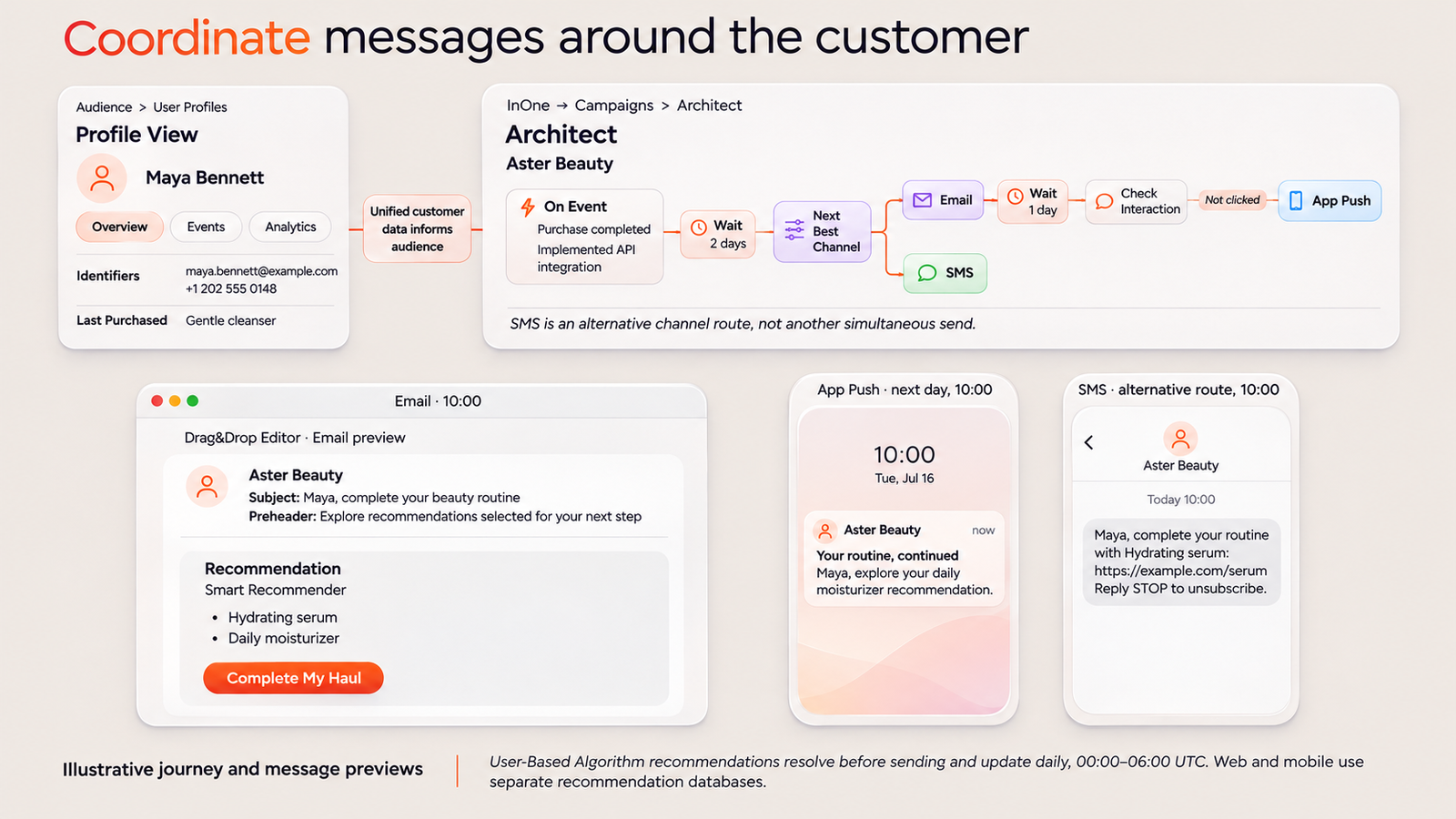
A customer data platform (CDP) can help close the execution gap by bringing connected behavioral, transactional, and channel-level data into a unified customer profile, subject to the availability and quality of source-system data.
Instead of a shopper existing as five fragmented records across email, mobile, web, and point-of-sale systems, unified customer data brings connected behavioral, transactional, and customer signals into a single profile. Insider One’s Customer Data Management layer supports this kind of unification across retail touchpoints.
Unified data becomes valuable when it informs relevant cross-channel experiences.
Insider One’s Journey Orchestration capability can use connected customer signals to coordinate cross-channel journeys instead of firing parallel campaigns that collide or contradict each other. If a customer just completed a purchase in-store, orchestration logic can suppress a cart-abandonment email and begin a post-purchase journey instead.
Agent One can plan, execute, learn from, and optimize customer engagement toward defined goals, helping teams continuously improve the journeys they run. Watsons illustrates how a connected customer-engagement approach can support retail programs; see the Watsons customer story for details.
Best practices that separate omnichannel leaders from laggards
Map the journey and assign clear channel ownership
Leaders map the full customer journey across every touchpoint before they add a new channel, identifying exactly where each one should intervene and who owns that decision internally.
Without clear ownership, two teams end up messaging the same customer about the same offer through different channels on the same day, which erodes trust faster than silence would. Assigning ownership at the journey-stage level, not the channel level, prevents that collision and keeps messaging coherent as the customer moves from awareness to purchase to retention.
Replace vanity metrics with shared cross-channel KPIs
Laggards still report email open rates and app session counts in separate dashboards that never talk to each other. Leaders replace those isolated, per-channel key performance indicators (KPIs) with shared metrics that reflect the whole customer relationship: customer lifetime value, repeat purchase rate, and cost per contact across all channels combined.
Carrefour provides a useful retail customer-story reference for teams moving from channel-level reporting toward more unified, customer-centric measurement. Our collection of omnichannel marketing examples shows how several retailers made that same shift from channel-level to customer-level reporting.
Proving ROI: Metrics, benchmarks, and a phased rollout plan
Retailers that attempt a full omnichannel relaunch in one move tend to underestimate how much their martech, data governance, and team structure need to change simultaneously. A phased rollout reduces that risk by starting with one channel pairing, such as email and app push, then using shared measurement to assess retention, repeat purchase, and customer experience before expanding further. This sequencing also gives the marketing team a concrete internal case study to justify the next phase of investment.
A practical rollout sequence looks like this:
- Pilot a single channel pairing with a defined customer segment and a clear success metric, such as repeat purchase rate within 60 days
- Measure lift against a comparable single-channel control group, isolating the effect of unified identity and orchestration from general marketing performance
- Expand to a third channel only once the pilot shows a measurable improvement, carrying the same unified profile and orchestration logic forward
Slazenger provides a relevant customer-story reference for teams considering an incremental omnichannel rollout rather than a single large-scale relaunch. For a deeper look at sequencing a broader retail program, our guide to omnichannel retail strategy covers how to structure that expansion beyond the first pilot.
Conclusion
Channel count was never the real measure of omnichannel maturity. The brands closing the execution gap are the ones that unify customer identity, use timely signals from connected retail systems, and coordinate journeys instead of running every channel in parallel.
That shift from presence to unification is what turns a crowded martech stack into a coherent customer experience, while personalization, recommendations, experimentation, analytics, and Agent One help teams improve it over time.
To evaluate the fit of our platform for your use case, book a personalized demo to review your goals, data requirements, and implementation constraints with the Insider One team.
Frequently Asked Questions
Multichannel means a retailer operates on several channels independently, each with its own data and rules. Omnichannel means those channels use a unified customer identity and connected signals to coordinate what the customer sees in email, app, web, and store experiences.
Check whether a customer’s loyalty status, cart contents, and purchase history are consistently available across channels based on timely data from connected systems, without manual channel-by-channel reconciliation. If teams manage channels in separate dashboards and messages sometimes contradict each other, the brand is operating multichannel with omnichannel branding rather than true unification.
A customer data platform (CDP) merges behavioral, transactional, and channel-level data into one profile per customer, resolving identity across devices and touchpoints. Without that unified profile, orchestration tools have no reliable data to act on, which is why most execution gaps trace back to fragmented or siloed customer data.
Piloting one channel pairing first, measuring lift against a control group, and expanding only after proving results reduces risk and builds internal confidence. A full-scale relaunch across every channel simultaneously makes it harder to isolate what’s working and increases the chance of costly implementation missteps.
Shared, cross-channel metrics like customer lifetime value, repeat purchase rate, and cost per contact reveal whether unification is paying off. Per-channel metrics such as email open rate or app session count can look healthy in isolation while the overall customer experience remains fragmented and inconsistent.

Keep Reading
4 min.

Chris Baldwin
3 Feb 2026
8 min.
Chris Baldwin
10 Nov 2026
13 min.
Chris Baldwin
10 Nov 2026