

 Platform Overview

 Integration Hub

 Agent One™

 Agent One Teams™

 Customer Data Management

 Personalization

 Journey Orchestration

 Reporting & Data

 Behavioral Analytics

 Web
Web

 Email
Email

 Site Search

 Conversational CX

 WhatsApp

 Web Push

 InStory

 App
App

 SMS & RCS

 Join the $0 Migration Movement™

 The Insider One Difference

 Compare Vendors

 Switch to Insider One

 Success Story

 Retail & Ecommerce

 Financial Services

 Travel & Hospitality

 Beauty & Cosmetics

 Automotive

 Telecommunications

 Total Economic Impact™ Study

 Blog
Blog

 E-Books & Guides

 Events

 Glossary
Personalization vs Segmentation: Which Strategy Wins?

Updated on 1 Jul 2026
14 min.
Table of Contents
- What is email segmentation?
- What is email personalization?
- Key differences between segmentation and personalization
- How to use segmentation and personalization together
- How Insider One unifies segmentation and personalization at scale
- Case studies and examples
- Do you need to use both segmentation and personalization?
- Frequently asked questions
Most Popular
The debate of personalization vs segmentation has moved beyond targeting tactics to become a core growth strategy.
Segmentation helps marketers group customers by shared traits like lifecycle stage, purchase history, or engagement patterns. Personalization goes further by adapting content, timing, and offers to the individual. That difference matters more now because AI has changed what brands can do at scale.
Customer expectations have kept pace. Recent data shows that 71% of consumers prefer personalized experiences, while 76% are frustrated by generic interactions. Yet, 84% of marketers still run generic campaigns, even as AI adoption rises.
This gap is where confusion around email segmentation vs personalization shows up. Segmentation targets groups. Personalization responds to each customer’s context, intent, and behavior in real time.
Platforms like Insider One are built to support both, helping enterprises turn audience data into a scalable, personalized marketing strategy.
What is email segmentation?
Email segmentation is the practice of dividing your subscriber base into meaningful groups based on shared traits, behaviors, or needs, so that each group receives more relevant messaging. In practice, that can mean grouping people by demographic profile, geography, purchase history, browsing behavior, engagement level, or funnel stage, rather than sending the same email to everyone.
Types of segmentation
Most email segmentation strategies group users based on shared characteristics that signal intent, value, or stage in the journey.
- Demographic segmentation uses attributes like age, gender, income, or location to tailor messaging to broad audience profiles. This is often the starting layer for regional campaigns or product-market fit.
- Lifecycle stage segmentation maps users to where they are in the journey: awareness, evaluation, first purchase, repeat purchase, or loyalty. This helps align messaging with intent, from education to conversion to retention.
- Engagement-based segmentation focuses on behavior within your channels. For example, recent openers, frequent clickers, cart abandoners, or inactive users. This is critical for reactivation and frequency control.
- Persona-based segmentation groups users by mindset or buying behavior. Discount-seekers, premium buyers, or convenience-first customers respond to very different triggers, even if their demographics look similar.
With AI, these segments are no longer static. Dynamic segmentation continuously updates groups in real time based on live behavior, predictive scores, and intent signals, helping marketers move from broad cohorts to high-value micro-segments without manual effort.
Why email segmentation matters
Segmentation matters because it directly improves relevance, and that impact shows up clearly in engagement and revenue metrics.
- Segmented campaigns consistently outperform generic ones, with 15-20% higher open rates and 28% higher click-through rates, driven by better message-to-audience fit.
- The impact compounds into revenue. Advanced segmentation drives 10%+ incremental revenue gains, while AI-powered segmentation can deliver 2-3x higher conversion performance.
- High-performing programs report hundreds of percentage points in uplift, with some exceeding 700% revenue gains over non-segmented campaigns.
What has changed is how segmentation gets managed. It is no longer just a manual list-building exercise. Automated segmentation continuously adjusts audience membership as customer behavior, preferences, and lifecycle stage change.
Dynamic segments refresh automatically in real time, and predictive segments score users based on live behavior, including likelihood to purchase, churn status, app engagement, and discount affinity.
That is why email segmentation remains foundational even in an AI-first stack. Marketers still define the initial logic and business goals. But AI-driven systems can now keep segment membership fresh, detect high-intent or at-risk users sooner, and surface smaller, more actionable micro-segments without constant manual rebuilding.
Platforms like Insider One are built for exactly this shift, helping enterprises combine rule-based segmentation with predictive, real-time audience refinement at scale.
What is email personalization?
Email personalization is the practice of tailoring content, timing, and messaging for individual subscribers using their specific data, such as name, purchase history, browsing behavior, preferences, and real-time context. Unlike segmentation, which targets groups, personalization operates at a one-to-one level. It builds on segmentation but goes further by adapting each experience to the individual.
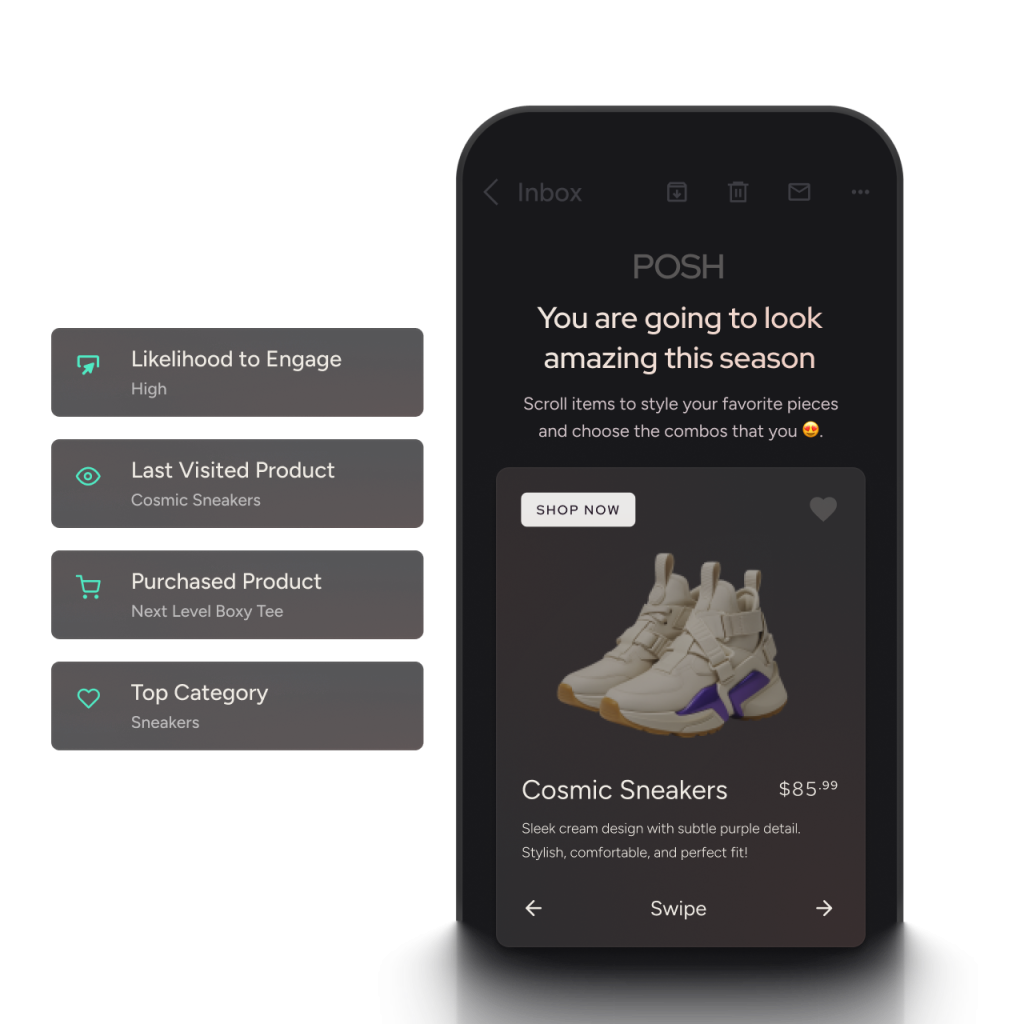
Levels of email personalization
Modern personalization operates across multiple layers of intelligence:
- Contextual personalization uses real-time signals such as location, time of day, device, or channel behavior to adjust messaging. For example, sending time-sensitive offers based on local time zones or optimizing content for mobile vs desktop users.
- Predictive personalization uses machine learning to anticipate what a user is most likely to do next. This includes next-best action recommendations, product suggestions, churn prediction, or identifying when a user is most likely to convert.
- Autonomous personalization goes a step further. AI agents dynamically adjust content, offers, frequency, and timing without manual intervention. Campaigns continuously evolve based on live performance signals and individual user responses.
Why email personalization matters
Personalization improves performance because it increases precision at the individual level.
- AI-driven personalization enables marketers to deliver highly relevant experiences that align with each user’s intent, leading to higher engagement, stronger conversion rates, and improved retention. Instead of reacting to past behavior alone, predictive systems proactively guide users toward desired actions.
- Personalization compounds over time. As systems learn from each interaction, they refine recommendations, improve targeting accuracy, and reduce wasted impressions.
This is where platforms like Insider One come in. They enable enterprises to orchestrate real-time, AI-driven personalization across channels, combining customer data, predictive intelligence, and automation to deliver individualized experiences at scale.
Key differences between segmentation and personalization
Segmentation and personalization are often used interchangeably, but they solve different problems. Both rely on customer data. Both aim to improve relevance. But they differ in how they execute and scale.
At a high level, segmentation is one-to-many targeting, while personalization is one-to-one customization. Segmentation groups users into cohorts based on shared traits. Personalization adapts the experience for each individual within (or across) those cohorts.
Segmentation typically requires manual input. Marketers define rules, build lists, and update criteria over time. Personalization, especially in modern stacks, is increasingly AI-driven.
Machine learning models and intelligent agents continuously adjust content, timing, and offers based on real-time behavior and predictive signals.
AI is now reshaping both. It makes segmentation dynamic by updating audience groups in real time and uncovering micro-segments. At the same time, it powers personalization engines that decide what each user should see, when, and why, without constant manual intervention.
| Segmentation | Personalization | |
| Approach | One-to-many targeting | One-to-one customization |
| Core function | Groups users by shared traits | Tailors experience for each individual |
| Data usage | Demographics, behavior, lifecycle stage | Real-time behavior, preferences, predictive signals |
| Execution | Rule-based, marketer-defined | AI-driven, adaptive, real-time |
| Level of granularity | Broad audience cohorts | Individual user level |
| Optimization | Periodic updates by marketers | Continuous optimization via AI |
| Workload | Higher manual setup and maintenance | Automated once models are trained |
| Role in strategy | Foundation for targeting | Activation layer for engagement and conversion |
In practice, high-performing teams do not choose between personalization and segmentation. They combine both. Segmentation organizes the audience. Personalization makes every interaction count. Platforms like Insider One bring these layers together, enabling enterprise teams to move from static targeting to real-time, individualized engagement at scale.
How to use segmentation and personalization together
Segmentation and personalization work best when used as a system. Segmentation creates structure. Personalization drives precision. Together, they turn email into a scalable growth channel.
- Start with segmentation to define the audience. Segmentation answers who should receive a message by grouping users based on lifecycle stage, behavior, or value. This ensures campaigns are directionally relevant before any personalization is applied.
- Layer personalization within each segment. Personalization answers what each user should see. AI-driven systems tailor subject lines, content blocks, product recommendations, and send times based on individual behavior and intent signals within each segment.
- Use AI orchestration to scale both. 75% of marketers are using AI, yet 84% still run generic campaigns. This gap is where intelligent agents step in, automatically creating and refining segments, delivering next-best actions, and optimizing campaigns in real time without manual intervention.
- Activate through platforms like Insider One. Insider One enables dynamic content, predictive recommendations, send-time optimization, and automated workflows across the customer journey. It connects segmentation and personalization into a single execution layer.
- Roll out incrementally. Start with clear segmentation logic. Then layer personalization where it drives the most impact, such as product recommendations, triggered journeys, and dynamic offers. This reduces complexity while improving performance step by step.
Segmentation tells you where to focus. Personalization ensures every interaction within that focus is relevant. With AI, both become continuous systems that learn, adapt, and improve over time.
How Insider One unifies segmentation and personalization at scale
Now, you know the value of combining segmentation and personalization is obvious. However, the challenge is executing both at an enterprise scale. With Insider One, you get one intelligent system that unifies both instead of disconnected workflows.
Unified customer data as the foundation
Insider One builds unified customer profiles using everything from behavioral signals and interests to survey responses and 120+ customer attributes, including CRM IDs, phone numbers, and email addresses.
Its CDP brings together data from online and offline sources, like CRMs, POS systems, contact centers, and marketing platforms, into a single, unified database that powers both segmentation and personalization.
These profiles give marketers a complete view of every customer, from names, emails, and phone numbers to behavioral data, purchase history, channel preferences, and predictive insights. With every interaction, the profiles become richer and more accurate, helping brands understand customers better over time.
AI-powered segmentation at scale
Insider One turns traditional, manual segmentation into an AI-powered, automated process. Marketers can build highly targeted audiences using 120+ attributes, including customer behaviors, preferences, traits, and engagement patterns. The platform offers three types of segments:
- Standard segments include factors like demographics, location, device type, and operating system.
- Predefined segments automatically group users based on behaviors, like cart abandonment, browsing activity, or channel engagement.
- Predictive segments use AI to forecast future behavior, including likelihood to purchase, churn risk, discount affinity, and expected spending.
These predictive models continuously analyze the latest customer signals to update audience segments in real time. That means marketers can automatically target customers most likely to buy, re-engage users at risk of churn, and personalize campaigns based on changing behavior in real time.
Real-time personalization across channels
Once audiences are defined, Insider One personalizes every customer interaction at the individual level. The platform unifies channels like websites, mobile apps, email, SMS, WhatsApp, and push notifications to deliver seamless, hyper-personalized experiences wherever customers engage.
Its AI capabilities work together to make personalization smarter and faster. Predictive AI identifies what each customer is most likely to do next: whether that’s making a purchase, churning, exploring a new category, or waiting for a discount. Marketers can then target users based on signals like purchase intent, lifecycle stage, discount affinity, and preferred engagement channels.
Generative AI turns those insights into action by instantly creating personalized content, product recommendations, and cross-channel customer journeys at scale.
Journey orchestration with Architect
Insider One brings segmentation and personalization together through Architect, its omnichannel journey orchestration platform. Architect enables marketers to create seamless, data-driven customer journeys across 12+ channels, including email, SMS, WhatsApp, push notifications, web, app, and TikTok, from a single unified system.
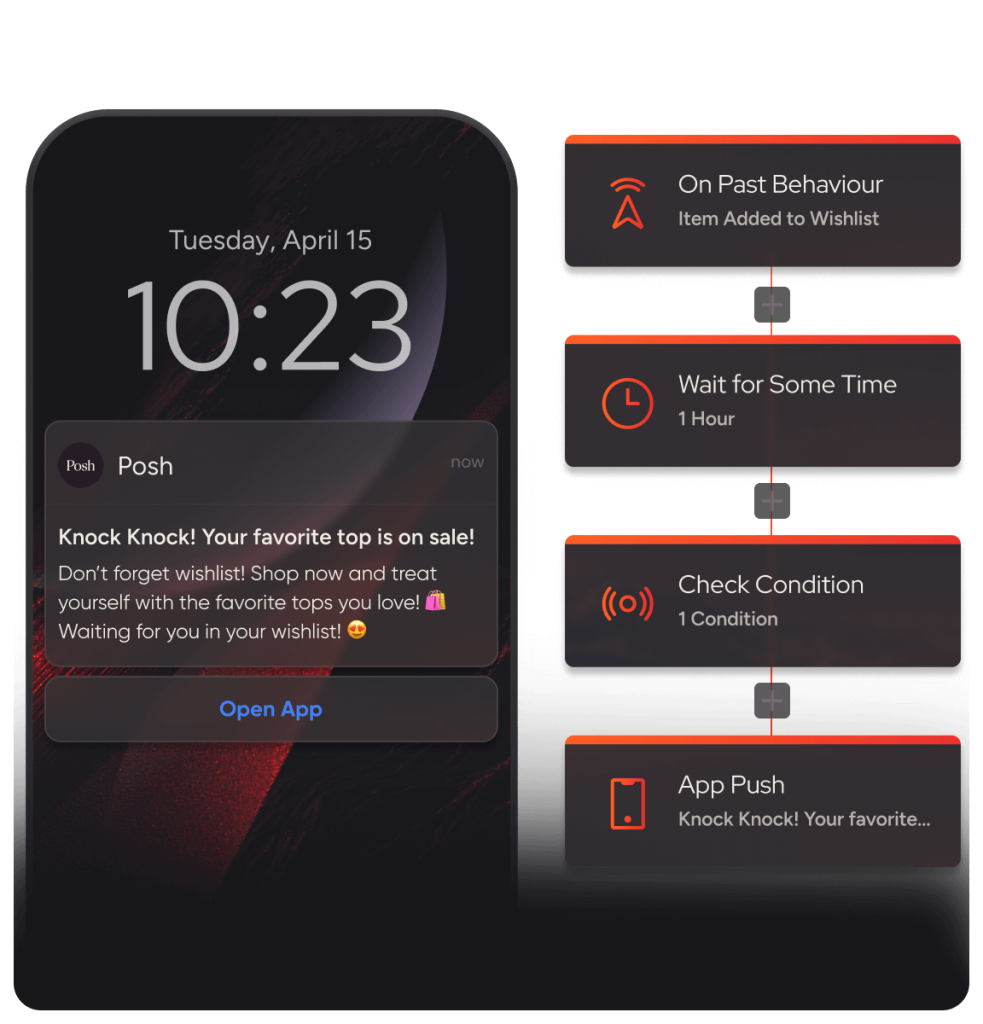
Using real-time triggers, events, and actions, marketers can design connected experiences that drive revenue and customer loyalty across every touchpoint. Because everything runs through one orchestration layer, segmentation logic and personalization rules stay consistent across channels, creating a smoother and more cohesive customer experience.
Autonomous Decision-Making with Agent One
Beyond automation, Insider One introduces autonomous intelligence through Agent One, a suite of AI-powered agents designed to deliver more personalized, emotionally aware customer experiences through real-time decision-making. Each agent is built for a specific role:
- Shopping Agent helps customers discover products faster by anticipating intent, asking relevant questions, and delivering personalized recommendations that increase purchase confidence.
- Support Agent provides always-on assistance, autonomously resolving customer inquiries and post-purchase issues.
- Insights Agent transforms campaign, audience, and product data into actionable insights, recommendations, and visual reports that help marketers move from analysis to action faster.
Now, look at what results you can drive with these capabilities.
Case studies and examples
Enterprise teams are already combining segmentation and personalization to drive measurable impact across channels. The results show how targeted audiences and individualized experiences work together in practice.
- Philips improved cart conversion by layering personalization on top of behavioral segmentation. By triggering personalized social proof messages for users with items in their cart, the brand saw a 3.74% increase in AOV and a 14% uplift in conversion rates.
- GAIA combined segmentation across lifecycle stages with AI-driven personalization using Insider’s Smart Recommender and coupon optimization. This led to a 166% increase in conversions across channels.
- ECCO scaled personalization across multiple markets by deploying AI-powered product recommendations and exit-intent overlays. The result was a 7.4x ROI and a 95% increase in conversion rates across six European websites.
- Matahari bridged online and offline segmentation with personalized email and app experiences. By aligning messaging with customer behavior across channels, the brand achieved a 356x ROI in just four months.
- Martes Sport used preference-based segmentation to personalize homepage banners in real time. This drove a 30.77% increase in conversion rates, showing how even simple personalization layers can significantly improve performance.
These examples highlight a consistent pattern. Segmentation identifies the opportunity. Personalization captures it. When combined with AI-driven orchestration, the impact compounds across conversion, AOV, and ROI.
Do you need to use both segmentation and personalization?
Yes, you need both segmentation and personalization.
Customers no longer respond to generic campaigns. They expect messaging that feels relevant to their context, intent, and behavior. Segmentation gets you closer by narrowing the audience. Personalization completes the job by making each interaction feel tailored.
Moreover, modern AI has blurred the line between the two. Segmentation and personalization are no longer separate workflows. AI systems now connect them into a single loop, continuously refining audience groups, predicting intent, and adapting content in real time. This makes campaigns more responsive without increasing manual effort.
That said, jumping straight into advanced personalization without the right foundation rarely works. Start with data readiness. Ensure your customer data is unified, clean, and accessible across channels. Then define clear segmentation logic aligned to lifecycle stages, behaviors, and business goals. Only after that should you layer in AI-driven personalization like recommendations, dynamic content, and send-time optimization.
This also requires cross-functional alignment. Marketing, data, product, and CRM teams need to work together to map audience needs, identify available data signals, and design campaigns that move users through the journey.
Platforms like Insider One are built to support this evolution. They combine segmentation, real-time personalization, and predictive intelligence into a single system, helping enterprise teams scale relevance without increasing complexity.
Want to operationalize both strategies? Book a demo to see how Insider One helps create impactful, personalized campaigns that scale, or explore how it enables segmentation and personalization across channels to drive engagement, conversions, and loyalty.
Frequently asked questions
Segmentation groups subscribers into cohorts based on shared traits like behavior, lifecycle stage, or demographics, enabling one-to-many targeting. Personalization goes further by tailoring content, timing, and offers for each individual using real-time data and predictive signals. In short, segmentation defines the audience, while personalization adapts the experience for each user.
Yes, both are essential for modern email marketing. Segmentation ensures campaigns are relevant at a group level, while personalization makes each interaction feel tailored to the individual. Together, they create scalable relevance that drives engagement and conversions.
Segmentation improves baseline performance by increasing message relevance, which lifts open rates, click-through rates, and conversions. Personalization compounds this impact by optimizing each interaction using real-time and predictive data, leading to higher revenue per user and stronger retention. Combined, they significantly improve overall campaign ROI.
Hyper-personalization uses AI and real-time data to deliver highly individualized experiences based on context, intent, and predicted behavior. Unlike basic personalization, which relies on static data like name or past purchases, hyper-personalization continuously adapts messaging, offers, and timing dynamically. This makes interactions more precise and responsive across the customer journey.

Keep Reading
7 min.

Muharrem Derinkok
4 Jun 2026
11 min.

Chris Baldwin
2 Jun 2026
4 min.
Chris Baldwin
3 Feb 2026