

 Platform Overview

 Integration Hub

 Agent One™

 Agent One Teams™

 Customer Data Management

 Personalization

 Journey Orchestration

 Reporting & Data

 Behavioral Analytics

 Web
Web

 Email
Email

 Site Search

 Conversational CX

 WhatsApp

 Web Push

 InStory

 App
App

 SMS & RCS

 Join the $0 Migration Movement™

 The Insider One Difference

 Compare Vendors

 Switch to Insider One

 Success Story

 Retail & Ecommerce

 Financial Services

 Travel & Hospitality

 Beauty & Cosmetics

 Automotive

 Telecommunications

 Total Economic Impact™ Study

 Blog
Blog

 E-Books & Guides

 Events

 Glossary
Mobile App Messaging Strategies That Actually Retain Users

Updated on 7 Jul 2026
10 min.
Table of Contents
- Summary
- Why app messaging strategies fail before the first conversion
- Choosing the right channel: push, in-app, or both
- Frequency and timing guardrails that protect retention
- Lifecycle sequencing: from install to loyal user
- Personalization and cross-channel orchestration at scale
- Frequently asked questions
Most Popular
Summary
Push notifications and in-app messages serve different purposes and are most effective when used at the right stage of the customer journey. Coordinating them with behavioral triggers and other channels improves engagement, reduces churn, and strengthens long-term retention.
When a mobile messaging program looks healthy on the surface, campaigns running and open rates reasonable, and then someone pulls the Day 30 retention number and the math stops working, the cause is rarely the creative or the audience definition.
It’s usually the sequencing: messages sent at the wrong moment in the session lifecycle, through the wrong channel for that moment, to users who had already formed an opinion about whether they cared.
The channel was technically correct, the copy was fine, and the targeting was reasonable. The sequencing was not.
That sequencing problem is what this article addresses through a channel-by-channel decision framework that clarifies when push, in-app messaging, or a cross-channel sequence is the right call.
The verticals covered here, fintech, retail, media, and travel, each carry different tolerance thresholds and lifecycle shapes, and the mobile app messaging strategies that produce durable retention are built around those differences.
Why app messaging strategies fail before the first conversion
Users who abandon an app after a single session rarely do so because nothing happened. They leave because the wrong thing happened: the wrong kind of engagement arrived too early, too often, or through a channel that did not match their current state.
That dropout is a signal worth treating as a planning baseline rather than an anomaly.
The notification fatigue trap
Push notification fatigue isn’t a volume problem in isolation. It’s a relevance-volume problem.
A high-frequency fintech app sending daily account balance nudges to users who check manually anyway adds friction without value, and a retail app sending three promotional pushes in a 48-hour window to a user who just completed their first purchase is optimizing for short-term clicks at the cost of long-term trust.
The user does not distinguish between bad timing and a bad product. They simply uninstall, and that uninstall represents not just lost revenue but the full cost of acquisition, onboarding, and any loyalty investment already made.
Recovering that user later costs more than getting the sequencing right the first time.
Channel mismatch as a silent churn driver
The less-discussed failure mode is channel mismatch. Teams default to push because it is measurable and immediate, but push requires the app to be closed and the user to be reachable via their device lock screen.
When someone is actively browsing your app and you want to guide them toward a feature or complete a conversion, an in-app message is the appropriate channel, not a notification competing with their current task.
Push in that context interrupts rather than assists. Conversely, in-app messages are invisible to offscreen users, making them useless for win-back or re-engagement flows.
The channel decision should follow the user’s session state, not the team’s preferred tool.
Choosing the right channel: push, in-app, or both
It’s not about which channel is better overall. It’s about which channel matches the user’s current state and the message’s time sensitivity.
A decision matrix mapped to user state
Push notifications are the right choice when the app is closed and the message has a genuine time component: a price drop on a watched item, a transaction alert, a flight status update, or an expiring offer.
They are also the right re-engagement tool for users who have been inactive for a defined window, typically seven to 14 days depending on vertical.
In-app messages belong inside the session. They work best for onboarding tooltips that surface as a user encounters a feature for the first time, for upsell prompts triggered by a specific behavior such as adding a second item to a cart, for rating request nudges after a successful transaction, and for contextual guidance that would feel intrusive on a lock screen.
In-app messages do not require opt-in permission, which gives them a structural advantage for iOS (Apple’s mobile operating system) audiences in particular.
Platform opt-in gaps and what they mean for channel mix
On Android, push opt-in is granted by default, while iOS requires an explicit user permission prompt. This creates a meaningful planning gap for teams managing cross-platform audiences.
On iOS, a portion of your installed base may be unreachable via push before they opt in, which means in-app messaging and email carry more weight in the early lifecycle stages.
iOS campaigns therefore need sharper personalization to convert a smaller opted-in pool, and broad promotional pushes tend to perform worse on that platform than behavioral or transactional ones.
Your app channel strategy should reflect the platform distribution of your actual user base rather than a platform-agnostic template, because building a messaging plan without accounting for this split leaves a measurable portion of your audience underserved.
Frequency and timing guardrails that protect retention
Getting the channel right is necessary, but getting the cadence wrong still costs you users.
Frequency patterns by vertical
Apps are moving toward one of two conscious frequency models: high-frequency, high-relevance (daily finance updates, real-time sports scores, flash sale retail) or strictly curated and behavior-triggered (luxury, travel, wellness).
The apps that struggle most are those sitting in the middle, sending messages without a clear behavioral trigger or a defined high-frequency value proposition. That approach creates enough irritation without generating enough perceived value to justify the volume.
Retail apps generally support higher push frequency during peak periods, with behavioral sends pulling back in steady state. Media apps can sustain daily sends if content is genuinely personalized to reading or viewing history.
Fintech apps should anchor push almost entirely to account events and transactional triggers. Travel apps are event-driven by nature: pre-trip, in-trip, and post-trip sequences each carry different frequency tolerances, and conflating them is a common source of unsubscribes.
Behavioral send-time optimization
Sending at 10 a.m. local time because aggregate data suggests that is when open rates peak is a blunt instrument. The higher-value approach is aligning delivery to individual session patterns.
If a user consistently opens your app between 7 and 8 p.m., a re-engagement push sent at noon wastes an impression on someone unlikely to act on it.
Behavioral send-time optimization, where the platform learns each user’s engagement window and schedules delivery accordingly, increases the probability that a message arrives when the user is already disposed to engage.
The result is better open rates from the same audience without any increase in message frequency.
Lifecycle sequencing: from install to loyal user
The four lifecycle stages where messaging decisions most directly determine retention outcomes are onboarding, activation, habit formation, and re-engagement. Each stage has a different objective, a different appropriate channel mix, and a different tolerance for message frequency.
Stage 1: onboarding (day 0 to 3)
The goal here is frictionless first value. In-app messages are the primary tool, surfacing at the right moment in the interface to reduce cognitive load and guide the user toward their first meaningful action.
Push has a limited role in this window unless the user has already completed an action that warrants a follow-up, such as a welcome confirmation or a setup reminder if they have dropped off mid-flow.
Avoid requesting push opt-in on Day 0, and frame the permission ask around a specific benefit the user has already shown interest in, timed after their first value moment.
Stage 2: activation (day 3 to 7)
Activation is about converting an interested user into one who has completed a core action: a first purchase, a first completed workout, a first investment, or a first article read to completion.
Behavior-triggered messages in this window outperform scheduled sends because the message responds to a demonstrated signal rather than a calendar assumption.
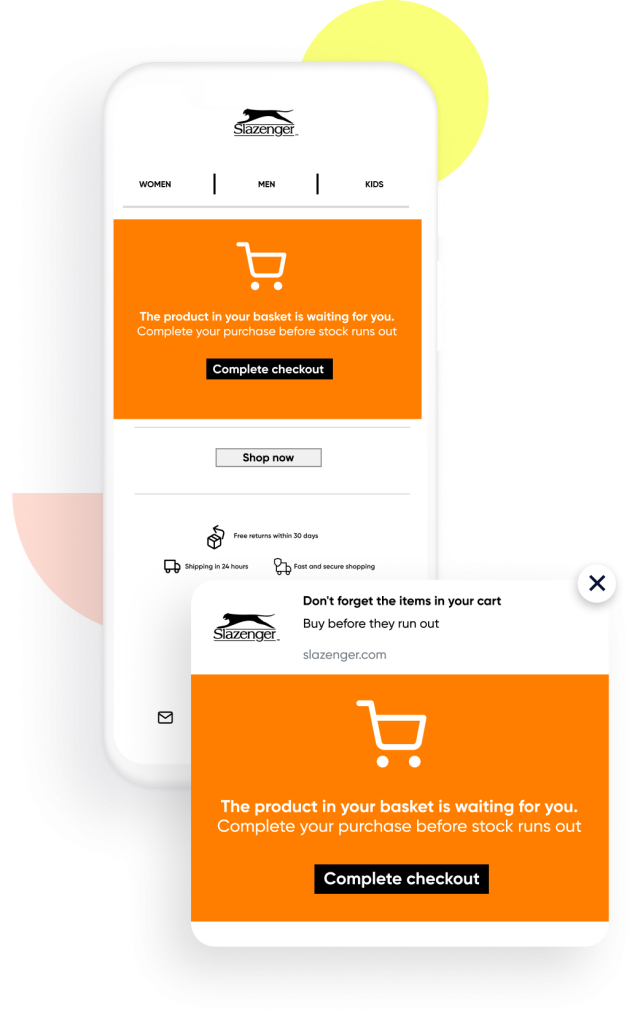
If a user adds an item to a cart but does not complete checkout, a push notification within 30 to 60 minutes with a direct link back to that cart is a well-established, high-performing intervention.
For apps where the core action takes multiple sessions, in-app messaging continuity keeps the user oriented toward the goal across visits.
Stage 3: habit formation (day 7 to 30)
The Day 7 to Day 30 window is where the retention curve separates retained users from eventual churn. The objective is building a behavioral loop: a reason to return that the user has internalized rather than a promotional incentive that expires.
Messaging in this window should shift toward personalization based on in-app behavior rather than demographic properties.
If a user in a retail app has browsed athletic footwear three times without purchasing, that is a signal warranting a targeted message rather than a generic promotional send. DeFacto drove 8x higher conversion rates using behavioral app push notifications precisely because the message matched what the user had already signaled they wanted.
Wondering where your own retention curve is leaking? Book a personalized demo and we’ll walk through onboarding, activation, and habit-formation sequencing against your actual app data.
Stage 4: re-engagement (day 30 and beyond)
Inactivity flows represent a high-value investment in mobile lifecycle marketing. Users who have already completed onboarding require less nurturing than brand-new installs, which makes reactivation an efficient use of messaging resources.
A well-structured re-engagement sequence typically starts with a push notification referencing something specific to the user’s last session. If that push goes unopened, the next step is an email with a clear value proposition, followed by an in-app message presenting a reactivation offer on the next session open.
Cap the sequence at three to four touchpoints before suppressing the user from re-engagement sends for a defined window. The specificity of the initial message is the difference between a win-back that works and one that accelerates uninstall.
Personalization and cross-channel orchestration at scale
A single-channel messaging strategy, even a well-executed one, leaves gaps that compound into churn over time. No single channel covers every user state or session context, and addressing those gaps requires both a unified data layer and orchestration logic that moves across channels based on user response rather than a broadcast schedule.
Why behavioral segmentation outperforms demographic targeting
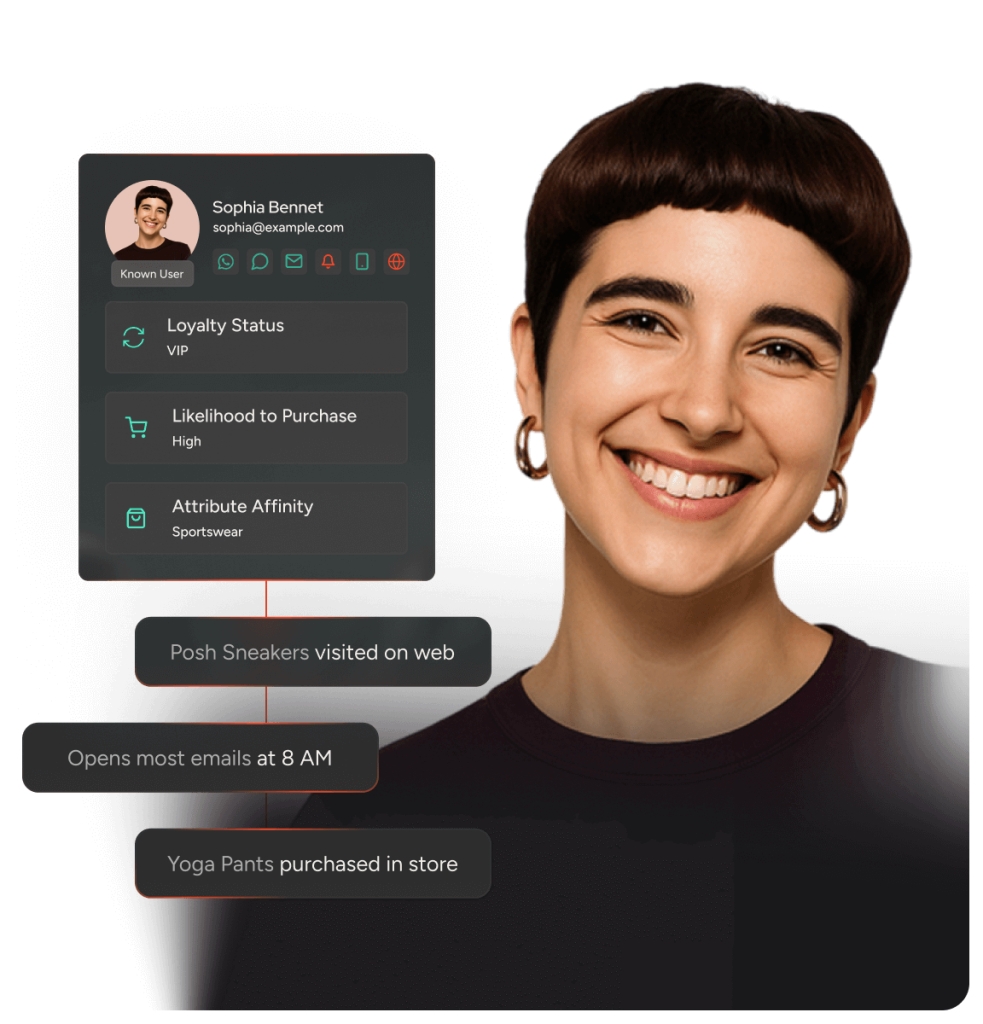
Behaviorally segmented messages, targeted by purchase history, session recency, feature usage, or lifecycle stage, consistently outperform demographic-only segmentation.
Targeting by what users have actually done in your app versus who they are on paper produces meaningfully higher click-through rates (CTR), because the message responds directly to a demonstrated signal rather than an inference about audience characteristics.
This kind of segmentation requires a unified customer data platform (CDP) layer that connects in-app behavior to cross-channel history.
Without it, messages are educated guesses. Insider One’s Customer Data Management capability provides that unified layer, making it possible to act on behavioral signals across channels in real time rather than relying on static audience lists.
Cross-channel sequencing that closes the gaps
Push reaches users when the app is closed. In-app messages reach users during active sessions. Email reaches users who have not opened the app at all, and SMS closes the loop for high-urgency events where email latency is too slow.
A cross-channel sequence that moves intelligently across these channels based on user response, rather than blasting all channels simultaneously, ensures that no intent signal goes unanswered.
Insider One’s Architect journey builder, available through the Journey Orchestration capability, lets teams define channel escalation logic, suppression rules, and behavioral triggers in a single canvas without requiring separate campaign tools for each channel. Beyond standard push and in-app messages, Insider One’s App Suite adds rich formats such as InStory, full-screen, swipeable Stories-style content inside the app, which gives onboarding and habit-formation moments a more immersive surface than a banner or a lock-screen alert.
Sirius AI™, Insider One’s artificial intelligence (AI) layer, adds predictive decisioning to that canvas, selecting the next-best channel and timing based on each user’s live engagement patterns. It also scores predictive churn risk, so a fading user can be re-engaged the moment early disengagement signals appear rather than waiting for a fixed seven- to fourteen-day dormancy window to elapse.
Adidas achieved a 259% increase in average order value and a 13% uplift in conversion rate in a single month by combining onsite personalization with coordinated cross-channel messaging, a result that illustrates what orchestration produces when the data layer and the channel logic work together.
Slazenger achieved 49x ROI (return on investment) in just eight weeks by replacing a broadcast model with behavioral triggers and channel sequencing that matched each user’s actual state.
If you want to see how Insider One’s Architect, Customer Data Management, and Insider One AI™ turn live customer data into coordinated, revenue-driving experiences, book a personalized demo to see the exact use cases, decision logic, and growth levers most relevant to your team.
Frequently asked questions
Sending push notifications on a calendar schedule rather than a behavioral trigger. Time-based sends treat all users as if they are in the same state at the same time.
Behavioral triggers send when the user has just demonstrated intent, which is when messages are most likely to produce a meaningful action rather than an unsubscribe.
Any time the user is in an active session and you want to guide, inform, or upsell without disrupting their context.
In-app messages are also the right channel when a user has not opted in to push on iOS, since they do not require permission and appear naturally within the app environment.
Start with a push that references something specific to the user’s last session rather than a generic greeting. If push goes unopened within 24 to 48 hours, escalate to email with a clear value proposition.
Use in-app messaging to present a reactivation offer on the next session open, and cap the sequence at three to four touchpoints before suppressing the user from re-engagement sends for a defined window.
There is no universal ceiling, but retail apps in steady state typically perform better at one to two behavior-triggered sends per week than at three or more scheduled sends.
During peak periods, higher frequency is defensible if the messages are genuinely relevant. The signal to watch is unsubscribe rate by send type: if promotional sends are driving disproportionate opt-outs, that is a frequency and relevance problem, not just a volume one.

Keep Reading
7 min.

Muharrem Derinkok
4 Jun 2026
11 min.

Chris Baldwin
2 Jun 2026
4 min.
Chris Baldwin
3 Feb 2026