

 Platform Overview

 Integration Hub

 Agent One™

 Agent One Teams™

 Customer Data Management

 Personalization

 Journey Orchestration

 Reporting & Data

 Behavioral Analytics

 Web
Web

 Email
Email

 Site Search

 Conversational CX

 WhatsApp

 Web Push

 InStory

 App
App

 SMS & RCS

 Join the $0 Migration Movement™

 The Insider One Difference

 Compare Vendors

 Switch to Insider One

 Success Story

 Retail & Ecommerce

 Financial Services

 Travel & Hospitality

 Beauty & Cosmetics

 Automotive

 Telecommunications

 Total Economic Impact™ Study

 Blog
Blog

 E-Books & Guides

 Glossary
Best All-in-One Marketing Automation Platforms for Modern Teams

Updated on 19 Jun 2026
8 min.
Table of Contents
- Summary
- Which all-in-one marketing automation platforms stand out?
- Which all-in-one marketing automation platforms are best for different teams?
- What is an all-in-one marketing automation platform?
- What features matter most in a marketing automation platform?
- How do you choose the right all-in-one marketing platform?
- Why does Insider One lead in all-in-one marketing automation?
- Frequently asked questions
Most Popular
Summary
All-in-one marketing automation platforms replace disconnected tools for email, SMS, personalization, and customer data with one unified system. The best platforms combine customer profiles, cross-channel journeys, AI, personalization, and analytics to help teams launch faster, improve targeting, and measure ROI. Choosing the right platform depends on your channels, data needs, team capabilities, and pricing model.
Marketing teams run campaigns across more channels than ever. Most still rely on separate tools for email, SMS, web personalization, and customer data. All-in-one marketing automation platforms consolidate these capabilities into a single system, eliminating the integration overhead that slows execution and fragments customer experiences.
When data, orchestration, and personalization work from one platform, teams launch faster, personalize better, and prove ROI without stitching together disconnected tools.
Which all-in-one marketing automation platforms stand out?
| Platform | Core capabilities | Channel coverage | AI features | Best for | Pricing model |
| Insider One | customer data platform (CDP), orchestration, personalization | Web, app, email, SMS, WhatsApp, paid | Agentic AI, predictive segments | Enterprise and mid-market | MTU-based |
| HubSpot | customer relationship management (CRM), email marketing, workflows | Email, web, social, ads | Content generation, predictive scoring | B2B and inbound marketing | Contact-based |
| Salesforce | Journey builder, data extensions | Email, SMS, push, web | Einstein AI optimization | Complex enterprise stacks | Custom |
| Adobe Marketo | Lead management, B2B automation | Email, web, social, ads | Predictive audiences | B2B enterprise | Database size |
| Braze | Mobile engagement, streaming data | App, web, email, SMS | Send-time optimization | Mobile-first consumer brands | Credit-based |
| Klaviyo | Ecommerce automation, analytics | Email, SMS, push | Predictive retail analytics | Shopify ecommerce brands | Contact-based |
Which all-in-one marketing automation platforms are best for different teams?
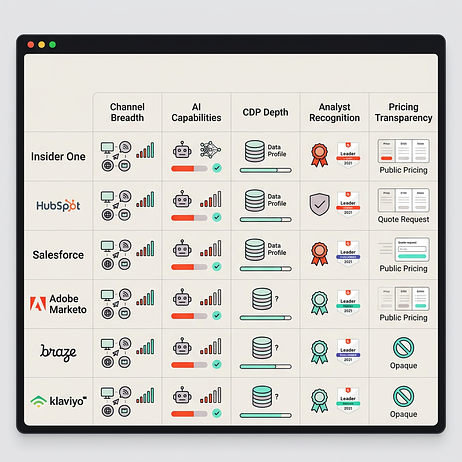
We evaluated these platforms on:
- Channel breadth
- AI capabilities
- customer data platform (CDP) depth
- Analyst recognition
- Pricing transparency
Each one gets the same treatment so you can compare directly.
Insider One
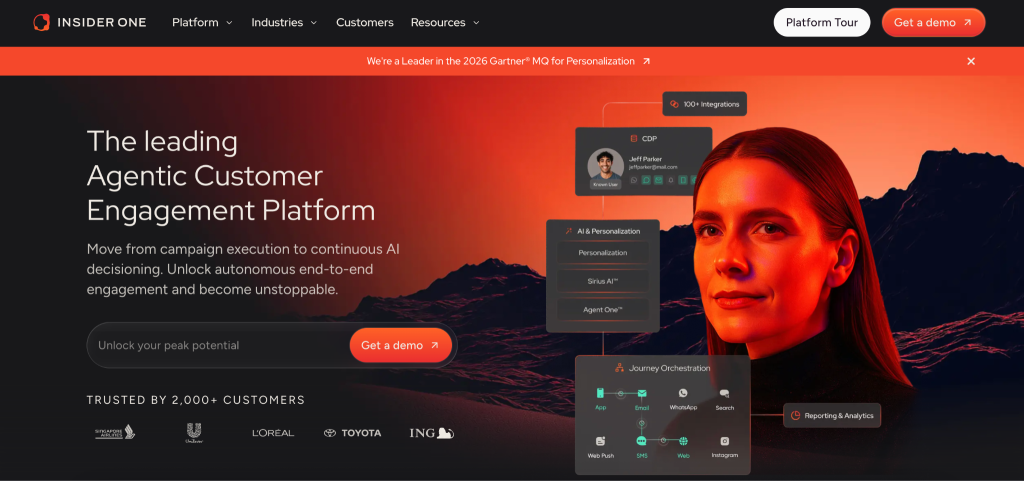
Insider One combines these capabilities across every channel marketing teams actually use:
- CDP
- Artificial intelligence (AI)
- Personalization
- Journey orchestration
- Reporting
Everything runs from one platform. You don’t stitch together separate tools.
The Unified Customer Database ingests data from web, app, API, and offline sources into 360-degree profiles. Architect, Insider One’s customer journey orchestration solution, lets you design, automate, and optimize cross-channel journeys in real time. Sirius AI™, Insider One’s extensive set of AI capabilities, powers:
- Predictive segmentation
- Next-best-channel selection
- Send-time optimization
- A/B auto-winner selection
Insider One holds a 4.9 rating on Gartner Peer Insights. It’s recognized as a Leader in the Gartner Magic Quadrant for Personalization Engines and the IDC MarketScape for AI-Enabled Marketing Platforms.
Main features:
- Unified Customer Database with real-time identity resolution across web, app, and offline
- Architect for cross-channel journey orchestration across SMS, email, WhatsApp, web push, in-app, and paid media
- Sirius AI™ with predictive segmentation, next-best-channel, send-time optimization, and journey generation from text prompts
- Smart Recommender with a range of algorithms for personalized product suggestions
Pricing: MTU-based pricing with no charges for data storage, duplicate events, or overage penalties. Teams typically go live quickly. If you want to see what “one platform” looks like with your channels and data, request a demo.
HubSpot Marketing Hub
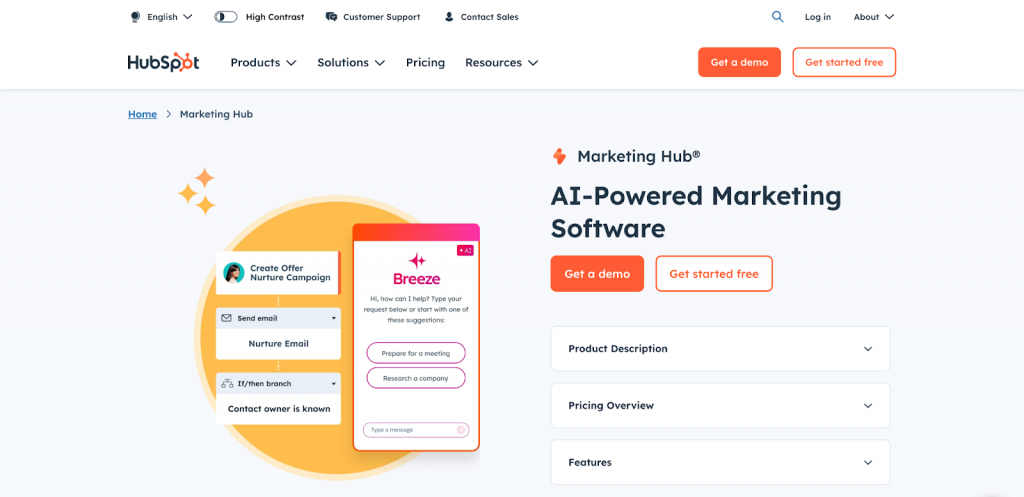
HubSpot takes a customer relationship management (CRM)-centric approach. Marketing and sales teams share the same data, which makes alignment easier. Lead scoring, attribution reporting, and workflow automation come built in.
If you’re already in the HubSpot ecosystem, this platform makes sense. The learning curve is gentle. Teams that need deep mobile app personalization or advanced predictive segmentation should validate fit during evaluation.
Pricing: Tiered pricing based on marketing contacts. Free tier available with limited features.
Salesforce Marketing Cloud
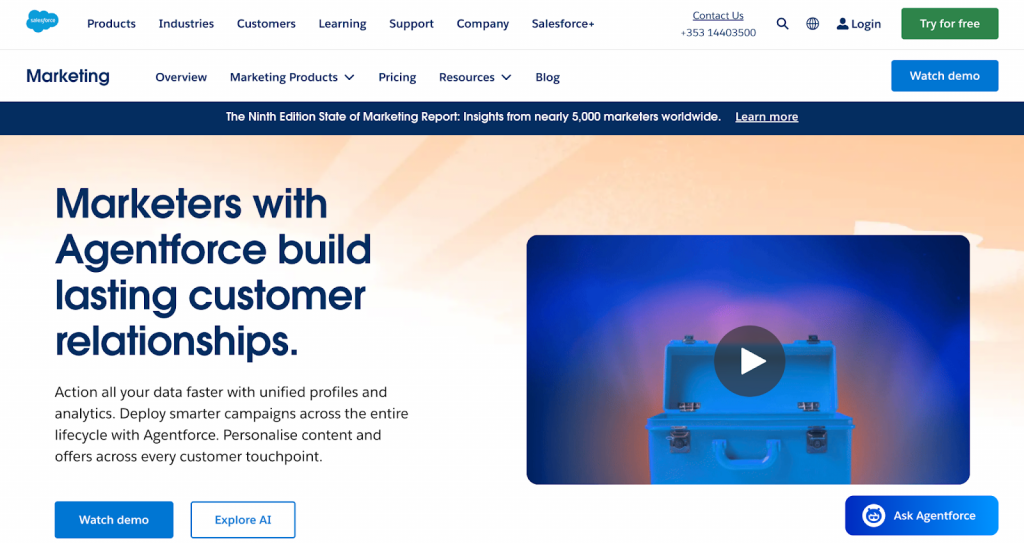
Salesforce Marketing Cloud offers deep enterprise capabilities powered by Einstein AI and Journey Builder. It integrates tightly with the broader Salesforce ecosystem, connecting marketing, sales, and service data.
This depth comes with complexity. Teams should assess implementation requirements and day-to-day operating needs during evaluation.
Pricing: Custom enterprise pricing based on contacts, channels, and add-on products.
Adobe Marketo Engage
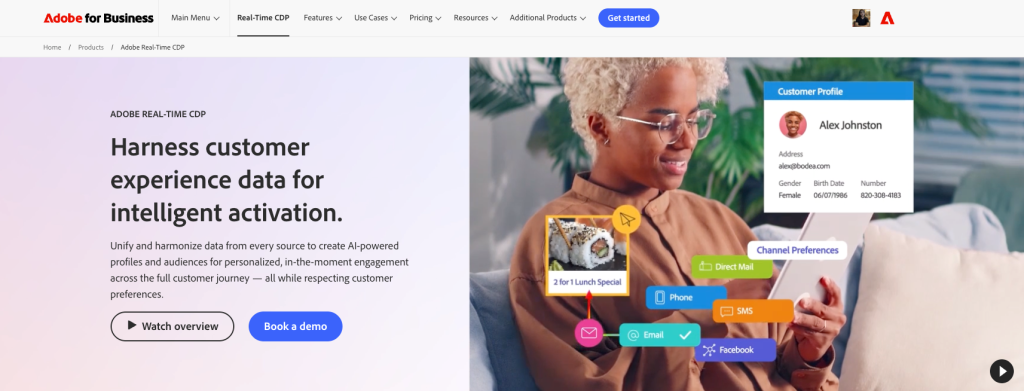
Marketo focuses on B2B marketing automation and complex lead management. Lead nurturing, account-based marketing, and revenue attribution are its strengths, and it integrates deeply with Adobe Experience Cloud.
Teams should review onboarding needs and required training during evaluation. Teams should confirm the level of administrative support required before they commit. Consumer brands or teams needing rapid cross-channel execution should validate fit during trial periods.
Pricing: Tiered pricing based on database size and feature packages.
Braze

Braze built its platform around mobile-first positioning and real-time data streaming. The Canvas journey builder orchestrates messaging across app, web, email, and SMS. In-app personalization and push notifications are where it excels.
Teams should verify whether the platform includes native customer data platform capabilities or requires additional tools. Teams should compare total cost of ownership across licensing, data, and integration needs.
Pricing: Credit-based pricing with separate charges for channels and data points.
Klaviyo
Klaviyo focuses specifically on ecommerce automation and retail analytics. Deep Shopify integration and predictive analytics for churn risk and customer lifetime value make it popular with online retailers.
Brands with broader channel needs or complex mobile app requirements should confirm long-term fit during evaluation. Teams that require advanced orchestration across paid media or WhatsApp should validate native support during evaluation.
Pricing: Contact-based pricing with email and SMS tiers. Free tier available for smaller lists.
What is an all-in-one marketing automation platform?
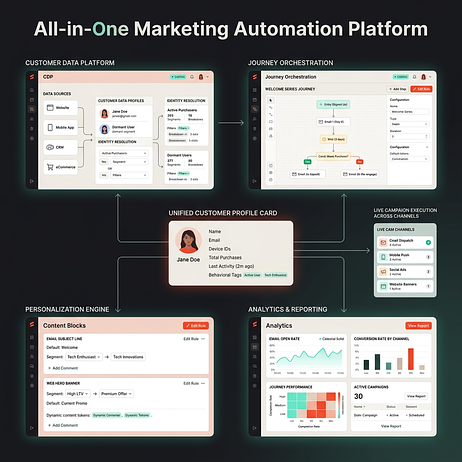
An all-in-one marketing automation platform consolidates these functions into a single system:
- Customer data management
- Journey orchestration
- Personalization
- Analytics
You execute campaigns across every touchpoint without relying on IT to connect different tools.
These platforms differ from basic marketing automation programs that focus only on email or single-channel execution. The core components that define this category:
- Customer data platform: Unifies customer profiles from web, app, CRM, and offline sources into a single view
- Journey orchestration: Enables automated, multi-step campaigns triggered by behavior or events
- Personalization engine: Delivers individualized content, recommendations, and experiences across touchpoints
- Cross-channel execution: Supports messaging across email, SMS, push, in-app, web, and paid media from one interface
- Analytics and reporting: Tracks campaign performance, attribution, and customer behavior without requiring separate tools
If you’re evaluating whether “all-in-one” covers your use cases, run a focused walkthrough instead of a generic tour in the product demo hub.
What features matter most in a marketing automation platform?
Most platform evaluations stall because teams compare feature lists without weighting what actually matters for their situation. Organize your evaluation around the operational problems these features solve.
Data unification and identity resolution:
- Ability to ingest data from web, app, CRM, point-of-sale systems, and data warehouses
- Real-time identity resolution that merges anonymous and known profiles without creating duplicates
- Flexible data retention and governance controls for compliance requirements
Journey orchestration depth:
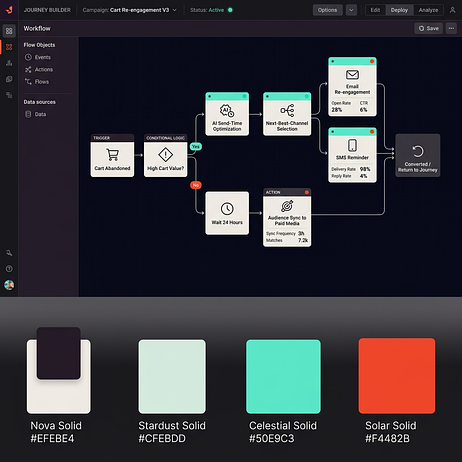
- Visual canvas for building multi-step, multi-channel journeys
- Behavioral triggers and conditional logic without requiring developer involvement
- Native support for A/B testing and path optimization within journeys
AI and automation capabilities:
- Predictive segmentation based on likelihood to purchase, churn risk, or lifetime value
- Send-time optimization that adapts to individual recipient behavior
- AI-generated content, subject lines, or journey recommendations
Channel breadth:
- Native support for email, SMS, WhatsApp, web push, mobile push, and in-app messaging
- Paid media audience sync for retargeting on Google, Meta, and TikTok
- Consistent personalization across channels from unified customer data
The pricing model you choose significantly impacts long-term costs:
| Pricing model | How it works | Hidden cost risks |
| MTU-based | Pay based on monthly tracked users | Very low risk |
| Event-based | Pay per data point or user action | High costs for active users |
| Credit-based | Buy credits consumed by messages | Penalizes multi-channel journeys |
If you want to see how these requirements translate into a real build (data in, journeys live, reporting clean), request a demo.
How do you choose the right all-in-one marketing platform?
The right platform depends on your current tech stack, team technical capacity, and the channels where your customers actually engage. A platform that excels for mobile-first consumer brands creates unnecessary complexity for teams focused on email and web.
1. Audit your current stack and pain points
Start by documenting which tools you currently use and where data silos exist. Identify the manual processes that slow down campaign execution. Then list the channels where you need to reach customers but currently lack capability.
2. Define your non-negotiables
Which channels must be natively supported, not just available through integration? What level of AI automation do you need versus want? Consider your compliance and data residency requirements carefully.
3. Evaluate against your actual use cases
Request demos focused on your specific campaigns, not generic product tours. Test the platform with your own data during trial periods, and assess how much IT involvement is required for typical marketing workflows.
4. Calculate total cost of ownership
Include these costs:
- Implementation
- Migration
- Training
- Ongoing support
Understand pricing model implications for your data volume and messaging frequency. Factor in the cost of integrations you’ll need to maintain.
Sometimes a specialized tool makes more sense. If your engagement is almost entirely single-channel, a channel-specific platform offers better depth. If your data infrastructure is immature, invest in data foundations before platform consolidation.
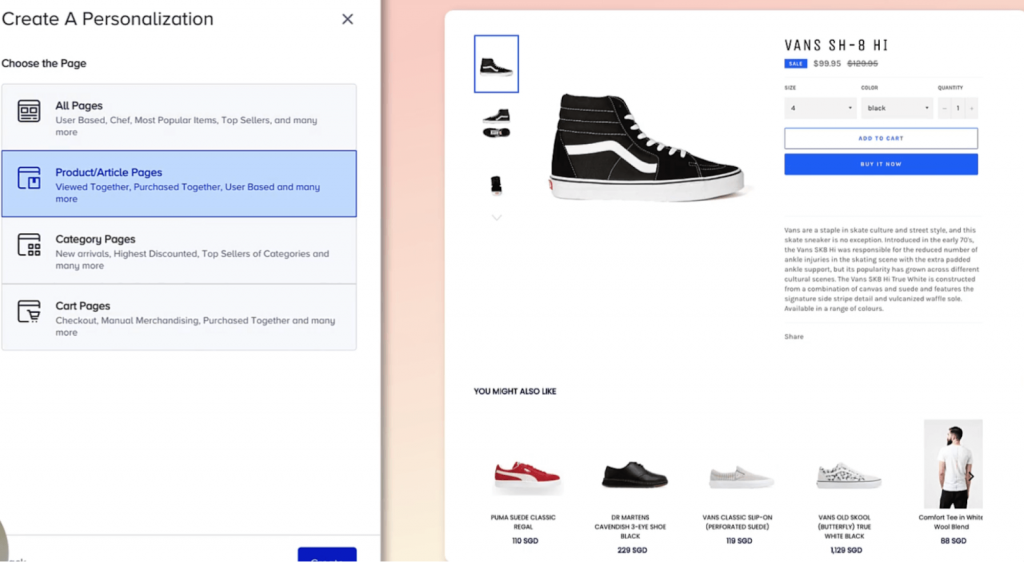
Why does Insider One lead in all-in-one marketing automation?
Insider One is a unified platform from the start, not a system assembled through acquisitions or integrations. The following functions work together natively without requiring middleware or manual syncing:
- Customer data
- Journey orchestration
- Personalization
- AI
- AI-native execution, not bolt-on assistance: Sirius AI™ powers predictive segmentation, next-best-channel selection, send-time optimization, and A/B auto-winner selection. Agent One™, Insider One’s suite of purpose-built agents for customer engagement, enables autonomous decision-making within campaign workflows
- One platform instead of stitched-together products: The Unified Customer Database, Architect, Smart Recommender, and analytics operate from shared data infrastructure. Teams don’t need separate CDP, personalization, and orchestration contracts
- Predictable pricing without hidden charges: MTU-based pricing includes data storage, duplicate events, and standard integrations. No overage penalties or credit-based surprises
- Marketer autonomy without IT dependency: Journey building, segmentation, and personalization happen in the UI without requiring Jinja templates, SQL queries, or developer tickets
If you’re ready to move from “possible” to live journeys that don’t depend on tickets and workarounds, take the next step in the product demo hub.
Frequently asked questions
Marketing automation typically refers to tools that automate repetitive tasks like email sequences or lead scoring. An all-in-one marketing platform combines automation with customer data management, cross-channel orchestration, personalization, and analytics in a single system.
Implementation timelines vary by platform and complexity. Enterprise platforms with heavy customization can require several months. Insider One teams can go live quickly with Migration Lab™ support.
Many all-in-one platforms include native CDP capabilities that can replace standalone CDP investments. Evaluate whether the platform’s data unification, identity resolution, and segmentation capabilities meet your requirements before consolidating.
Distinguish between generative AI for content creation, predictive AI for segmentation and scoring, and agentic AI for autonomous decision-making. Ask vendors to demonstrate specific AI capabilities with your use cases rather than accepting generic claims.

Keep Reading
7 min.

Muharrem Derinkok
4 Jun 2026
11 min.

Chris Baldwin
2 Jun 2026
4 min.
Chris Baldwin
3 Feb 2026