

 Platform Overview


 Integration Hub


 Agent One™


 Agent One™ Teams


 Customer Data Management


 Personalization


 Journey Orchestration


 Reporting & Data


 Behavioral Analytics


 Web


 Email


 Site Search


 Conversational CX


 WhatsApp


 Web Push


 InStory


 App


 SMS & RCS


 Join the $0 Migration Movement™


 The Insider One Difference


 Compare Vendors


 Switch to Insider One


 Success Story


 Retail & Ecommerce


 Financial Services


 Travel & Hospitality


 Beauty & Cosmetics


 Automotive


 Telecommunications


 Total Economic Impact™ Study


 Blog


 E-Books & Guides


 Events


 Glossary
6 ways to improve your customer journey and actually boost conversions

Updated on 2 Nov 2026
9 min.
Table of Contents
Most Popular
Summary
- A journey map built once in a workshop goes stale the moment a customer deviates from it, so treat journey improvement as a live system, not a static document
- Execution usually breaks down because journey ownership sits with one team while the data, consent records, and triggers it needs sit with three others
- A unified customer data platform (CDP) is the prerequisite for real-time orchestration, not an optional add-on layered in later
- Platform evaluation should prioritize identity resolution, unified profiles, real-time triggers,
- Six sequenced fixes, from data unification to incentive alignment, turn scattered channel tactics into one coordinated journey
Improving the customer journey means closing the gap between what a customer does right now and how fast your brand reacts, not redrawing a map every quarter. For lifecycle, customer relationship management (CRM), and growth marketers who own retention, activation, and conversion metrics, that gap is usually the real cost center: a customer browses, abandons, and then gets a generic email three days later because that’s when the campaign was scheduled to send.
This article is for teams past the workshop phase who already understand journey stages and want to know why execution stalls anyway. You’ll learn where journey work breaks down structurally, what data and orchestration layer teams are missing most often, and how to fix it without bolting on another disconnected channel tool. The goal isn’t more touchpoints, it’s a journey that reacts to real intent the moment it happens.
What a working customer journey actually looks like
A customer journey that actually works responds to behavior in real time instead of waiting for the next scheduled campaign. The execution standard is simple: teams should be able to use current customer behavior, such as cart abandonment, a pricing-page revisit, or a support interaction, when deciding the next relevant message.
Picture a typical planning workshop: stakeholders spend two days mapping awareness, consideration, purchase, and retention stages onto a whiteboard, then file the document away until the next quarterly review. That map captures intent at a single point in time, and that isn’t the real problem.
The problem is treating it as a finished product instead of the starting input for an orchestration layer that updates with every customer action, a shift covered in more depth in how to build customer journey orchestration.
When it works structurally, a few things are true:
- A browse session on a product page triggers a relevant message within the hour, not the next day’s batch send
- A support interaction can be used as a signal in orchestration rules so teams can coordinate promotional messages with the customer’s current context.
- A loyalty tier change updates eligibility across channels without a separate rule change in each tool
- Channel selection shifts based on where the customer engaged last, not a fixed, predetermined sequence
Leroy Merlin used Architect journeys to increase ecommerce revenue by 18% and to reduce navigation abandonment and send personalized price-drop notifications.
Where customer journey execution breaks down
Execution breaks down when journey ownership sits with lifecycle marketing while the data and infrastructure it depends on sit with engineering, data, and compliance teams working on different timelines. A marketer who wants to trigger a message based on a same-day event hits a wall if that event doesn’t reach a usable system fast enough to act on.
Adding more channels compounds the coordination problem instead of flattening it, since email, SMS, push, and on-site messaging often run on separate logic, separate send windows, and sometimes separate consent records. A customer who opts out of email but not SMS can still receive the wrong message if those preferences aren’t synced at the point of send, which erodes trust faster than a slow response ever would.
The structural blockers tend to repeat across mid-market and enterprise teams:
- Consent and preference data live in disconnected systems, so opt-outs don’t propagate across channels in time
- Campaign calendars are planned weeks ahead, leaving no room to react to same-day behavior
- Incentive structures reward channel-level metrics like open rate instead of journey-level outcomes like retention
- Orchestration rules are hardcoded per campaign rather than centralized, so the same customer can hit conflicting logic from different teams
Why this complexity compounds instead of plateauing
Each new channel adds its own send logic, its own reporting view, and often its own version of the customer’s preferences. Without a shared source of truth, teams end up reconciling conflicts after the fact instead of preventing them.
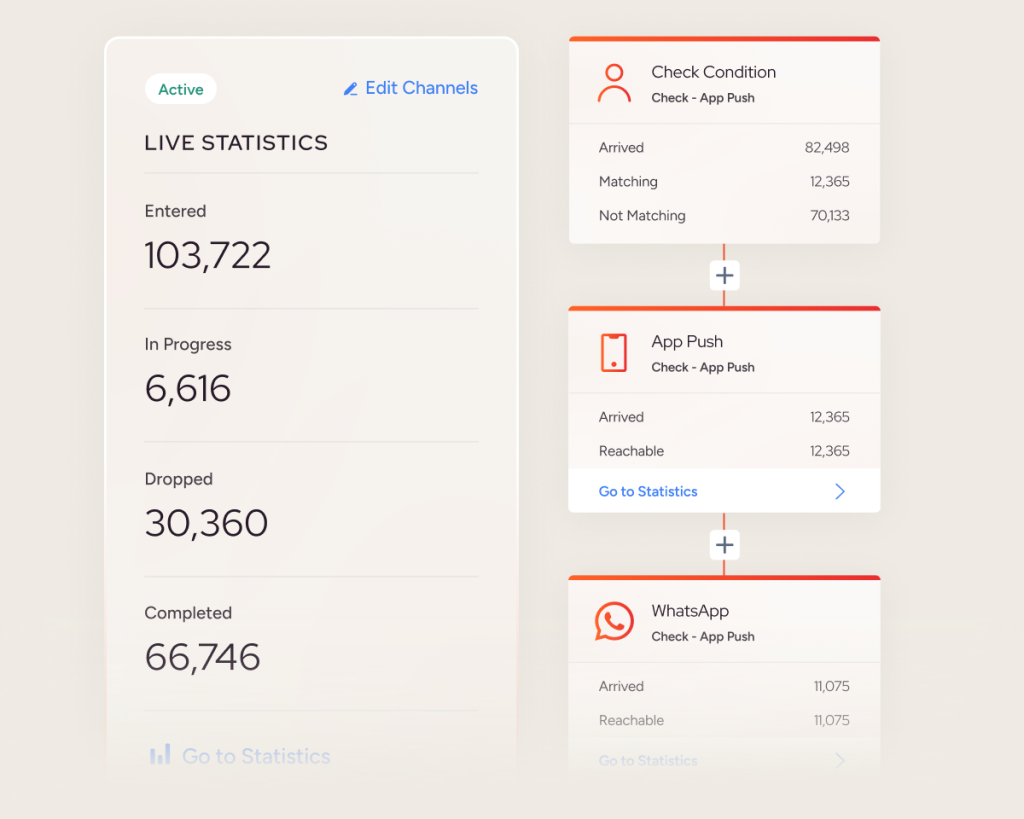
The data and orchestration layer teams usually miss
The missing layer is a unified, real-time customer data foundation that every channel and every team reads from and writes to. Most teams have channel-level data instead: email engagement in the email service provider (ESP), app behavior in a separate analytics tool, purchase history in the order system, none of which alone can describe what a customer is doing across channels right now.
That’s the job of a unified customer data platform (CDP), which can use identity resolution to bring identity, behavior, and available customer data into unified profiles that orchestration logic can use. Without that layer, event-driven orchestration stays theoretical. A journey tool can be configured to react to a browse event, but if the event doesn’t reach the orchestration engine within the same session, the moment has already passed by the time a message goes out.
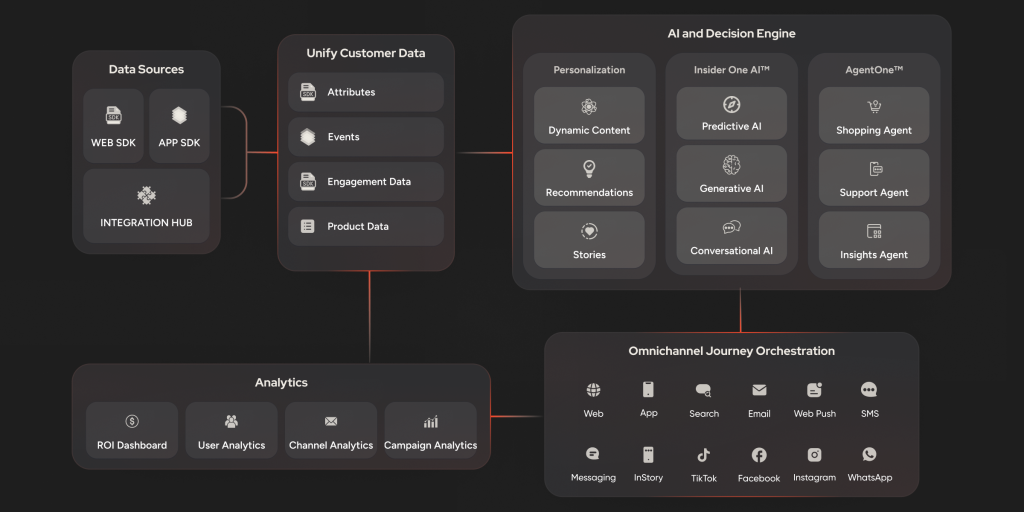
Insider One’s Customer Data Management layer connects data sources and supports unified profiles, while Journey Orchestration in Architect can use real-time triggers to coordinate experiences based on current customer behavior rather than only a campaign calendar.
Teams that unify data before building new journey logic tend to spend less time debugging conflicting messages later, a pattern explored further in how CDPs power real-time customer journey mapping.
How to fix execution without adding more channel chaos
The fix is sequencing: unify data first, centralize orchestration rules second, and only then expand channels, instead of adding new tools on top of a fragmented foundation. Here are the six changes that move the needle, in the order they should happen.
- Unify first-party data into one customer profile before mapping new journey stages, so triggers have something real to react to
- Centralize orchestration rules in one engine instead of per-channel tools, so a single customer never hits conflicting logic across email, SMS, and push
- Make consent and preference data available to the teams and channel workflows that need it, rather than relying only on delayed batch updates.
- Replace fixed campaign calendars with event-based triggers for high-intent moments such as cart abandonment or price drops, and use individualized product recommendations where relevant to support product discovery.
- Align team incentives to journey-level outcomes, such as retention and lifetime value, instead of channel-level opens and clicks
- Measure journey performance end to end, not channel by channel, so a conversion gets credited to the sequence that actually drove it
Brands can also apply these principles in different ways. Coca-Cola increased conversion rate by 19% through Coupon Overlays as part of an onsite personalization approach, rather than through the journey-orchestration attribution previously stated here.
What to evaluate before choosing a platform
Evaluate a platform on whether it unifies data and enforces orchestration rules centrally, not on how many channels it claims to support. Channel count is easy to market and hard to operationalize if every channel still runs on its own disconnected logic underneath.
The criteria that actually predict execution quality:
- Does the platform ingest real-time behavioral events, or only batch imports on a fixed schedule
- Can one journey engine coordinate logic across every channel, or does each channel run its own separate rules
- How does the platform make consent and preference data available across the channel workflows a team operates?
- Can marketers build and adjust journeys, audiences, and triggers with governance appropriate to their operating model?
- Does reporting connect to journey-level outcomes like retention and lifetime value, not just channel opens and clicks
These criteria matter more at scale than in a pilot. A platform that handles ten journeys cleanly can still buckle at two hundred if orchestration rules aren’t centralized. At scale, coordinated capabilities can matter: Samsung increased conversions by 275% in 20 days through a combined launch strategy that included personalized search experiences and omnichannel messaging.
Insider One’s Platform connects data sources, identity resolution, unified profiles, Architect, real-time triggers, dynamic content, and campaign and journey performance analytics; teams seeking advanced adaptive optimization can also evaluate Agent One against defined outcomes, constraints, and approval rules, with the reasoning detailed on Why Insider One.
Conclusion
Improving the customer journey works best as an ongoing operating model rather than a one-time redesign project. The brands getting real lift treat journey stages as live decision points fed by unified data, not static diagrams revisited once a year. Fix the data and orchestration layer first, align incentives to journey outcomes, and channel expansion stops creating chaos and starts creating leverage.
To evaluate the fit of our platform and Customer Data Management for your use case, book a personalized demo to review your goals, data requirements, and implementation constraints with the Insider One team.
Frequently Asked Questions
Customer journey optimization is the ongoing process of adjusting touchpoints, timing, and channel selection based on real customer behavior rather than a fixed campaign calendar. It depends on unified data and centralized orchestration rules so every interaction reflects what a customer just did, not what was planned weeks in advance.
Most journeys span awareness, consideration, purchase, onboarding, and retention, though labels vary by business model. The stages matter less than how a brand detects movement between them. A live orchestration layer tracks that movement in real time instead of assuming every customer follows the same fixed sequence.
Customer journey mapping documents expected behavior at a point in time, usually during a planning workshop. Journey orchestration is the live system that can use real customer behavior to coordinate triggers, channels, and timing as journeys progress. Mapping sets direction; orchestration does the ongoing work of reacting.
Engagement often improves more from coordination than addition. When existing channels run off the same real-time data instead of independent logic, messages stop conflicting and timing improves. Centralizing orchestration rules and syncing consent across channels frequently lifts engagement more than launching a new channel on top of an already fragmented stack.
Stalls usually trace back to disconnected data, inconsistent consent records, and incentives that reward channel-level metrics over journey-level outcomes. Fixing the data and orchestration foundation first, before layering on new tactics, prevents the rework that derails most mid-market and enterprise initiatives.

Keep Reading
4 min.

Chris Baldwin
3 Feb 2026
9 min.
Chris Baldwin
2 Nov 2026
9 min.
Chris Baldwin
2 Nov 2026