

 Platform Overview

 Integration Hub

 Agent One™

 Agent One™ Teams

 Customer Data Management

 Personalization

 Journey Orchestration

 Reporting & Data

 Behavioral Analytics

 Web
Web

 Email
Email

 Site Search

 Conversational CX

 WhatsApp

 Web Push

 InStory

 App
App

 SMS & RCS

 Join the $0 Migration Movement™

 The Insider One Difference

 Compare Vendors

 Switch to Insider One

 Success Story

 Retail & Ecommerce

 Financial Services

 Travel & Hospitality

 Beauty & Cosmetics

 Automotive

 Telecommunications

 Total Economic Impact™ Study

 Blog
Blog

 E-Books & Guides

 Events

 Glossary
How CDPs Create Accurate Customer Journey Maps From Fragmented Data

Updated on 5 Oct 2026
14 min.
Table of Contents
- Summary
- Why traditional journey maps break down without unified data
- What a CDP actually does inside a customer journey map
- The five journey phases and the CDP capabilities that power each one
- Closing the CDP utilization gap in journey orchestration
- Choosing a CDP that natively supports journey mapping at scale
- FAQs
Most Popular
Summary
A CDP creates a real-time, unified customer profile across devices and channels, enabling personalized journeys that update as customer behavior changes. Unlike CRMs or DMPs, CDPs maintain persistent identities throughout the customer lifecycle, but they work best when data, segmentation, and journey orchestration are all managed within the same platform to avoid delays and data loss.
When a customer abandons your site on mobile, returns on desktop two days later, opens an email on their phone, and converts through a paid retargeting ad, every one of those touchpoints is recorded somewhere in your stack.
The problem is that none of those records is communicating with each other. The journey map on your whiteboard still shows a clean linear path from awareness to purchase, while the actual customer has moved through four channels and two devices without your messaging ever catching up.
The gap is not a data shortage. Enterprise stacks are often saturated with behavioral signals. The core problem is the activation gap between the data you have and the journey maps your team is making decisions from. A customer data platform (CDP) is the mechanism that closes it. This article explains how, starting from the mechanics of profile unification through to the five journey phases and the CDP capabilities that power each one.
Why traditional journey maps break down without unified data
Static snapshots go stale immediately
Traditional journey maps are built from research: interviews, session recordings, analytics exports, and customer relationship management (CRM) pulls. By the time that material is assembled into a coherent document, it is already historical. It describes how a cohort of customers behaved in a past window, not how your customer is moving right now.
The fragmented martech stack makes this worse. Your email platform sees clicks. Your web analytics tool sees sessions. Your mobile push tool sees app opens. Each channel produces a journey snapshot that is accurate within its own silo and misleading at the system level. A customer who received three abandoned-cart emails and still did not purchase is not necessarily disengaged with email; they might be comparing prices elsewhere, and no single channel’s reporting will tell you that.
Identity resolution is where journey maps fall apart
The deeper problem is identity. An anonymous browser session, a known email address, a hashed mobile device identifier, and a loyalty account can all belong to the same person. Without resolving those identifiers into a single persistent profile, every touchpoint looks like a different customer, and journey maps built on unresolved identity do not map journeys at all; they map fragments.
Identity stitching, connecting anonymous-to-known signals across devices and sessions, is the foundational problem that CDPs were built to solve. When a customer logs in on desktop after browsing anonymously on mobile, a CDP merges that historical behavior into one profile immediately, not in a nightly batch. That is the difference between a journey map that reflects reality and one that shows you what you hoped was happening.
Insider One’s identity resolution is built on deterministic matching, linking profiles through concrete identifiers such as email addresses, loyalty IDs, and authenticated session tokens to maintain high data integrity. Where direct identifiers are absent, the platform applies advanced deterministic heuristics, using behavioral sequences and contextual signals to extend profile continuity across sessions without introducing the data quality trade-offs associated with probabilistic or fuzzy matching approaches.
For enterprise buyers operating across multiple brands or household relationships, Group-Level Unification extends this capability further. Profiles can be linked at the household or brand-portfolio level, enabling coordinated journey logic across sibling brands and shared accounts. A customer’s engagement with one brand informs the experience they receive across others, without requiring the customer to re-identify in each context.
What a CDP actually does inside a customer journey map
Core CDP functions in plain terms
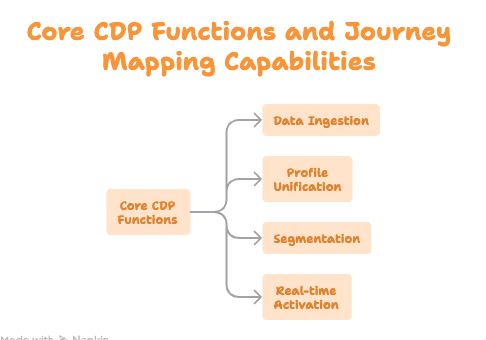
A CDP performs four core operations, and each one maps directly to a journey-mapping capability that neither a CRM nor a data management platform (DMP) can replicate.
Data ingestion
The CDP pulls behavioral, transactional, and contextual data from every connected source, whether that is your website, mobile app, email platform, point-of-sale (POS) system, or ad network. Unlike a CRM, which is optimized for structured relationship data, a CDP ingests raw event streams, including clicks, page views, searches, and product interactions, in real time.
Profile unification
The CDP resolves all of those signals into a single customer record, linking anonymous behavior to known identities as recognition events occur. This is the engine of accurate journey mapping: you cannot map a journey you cannot see in full.
Segmentation
Segmentation lets you define audience groups dynamically, based on current behavior and predicted intent rather than static lists. A segment is not a list you export once; it is a live query that adds and removes customers as they meet or fall out of the criteria. A customer who just viewed a pricing page moves into a high-intent segment in real time, not at the next weekly batch refresh.
Real-time activation
Real-time activation means those segments connect directly to your messaging channels, ad platforms, and content systems. The CDP does not just store data; it triggers action. That is the gap most CRM and DMP deployments cannot close: they can describe who the customer is, but they cannot push a personalized message to the right channel in the moment the intent signal appears.
Why CRM and DMP tools fall short
A CRM manages the commercial relationship: accounts, contacts, opportunities, and service history. It is structured around sales and support workflows, not continuous behavioral signals across anonymous and known customer states.
A DMP handles audience targeting for paid media, but it works with probabilistic, cookie-based identifiers that degrade with every browser policy update and do not persist across sessions.
Neither tool was designed to maintain a living customer profile that updates with each interaction and drives personalized experiences in real time. That is a CDP’s job, and it is why Customer Data Management is the architectural prerequisite for meaningful journey mapping at scale.
The five journey phases and the CDP capabilities that power each one
The awareness-consideration-conversion-retention-advocacy framework describes how customers move through a relationship with your brand. A CDP does not just observe that movement; it enables you to respond to it at each phase with the right data, the right segment, and the right triggered action.
Awareness: segmenting the unknown
At the awareness stage, most visitors are anonymous. A CDP captures behavioral signals from the first session, including pages visited, time on site, referral source, and device type, and begins building a profile before identity is resolved. This allows you to segment anonymous visitors by intent signal and serve relevant onsite experiences without waiting for a form submission.
Web Personalization extends this capability beyond passive data collection. Rather than simply observing anonymous behavior, Insider One uses those early behavioral signals to modify the site experience in real time, adapting hero banners, product recommendations, and navigation prompts before the visitor has identified themselves. Awareness is not just about tracking; it is about shaping the first impression with the behavioral context already available.
Consideration: predictive scoring in action
In the consideration phase, customers are evaluating options: comparing products, reading reviews, and revisiting category pages. A CDP with predictive scoring assigns a likelihood-to-purchase score based on historical cohort behavior and current session signals. That score powers smarter segmentation, so instead of sending the same nurture email to everyone in a broad consideration bucket, you can differentiate messaging based on predicted intent.
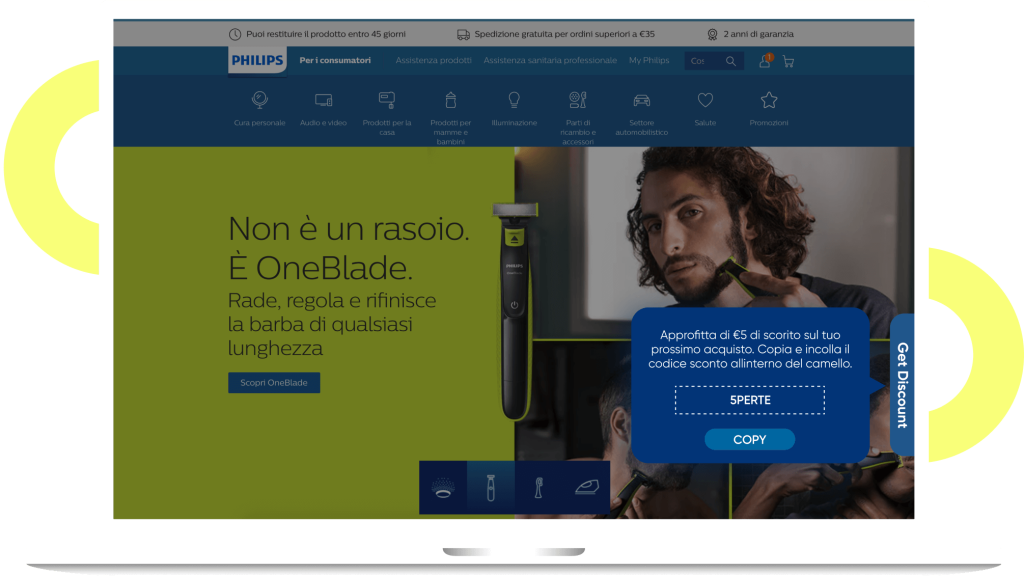
Philips achieved a 40.1% conversion rate increase by applying smart recommendations at this stage, surfacing the right products to the right visitor profiles at the moment consideration was highest.
Conversion: triggered messaging without batch lag
The conversion stage is where timing determines outcome. A cart abandoned at 2 PM on Tuesday has a very different recovery probability by Wednesday morning than it does within the first two hours. A CDP with real-time event streaming triggers the recovery message when the abandonment signal fires, not when the nightly batch job runs.
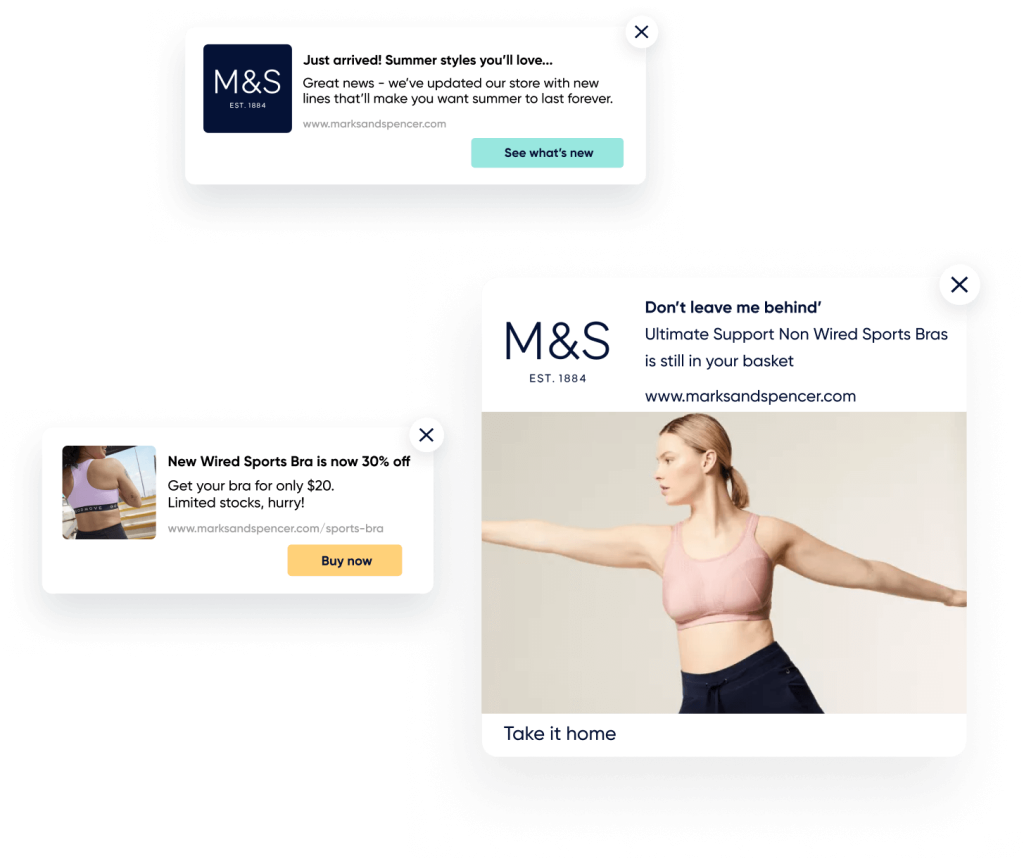
Marks and Spencer achieved a 15.1% cart recovery rate using web push notifications triggered through unified customer profiles.
Dynamic Date Triggers extend precision timing to non-retail use cases. In travel, a departure reminder series can be orchestrated entirely from the CDP, with message frequency and content adapting as the departure window narrows. In financial services and subscription businesses, renewal sequences and lapse-prevention campaigns are anchored to contract or billing dates stored in the unified profile, ensuring time-based outreach reflects the actual customer relationship rather than an arbitrary campaign calendar.
Retention: churn signals before they become churn
Retention is a prediction problem. By the time a customer has churned, the opportunity to act has passed. A CDP surfaces behavioral churn signals, including declining session frequency, reduced email engagement, and category browsing without purchase, and moves those customers into a re-engagement segment before they leave.
Insider One’s Predictive Churn model surfaces customers whose behavioral patterns indicate elevated exit risk before they disengage. Declining session frequency, reduced email engagement rates, and narrowing product category breadth all register as early churn indicators within the unified profile. Paired with Next Best Channel scoring, which determines the optimal outreach medium for each individual based on historical engagement patterns, the platform enables proactive retention rather than reactive win-back campaigns.
Cross-channel suppression rules matter here too: a customer receiving a win-back email should not also receive a promotional SMS the same day. The CDP holds the suppression logic so your channels do not work against each other.
Advocacy: closing the loop on the full journey
At the advocacy stage, the CDP identifies your highest-value, highest-satisfaction customers based on purchase frequency, revenue contribution, and engagement depth. These profiles power referral programs, loyalty tier upgrades, and co-marketing opportunities.
Sirius AI, Insider One’s generative AI layer, assists marketers in growing advocacy segments at scale. Rather than manually defining lookalike criteria, Sirius AI analyzes the behavioral characteristics of existing high-value advocates and generates segment definitions and journey paths that surface similar customers across the broader profile base. This reduces time-to-activation from days to hours and ensures that advocacy programs scale with the platform rather than with analyst headcount.
Critically, the CDP connects post-purchase behavior back into the journey map, so advocacy signals inform how you treat similar customers earlier in the funnel, turning the journey map into a feedback loop rather than a linear diagram.
Closing the CDP utilization gap in journey orchestration
Why many CDP deployments underperform
A CDP that stores unified profiles but does not activate them against real-time journey triggers functions as an expensive data warehouse. The utilization gap appears when teams build journey logic inside marketing automation platforms (MAPs) or multi-channel messaging hubs while the CDP sits upstream as a passive data source.
Data travels from the CDP to the MAP on a schedule, and by the time it arrives, the behavioral context has often changed.
The fix is not replacing your MAP. It is inverting the architecture: journey triggers should originate from CDP segments, not from campaigns built inside the MAP. The MAP handles message delivery; the CDP handles the decision of who receives what and when.
Comparing architectures: CDP + MAP vs. Insider One native platform
| Dimension | CDP + MAP Architecture | Insider One Native Platform |
| Data Latency | Batch sync on schedule (minutes to hours) | Real-time event streaming (sub-second) |
| Journey Triggers | Campaign-based, built inside the MAP | CDP segment-driven, native to platform |
| Field Mapping | Manual schema configuration per integration | Crowd-based SDK with automatic attribute inference |
| AI Capabilities | Separate tools or none | Sirius AI: generative segments, journey paths, and timing |
A practical activation checklist
If you are auditing your current CDP-to-journey-map setup, these three structural changes tend to produce the most immediate impact:
• Connect journey entry triggers to live CDP segments: Build entry rules around behavioral events that update the segment in real time, not around batch-exported lists
• Enable real-time event streaming: If your CDP syncs data to activation channels on a schedule rather than via event-driven triggers, every journey step introduces latency proportional to that schedule
• Set cross-channel suppression rules at the CDP level: Channel-level suppression creates coordination failures; suppression logic belongs in the unified profile layer where all channel activity is visible
For a deeper look at how to structure the orchestration layer, this customer journey orchestration guide walks through the architectural patterns in more detail.
Choosing a CDP that natively supports journey mapping at scale
The must-have capabilities
Not all CDPs are built for journey activation. Evaluating a CDP specifically for journey mapping use cases means checking for four capabilities:
• Real-time data processing: Profile updates should happen at the event level, not on a batch schedule, because any lag in profile update creates a corresponding lag in journey response
• AI-powered next-best-action: Predictive models that score intent, churn risk, and product affinity make the CDP proactive rather than reactive
• Cross-channel orchestration: The CDP should connect directly to web, mobile, email, SMS, paid media, and messaging channels without requiring a separate middleware layer
• Crowd-based data collection: Insider One’s Web SDK uses a crowd-based collection model that aggregates behavioral patterns across similar sites and user segments. This reduces the data-mapping burden that traditional CDPs impose on engineering teams: instead of configuring bespoke event schemas for every touchpoint, the SDK infers journey-relevant attributes from behavioral context automatically, accelerating time to value for new integrations.
• Consent and preference management: Journey maps that ignore consent are not just legally risky; they are inaccurate, because a customer who has opted out of a channel needs to be routed differently throughout the journey
The integrated platform advantage
The most common failure mode in CDP-to-journey-map setups is the handoff. Data leaves the CDP, travels through an API, and arrives in the journey tool with a delay, a field-mapping error, or a dropped attribute. Each handoff is a point of failure and a source of latency. When the CDP and the journey orchestration layer are native to the same platform, that handoff disappears, segments activate directly into journey flows, and the unified profile is visible to every channel simultaneously.
Insider One’s platform is built on this architecture: a unified data layer feeds Architect, the visual journey builder, so that behavioral signals flow from customer action to personalized response without leaving the platform.
Expressions, a layer of computed traits native to the platform, allow journey teams to define entry conditions with granular precision. Instead of building segments around raw behavioral events, Expressions compute intermediate values such as ‘days since last purchase,’ ‘points to next reward threshold,’ or ‘average order value over 90 days,’ and expose those values as first-class journey trigger conditions. The result is segment logic that would require custom engineering in a standard CDP-plus-MAP architecture, available natively without additional development overhead.
Generative Journey AI takes orchestration further. Sirius AI analyzes unified customer profiles and proposes optimized journey paths, including entry triggers, channel sequences, and message timing windows, based on aggregate behavioral patterns across your customer base. Marketers can accept, modify, or override AI-generated paths, compressing the time from strategic intent to live journey from weeks to hours.
MadeiraMadeira achieved significant revenue growth with Architect by running journey orchestration directly against unified customer profiles, eliminating the sync delays that had previously broken their funnel sequences. For teams evaluating the mechanics before building a business case, this guide to customer journey builders explains what to look for in an orchestration tool and how it connects to the data layer beneath it.
If you want to see how Insider One’s Architect and Customer Data Management turn live customer data into coordinated, revenue-driving experiences, book a personalized demo to see the exact use cases, decision logic, and growth levers most relevant to your team.
FAQs
A customer relationship management (CRM) tool manages structured relationship data: contacts, accounts, transactions, and service records. It is designed for sales and support workflows and does not ingest real-time behavioral signals from anonymous sessions.
A customer data platform (CDP) maintains a persistent, unified profile that includes both known and anonymous behavior, updates continuously as events occur, and connects to activation channels in real time. For journey mapping, the CDP is the more appropriate foundation because it can observe and respond to the full customer journey, not just the portion that exists in a sales record.
Identity resolution is the process of linking signals from anonymous sessions, known email addresses, device identifiers, and loyalty accounts into a single persistent customer profile. Without it, every touchpoint appears to belong to a different customer, making journey maps unreliable. A CDP performs this stitching continuously, so when a customer moves from an anonymous mobile session to a logged-in desktop session, their full behavioral history travels with them and informs the next personalized response.
Ideally, at every meaningful behavioral event. A customer who views a product detail page, adds to cart, and then exits without purchasing has moved through multiple micro-stages in a single session.
A CDP that processes events in real time can update that customer’s stage, score, and segment membership mid-session, allowing the next touchpoint to reflect their current intent rather than their state from the last batch sync. Batch-based updates, even daily ones, introduce enough lag to produce mistimed messaging in high-intent moments.
Journey mapping tells you where customers are in their relationship with your brand and what they need next. In a CDP context, the map is not a static deliverable; it is a live operational framework. CDP segments define who belongs at each stage, predictive models identify where customers are likely to go next, and real-time activation ensures the response reaches the right channel before the moment passes. The purpose shifts from documentation to execution.
Insider One’s advantage in journey mapping lies in the native integration between its Customer Data Management layer and its Architect journey builder. Unlike architectures that route behavioral data through separate marketing automation platforms before activation, Insider One processes events in real time and makes them immediately available as journey triggers. The combination of Expressions for granular trigger logic, Sirius AI for generative segment and journey path creation, and zero-latency handoff between the data layer and the orchestration layer means that journey maps in Insider One are operational frameworks that update continuously with customer behavior, not static deliverables built from historical snapshots.

Keep Reading
4 min.

Chris Baldwin
3 Feb 2026
8 mins.
Chris Baldwin
8 Oct 2026
8 mins.
Chris Baldwin
8 Oct 2026