

 Platform Overview


 Integration Hub


 Agent One™


 Agent One™ Teams


 Customer Data Management


 Personalization


 Journey Orchestration


 Reporting & Data


 Behavioral Analytics


 Web


 Email


 Site Search


 Conversational CX


 WhatsApp


 Web Push


 InStory


 App


 SMS & RCS


 Join the $0 Migration Movement™


 The Insider One Difference


 Compare Vendors


 Switch to Insider One


 Success Story


 Retail & Ecommerce


 Financial Services


 Travel & Hospitality


 Beauty & Cosmetics


 Automotive


 Telecommunications


 Total Economic Impact™ Study


 Blog


 E-Books & Guides


 Events


 Glossary
Personalized Marketing: What It Is, How to Build It, and 5 Examples With Results

Updated on 17 Sep 2026
9 min.
Table of Contents
- Summary
- What is personalized marketing?
- Why does personalized marketing matter in 2026?
- What are the benefits of personalized marketing?
- What stops brands from personalizing at scale?
- Which personalized marketing trends matter in 2026?
- How do you build a personalized marketing strategy?
- Five personalized marketing examples with results
- How do you personalize every touchpoint with Insider One?
- Conclusion
- Frequently asked questions (FAQs) about personalized marketing
Most Popular
Summary
- Personalized marketing tailors content, recommendations, channels, and timing to each customer across the journey.
- It relies on unified data, predictive segmentation, cross-channel execution, and journey orchestration.
- Key challenges are disconnected data, limited channel reach, and basic personalization.2026 trends include agentic and generative AI, warehouse-native activation, contextual data, and consent-led first-party data.
- Customer examples include a 502% rise in loan applications at BBVA, 49x ROI at Slazenger, and 525.71% higher average session duration at Media Prima.
- Set baselines and use holdout groups to measure true impact.
- Insider One combines unified profiles, AI, and native channel execution in one platform.
Personalization is an umbrella term for the techniques that make each customer’s experience relevant to them. Applied properly, it delivers individualised content, messaging and product recommendations across every channel and every stage of the journey, from first visit to post-purchase.
This guide is for marketing, ecommerce and customer relationship management (CRM) leaders building or rebuilding a personalization programme. You will get a working definition, the benefits and the blockers, the trends worth the budget in 2026, a five-step implementation sequence, and five examples from Insider One customers with the numbers they reported.
What is personalized marketing?
Personalized marketing, sometimes called one-to-one marketing, is a strategy that tailors the entire brand experience to an individual’s needs, interests and preferences.
It spans techniques and channels: website content personalization, email personalization, send time optimization, product recommendations, personalized site search and more. All of them depend on accurate customer data, both to understand what someone has done and to predict what they are likely to do next.
The distinction worth holding onto is between personalizing a message and personalizing an experience. The first changes a subject line. The second changes what the customer sees at every step.
Why does personalized marketing matter in 2026?
Three things have changed the stakes. AI has lowered the cost of producing variants, so the constraint has moved from content production to data quality and decisioning. Channel behaviour has fragmented, particularly outside North America, where WhatsApp and Rich Communication Services (RCS) now carry conversations that used to sit and be limited in emails. And consent has become the real limit on what you can personalize, since a signal you cannot lawfully use is not an asset.
The result is a widening gap between brands that personalize from a unified profile and brands that run channel-by-channel campaigns. The second group is not slower, it is working from a partial view of the same customer.
What are the benefits of personalized marketing?
Based on our experience helping brands personalize customer experience, four benefits come up consistently.
More consistent and relevant experiences. Personalizing shows customers you understand their preferences, which makes them more likely to engage and stay, because they trust you not to waste their attention.
Higher loyalty, retention and lifetime value. This follows from the first. Relevance sustained across the lifecycle is what keeps customers, and retention is where the richest data already sits.
Higher conversion rates and average order value (AOV). The more relevant the offer, the more likely the action, whether that is a purchase, a subscription or a booking. Offers built on past purchases and live behaviour also tend to lift AOV.
Better use of budget. Targeting relevant offers stops spend going to people who were never going to convert, and stops discounting people who would have bought anyway. Both effects show up in return on investment (ROI).
What stops brands from personalizing at scale?
Data silos. Personalization needs reliable data across the whole customer journey, but for most brands that data is split between CRMs, email platforms, analytics and service software. A customer data platform exists specifically to solve this.
Limited stacks. Many providers cover a narrow set of channels, which caps how far personalization can reach and produces a disjointed experience. Replacing several point solutions with one cross-channel platform removes the integration tax.
Too narrow a definition. For many teams, personalization means a first name in a subject line or a last-viewed product in a push notification. Useful, but not the same as tailoring the website, the app, the messaging channels and the timing to each person.
Which personalized marketing trends matter in 2026?
Agentic AI. Beyond generating content, agents now execute defined tasks: answering product questions, assembling campaigns, handling a shopping conversation end to end.
Generative AI for the long tail. Variant production is no longer the bottleneck, which means the winning teams are the ones with the data to decide which variant to show.
Predictive audiences as standard. Likelihood to purchase, churn risk, discount affinity and projected lifetime value are now table stakes for targeting rather than advanced features.
Warehouse-native activation. Zero Copy Segmentation with Snowflake lets teams build and activate audiences without duplicating data, which removes a long-standing governance objection.
Contextual data beyond the profile. Store hours, local promotions and inventory shape what an individual should see. Lookup tables hold that context without forcing it onto the user record.
Consent-led first-party data. Brands are prioritising what customers share willingly, which builds trust and produces more accurate personalization. Worth separating two ideas that are often merged: collecting zero-party and first-party data is a strategy, and cookieless personalization is a capability. They support each other but they are not the same thing, and Google confirmed in April 2025 that it will not deprecate third-party cookies in Chrome, so the driver here is consent and browser defaults rather than a deadline.
How do you build a personalized marketing strategy?
In outline, personalized marketing means gathering accurate data about customer journeys, showing each person relevant content and recommendations, and reaching them on their preferred channel at their preferred time. Six steps get you there.
#1 Aggregate data into unified profiles
To personalize anything you need to know who your customers are, what interests them, and how they interact with your brand. That data usually sits in disconnected systems.
Insider One’s Actionable CDP unifies data from any online or offline source, including CRMs, content management systems, application programming interfaces, analytics platforms and customer service software. It then builds 360-degree profiles holding contact details, preferred channels, full browsing and purchase history, last browsed and abandoned products, survey answers and CRM identifiers.
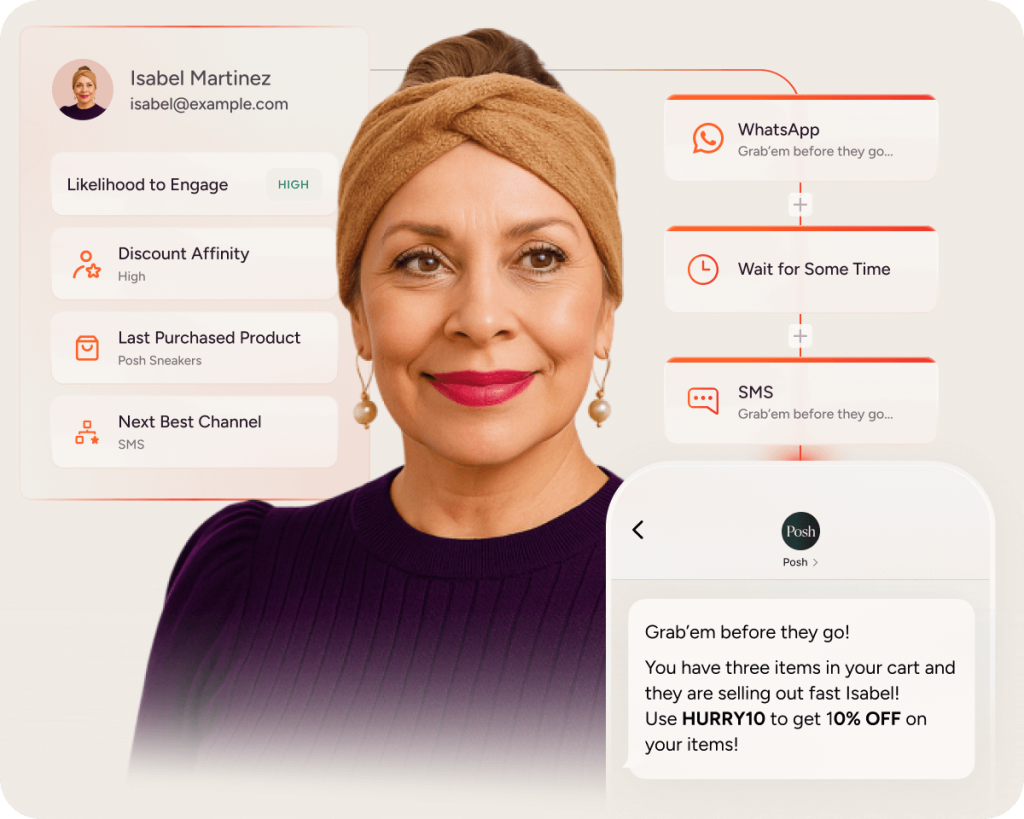
Profiles update continuously as customers interact with your brand, which means the data layer maintains itself rather than needing a quarterly rebuild. For more on this, see our guide to how CDPs help marketing teams drive growth.
#2 Segment with behaviour and prediction
Segmentation groups customers by shared characteristics and behaviours, and it underpins everything else. Insider One creates audiences automatically for common cases, including cart abandoners, product page abandoners and people who engaged on a specific channel.
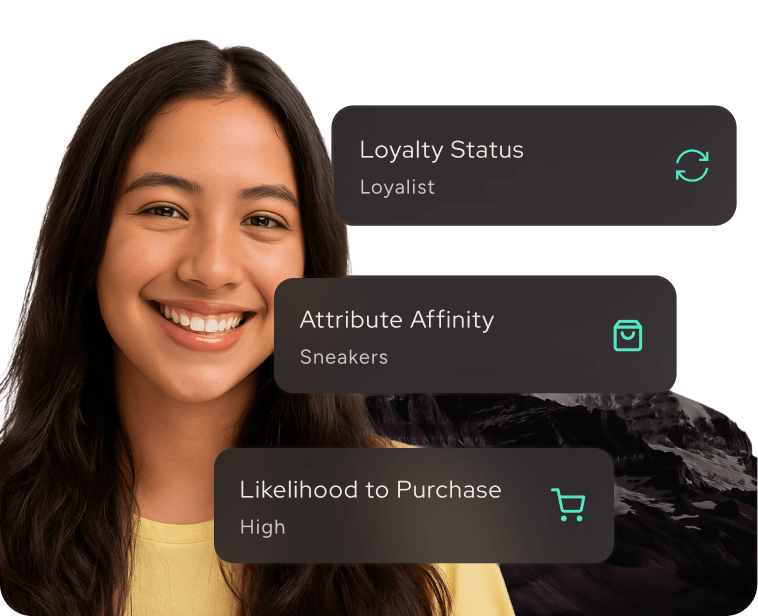
You can narrow any of those with more than 120 attributes covering location, device, behaviour, demographics and CRM fields. Our AI intent engine then adds predictive dimensions: likelihood to purchase or churn, projected lifetime value, discount affinity and interest clusters.
#3 Personalize the website and mobile app
Your site and app are the highest-leverage place to start, because you are already paying to bring people there.
Insider One can show personalized product recommendations to every user, choosing from strategies including top sellers, frequently viewed together and frequently purchased together. A user-based strategy hands the choice to the algorithm, matching each recommendation to the individual.
Beyond recommendations, the platform personalizes banners, pop-ups, category navigation and site search results through Eureka. InStory adds a familiar story-format product discovery to the site or app, with content personalized per viewer.
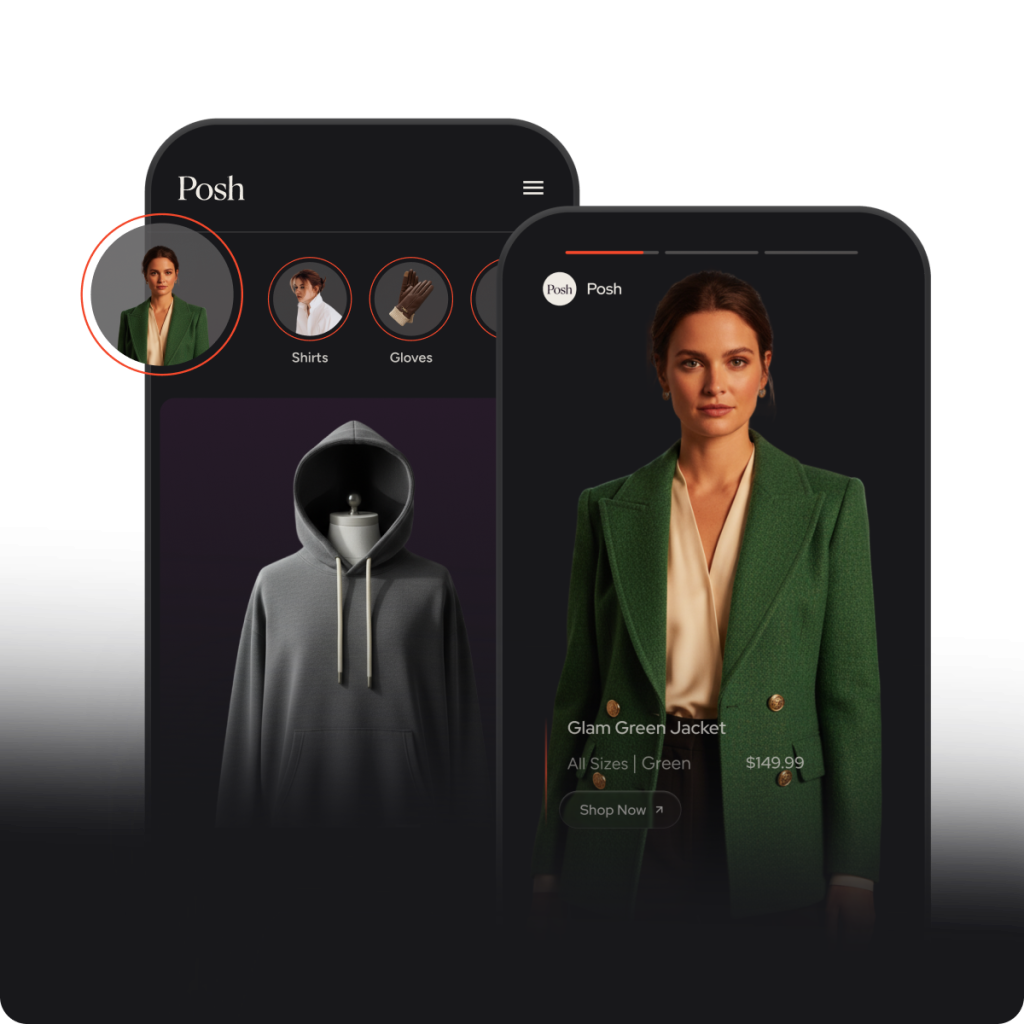
Dover Saddlery used InStory and wider personalization to generate reported incremental revenue of $1.7 million from InStory and more than $2 million from personalization overall. Read the Dover Saddlery case study, and see our guide to website personalization for the tactic list.
#4 Extend personalization to messaging channels
Once the site and app are handled, scale to the channels customers actually use. Insider One brings web, app, email, web push, SMS, RCS, WhatsApp, site search and conversational experiences into one platform.
Email and SMS: Include cart items, last purchased products, AI-driven recommendations, names, birthdays and other dynamic content without building templates from scratch.
Push notifications: Web and app push can reach anonymous visitors with products based on the categories and attributes they browsed, which is among the fastest ways to convert a first-time visitor.
WhatsApp: Promotional messages, price drop alerts and reminders, plus conversational commerce flows that keep the buying experience inside the thread.
Online ads: Push segments to search and social platforms as audiences. Pierre Cardin used this to report a 67% reduction in cost per acquisition, a 164.83% improvement in return on ad spend and a 445% uplift in conversion rate.
#5 Orchestrate the journey
The last step is tying individual touchpoints into one experience, a process usually called journey orchestration.
Architect is Insider One’s cross-channel journey builder. Journeys can start from an event such as a purchase, branch on real-time behaviour, wait for a condition, and A/B test whole flows against each other rather than single messages.
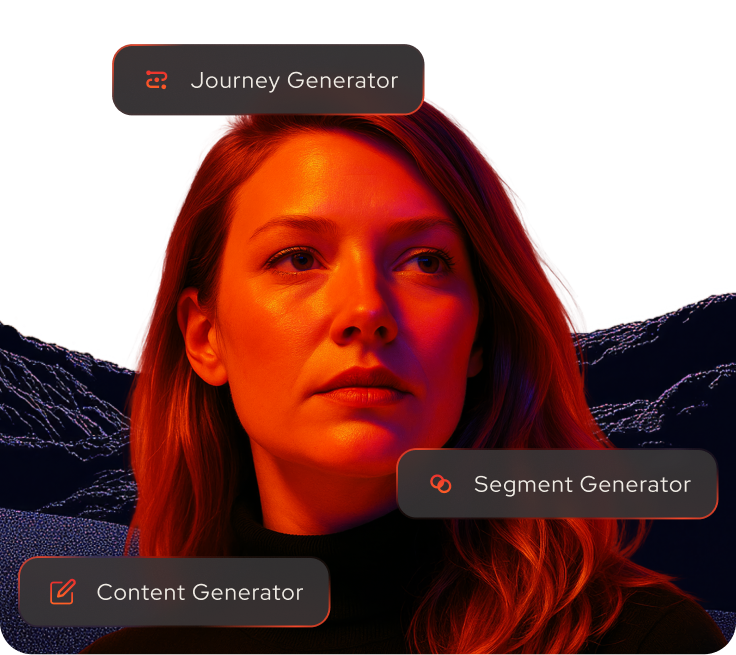
Three AI capabilities reduce manual work. A/B test winner autoselection promotes the winning path automatically against a metric you choose. Send-time optimization and next-best-channel prediction decide when and where to reach each person. Generative features in Insider One AI draft copy, build segments and assemble journeys from a prompt.
For a wider view, see our guide to marketing automation platforms.
#6 Measure incrementality, not activity
Most personalization programmes are reported on activity: campaigns shipped, variants tested, uplift versus last month. None of that survives a finance review.
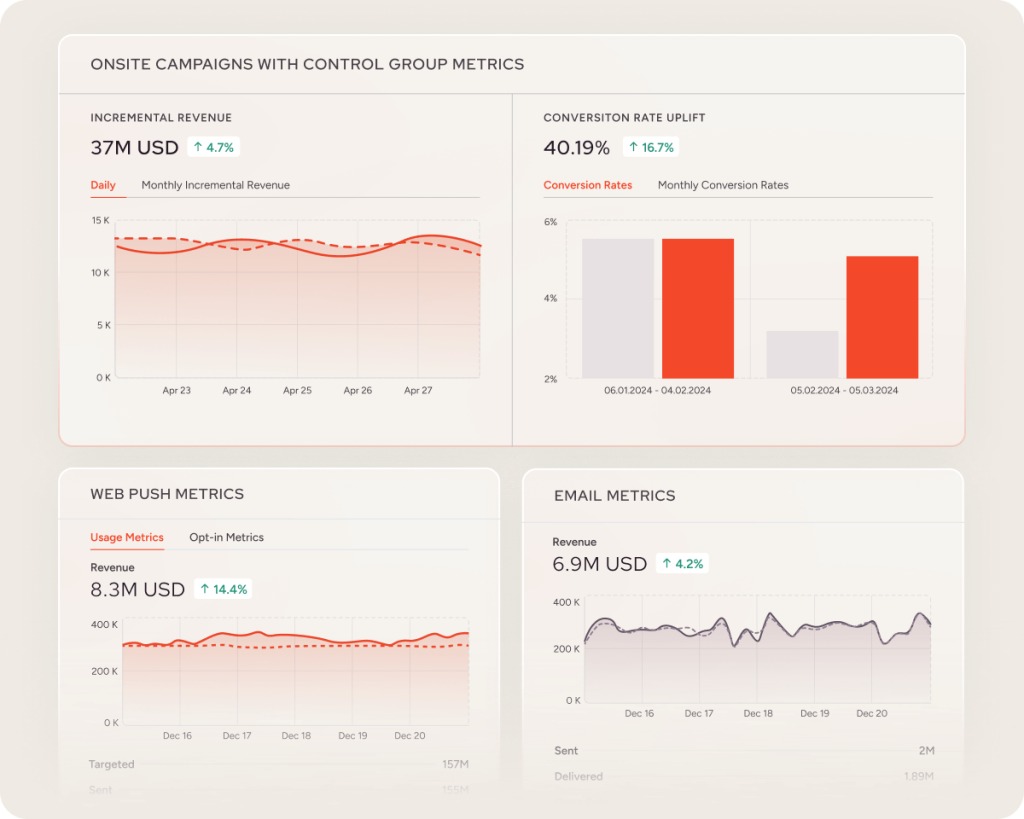
Agree the metric and the baseline before launch, hold back a control group, and report incremental conversion rate, AOV, retention and lifetime value against that control. The uncomfortable version of this question, which is worth asking early, is how much of the personalized revenue would have arrived anyway.
Five personalized marketing examples with results
Widely cited examples such as Coca-Cola’s Share a Coke campaign, Amazon’s recommendations and Spotify’s Discover Weekly are useful illustrations, but the results are rarely published. The five below are Insider One customers, with the figures they reported.
BBVA: A 502% increase in loan applications
BBVA is a leading financial services group serving millions of customers. Its marketing team wanted to raise engagement by introducing customers to new channels, improving segmentation and delivering timely, relevant messages.
One priority segment was customers aged 55 and over, who faced particular difficulty on the website. The team identified the most common online transactions for that age group, then built a simplified homepage personalized to the segment, using Insider One’s experimentation and personalization capabilities to collect behavioural data on how the segment used the new pages.
Reported results: Search bar usage up 52%, loan applications up 502%, credit card applications up 192%.
Adidas: A 259% increase in AOV and 50.3% higher mobile conversions
Adidas is Europe’s largest sportswear manufacturer and the second largest worldwide. It partnered with Insider One during the pandemic, when site traffic was climbing faster than the team could engage and retain it.
Three use cases went live quickly. Targeted coupon codes, using segments of new and returning visitors with a side-menu coupon offering 10% off, varied per segment, reported a 259% increase in AOV and a 35.5% increase in conversion rate. Category Optimizer personalized the mobile menu against each customer’s browsing history, reported at a 50.3% increase in mobile conversion rate. Smart Recommender, applied to homepage product discovery, reported a 13% conversion rate increase on the homepage and 7% on product pages after one month.
Slazenger: A 49x return on investment in eight weeks
Slazenger is an established sports brand covering cricket, tennis, swimming, hockey and golf. Its team wanted cross-channel personalization, better cart abandonment and click-through metrics, and more return from its stack.
Cart abandonment campaigns delivered through web push, email and SMS were timed and targeted using customer data, and one campaign recovered 40% of lost revenue. Price drop alerts notified users when a product they had viewed, wishlisted or abandoned fell by 10% or more, reported at a 12% increase in click-through rate.
Reported results after deployment: a 700% increase in customer acquisition and a 49x return on investment within eight weeks.
ICI Paris XL: A 110% conversion rate uplift and 86% AOV increase
ICI Paris XL is a perfume retailer founded in Belgium in the late 1960s. It wanted website personalization, better segment communication and fast time to market.
Five tactics ran with support from our growth consultants. “Also available as a set” labels on product pages reported a 110% conversion rate uplift and a 26.64% AOV increase. Personalized exit-intent overlays offering a checkout incentive reported a 25.5% AOV uplift and a 2.62% conversion rate increase. A countdown banner for a shopping night reported an 86.49% AOV uplift and a 20.36% conversion rate increase. InStory reported a 46% reduction in bounce rate. Social proof reviews on product pages reported a 9.98% conversion rate uplift against a control group.
Media Prima: A 525.71% uplift in average session duration
Media Prima is Malaysia’s leading integrated media house, spanning television, print, radio, out-of-home, content and digital. The programme began in 2017 with a goal of delivering personalized content to each visitor.
The team sent automated browser push notifications when a reader’s favourite author published, personalized homepage content, built scenarios encouraging social sharing, and added InStory content units.
Reported results: a “Read next article” button produced a 91.55% uplift in pages per session and over 300% uplift in average session duration, homepage personalization produced a 60% uplift in pages per session and 75% in session duration, and InStory produced a 525.71% increase in average session duration.
How do you personalize every touchpoint with Insider One?
Insider One suits mid-market and enterprise companies scaling personalization across the whole journey. Our personalization engine ingests customer data from any source and delivers relevant content, messaging and recommendations across every touchpoint.
In practice, the platform helps you unify customer data from CRMs, content systems, analytics and offline sources; track behaviour to uncover interests and preferred channels; predict churn and purchase likelihood with the AI intent engine; deliver individualised experiences across web, app, email, SMS, WhatsApp and Messenger; and improve conversion, revenue, acquisition cost, AOV and lifetime value.
On external validation, Insider One was named a Leader in the 2026 Gartner Magic Quadrant for Personalization Engines, the fifth time as a Leader, topped G2’s Fall ’26 reports across 14 categories, and a commissioned Forrester Total Economic Impact study put its return on investment at 449%, with $10.2M in attributed revenue for the composite organisation. Setup support, an experienced services team and a large template library shorten time to value, and the $0 Migration Movement covers the cost of moving from another vendor.
Conclusion
Personalized marketing is not a channel tactic. It is a data problem, a decisioning problem and an orchestration problem, and the brands that treat it that way get compounding returns because every channel they add inherits a profile that already works.
The sequence that holds up: unify the data, segment with behaviour and prediction, personalize the site and app, extend to messaging, orchestrate the journey, then prove incrementality against a control. Teams that start at step four and work backwards tend to rebuild the programme a year later.
Book a demo to review your data, channels and use cases with the Insider One team.
Frequently asked questions (FAQs) about personalized marketing
To give each customer relevant content, messaging and product recommendations at every stage of their journey, on the channel they prefer. Done well, that lifts engagement, conversion rate and revenue, and it lowers acquisition cost because fewer impressions are wasted on the wrong people.
Showing different homepage products to each visitor based on purchase history, browsing behaviour and how they engaged on email or SMS. A fuller strategy extends the same profile to messaging, ad audiences and site search, so every surface reflects what that person has shown interest in.
Effective enough to be measurable, provided you measure properly. The customer examples in this guide report conversion rate and AOV uplifts well above 50%, and several above 100%. Always validate against a holdout group, since uplift measured without a control tends to overstate the result.
Tailoring ads to individuals using their interests, behaviours, demographics and past interactions with a brand. It uses first-party data to build audiences that are more likely to convert, which raises engagement and conversion while reducing acquisition cost, and it depends on consent for the signals involved.
Personalized advertising is the practice of tailoring ads to individual users based on their specific interests, behaviors, demographics, and past interactions with a brand or product. The process leverages data to create highly relevant and targeted advertising experiences that resonate with each user, increasing the chances of engagement and conversion, while also reducing acquisition costs.
Start with identity resolution and consistent event naming, not with tactics. Personalization built on a fragmented profile produces contradictory experiences across channels, and every model you add inherits the quality of that data layer. A CDP, or a platform with one built in, is the practical fix.

Keep Reading
3 min.

Muharrem Derinkok
13 Oct 2025
8 min
Muharrem Derinkok
13 Jan 2025
9 min
Muharrem Derinkok
13 Jan 2025