

 Platform Overview

 Integration Hub

 Agent One™

 Agent One Teams™

 Customer Data Management

 Personalization

 Journey Orchestration

 Reporting & Data

 Behavioral Analytics

 Web
Web

 Email
Email

 Site Search

 Conversational CX

 WhatsApp

 Web Push

 InStory

 App
App

 SMS & RCS

 Join the $0 Migration Movement™

 The Insider One Difference

 Compare Vendors

 Switch to Insider One

 Success Story

 Retail & Ecommerce

 Financial Services

 Travel & Hospitality

 Beauty & Cosmetics

 Automotive

 Telecommunications

 Total Economic Impact™ Study

 Blog
Blog

 E-Books & Guides

 Glossary
How AI is Transforming Customer Engagement: 6 Strategies That Actually Work

Updated on 17 Sep 2026
10 mins.
Table of Contents
- Summary
- Why AI engagement programmes stall
- Strategy 1: Unify behavioural, transactional and support data first
- Strategy 2: Score customers predictively before choosing a channel
- Strategy 3: Sync consent and identity across every channel
- Strategy 4: Trigger journeys, not single messages
- Strategy 5: Route conversational AI through the same live profile
- Strategy 6: Set one shared KPI across marketing, CX and retention
- What to evaluate before choosing a platform
- Conclusion
- FAQs
Most Popular

Summary
- AI features alone don’t create AI-driven engagement. The difference is how AI influences decisions.
- Unify customer data so AI can act on a complete, current profile.
- Use predictive scoring to identify who needs attention before choosing the channel.
- Sync consent and identity across channels to prevent conflicting outreach.
- Trigger coordinated journeys, not isolated messages, from churn signals.
- Connect conversational AI to the same live customer profile used across engagement.
- Align teams around one KPI across marketing, CX, and retention.
You turned on AI subject lines, added a chatbot and switched on recommendations. Six months later, retention and average order value look much as they did before.
That pattern is common enough to have a name. Adoption is close to universal, while the technology rarely becomes the thing actually driving decisions.
This article is for senior marketers, growth leaders and CX professionals who have already bought AI capability and are not seeing it move outcomes.
Below are six strategies that separate programmes where AI changes results from programmes that simply contain AI, in the order they need to be tackled.
Why AI engagement programmes stall
AI models get dropped into organisations built for channel-by-channel campaign management rather than real-time decisioning. Email teams own email data, app teams own app data, support runs a separate ticketing system. The model sits on top of one slice and its output is only ever as good as the fragment it can see.
Most coverage of this topic stops at the feature layer: which chatbot, which recommendation engine, which send-time optimiser.
That skips the coordination problem. A model recommending a product a customer already returned, or a retention offer sent after that customer churned through support, is not a model failure. It is a data and process failure, and no amount of algorithmic sophistication fixes it.
The problem compounds with every channel you add. Each new touchpoint brings its own consent rules, identity signals and data latency, so without a shared layer underneath, the odds rise that one channel’s AI decision contradicts another’s. Customers notice that inconsistency well before internal teams do.
The six strategies below address that directly. The order matters: the first three are prerequisites, and running the last three without them produces faster wrong decisions.
Strategy 1: Unify behavioural, transactional and support data first
A predictive model can only score what it can see. If purchase history sits in one system, support interactions in another and browsing behaviour in a third, the model is making decisions about a partial customer rather than a real one.
Customer Data Management solves the visibility problem by merging behavioural, transactional and consent data into a single profile that updates continuously.
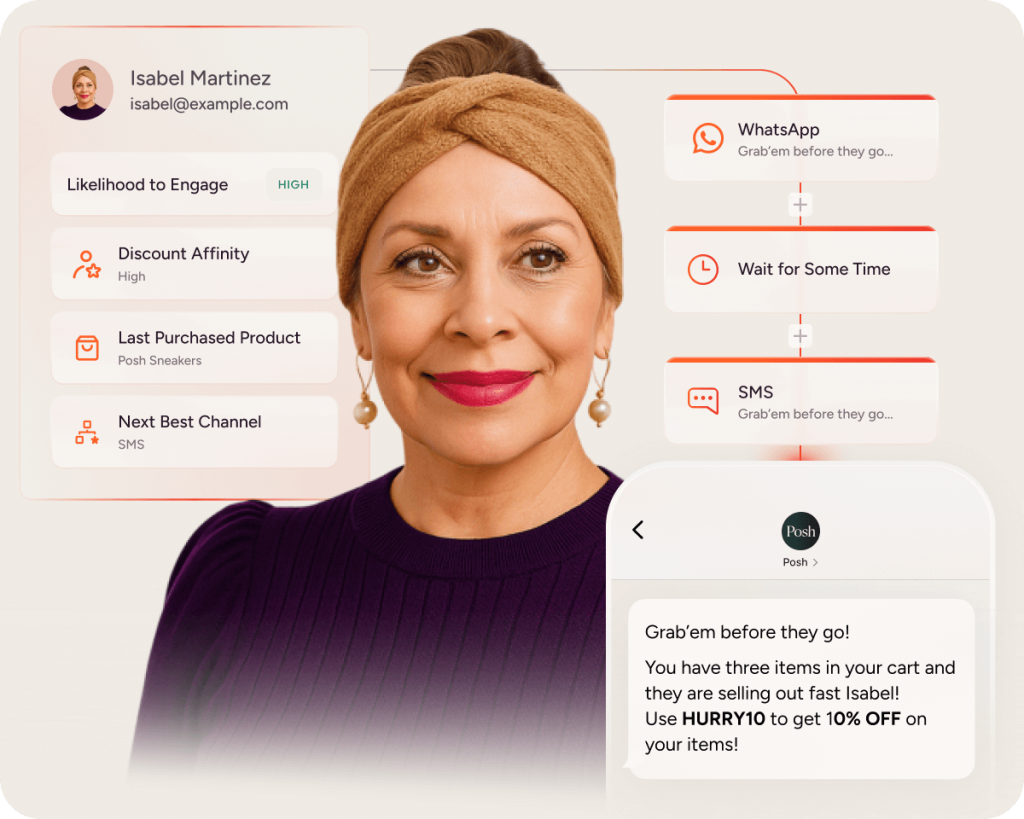
What good looks like: a support agent, an email campaign and an on-site recommendation all reading the same profile at the same moment, including the return processed an hour ago.
Kiehl’s addressed this fragmentation directly and reported a 25% conversion rate lift and seven times return on investment after connecting its personalization engine to a single customer view rather than siloed campaign data. Read the Kiehl’s case study. The model did not get smarter. The data feeding it stopped being split across departments.
Do this before switching on anything else. Stacking AI features on fragmented data multiplies inconsistency rather than resolving it.
Strategy 2: Score customers predictively before choosing a channel
Most teams pick the channel first and then work out who to send to. Reversing that produces better results, because the question of who needs proactive attention is answered by behaviour, while the question of where to reach them is answered by preference.
Predictive segmentation, whether based on engagement, value or churn risk, identifies the people worth acting on. Only then does channel selection matter. This is also what turns AI personalization from a content exercise into a targeting decision, and it is the step that stops campaigns defaulting to whoever is on the biggest list.
Philips connected product recommendations to actual customer behaviour rather than static rules and reported a 35% increase in average order value. Read the Philips case study. The mechanism is unglamorous: recommendations that reflect what someone did in the last hour beat recommendations built from a segment definition written last quarter.
Strategy 3: Sync consent and identity across every channel
This is the least discussed strategy and the most visible when it fails. A customer who opts out of email and then receives a push notification or an SMS has not experienced a clever personalization programme. They have experienced a company that does not listen.
Consent needs to live on the same profile as behaviour, and it needs to be enforced in journey logic rather than checked in a separate system before each send. Identity resolution matters for the same reason: the same person on mobile web, in the app and on a support call should resolve to one profile, or your frequency rules apply three times over.
Getting this right also protects the measurement work later, since consent gaps quietly distort audience sizes and make results hard to compare.
Strategy 4: Trigger journeys, not single messages
A churn-risk score that fires a single email is a wasted signal. The same score should set off coordinated action: a message on the channel that customer actually uses, a follow-up if there is no response, suppression from acquisition ads, and a flag for the service team if the risk came from an unresolved ticket.
Journey orchestration is what decides which channel, message and timing wins when several triggers fire for the same person. Without it, teams end up with AI outputs that compete instead of coordinate, which is the technical version of the incentive problem in strategy six.
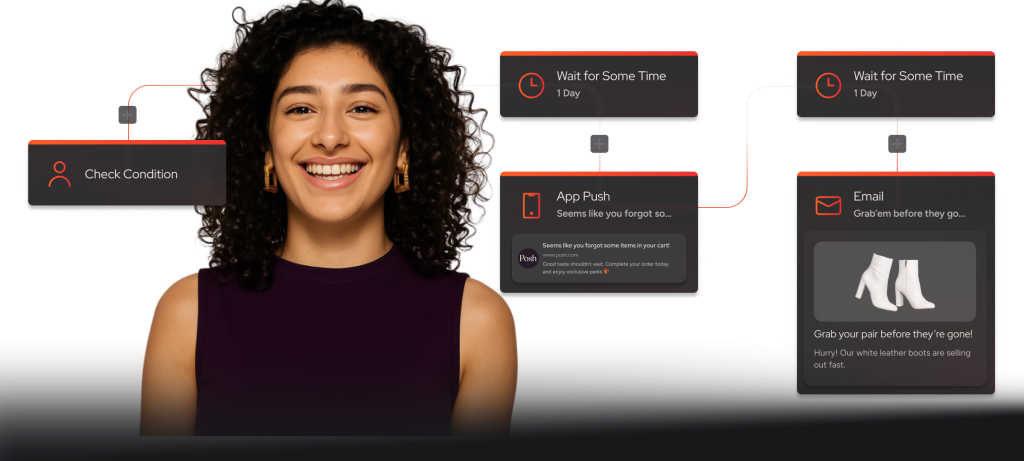
Samsung applied this kind of coordinated approach, aligning personalization logic with a single customer data foundation rather than running channel-specific AI in isolation, and reported a 275% rise in conversions within 20 days. Read the Samsung case study. The result came from structural change rather than a new algorithm.
Strategy 5: Route conversational AI through the same live profile
Conversational AI fails in a specific and recognisable way: the assistant knows nothing about the customer it is talking to. It asks for an order number the company already has, or recommends a product the customer returned last week.
Conversational CX only works when the assistant reads from the same real-time profile powering email, app and web personalization. That means a support conversation on WhatsApp reflects the most recent purchase, the open complaint and the browsing session from this morning.
It does not replace human teams. It handles repetitive queries and routes complex cases faster, which is only possible when it has the full context to route on.
Strategy 6: Set one shared KPI across marketing, CX and retention
The structural fix that most teams skip. If the retention team is measured on email opens while the CX team is measured on ticket resolution time, neither has a reason to prioritise the customer’s actual next best action, and your orchestration rules will quietly compete no matter how well they are configured.
Pick one outcome that all three teams share, usually retention or incremental revenue, and report it at customer level rather than channel level. Channel dashboards will still exist, but they stop being the thing people optimise toward.
This is also the strategy that makes the other five provable. Our guide to measuring personalization ROI covers holdout design and the difference between incremental and attributed revenue, which is the distinction that decides whether anyone believes your results.
What to evaluate before choosing a platform
Evaluate a vendor on whether it unifies data and enforces orchestration logic, not on how advanced its individual models sound in a demo. Recommendation accuracy and chatbot fluency mean little if the platform cannot ingest your existing sources or apply consistent rules across channels.
Three criteria determine whether a platform scales past pilot stage.
Data unification. Confirm it can unify first-party data from web, app, email and support without a separate integration project for every source. Integration depth predicts how quickly you can act on unified data.
Centralised orchestration. Check that one journey engine decides what a customer sees next, rather than several disconnected products each making their own call.
Customer-level measurement. Verify that the platform reports outcomes per customer, not just channel engagement, because AI-driven retention only proves itself when a specific segment’s behaviour change traces back to a specific decision. Reporting and analytics and behavioural analytics are where that evidence lives.
Our platform overview and the Insider One difference both set out how unification, orchestration and measurement fit together, which is a useful benchmark when comparing vendors making similar claims.
Conclusion
AI changes engagement outcomes when it stops being a feature to switch on and becomes a decision layer running on unified data, shared orchestration rules and aligned incentives.
The order in this article is the order to work in. Fix the data, then the targeting, then consent, and only then expect journeys, conversations and agents to produce results worth reporting. Teams that skip to the last three end up with more activity and the same numbers.
To evaluate the fit of Customer Data Management and AI personalization for your use case, book a demo to review your goals, data requirements and implementation constraints with the Insider One team.
FAQs
Usually because the model sees only one channel’s data. Its output then gets ignored, overridden or contradicted by another channel making a different decision about the same customer. The fix is a unified profile, not a better model.
Basic segmentation sorts customers into static buckets refreshed periodically. AI personalization scores behaviour continuously and adjusts recommendations, timing and messaging in real time, which needs a live unified profile rather than a periodic export from a customer relationship management system.
No. It handles repetitive queries and routes complex cases faster when it has full customer context. Human teams still handle judgement calls, escalations and relationship-sensitive conversations, which are exactly the situations an automated flow handles badly.
Data unification. If purchase history, support interactions and browsing behaviour sit in separate systems, no retention model can see the whole customer. Fixing that foundation before adding capability usually produces faster and more measurable improvement than any new feature.
Check whether it unifies data across channels, centralises orchestration rather than running isolated point solutions, and reports outcomes at the customer level. Individual model demos matter less than whether the platform coordinates decisions across your whole engagement stack.
Data unification, predictive scoring and consent sync first, since they are prerequisites. Journey triggering, conversational routing and shared KPIs follow. Running the second three without the first three produces faster decisions built on incomplete information, which is worse than slower ones.

Keep Reading
7 min.

Muharrem Derinkok
4 Jun 2026
11 min.

Chris Baldwin
2 Jun 2026
4 min.
Chris Baldwin
3 Feb 2026