

 Platform Overview

 Integration Hub

 Insider One AI™

 Customer Data Management

 Personalization

 Journey Orchestration

 Reporting & Data

 Behavioral Analytics

 Web
Web

 Email
Email

 Site Search

 Conversational CX

 WhatsApp

 Web Push

 InStory

 App
App

 SMS & RCS

 Join the $0 Migration Movement™

 The Insider One Difference

 Compare Vendors

 Switch to Insider One

 Success Story

 Retail & Ecommerce

 Financial Services

 Travel & Hospitality

 Beauty & Cosmetics

 Automotive

 Telecommunications

 Total Economic Impact™ Study

 Blog
Blog

 E-Books & Guides

 Glossary
How AI Agents Identify and Execute the Next Best Customer Action

Updated on 11 Aug 2026
9 min.
Table of Contents
- Summary
- Why propensity scoring is not NBA
- How AI agents actually decide: the arbitration loop explained
- The data foundation that makes or breaks NBA
- Where some platforms draw the line
- Evaluating a platform's NBA capability: a practical buyer checklist
- Why Insider One for next best action
- Frequently asked questions
Most Popular


Summary
Propensity scoring predicts what a customer is likely to do, while true next best action (NBA) uses real-time data, constraints, and continuous feedback to decide and execute the best action automatically. Effective NBA depends on a unified real-time customer profile and closed-loop learning, making it more than just advanced A/B testing.
Picture a customer who abandons a cart on mobile, then opens their email 90 seconds later. The platform has behavioral data, channel integrations, and a feature marketed as the next best action.
Yet someone still has to decide what actually gets sent: the platform scores, a human interprets, a rule fires, and somewhere in that handoff the right moment slips by. This is not a workflow problem; it is an architectural one, and understanding the distinction matters before choosing a solution.
Scoring and autonomous decisioning are not the same thing, and the gap between them carries real commercial weight. A platform that ranks propensity but cannot arbitrate across all eligible actions under live constraints still requires a human or a downstream rule to complete the loop.
That reintroduces latency into what should be a real-time decision, and it means your personalization ceiling is set not by your data or your AI but by how fast your team can interpret outputs and configure responses. For enterprise brands running millions of interactions daily, that gap compounds quickly.
Why propensity scoring is not NBA
Propensity scoring answers one question: how likely is this customer to do X? That is a useful input, but it is not a decision. A genuine NBA system answers a structurally different question: given everything known about this customer right now, all eligible actions, all active business constraints, and all predicted outcomes, what single action should be executed, through which channel, and at what moment?
The arbitration gap in most platforms
The functional difference is arbitration. Scoring produces a ranked list. Arbitration evaluates the full action space simultaneously, applies frequency caps, consent signals, inventory limits, and channel fatigue rules, and resolves to a single executable action without human intervention.
Platforms that skip arbitration can still produce impressive-looking dashboards, but they push the hard coordination work downstream, either onto rule engines or onto the marketer who must wire up the logic themselves.
At scale, that complexity accumulates into a maintenance burden that erodes whatever speed advantage the AI was supposed to provide.
The commercial cost of skipping arbitration
When a scoring layer is mistaken for the next best action engine, the consequences are specific. Email gets sent during app fatigue windows because the channel constraint was never enforced inside the model.
A customer receives an acquisition offer the day after their first purchase because inventory suppression lived in a separate system. A high-value segment gets contacted six times in a week because frequency caps were configured in a downstream campaign tool, not in the decisioning layer.
These are predictable failure modes of an architecture that scores first and arbitrates never.
How AI agents actually decide: the arbitration loop explained
A genuine agentic NBA system does not run as a single model call. It executes as a sequential loop, and the mechanics of each step determine whether the output is actually intelligent or just fast rule-firing dressed in AI terminology.
The decisioning loop, step by step
The loop begins with unified real-time profile ingestion. The agent pulls the customer’s current state from a live profile that includes behavioral signals, transaction history, consent flags, and channel engagement recency.
It then evaluates action eligibility, filtering the full action catalog down to what this customer qualifies for right now based on business rules, segment membership, and active campaign constraints.
After eligibility filtering, the agent runs constraint enforcement inline. Frequency caps, suppression lists, channel availability, and inventory limits are applied inside the decision engine before ranking occurs, not after.
Ranking then uses a reinforcement-learning policy that predicts expected reward across all eligible actions simultaneously.
The agent selects the highest-ranked action and executes it directly, triggering channel delivery without routing through a separate campaign tool.
This is where agentic AI diverges from automation: the execution step is part of the loop, not a separate downstream process. Agent One™, Insider One’s autonomous engagement agent, is built around this closed loop rather than treating execution as an afterthought.

Why the reward signal is non-negotiable
The reward signal closes the loop and separates genuine reinforcement learning from a static model. After the action executes, the agent needs outcome feedback: did the customer convert, disengage, unsubscribe, or churn?
That signal updates the agent’s policy, shifting future decisions toward higher-reward actions and away from combinations that generated suppression or drop-off.
Without closed-loop feedback, the model optimizes against its initial assumptions indefinitely, which is functionally equivalent to sophisticated A/B testing with a longer setup time.
If a vendor’s NBA implementation does not include auditable reward signals and policy update logs, the reinforcement learning claim should be treated with skepticism.
The data foundation that makes or breaks NBA
An arbitration loop is only as good as the data it runs against. This is where many NBA implementations fail quietly.
The agent may execute correctly from a logic standpoint, but if the customer profile feeding it is 24 hours stale, the decision reflects a version of the customer that no longer exists.
Real-time unification is a prerequisite, not a feature
A unified real-time customer profile means that behavioral events, channel interactions, purchase signals, and consent updates are all reflected in the profile before the agent evaluates eligibility.
Brands that rely on nightly ETL syncs or customer data platform (CDP)-to-campaign tool exports introduce a structural lag the agent cannot compensate for. The agent will optimize accurately against the data it receives; if that data is stale, the optimization is precise and wrong.
Customer Data Management at this level requires more than identity resolution. It requires event-streaming infrastructure that updates profiles in milliseconds across channels, so a cart abandonment on mobile surfaces as an active signal when the customer opens email 90 seconds later.

Without that infrastructure, NBA becomes NBA-adjacent: close enough to look like decision making in a demo, too slow to work reliably in production at scale.
Constraint enforcement belongs inside the engine
One of the clearest markers of an immature NBA implementation is constraint enforcement that lives outside the decisioning layer.
Frequency caps configured in an email platform, suppression lists managed in a separate data warehouse, and channel rules set in a campaign canvas downstream from the AI are all signs that arbitration is not happening in one place.
When constraints are distributed across systems, the agent can make a technically correct decision that violates a business rule it never had access to.
The result is suppression failures, compliance risks, and the kind of customer experience degradation that erodes trust faster than any personalization gain can recover it.
Centralizing constraint enforcement inside the decision engine is not optional; it is the condition that makes next best action results auditable and repeatable.
Where some platforms draw the line
Understanding where platforms stop matters to buyers evaluating the real-world performance of NBA, not the marketed version.Some platforms may deliver strong arbitration when the entire data model lives natively within their stack.
The challenge is the prerequisite: arbitration quality can become contingent on data model completeness, and for brands not already standardized on those ecosystems, the ramp time before NBA is functional may stretch considerably.
That setup cost does not appear in feature comparison matrices but does appear in implementation timelines and consulting invoices.
Other platforms may optimize messaging variables, such as subject line, send time, and content variant, within existing journey steps, without natively arbitrating the full action space, including channel, offer type, content, timing, and suppression, within a single inline decision. That is a meaningful boundary.
Such an approach can identify the best version of a message; it cannot determine whether the message should be sent at all, through which channel, and against which competing action.
Those gaps require manual orchestration to bridge, which reintroduces the human-in-the-loop dependency the NBA claim was supposed to eliminate.
The agent-washing problem
The market has absorbed a large volume of “agentic AI” positioning that does not reflect genuine autonomous decisioning.
Buyers evaluating platforms in 2026 should ask for three things before accepting an NBA claim: a latency benchmark for in-session web and app decisions under production load, documentation of how constraints are enforced inside the decisioning engine rather than downstream, and an explanation of the reward signal mechanism with sample audit logs.
If a vendor cannot produce all three, the NBA capability is likely scoring dressed in agentic language. For a deeper look at what genuine agentic AI looks like in practice, see our piece on autonomous AI for customer engagement.
Evaluating a platform’s NBA capability: a practical buyer checklist
The following criteria are designed to pressure-test NBA claims against operational reality, not just feature documentation.
Five criteria that separate real NBA from scoring with branding
- In-session latency matters more than sandbox benchmarks: Can the platform make and execute a decision within the same web or app session, under production load, without degrading page performance? Ask for benchmarks with real traffic volumes, not controlled sandbox results.
- Native constraint enforcement separates decisioning from decoration: Are frequency caps, consent signals, inventory limits, and channel fatigue rules enforced inside the decisioning engine before ranking occurs? Or are they configured in downstream tools the agent never consults?
- Closed-loop reinforcement learning requires auditable reward signals: Does the agent update its policy based on outcome data, and can you inspect the reward signal log? Without this, the platform is not learning from its decisions.
- Cross-channel arbitration breadth determines real scope: Does the agent arbitrate across email, SMS, push, web, in-app, paid, and WhatsApp within a single decision step? Or does cross-channel coordination require building separate AI objects and connecting them manually?
- Explainability and reason codes enable compliance and trust: Can the platform surface a human-readable explanation for why a specific action was selected for a specific customer? Reason codes matter for compliance, for debugging, and for building internal confidence in the system’s outputs.
The implementation risk dimension
A platform that requires ecosystem standardization before arbitration is functional transfers significant setup cost and timeline risk to the buyer.
A genuinely capable NBA platform should ingest data from existing sources, enforce constraints immediately, and begin autonomous decisioning without requiring a full data model migration first.
Implementation complexity is a feature, not a footnote, and it compounds when brands are working against seasonal deadlines or competitive pressure.
Adidas achieved a 259% increase in average order value and a 13% lift in conversion rate in a single month by applying personalized decisioning at scale, a result that depends on arbitration working correctly across channels, not just scoring correctly in isolation.

For a structured view of how AI agents drive customer engagement across the full journey, including where NBA fits within a broader orchestration strategy, Insider One’s resources walk through the operational architecture in detail.
You can also explore how customer journey orchestration works when real-time decisioning is built into the foundation rather than bolted on.
Why Insider One for next best action
Arbitration happens inside Architect, not downstream of it.
Constraints enforced in the decision layer. Unified frequency capping applies across all channels from the journey canvas rather than per channel inside each sending tool. Consent state, including a lifetime history of opt-ins with dates and sources, sits on the same profile the decision reads. Low-inventory triggers are native, so stock is an input to the decision rather than a suppression rule applied afterwards.
Arbitration rather than first-come, first-served. Journey Prioritization resolves competing journeys by selecting the most appropriate message for each customer at that moment, regardless of which journey scheduled it first. Frequency capping on its own is queue order; prioritization is arbitration, and the two run together.
Reason codes. Prioritization reporting exposes why a customer exited a journey, including a dedicated Exit-Prioritization code, so a suppressed action is traceable rather than invisible. Smart Journey Creator likewise shows the reasoning behind each decision point it proposes.
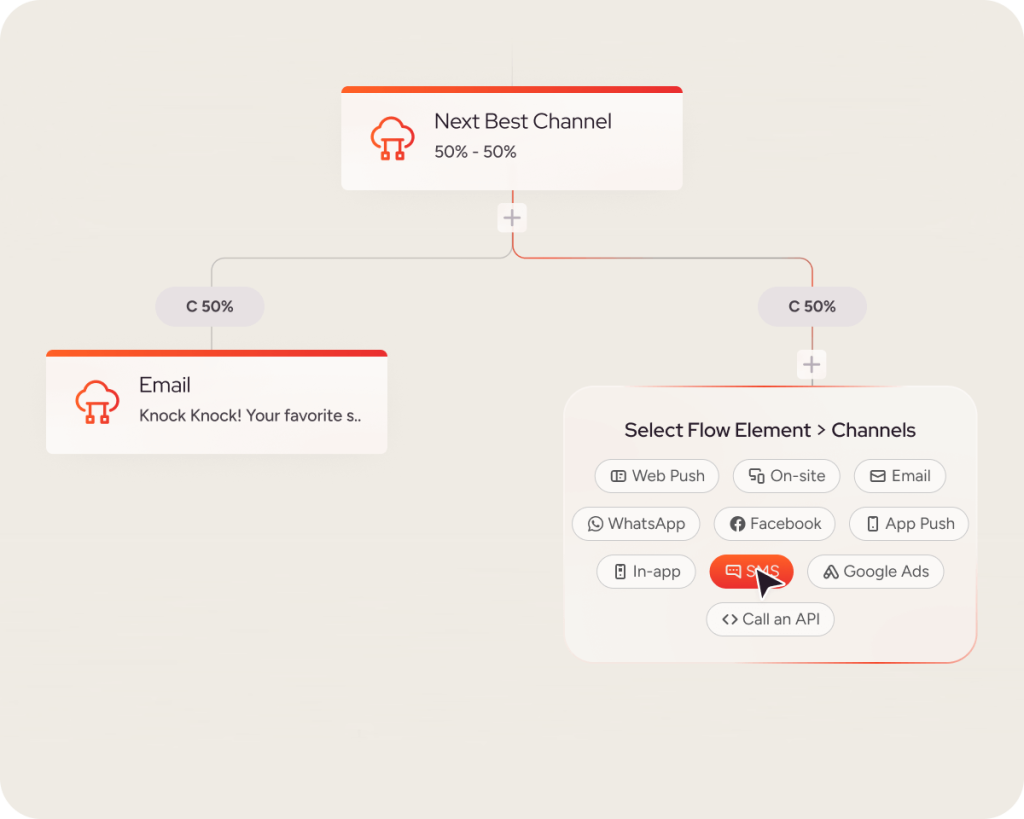
Breadth inside one decision. Next Best Channel and Send Time Optimization run per individual across 12+ native channels on the same canvas, with on-site and in-app among them rather than as separate integrations. Agent One is itself a journey step, so an abandoned agent conversation can re-engage that customer on any of those channels.
Where to press us. Reward-signal logs and in-session latency under production load are exactly the right things to test in a live account rather than accept on a slide. Book a demo and bring your own traffic volumes, or take the platform tour first.
Frequently asked questions
Next best action is a broader decisioning category that includes channel selection, timing, suppression, content type, and offer choice as simultaneous variables. Next best offer is a subset that focuses specifically on which promotional offer to present. An NBA system should be able to make a next best offer decision, but a next best offer system cannot substitute for full action arbitration across the complete customer experience.
An NBA agent can ingest data from multiple sources, but without a unified real-time profile it will optimize against incomplete or inconsistent customer representations. The CDP is not a vendor requirement; it is a data architecture requirement. The agent’s decisions will be exactly as good as the real-time completeness and accuracy of the profile it receives.
The primary signal is reward policy convergence: are the agent’s decisions trending toward higher-value outcomes, such as conversion rate, lifetime value, or churn reduction, over successive policy update cycles?
Secondary signals include suppression rate trends, which should decrease as the agent learns to avoid fatigue-generating patterns, and reason code distribution, which should show the agent diversifying its action selections as it learns more about individual customer response patterns. If these signals are not measurable within your platform’s reporting layer, the reinforcement learning component may not be functioning as claimed.

Keep Reading
7 min.

Muharrem Derinkok
4 Jun 2026
11 min.

Chris Baldwin
2 Jun 2026
4 min.
Chris Baldwin
3 Feb 2026