

 Platform Overview

 Integration Hub

 Agent One™

 Agent One™ Teams

 Customer Data Management

 Personalization

 Journey Orchestration

 Reporting & Data

 Behavioral Analytics

 Web
Web

 Email
Email

 Site Search

 Conversational CX

 WhatsApp

 Web Push

 InStory

 App
App

 SMS & RCS

 Join the $0 Migration Movement™

 The Insider One Difference

 Compare Vendors

 Switch to Insider One

 Success Story

 Retail & Ecommerce

 Financial Services

 Travel & Hospitality

 Beauty & Cosmetics

 Automotive

 Telecommunications

 Total Economic Impact™ Study

 Blog
Blog

 E-Books & Guides

 Events

 Glossary
AI Decision-Making in Marketing: How It Drives Personalization

Updated on 5 Oct 2026
9 min.
Table of Contents
- Summary
- What is AI decision making?
- Why AI decision making matters for marketing and customer experience (CX) teams.
- How AI decision making works in customer engagement.
- AI decision making examples for marketing teams.
- Human oversight and explainability in AI decision making.
- Risks and guardrails for AI decision making.
- How Insider One enables AI decision making with built-in oversight.
- FAQs
Most Popular
Summary
AI decisioning uses algorithms and unified data to drive marketing actions, such as timing and channel choice. Most use cases sit between decision support and full automation. It requires unified data, model scoring, and orchestration, with human oversight for high-stakes decisions.
Marketing teams face a growing challenge: how to act on AI predictions without losing control. You’ve built propensity models, trained recommendation engines, and invested in predictive analytics. But predictions alone don’t drive revenue.
Execution does. AI decision making closes that gap by selecting and triggering actions autonomously, within guardrails you define. This article explains how AI decisioning works in customer engagement, where human oversight still matters, and how to operationalize it without adding risk.
You’ll learn the difference between prediction and action, see practical examples across personalization and journey orchestration, and understand how to build the right oversight model for your team.
What is AI decision making?
AI decision making is the use of algorithms, machine learning models, and unified data to generate recommendations or take actions that would otherwise require human judgment. This means the system doesn’t just analyze your data. It acts on it.
To understand where AI fits into your marketing operations, think about four tiers of capability:
- Insight: The system surfaces a pattern. “Customers who browse multiple product pages convert at higher rates”
- Recommendation: The system suggests a specific action. “Send this user an email at the optimal time”
- Decisioning: The system selects and commits to an action within guardrails. “Route this user to WhatsApp, not SMS”
- Execution: The system carries out the action autonomously. “Trigger the journey and personalize the content”
Most marketing applications today operate at the recommendation or decisioning tier. Autonomous execution is expanding, but high-stakes decisions still require human oversight.
One distinction matters here: predictive analytics forecasts what will happen. AI decision making acts on that forecast.
| Term | What it does | Example |
| Predictive analytics | Forecasts an outcome | “This user has a high likelihood to churn” |
| AI decisioning | Selects an action based on the forecast | “Trigger a retention offer via WhatsApp” |
| Automated decision-making | Executes the action without human approval | “Send the offer now” |
Why AI decision making matters for marketing and customer experience (CX) teams.
You’re managing campaigns across multiple channels:
- SMS
- Push notifications
You can’t manually optimize send times, channel selection, and content variants for large user bases. AI decisioning closes that gap.
- Speed and responsiveness: Decisions that once required campaign review cycles now happen quickly. You can act on real-time signals like browse abandonment or price drops without waiting for the next batch run
- Consistency at scale: AI applies the same decision logic across every user, eliminating variance from manual campaign builds. This reduces errors and ensures brand-safe execution
- Personalization and revenue: AI models score propensity, predict next-best-action, and select the optimal channel per user. The result is higher conversion rates, improved average order value (AOV), and better return on ad spend (ROAS)
- Efficiency and cost: Automating routine decisions frees your team to focus on strategy and creative. Fewer manual touches also reduce operational burden and speed time-to-value
How AI decision making works in customer engagement.
Many teams deploy a recommendation model but see no lift because the model isn’t connected to an orchestration layer that can act on its outputs in real time. Understanding the full stack prevents this.
Data signals and customer profiles.
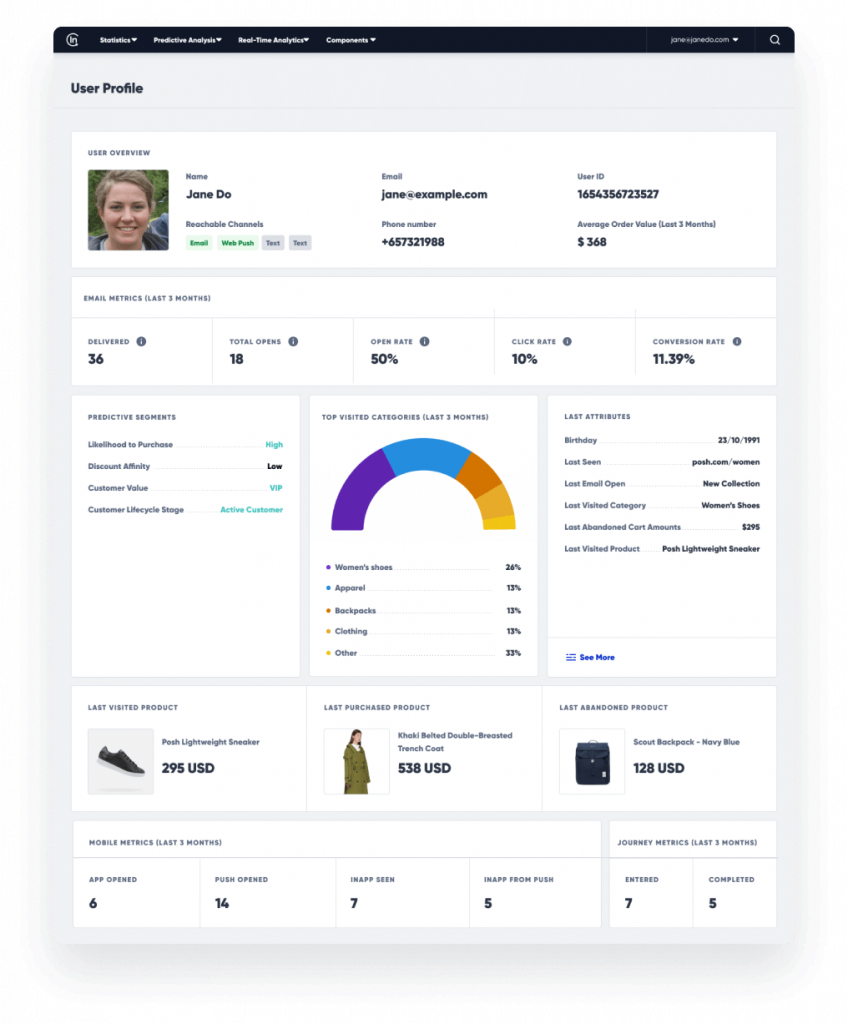
AI decision making depends on unified, real-time customer data. Without it, you’ll see fragmented or conflicting decisions across channels.
The data foundation includes:
- Behavioral events: Page views, cart adds, purchases, app opens
- Profile attributes: Segment membership, lifecycle stage, predicted customer lifetime value (CLV)
- Contextual signals: Device type, location, time of day
Teams using a customer data platform (CDP) with identity resolution can feed consistent profiles to the decision layer. Teams without unified data will get inconsistent results.
Model scores and predictions.
Models generate scores or probabilities that inform decisions. They don’t make the final call. They produce the inputs.
Common model outputs include:
- Propensity scores: Likelihood to purchase, churn, or engage
- Affinity scores: Preferences for product categories, channels, or content types
- Timing predictions: The optimal window for sending a message
Supervised models handle propensity scoring. Collaborative filtering powers recommendations. Multi-armed bandits optimize in real time.
Rules, constraints, and business logic.
Business rules sit between model outputs and execution. This is where guardrails live.
- Frequency caps: No more than a set number of messages per day
- Channel eligibility: User hasn’t opted into SMS
- Inventory constraints: Don’t recommend out-of-stock items
- Compliance rules: Suppress users in certain regions
A model may recommend SMS as the highest-converting channel. But if the user hasn’t opted in, the decision engine falls back to email or push. Without this layer, models can make technically correct but operationally inappropriate decisions.
Orchestration and the decision engine.
The decision engine combines model scores, rules, and real-time context to select and trigger an action. This is where AI decisioning becomes operational.
A robust decision engine provides:
- Real-time evaluation: Low latency for in-session decisions
- Multi-armed bandit optimization: Auto-allocate traffic to winning variants
- Next-best-action selection: Choose the single best action from a ranked list
- Fallback logic: Execute a secondary action if the primary one fails
Architect, Insider One’s customer journey orchestration solution, connects the decision engine to channel execution. The platform delivers the selected action through these channels:
If you want to see what that “model-to-action” stack looks like in a real enterprise setup, book a demo, and we’ll map it to your channels, data, and guardrails.
AI decision making examples for marketing teams.
AI decision making is already embedded in common marketing workflows. Here’s how it looks in practice.
Personalization and product recommendations.
- Decision type: Which products to surface for a specific user
- Inputs: Browse history, purchase history, segment membership, real-time context
- Output: Ranked product list displayed on homepage, PDP, or email
- Oversight mode: Typically autonomous. Merchandising teams review rules and exclusions
Smart Recommender applies multiple algorithms, including recently viewed, purchase together, and user-based bestsellers. Merchandising teams can pin, boost, or suppress items based on inventory or strategy.
Channel and send-time optimization.
- Decision type: Which channel and time to reach a specific user
- Inputs: Historical engagement by channel, time-of-day patterns, device preferences
- Output: Message delivered via the predicted best channel at the predicted best time
- Oversight mode: Human-on-the-loop. Marketers set guardrails like “no sends before business hours”
Insider One AI, Insider One’s extensive set of AI capabilities, includes Next Best Channel and Send Time Optimization as native capabilities within Architect. Go deeper on real-world decisioning patterns in the product demo hub and use the examples that fit your mix.
Journey orchestration and next best action.
- Decision type: Which journey step to trigger based on real-time behavior
- Inputs: Event triggers (cart abandonment, price drop, back-in-stock), segment membership, journey history
- Output: Personalized journey step executed, like a WhatsApp reminder with a discount code
- Oversight mode: Human-in-the-loop for journey design. Autonomous for execution within approved journeys
Architect enables A/B Auto-Winner Selection, which automatically promotes the winning variant on a regular cadence based on conversions, conversion rate, or revenue.
Human oversight and explainability in AI decision making.
Teams often assume they must choose between full automation and full manual control. The right oversight mode depends on the stakes, reversibility, and uncertainty of the decision.
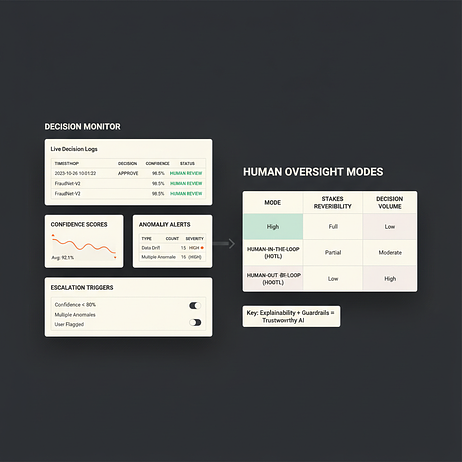
- Human-in-the-loop (HITL): A human approves each decision before execution. Use for high-stakes, low-volume decisions like VIP customer escalations or compliance-sensitive offers
- Human-on-the-loop (HOTL): AI executes decisions autonomously, but humans monitor dashboards and can intervene. Use for medium-stakes, high-volume decisions like campaign send-time optimization
- Human-out-of-the-loop (HOOTL): AI executes without real-time human monitoring. Use for low-stakes, high-volume, reversible decisions like homepage product recommendations
| Factor | HITL | HOTL | HOOTL |
| Decision stakes | High | Medium | Low |
| Decision volume | Low | High | High |
| Reversibility | Low | Medium | High |
| Uncertainty | High | Medium | Low |
Default to more oversight when launching new models. Relax constraints as confidence increases.
Escalation design and human handoff.
Escalation triggers define when AI should defer to a human:
- Confidence score below threshold
- High-value customer flag
- Sensitive topic detection in chat
Agent One™, Insider One’s suite of purpose-built agents for customer engagement, includes Exit Actions in its Support Agent for seamless human handover with full customer context.
How to make AI decisions explainable to customers.
Explainability has two audiences: internal teams for debugging and governance, and customers for trust and recourse.
For customer-facing explanations:
- Use reason codes: Translate model logic into plain language. “We recommended this product because you recently viewed similar items”
- Provide appeal routes: “Not interested? Tell us why”
- Avoid jargon: Don’t expose raw model scores or technical terms
Transparency builds trust, especially for automated decisions affecting pricing, eligibility, or recommendations. If you want to evaluate the right oversight model (HITL/HOTL/HOOTL) for your highest-stakes journeys, book a demo and we’ll walk through a governance setup your team can actually run.
Risks and guardrails for AI decision making.
A model that performs well in testing can degrade in production due to data drift, feedback loops, or edge cases the training data didn’t cover. Guardrails aren’t optional.
Bias and fairness in AI decisions.
Bias can enter through training data, feature selection, or feedback loops. For marketing, this means certain customer segments receive systematically worse offers or get excluded from campaigns entirely.
Detection:
- Audit model outputs by segment (age, geography, tenure) to identify disparate impact
- Monitor for proxy variables that correlate with protected attributes
Mitigation:
- Retrain on balanced datasets
- Add fairness constraints to the decision layer
- Establish a review cadence for high-stakes models
This matters especially for automated decision-making in eligibility, pricing, or credit contexts.
Model drift and performance degradation.
Model drift occurs when the relationship between inputs and outcomes changes over time. Customer behavior shifts post-holiday. Preferences evolve. The model that worked in one period may underperform in another.
Detection:
- Monitor prediction accuracy and calibration over time
- Set alerts for sudden drops in conversion rate or engagement from AI-driven campaigns
Mitigation:
- Retrain models on a regular cadence
- Implement circuit breakers that fall back to rule-based logic if model performance drops below threshold
- Log all decisions for post-hoc analysis
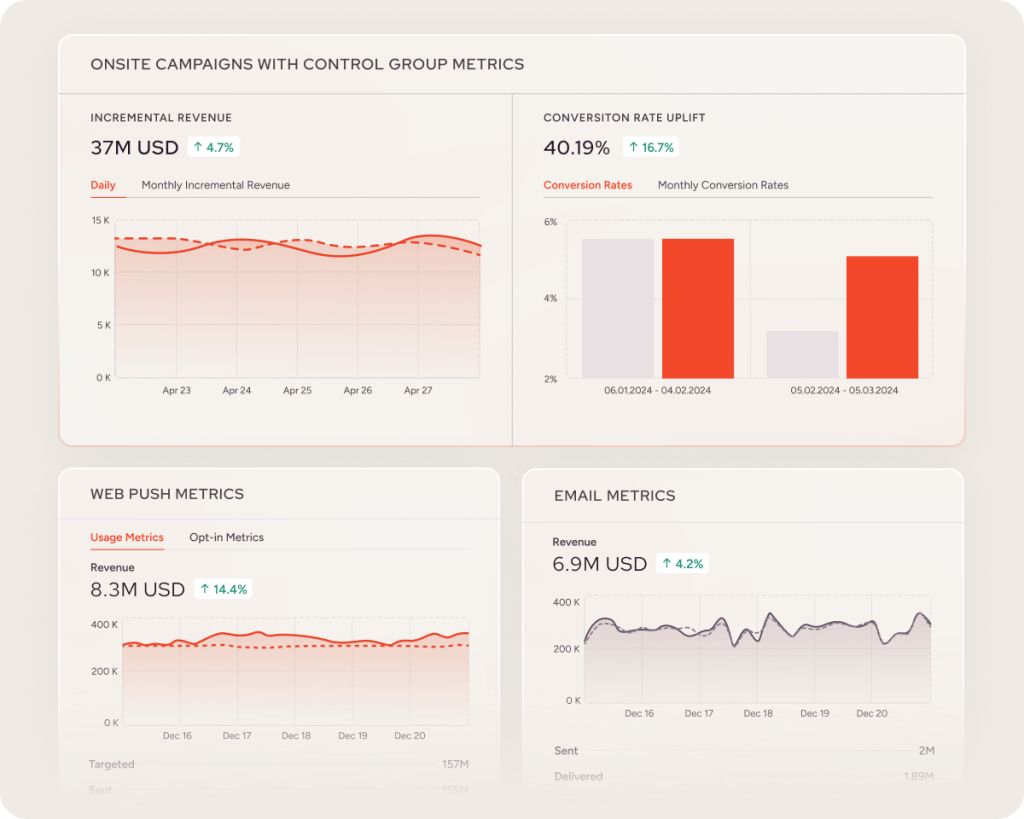
Insider One’s Insights Agent proactively monitors campaign performance and detects anomalies before they escalate. See how teams operationalize drift alerts, circuit breakers, and audit-ready decision logs in the product demo hub.
How Insider One enables AI decision making with built-in oversight.
Insider One was built to operationalize AI decisioning across the full customer journey, with guardrails designed in from the start.
- Unified customer data: Insider One’s CDP unifies behavioral, transactional, and profile data into 360° profiles with real-time identity resolution
- Predictive and generative AI: Insider One AI powers propensity scoring, Next Best Channel, Send Time Optimization, and A/B Auto-Winner Selection natively within Architect
- Orchestration and decisioning: Architect connects model outputs to channel execution with low latency. Rules, constraints, and fallbacks are configurable without code
- Agentic execution: Agent One™ extends decisioning into conversational commerce, support automation, and proactive campaign intelligence
- Oversight and explainability: Insights Agent monitors for anomalies and surfaces winning strategies. Decision logs and audit trails support compliance and post-hoc analysis
If you’re ready to move from “AI insights” to decisions that actually ship across channels, book a demo and we’ll show you how to stand up decisioning with guardrails, fast, and without losing visibility into how it works.
FAQs
Predictive analytics forecasts outcomes, like a user’s likelihood to churn. AI decision making acts on those forecasts by selecting or executing an action, like triggering a retention offer. Predictive analytics is an input; AI decisioning is the operational layer that turns predictions into results.
AI can make decisions autonomously for low-stakes, high-volume, reversible actions like product recommendations or send-time optimization. High-stakes or compliance-sensitive decisions should retain human-in-the-loop or human-on-the-loop oversight until model confidence is established.
Audit model outputs by segment to detect disparate impact, monitor for proxy variables, and retrain on balanced datasets. Establish a review cadence for high-stakes models and add fairness constraints to the decision layer.
Unified customer profiles combining behavioral events (page views, purchases), profile attributes (segment membership, predicted CLV), and contextual signals (device, location, time). A CDP with identity resolution ensures consistent data across channels.
A decisioning platform combines model scores, business rules, and real-time context to select and execute actions across channels. It sits between predictive models and channel execution, enabling AI-driven personalization at scale with built-in guardrails. A recommendation engine generates suggestions; a decisioning platform acts on them.

Keep Reading
4 min.

Chris Baldwin
3 Feb 2026
10 min.
Chris Baldwin
24 Oct 2026
9 min.
Chris Baldwin
24 Oct 2026