

 Platform Overview


 Integration Hub


 Agent One™


 Agent One™ Teams


 Customer Data Management


 Personalization


 Journey Orchestration


 Reporting & Data


 Behavioral Analytics


 Web


 Email


 Site Search


 Conversational CX


 WhatsApp


 Web Push


 InStory


 App


 SMS & RCS


 Join the $0 Migration Movement™


 The Insider One Difference


 Compare Vendors


 Switch to Insider One


 Success Story


 Retail & Ecommerce


 Financial Services


 Travel & Hospitality


 Beauty & Cosmetics


 Automotive


 Telecommunications


 Total Economic Impact™ Study


 Blog


 E-Books & Guides


 Events


 Glossary
The New Martech Stack: Where AI Agents Really Fit In

Updated on 5 Nov 2026
8 mins.
Table of Contents
- Summary
- What an AI marketing tech stack looks like when it actually works
- Where execution breaks down for an AI marketing tech stack
- The data and orchestration layer teams usually miss
- How to fix an AI marketing tech stack without adding more channel chaos
- What to evaluate before choosing a platform
- Conclusion
- Frequently Asked Questions
Most Popular
Summary
- Agentic AI works best layered inside your existing customer data platform (CDP) and orchestration infrastructure, not bolted on as a separate platform
- Governance, permissions, and data readiness decide whether an agent helps your team or creates a new compliance headache
- Stacking vendor-native agents on top of already-licensed platform modules can quietly multiply cost without multiplying value
- A clean data layer and clear orchestration logic matter more than which agent vendor wins the pitch
- B2B and B2C martech stacks need different guardrails around agent permissions, even when the underlying architecture looks nearly identical
An AI marketing tech stack is the layered set of systems, customer data platform, orchestration engine, and channel tools that accommodate autonomous or semi-autonomous agents making real-time decisions. It matters because the key evaluation question is not whether to add an agent, but how it connects to the customer data, permissions, journeys, and channels already in place. Insider One is an AI-powered Growth Management Platform that brings audience segmentation, cross-channel personalization, AI product recommendations, and cross-channel analytics into a single panel for marketers.
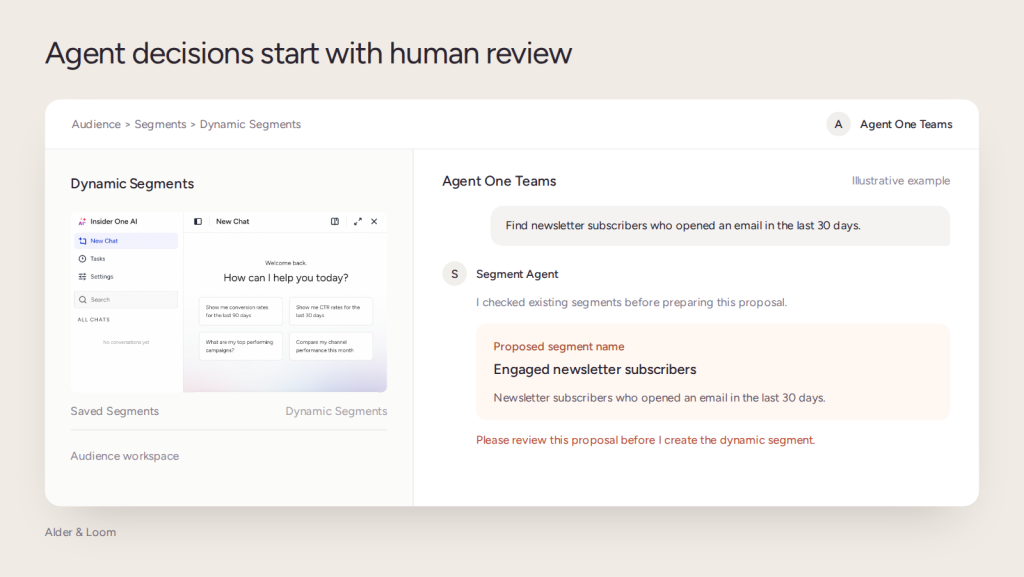
This piece is for marketing operations leaders, customer data platform (CDP) and lifecycle marketing managers, and martech or customer relationship management (CRM) directors evaluating agentic AI vendors right now. You will get a layer-by-layer map of where agents belong, where teams get this wrong, and what to check before signing another contract.
What an AI marketing tech stack looks like when it actually works
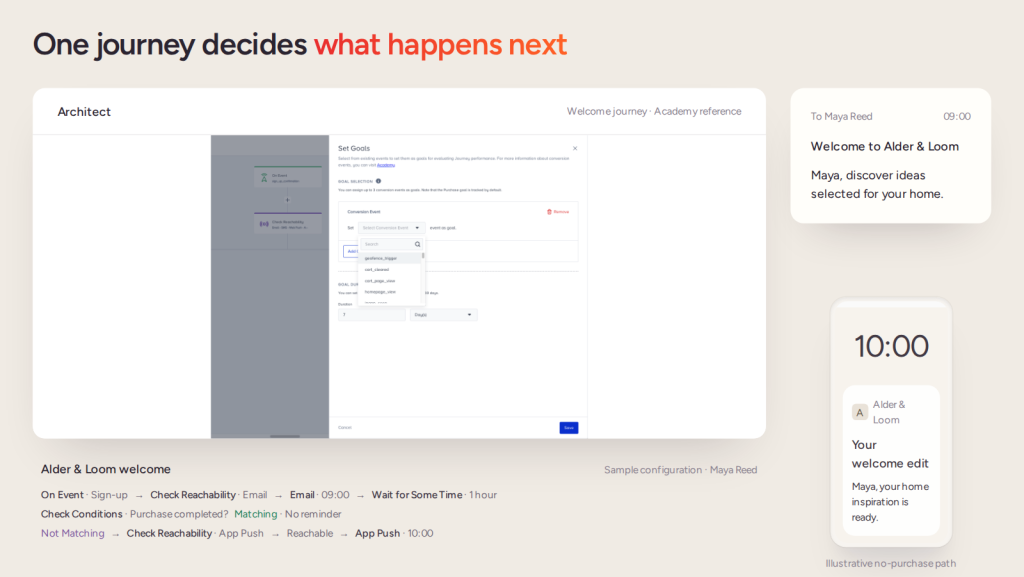
For coordinated customer engagement, an AI marketing tech stack can treat agents as a function connected to the CDP and orchestration layers rather than as an isolated fourth system. The agent should read from a unified customer record, respect the same consent and permission rules as every other tool, and hand decisions to the orchestration layer that governs journey logic. This operating model lets teams evaluate agents without assuming they must replace the systems already in place.
The execution standard is simple to state and hard to hit: one customer record, one permission model, one orchestration engine deciding what happens next, with agents acting as specialized decision-makers inside that structure. Our platform, Insider One, is built around this idea, connecting a shared live customer profile to audience segmentation, cross-channel personalization, and journey logic marketers run through orchestration rather than asking teams to stand up a parallel system. Agent One is Insider One’s agentic AI system for customer engagement, designed to plan, execute, learn from, and optimize engagement toward defined goals. When an agent has to guess at customer state because it cannot see the full record, it will eventually make a decision that contradicts what another channel already promised the customer.
Where execution breaks down for an AI marketing tech stack
Execution breaks down when agents get deployed as isolated point solutions, each with its own data connector, its own activity log, and its own idea of what a customer just did. A support agent bolted onto the help desk, a discovery agent bolted onto search, and a lifecycle agent bolted onto the email tool all sound useful individually. Together, they create three partial views of the same customer instead of one accurate one.
This is where the licensing problem compounds the data problem. When evaluating vendor-native agents sold as add-ons to modules you already pay for, buyers should verify whether they introduce a separate pricing tier, admin console, or permission model on top of the platform’s existing one. For a mid-market team, that means paying twice for governance you already thought you had, and reconciling three different logs when a customer complains about a message that should not have gone out.
B2C teams often feel this first in channel volume: an unmanaged agent generating personalized push, email, and WhatsApp content at scale can out-message a customer before anyone notices the conflict. B2B teams commonly feel it through account-level decisions made by an agent that cannot see the full deal context sitting in the CRM. Both problems trace back to the same root cause: agents operating outside the layer that is supposed to coordinate them.
The data and orchestration layer teams usually miss
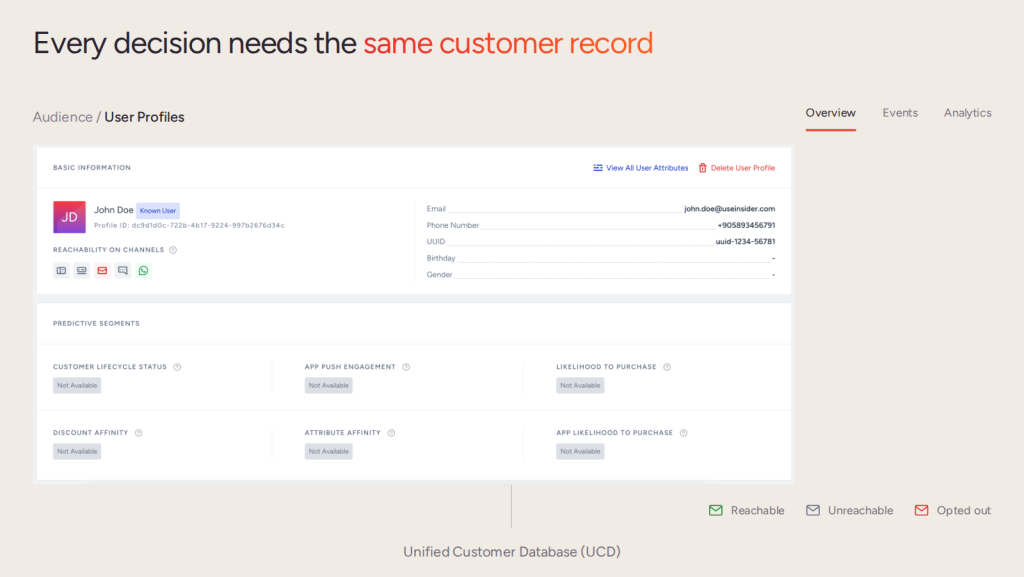
Every governance conversation about agents eventually comes back to two layers most teams underinvest in: the data layer and the orchestration layer. Get these two right, and agent sprawl becomes a manageable extension of the stack. Get them wrong, and every new agent adds a new failure point.
Why the CDP has to be the agent’s source of truth
An agent is only as reliable as the record it reads from. If your customer data management layer is fragmented across five systems, an agent making a real-time offer decision is working from a partial picture, and it will eventually recommend a product the customer already returned or message someone who just opted out. The fix is not a smarter agent. It is a single record the agent, and every other tool, reads from.
Why orchestration logic can’t be duplicated per agent
Orchestration is the layer that decides sequencing: what happens next, on which channel, and why. When each agent carries its own version of that logic, journeys start conflicting with each other in ways that are hard to trace.
Kiehl’s improved conversion rate and return on investment by centralizing personalization decisions in one orchestration layer instead of scattering logic across disconnected tools, which is the same principle that has to hold once agents enter the mix.
How to fix an AI marketing tech stack without adding more channel chaos
The fix starts with sequencing, not shopping. Consolidate the data layer before evaluating any agent vendor; Insider One can ingest user attributes, events, and product data through Web SDKs, Mobile SDKs, and the Upsert API to support unified user profiles and personalization across channels. Define a single permission model before granting an agent write access to customer records, and treat orchestration as the control layer every agent has to pass through rather than a system agents can bypass for speed.
- Audit which systems currently write to the customer record and shut down duplicate writes before adding an agent that will write to it too
- Define, in writing, what an agent is and is not allowed to change without human review
- Route every agent decision through existing orchestration logic instead of letting it trigger channels directly
- Measure agent impact against the same key performance indicators (KPIs) you already track for orchestration, not a separate success metric invented for the pilot
Lenovo removed friction from its purchase journey by tightening orchestration across channels before adding more automation on top, a sequencing choice that holds up just as well for teams introducing agents now. A practical B2B pattern is to sync Salesforce Leads, Contacts, Opportunities, or custom-object data into Insider One, place a new lead in an Architect journey, and send a personalized SMS after a relevant action, such as booking a reservation. The measurable outcome is not “we deployed an agent.” It is fewer conflicting messages, faster resolution when something goes wrong, and a permission trail that survives an audit.
What to evaluate before choosing a platform
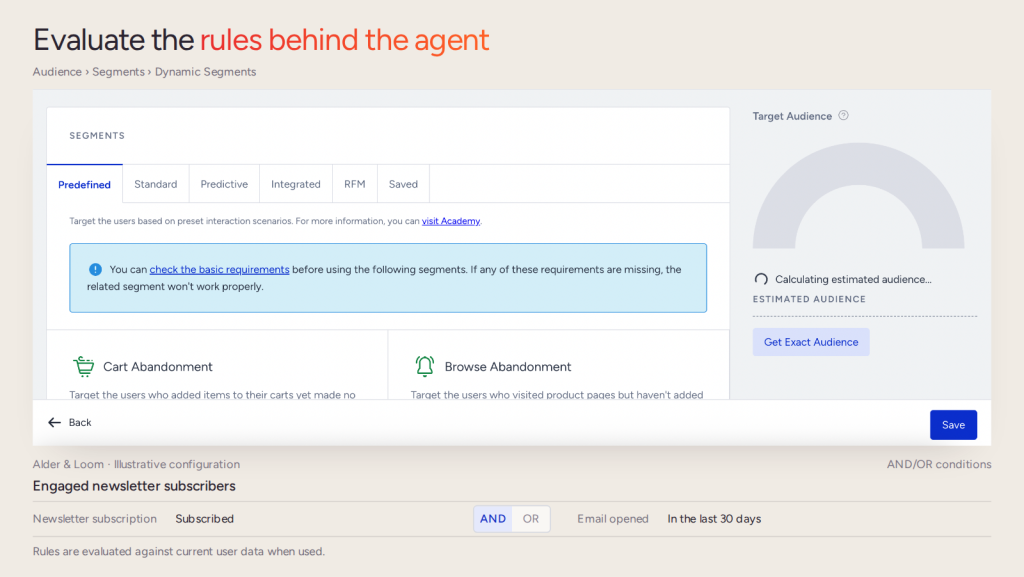
The right evaluation question is not “what can this agent do.” It is “what does this agent depend on, and what does it cost once it’s live.” Vendor demos show the agent’s output. They rarely show whether it reads from your existing CDP or maintains its own cache, and they rarely show the full licensing structure once you add agent seats to a module you already pay for.
Before signing, marketing operations and martech leaders should push on a specific set of criteria:
- Does the agent read from and write to your existing customer record, or does it maintain a separate data store you now have to reconcile
- Can you set granular permission boundaries per agent action, not just per user role
- Is agent pricing a modular layer on infrastructure you already own, or a new platform with its own implementation timeline
- Does the vendor support both B2B account-level context and B2C channel-level personalization, or only one
- How does the platform handle integrations with the systems already in your stack, rather than requiring a separate connector for every agent
These criteria matter more as agent count grows. One agent with unclear permissions is a manageable risk. Five agents from three vendors, each with a different governance model, is a structural problem that shows up in every customer conversation your team has to clean up later.
Reviewing your current platform architecture against these questions before buying is worth more time than another vendor demo. Teams weighing platform consolidation more broadly can also review how agentic commerce is reshaping the marketing stack and how agentification compares to past martech shifts before making a final call.
Conclusion
Agents do not replace your stack. They inherit whatever discipline, or disorder, already exists in your data and orchestration layers. The teams getting real value are the ones fixing the data layer first and treating governance as a design requirement, not a compliance afterthought bolted on after launch. The teams struggling are the ones buying agents before they fix what those agents will depend on.
To evaluate the fit of our platform and AI agents for your use case, book a personalized demo to review your goals, data requirements, and implementation constraints with the Insider One team.
Frequently Asked Questions
It is the layered combination of a customer data platform, an orchestration engine, and channel tools, extended to include AI agents that make real-time decisions using those layers. In Insider One, a shared live customer profile can connect agentic AI, audience segmentation, cross-channel personalization, journeys, recommendations, search experiences, and analytics. The stack works when agents read from one customer record instead of maintaining separate, disconnected data stores.
No. Agents depend on the customer data platform for an accurate, unified view of each customer. Without that foundation, an agent works from partial or outdated information, which increases the risk of conflicting or poorly timed decisions across channels.
B2C stacks typically need agent guardrails around channel volume and message frequency, since agents can generate personalized content at speed. B2B stacks need guardrails around account-level context, since agent decisions often touch deal data sitting in the customer relationship management (CRM) system.
Cost stacking and governance fragmentation. Each vendor-native agent can arrive with its own pricing tier and permission model layered on modules you already pay for, which means paying twice for oversight and reconciling multiple logs when something goes wrong.
Confirm whether the agent reads from your existing customer record or a separate cache, whether you can set granular permission boundaries per action, and whether pricing is a modular add-on to infrastructure you already own or a new platform with its own implementation cycle.

Keep Reading
4 min.

Chris Baldwin
3 Feb 2026
9 min.
Chris Baldwin
5 Nov 2026
9 min.
Chris Baldwin
2 Nov 2026