

 Platform Overview


 Integration Hub


 Agent One™


 Agent One™ Teams


 Customer Data Management


 Personalization


 Journey Orchestration


 Reporting & Data


 Behavioral Analytics


 Web


 Email


 Site Search


 Conversational CX


 WhatsApp


 Web Push


 InStory


 App


 SMS & RCS


 Join the $0 Migration Movement™


 The Insider One Difference


 Compare Vendors


 Switch to Insider One


 Success Story


 Retail & Ecommerce


 Financial Services


 Travel & Hospitality


 Beauty & Cosmetics


 Automotive


 Telecommunications


 Total Economic Impact™ Study


 Blog


 E-Books & Guides


 Events


 Glossary
How agentic personalization moves customer value metrics while the customer is still there

Updated on 5 Nov 2026
9 min.
Table of Contents
Most Popular
Summary
- Agentic personalization can be measured against customer lifetime value (CLV), average order value (AOV), churn probability, and cost-to-serve as behavioral signals arrive, using a cadence teams define for their data and implementation
- Some value metrics can be evaluated through near-term signals (AOV, churn risk), while others require several touchpoints (CLV, cost-to-serve), and marketers need to define those expectations before reporting results
- A measurement model can connect signal capture, intent interpretation, configured actions, and outcome analysis so teams can evaluate whether an experience influenced a metric
- Much of the public content on agentic personalization describes orchestration conceptually without showing how CLV or RFM (recency, frequency, monetary) scores actually recalculate or get measured
- A credible measurement framework can pair event-level attribution with holdout groups so finance can evaluate a configured engagement approach against baseline personalization
A customer lifetime value (CLV) dashboard that refreshes every Sunday night tells lifecycle teams who a customer was last week, not who they are right now. By the time a high-value shopper’s score updates, they may have already converted, churned, or gone quiet, and the campaign that could have changed that outcome has already run its course. That lag is why rules-based personalization keeps reporting what happened instead of acting while it happens.
With Insider One, Agent One is documented as an agentic AI system that plans, executes, learns from, and optimizes customer engagement toward business goals using a shared live customer profile. Teams should treat value-metric updates, next-action logic, and timing as measurement and implementation choices that require validation against their data, configuration, and channels.
This article is for lifecycle, customer relationship management (CRM), and customer experience leaders weighing a move from rules-based tools to agentic AI platforms. You’ll get a concrete breakdown of useful value metrics, a practical engagement-measurement model, and a framework built to hold up under finance scrutiny.
From nightly batch scores to live value signals
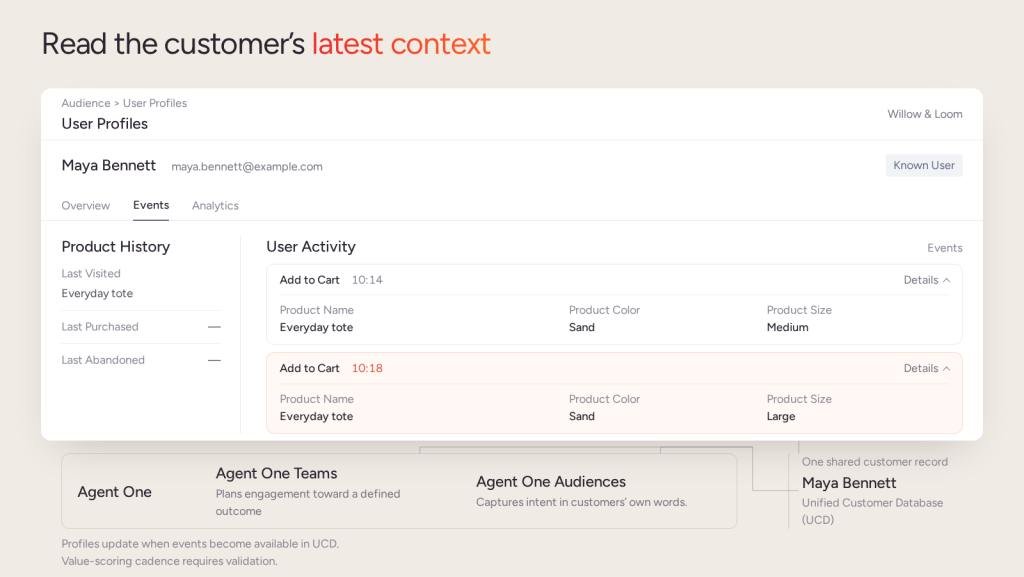
Customer data platforms (CDPs) built around batch processing recalculate CLV and RFM (recency, frequency, monetary) scores on a cycle, often daily, sometimes weekly, rather than as events happen. A customer’s recency, frequency, and monetary value gets recomputed after enough new orders or sessions accumulate, then the customer drops into a new tier. The math holds up, but the timing does not.
That lag means marketing acts on a snapshot of who the customer was last week, not who they are right now. A shopper who just abandoned a high-margin cart, browsed a competitor comparison page, or triggered three support tickets in a day still shows up in yesterday’s high-value, low-risk segment. The team keeps sending the same offer while the underlying value has already shifted.
Teams can reduce that gap by designing value scoring as a more continuous process rather than relying only on scheduled jobs. In Insider One, the customer data management approach can use user attributes, events, and product data ingested through SDKs or APIs to build unified user profiles that support personalization across channels.
The four metrics agentic systems move first
For measurement, teams often focus on four value metrics: CLV, AOV, churn or retention probability, and cost-to-serve. Each metric moves on a different cadence, so separating them helps lifecycle leaders set realistic expectations for what their dashboards can show in the moment.
What moves within a session
AOV and churn probability can be useful leading indicators while a customer is still active. Teams can test relevant bundles, shipping-threshold messages, retention offers, or proactive support across onsite and cross-channel journeys, then measure whether those configured experiences influence immediate behavior.
What moves across touchpoints
CLV and cost-to-serve are slower-moving, cumulative metrics. CLV compounds across multiple purchases, so teams should evaluate whether an engagement contributes to a changing trajectory over several sessions rather than assuming one action reclassifies lifetime value.
Cost-to-serve behaves similarly. Teams can measure whether self-service, conversational CX, or other configured experiences reduce escalations, with the full effect becoming visible only after the pattern repeats across the customer base.
Inside the real-time decision loop
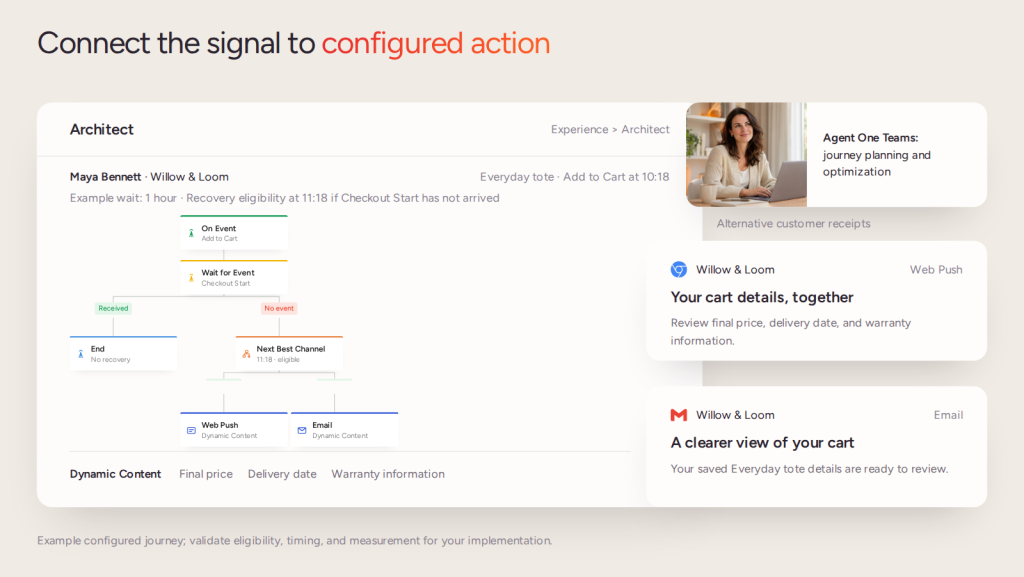
A useful agentic measurement model can be organized as a continuous loop rather than a one-time campaign trigger. Teams can define signal capture, intent interpretation, action selection, and outcome measurement as stages in that model, then validate the timing and effect of each stage in their own implementation.
Consider a shopper who adds a mid-tier item to their cart, then abandons after viewing shipping costs. Signal capture registers the hesitation event, and intent inference reads it against the customer’s history to flag rising price sensitivity.
For a configured test, teams can choose an appropriate onsite or cross-channel experience based on the data, eligibility, and channel setup available for that use case. They can then compare the customer’s response with the measurement plan’s AOV and retention indicators rather than assume that any metric updates automatically at the moment of response.
Agentic personalization can differ from rules-based automation by supporting engagement optimization toward business goals rather than relying solely on predetermined campaign conditions. Rather than treating any named model, including Agent One™, as proof of a specific same-session decision loop, teams should validate the available capabilities, data requirements, and measurement design for their use case.
Where generic platform content stops short
Public content about agentic personalization tends to describe orchestration and intent in broad terms, without showing how a metric like CLV or an RFM score is recalculated, or measured, at the moment an agent acts. The concepts are well covered. The operational proof, tracing one metric change back to one decision, usually is not.
Case-study style writeups often center on campaign execution paired with a single conversion lift, which makes for a good headline but not a repeatable framework a lifecycle leader can apply to their own funnel. A single lift number from one campaign does not explain how to attribute a metric movement to a specific agent decision.
The bigger gap is instrumentation. Much of what gets published skips over how to tie one value-metric change to one agent action at the exact moment it happens. That is the difference between reporting that personalization improved conversion at the end of a quarter and evaluating whether a specific configured experience influenced a customer’s AOV through a defined measurement method.
Building a measurement framework that finance will trust
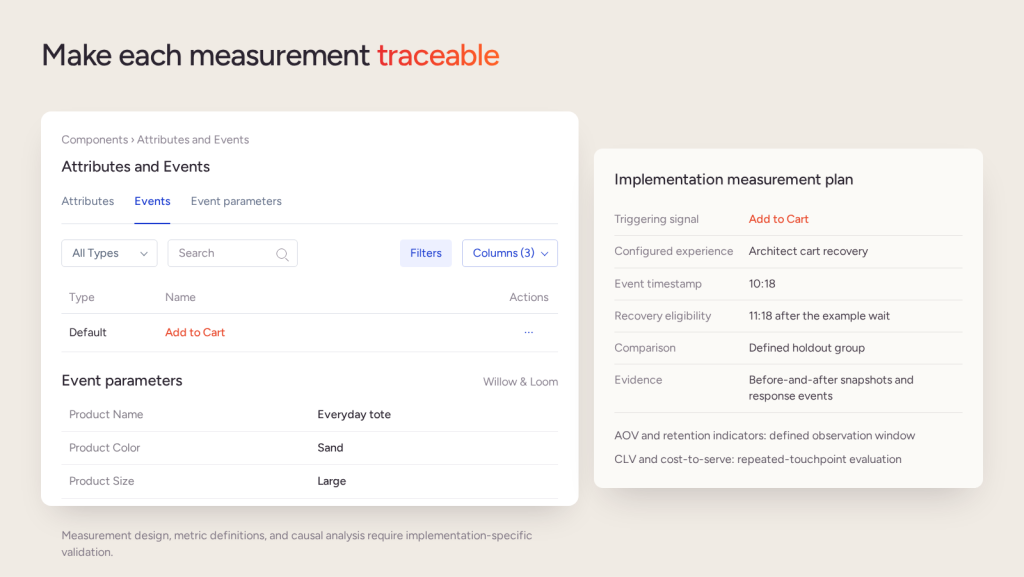
A framework finance will need to accept two things: event-level attribution and holdout groups that isolate agentic impact from everything else already running. Without both, saying that agentic personalization drove growth is an assertion, not a finding.
Instrument event-level attribution
For a rigorous measurement program, teams should create before-and-after snapshots of the value metrics an engagement is intended to influence. This can include logging the customer’s defined CLV, AOV, and retention indicators before a configured experience and again after the response, turning each experience into a testable unit rather than one input buried inside a campaign-level report.
- Log the triggering signal, the configured experience or action, and the timestamp for each measurement event
- Capture the defined value-metric state before and after the customer’s response according to the reporting cadence
- Tag each configured experience with the applicable model, rule, or campaign version
- Use the measured delta to inform future analysis and approved profile, journey, or campaign updates.
Structure holdout groups and dashboards
Holdout groups are a recommended way to evaluate a configured engagement approach against baseline personalization that’s already running. Teams can reserve a statistically valid slice of eligible customers from the tested experience, then compare their CLV, AOV, and churn trajectories with the treated group over the same window. The dashboard should show the delta by metric and experience type, not just an aggregate lift number.
Published onsite-personalization results provide useful proof points: Philips increased average order value by 35% using Insider One’s personalization capabilities, and Avon improved conversion rates by up to 78% through onsite Banner Management. These outcomes should be evaluated in the context of each brand’s implementation rather than treated as proof of a shared agentic decisioning approach.
Key takeaways
Agentic personalization is most credible when it is evaluated through a clear measurement program, not treated only as a smarter campaign tool. CLV, AOV, churn probability, and cost-to-serve move at different speeds, so teams should define how they will attribute outcomes, use holdouts, and review results alongside end-of-campaign reporting.
To evaluate the fit of customer data management and Agent One™ for your use case, book a personalized demo to review your goals, data requirements, and implementation constraints with the Insider One team.
Frequently Asked Questions
Agentic personalization uses AI systems to help plan, execute, learn from, and optimize customer engagement toward business goals. In Insider One, Agent One works alongside a shared live customer profile; the specific actions, timing, and measurement approach should be validated for each implementation.
Average order value and churn or retention probability can be useful near-term indicators, while customer lifetime value and cost-to-serve are cumulative metrics that usually require evaluation across multiple touchpoints. Teams should set the reporting cadence and metric definitions according to their data model and measurement plan.
For each configured experience being evaluated, log the relevant value-metric state before and after the customer response, along with the triggering signal and implementation context. This event-level snapshot supports per-experience analysis instead of relying only on aggregate end-of-campaign reporting that blends multiple influences together.
Yes. Holdout groups remain a clear way to isolate the impact of a configured engagement approach from baseline personalization that is already influencing customer behavior. Comparing metric trajectories for a valid holdout group and a treated group gives finance a more defensible, apples-to-apples comparison.
A practical evaluation should connect agentic engagement to unified profiles, segmentation, cross-channel personalization, journeys, recommendations, experimentation, and analytics. That platform-level combination gives teams a more complete basis for designing, testing, and measuring customer experiences than treating orchestration as an isolated campaign activity.

Keep Reading
4 min.

Chris Baldwin
3 Feb 2026
8 mins.
Chris Baldwin
5 Nov 2026
9 min.
Chris Baldwin
2 Nov 2026