

 Platform Overview


 Integration Hub


 Agent One™


 Agent One™ Teams


 Customer Data Management


 Personalization


 Journey Orchestration


 Reporting & Data


 Behavioral Analytics


 Web


 Email


 Site Search


 Conversational CX


 WhatsApp


 Web Push


 InStory


 App


 SMS & RCS


 Join the $0 Migration Movement™


 The Insider One Difference


 Compare Vendors


 Switch to Insider One


 Success Story


 Retail & Ecommerce


 Financial Services


 Travel & Hospitality


 Beauty & Cosmetics


 Automotive


 Telecommunications


 Total Economic Impact™ Study


 Blog


 E-Books & Guides


 Events


 Glossary
Voice Messages for AI Agents | Insider One

Updated on 6 Nov 2026
15 min.
Table of Contents
- What are voice messages?
- Why does voice messaging matter?
- The cost of AI agents that can't understand voice messages
- What is Voice Speech To Text for AI agents?
- How Voice Speech To Text works across Webchat, WhatsApp, and Instagram
- Core capabilities of Voice Speech To Text
- Types of use cases for Voice Speech To Text
- Key differences: Voice Messages vs text-only agents
- Types of Voice Speech To Text interactions
- Getting started with Voice Speech To Text
- FAQ
- How does Voice Speech To Text affect existing Shopping Agent and Support Agent setups?
- Which channels support voice messages for AI agents?
- Do teams need separate voice-specific flows or intents?
- How does Voice Speech To Text handle multilingual conversations?
- What impact can voice messages have on automation and deflection rates?
- How does this capability align with consumer behavior on WhatsApp and Instagram?
- What should teams consider when designing journeys that include voice messages?
Most Popular
76% of consumers say voice notes (or voice messages) are convenient for hands-free messaging, according to the latest research from Sky, with users citing how much quicker and expressive then can be versus written messages. The popularity of voice messages is growing. On WhatsApp alone, consumers send around 9.4 billion voice messages every day (Statista). Why do most AI agents still expect users to type. That mismatch is where engagement and adoption rates begin to crumble.
What are voice messages?
Voice messages, also known as voice notes, are short audio recordings that people send through messaging platforms like WhatsApp, Instagram and Webchat instead of typing a message, using the keyboard. Users simply tap or hold the microphone button, speak naturally and send their recording, allowing the recipient to listen and respond.
Why does voice messaging matter?
Typing isn’t always the most convenient way to communicate, particularly on mobile. Whether customers are shopping on the go, multitasking, or trying to explain a complicated issue, speaking is often faster, easier and feels more natural compared to typing everything out.
In fact, research from Stanford University found that speech recognition was 3X faster than typing on a smartphone on average, with 20.4% fewer errors in English-language input. For customers, that means less time composing messages and more freedom to explain exactly what they need, without the frustration of typing on a small screen.
But convenience is only part of the story. Voice messages can also make digital experiences more accessible and inclusive. According to the World Health Organization, 1.3 billion people, or 16% of the global population, experience significant disability. For customers with motor impairments, limited dexterity or conditions that make typing difficult, the ability to communicate through speech can remove an important barrier to accessing digital services, and improve the accessibility of your brand.
The cost of AI agents that can’t understand voice messages
When AI agents can’t process voice messages, they create unnecessary friction in customer engagement. Consumers are forced to change how they naturally communicate, type out lengthy requests or wait for a human agent to step in. This can lead to abandoned conversations, missed opportunities and increased pressure on support teams. It also creates accessibility barriers for customers who find typing difficult. For businesses, the implications extend beyond customer frustration: lower revenue, fewer automated resolutions and higher support costs.
For brands, who are missing AI agents that can understand voice messages and notes, the consequences include:
- Voice-first consumers drop off: Consumers who rely on voice notes have to either type out complex issues or wait for a human agent, which increases abandonment.
- Rich input gets compressed: When typing feels like effort, consumers offer shorter descriptions, fewer details, and less context. That limits the agent’s ability to resolve issues.
- Channel norms break: On WhatsApp and Instagram, voice notes are native. A text-only agent breaks the expectation of “tap, speak, send,” making automation feel out of place.
- Multilingual conversations stall: With typed input, teams typically have to configure
languages per channel and per agent. That adds friction when consumers switch languages mid-conversation.
Many brands have invested heavily in conversational commerce and AI support agents. Yet when those agents ignore the dominant behavior on messaging apps, a significant share of conversations either bypass automation or end prematurely.
This is the gap Insider One’s Voice Speech To Text capability is designed to close.
What is Voice Speech To Text for AI agents?
Voice Speech To Text is a new voice-in, text-out capability that allows customers to interact with Insider One’s Shopping Agent and Support Agent, part of Agent One™, by sending voice messages instead of typing.
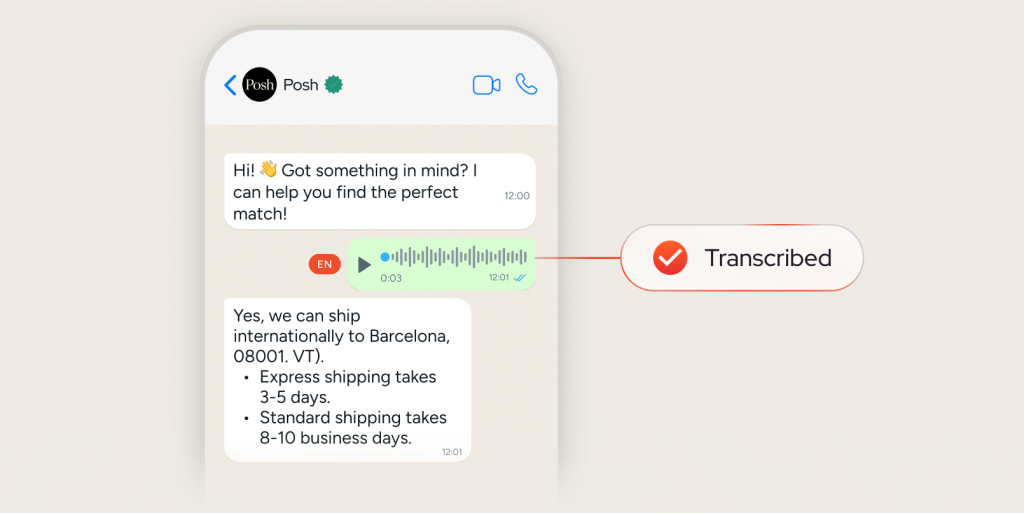
Available across WhatsApp, Instagram and Webchat, customers can simply record and send a voice message, just as they would when chatting with friends or family. The AI agent understands the spoken request in any supported language, processes it using its existing knowledge and capabilities, and responds in text.
For businesses, there’s no need to build separate voice agents or change existing configurations. Voice messages work within the same conversation flows used today. The agents convert voice into text behind the scenes, route it through the same autonomous logic and knowledge base, then reply in text.
Voice becomes a new input modality for the agents you already run, so every existing flow, rule, and action stays intact.
At a practical level, Voice Speech To Text works like a transcription layer wrapped around your agents. Consumers speak naturally. The platform turns that speech into text and feeds it into the same LLM-powered stack that drives Shopping Agent and Support Agent today.
How Voice Speech To Text works across Webchat, WhatsApp, and Instagram
Insider One’s Voice Speech To Text capability extends Agent One’s Shopping Agent and Support Agent, with native voice input available on three channels: Webchat, WhatsApp, and Instagram.
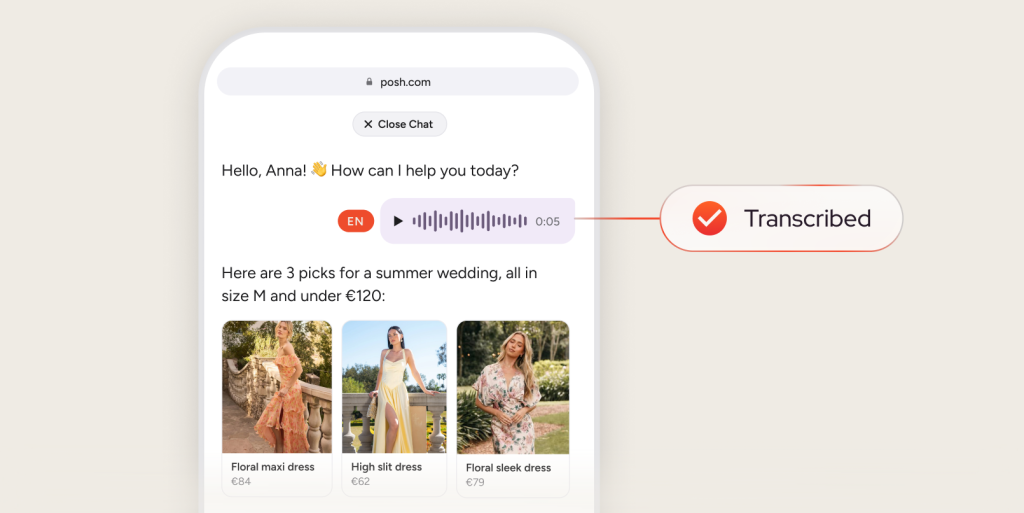
Webchat: microphone button and automatic transcription
On Webchat, a microphone icon appears in the message composer. Consumers tap it, record up to around two minutes (subject to file size limits), and send.
Behind the scenes:
- The recording is automatically transcribed into text before reaching the agent.
- The transcribed text is passed into the Shopping Agent or Support Agent exactly as if the consumer had typed it.
- The agent uses the same flows, routing logic, product search, and knowledge base to generate a text reply.
From a configuration perspective, teams enable voice on Webchat with a single “Voice Recording” toggle in the channel settings. There is no need to create separate voice-specific flows or intents.
WhatsApp: native voice notes processed directly
On WhatsApp, consumers continue to send voice notes the same way they always have, within WhatsApp’s existing UI. There is no new button or customization necessary.
When a voice note reaches the agent:
- The platform converts the voice note into text without exposing a transcription step to the consumer.
- The text representation flows into the Shopping Agent or Support Agent using the existing setup.
- The agent replies in text, preserving the familiar WhatsApp message experience.
Because WhatsApp already conditions consumers to treat voice notes as a default messaging format, supporting voice input allows brands to keep automated support and commerce journeys aligned with everyday usage.
Instagram: voice messages as a native input to agents
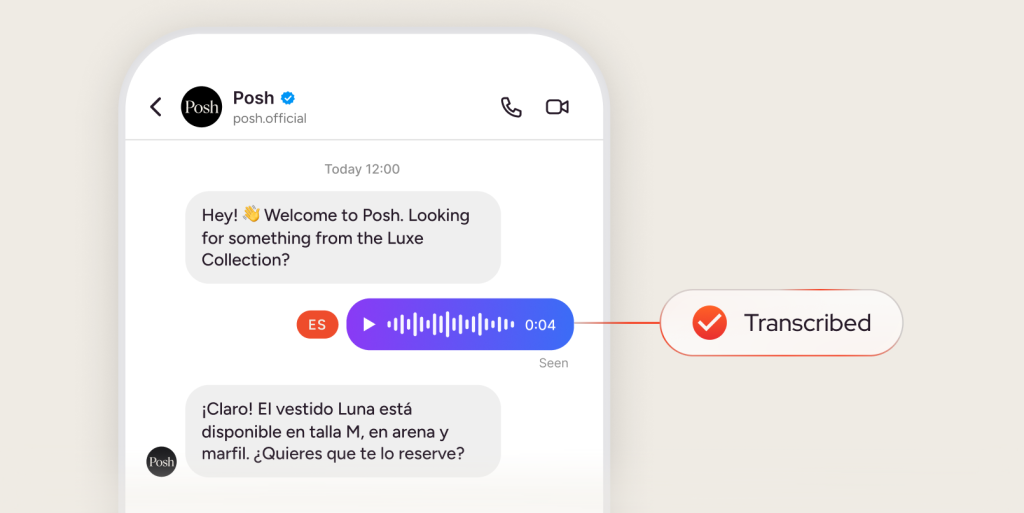
On Instagram, direct messages can include voice clips within Instagram’s existing UI. There is no new button or customization needed. With Voice Speech To Text, those voice messages are processed directly by the agent.
Operationally:
- Incoming Instagram voice messages are converted into text.
- The text is evaluated by the agent’s LLM-powered logic, using the same knowledge base and flows.
- The agent responds in text, maintaining the visual continuity of the Instagram inbox.
Across all three channels, voice becomes just another way for consumers to express intent. The agents do not need channel-specific versions. They simply see more detailed, natural descriptions of what consumers need.
Core capabilities of Voice Speech To Text
Insider One’s Voice Speech To Text focuses on three areas: input flexibility, language coverage, and operational simplicity.
Voice-in, text-out on conversational channels: Consumers send voice messages on Webchat, WhatsApp, and Instagram. Agents always reply in text, preserving clarity in the conversation history and making it easier for consumers to re-read resolutions.
This pattern is particularly useful for:
- Support conversations where consumers describe issues in detail.
- Shopping journeys where consumers list preferences verbally.
- Situations where hands are busy or the environment makes typing difficult.
Any-language understanding within a single chat
Voice messages are interpreted in any language supported by the underlying speech-to-text layer. Conversations can include language switches within a single chat without requiring per-channel language configuration.
For brands with international audiences, that means:
- Consumers can speak naturally in the language they prefer.
- A single agent configuration can serve multiple markets on the same channel.
- Language choices do not have to be pre-selected before the conversation starts.
Zero change to existing agent setup
Voice messages inherit everything the agent already does. The same configuration, routing logic, conversation flows, and knowledge base apply to both typed and spoken input.
This reduces operational overhead:
- No separate “voice agent” to design and maintain.
- No duplicate intents or flows for voice vs text.
- No additional knowledge base work.
Voice is simply an additional input that feeds the same autonomous agent stack that powers Shopping Agent and Support Agent today, including catalog search and personalization.
Simple activation on Webchat
On Webchat, customer engagement teams can turn on voice by enabling the “Voice Recording” toggle in the channel settings, within Insider One.
Once enabled:
- The microphone button appears for consumers.
- Recordings are automatically transcribed.
- The agent begins handling voice-in, text-out interactions alongside text-only conversations.
Consistent behavior across channels
Whether a conversation starts on Web, WhatsApp, or Instagram, the agent handles voice messages using the same logic.
This consistency matters for:
- Reporting and measurement, where deflection rates and resolution times need comparable baselines.
- Journey design, where teams want predictable behavior across the omnichannel experience.
- Training and QA, where support teams review a single set of flows and knowledge.
Types of use cases for Voice Speech To Text
Voice Speech To Text is most valuable where consumers already favor voice notes and where the details they share unlock better automation.
Support-heavy WhatsApp programs
Retail and logistics brands often see large volumes of WhatsApp conversations about deliveries, returns, and post-purchase questions. With Voice Messages, a Support Agent can receive a voice note describing a delivery problem, convert it to text, and resolve the issue in the same conversation.
Instead of asking consumers to type order numbers, addresses, and issue descriptions, the agent captures all of that from a single voice note and responds with tracking updates or resolution options.
Mobile shopping journeys on Webchat
On mobile web, tapping a microphone is often more convenient than typing. A consumer browsing an online store can tap the microphone in the web messenger and say, “I need a waterproof running jacket in medium under 100 euros.”
The recording is transcribed automatically. Shopping Agent uses the transcript to search the catalog, apply filters, and respond with relevant products. The result is a faster, more natural discovery flow that fits mobile behavior.
Multilingual conversations for global brands
Brands serving multilingual audiences often see consumers switch languages mid-conversation or combine phrases from different languages in the same message.
With Voice Speech To Text, the agent can understand voice messages in any supported language without per-channel configuration. A consumer can start in one language, continue in another, and still receive coherent, automated responses.
High-effort support scenarios with complex details
Some support scenarios involve complex descriptions: product malfunctions, co-browsing instructions, or multi-step issues. Typing those out on a phone can be time-consuming.
Voice Messages allow consumers to describe the situation in one or two voice notes, including context that text inputs often miss. The agent receives a richer transcript, which improves intent detection and resolution quality.
Always-on automation for hands-busy moments
Certain contexts make typing impractical: commuting, walking, or handling products during a shopping experience.
Voice-in, text-out interactions allow consumers to stay engaged with the brand’s AI agent even in those moments. They can speak, receive text responses, and continue the conversation without needing to stop and type.
Key differences: Voice Messages vs text-only agents
The shift from text-only agents to agents that accept voice messages is not about replacing the existing interaction model. It is about expanding it to reflect real consumer behavior on messaging channels.
Below is a high-level comparison of the two approaches.
| Criterion | Text-only AI agents | AI agents with Voice Speech To Text |
| Input modality | Typed text only on all channels | Typed text plus voice messages on Webchat, WhatsApp, and Instagram |
| Consumer effort on mobile | Higher effort for long or complex queries | Lower effort; consumers can speak naturally and quickly |
| Alignment with WhatsApp/Instagram norms | Partially aligned, focused on text | Fully aligned with native voice note behavior |
| Multilingual conversation handling | Often requires pre-configured languages per channel | Any-language understanding from voice, including mid-conversation switches |
| Automation coverage and deflection | Limited by how much detail consumers are willing to type | Expanded, as voice-first consumers stay with the agent instead of dropping off |
This table is intended to clarify where voice-in, text-out interactions create additional value. Text remains important, especially for quick confirmations and short replies. Voice adds a complementary path for richer, more natural input.
Types of Voice Speech To Text interactions
Within this capability, several interaction types emerge based on consumer behavior and channel.
- Single-shot problem description: Consumers send one long voice note describing an issue or request, and the agent resolves it in a few text messages.
- Iterative voice-text dialogue: Consumers alternate between voice messages and reading text replies, especially on mobile.
- Mixed-language exchanges: Consumers switch languages across voice notes in the same conversation, and the agent maintains context.
- Voice-assisted shopping queries: Consumers ask for products with detailed criteria (size, color, budget) in a voice message, and the agent returns tailored recommendations.
These interaction types help teams think beyond “voice vs text” and towards designing journeys around how consumers actually communicate.
Getting started with Voice Speech To Text
Voice Speech To Text is available as part of Insider One’s AI agents on Webchat, WhatsApp, and Instagram.
For existing consumers running Shopping Agent or Support Agent on these channels, activating voice is intentionally light-touch:
- On Webchat, enable the Voice Recording toggle in channel settings to surface the microphone button and start capturing voice messages.
- On WhatsApp and Instagram, ensure your agents are configured on the relevant channels. Native voice notes and voice messages will be processed automatically using the same flows and knowledge base.
Not an Insider One consumer yet? Explore how voice-in, text-out agents can fit into your broader conversational commerce strategy and support deflection plans.
To see Voice Speech To Text in action and understand how it fits into agentic commerce journeys, you can request an interactive walkthrough from the team. Get a Demo
FAQ
How does Voice Speech To Text affect existing Shopping Agent and Support Agent setups?
Voice Speech To Text is designed to sit on top of your current Shopping Agent and Support Agent configurations without requiring changes. Voice messages are converted into text and passed into the agents as if they were typed inputs. That means your existing flows, routing rules, knowledge base, and catalog connections continue to operate as usual. Teams can keep their agent designs intact while simply allowing consumers to speak instead of type.
Which channels support voice messages for AI agents?
Voice Speech To Text currently supports three channels: Webchat, WhatsApp, and Instagram. On Webchat, consumers use a microphone button to record voice messages that are transcribed before reaching the agent. On WhatsApp and Instagram, native voice notes and voice messages are processed directly without exposing a transcription step. Across all three, agents reply in text, preserving a consistent experience.
Do teams need separate voice-specific flows or intents?
No. One of the core principles of Voice Speech To Text is zero setup change. Voice messages use the same agent configuration as typed messages, including flows, routing rules, and intents. The speech-to-text layer simply transforms voice into text and passes it into the existing logic. This approach keeps maintenance manageable and avoids duplicating conversation designs for different input modalities.
How does Voice Speech To Text handle multilingual conversations?
Voice Speech To Text is built to understand voice messages in any language supported by the underlying speech recognition. Consumers can speak in different languages within the same conversation, and the agent receives text representations that reflect those inputs. Brands do not have to configure languages separately per channel for voice. This supports international deployments where consumers frequently mix languages or switch mid-conversation.
What impact can voice messages have on automation and deflection rates?
Voice messages often contain more detail than text inputs, especially on mobile. When consumers can describe their needs or issues in their own words without typing, agents receive richer information for intent detection and resolution. That can help keep more conversations with the agent instead of routing them to human support, protecting deflection rates and extending the scope of automation. The exact impact will vary by brand and use case, but voice generally increases the amount of actionable context in each conversation.
How does this capability align with consumer behavior on WhatsApp and Instagram?
WhatsApp and Instagram have normalized voice notes as everyday messaging behavior, with WhatsApp reporting around 7 billion voice messages sent daily. Voice Speech To Text aligns AI agents with that behavior by allowing consumers to send voice messages to the agent the same way they do to friends and family. That alignment reduces friction, keeps automation feeling native to the channel, and respects the norms consumers already follow when they contact brands.
What should teams consider when designing journeys that include voice messages?
When designing journeys around Voice Speech To Text, teams should focus on scenarios where voice adds meaningful value: complex support issues, detailed shopping preferences, and multilingual conversations. It is helpful to identify high-friction text paths where consumers often stop typing or drop off, and then reimagine those moments as voice-first interactions. Teams can also plan how agents should respond in text to long voice inputs, ensuring that replies remain clear, structured, and easy to scan on mobile.

Keep Reading
4 min.

Chris Baldwin
3 Feb 2026
9 mins.
Chris Baldwin
11 Nov 2026
11 mins.
Chris Baldwin
11 Nov 2026