

 Platform Overview

 Integration Hub

 Agent One™

 Agent One Teams™

 Customer Data Management

 Personalization

 Journey Orchestration

 Reporting & Data

 Behavioral Analytics

 Web
Web

 Email
Email

 Site Search

 Conversational CX

 WhatsApp

 Web Push

 InStory

 App
App

 SMS & RCS

 Join the $0 Migration Movement™

 The Insider One Difference

 Compare Vendors

 Switch to Insider One

 Success Story

 Retail & Ecommerce

 Financial Services

 Travel & Hospitality

 Beauty & Cosmetics

 Automotive

 Telecommunications

 Total Economic Impact™ Study

 Blog
Blog

 E-Books & Guides

 Glossary
SMS Audience Segmentation Strategies That Protect Opt-In Rates, Not Just Clicks

Updated on 4 Aug 2026
12 min.
Table of Contents
Most Popular


Summary
- Static demographic and purchase-history segments decay fast; refresh triggers, not one-time tags, keep SMS lists relevant
- Open rate hides real engagement in SMS because delivery visibility is near-universal; track click-through rate, response rate, and opt-out rate instead
- Behavioral, lifecycle, and RFM-style engagement-decay segments outperform basic demographic splits for cadence and content decisions
- Real-time triggers like cart abandonment and loyalty milestones should move subscribers between segments automatically, not on a quarterly review cycle
- Consent recency and frequency caps belong inside segment logic, not in a separate compliance checklist reviewed after the campaign goes out
- Insider One’s Segment Agent builds these audiences from a plain-language description rather than SQL or stacked filter builders, and keeps them current against live behavioral data
- Subscriber analytics that surface which campaigns drive the highest unsubscribe rates turn list erosion from a lagging surprise into a managed metric
We keep splitting our list by demographics and purchase history, but subscribers still opt out and nobody knows why until the unsubscribe rate spikes again.
That’s the quiet failure mode of most SMS programs: segmentation gets treated as a one-time targeting exercise instead of an ongoing governance system.
This article is for lifecycle, customer relationship management (CRM), and retention marketing managers running SMS on a customer data platform (CDP) or engagement platform who need segments that actively protect opt-in rates, not just goose one campaign’s click-through rate.
We’ll walk through why static segments erode engagement, which segmentation models actually earn their keep, how to make segments update themselves from live behavior, and how to build frequency and fatigue governance directly into your segment logic instead of bolting compliance afterward.
Why static SMS segments quietly erode engagement
A segment built once from demographics or last quarter’s purchase history goes stale the moment behavior shifts, and behavior shifts constantly.
A subscriber tagged “high-value repeat buyer” in January might not have opened a message since March, yet they keep receiving the same aggressive cadence as your genuinely active buyers. That mismatch is what drives opt-outs, not message content.
The deeper problem is measurement. SMS delivery visibility is near-universal, so open rate tells you almost nothing about whether a segment is actually engaged. A message that lands in every inbox but gets ignored still shows up as “delivered,” masking the real signal.
Click-through rate, response rate, and opt-out rate are far better indicators of segment health, because they reflect action rather than presence. Treating open rate as the primary success metric for a segmented SMS campaign is one of the most common reasons programs miss early signs of fatigue.
Decay is also measurable at the segment level, not just the campaign level. Insider One tracks segment size trends over time, so a cohort quietly shrinking or ballooning shows up as a chart rather than as a surprise in next quarter’s audit.
Paired with subscriber analytics that identify exactly which campaigns are driving the highest unsubscribe rates, list erosion becomes something you manage in-flight rather than diagnose after the fact.
Core segmentation models worth building first
The highest-leverage segments aren’t demographic splits; they’re built on behavior, lifecycle stage, and engagement decay.
These models tell you not just who someone is, but how they’re currently interacting with your brand, which is the information that actually determines what and how often to send.
| Segmentation model | What it should decide | What it needs to stay accurate |
|---|---|---|
| Behavioral | Message content and product relevance | Live browsing, cart, app-open and click events written to one profile |
| Lifecycle stage | Cadence pattern and journey entry | Automatic transitions between new, active, lapsing and dormant |
| RFM engagement decay | Cadence tolerance and churn-risk flagging | Event aggregates computed over a rolling window, not a static tag |
| Predictive | Pre-emptive win-back and offer depth | Likelihood-to-purchase and churn models trained on the unified profile |
| Consent and cadence governance | Suppression, re-permission and quiet hours | Consent recency and frequency tolerance stored as segment fields |
| Demographic | Tone, language and delivery mechanics | Locale variants and translation workflows, not a separate campaign per market |
Behavioral and lifecycle segments
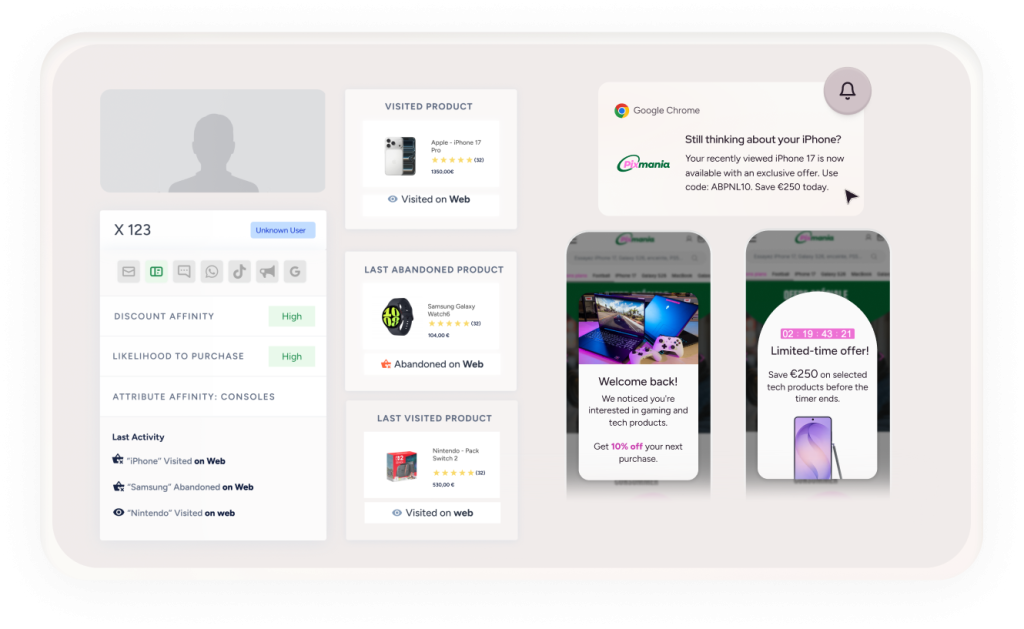
Behavioral segmentation groups subscribers by what they do: browsing patterns, cart activity, app opens, past click behavior.
Lifecycle-stage segmentation layers on where someone sits in the customer journey, such as new subscriber, active buyer, or lapsing.
Combined, these two models let you send a welcome-series cadence to new subscribers and a win-back cadence to lapsing ones, instead of one generic promotional stream for everyone.
The practical obstacle is rarely the concept, it’s the build. Most teams stall because expressing “lapsing high-value buyers who browsed in the last 14 days but haven’t clicked an SMS in 30” means either a SQL request to a data team or a stack of nested filters.
Insider One’s Segment Agent removes that step: you describe the audience in plain language and it translates the intent into precise rules, drawing on your existing segment library so its definition of “VIP” or “at-risk” matches how your team already uses those words.
The resulting segments read from live behavioral data, so there is no overnight batch job between a behavior changing and the audience reflecting it.
RFM-style engagement-decay scoring
Recency, frequency, and monetary value (RFM) scoring, applied to engagement rather than just purchases, lets you rank segments by how quickly their attention is decaying.
A subscriber who clicked every message for three months and then went silent for two weeks is a different risk profile than one who has been quiet for two months straight.
Scoring decay this way flags churn risk before the unsubscribe happens, giving you a window to adjust cadence or content before losing the subscriber entirely.
Building that score requires arithmetic over event history, counts, sums, averages, and distinct counts across a rolling window, rather than a simple attribute lookup.
Insider One supports this natively through event aggregates, so a metric like “SMS clicks in the last 30 days versus the previous 30” becomes a segmentable field rather than an offline calculation someone re-runs by hand.
Predictive scoring sits alongside it: likelihood-to-purchase and churn-risk models built on the same unified profile let you act on where a subscriber is heading, not only where they have been.
- Purchase frequency should set cadence tolerance, not just offer type: frequent buyers can absorb more messages before fatigue sets in
- Browsing signals without purchase should trigger lighter-touch, discovery-oriented content rather than hard promotional pushes
- Demographic splits still matter for tone and language, but they shouldn’t be the primary lever for message frequency
- Engagement-decay tiers should be recomputed continuously from live events, not frozen at the moment the segment was first built
Turning engagement data into live, self-updating segments
Segments that only update on a manual review cycle are already behind the behavior they’re supposed to reflect.
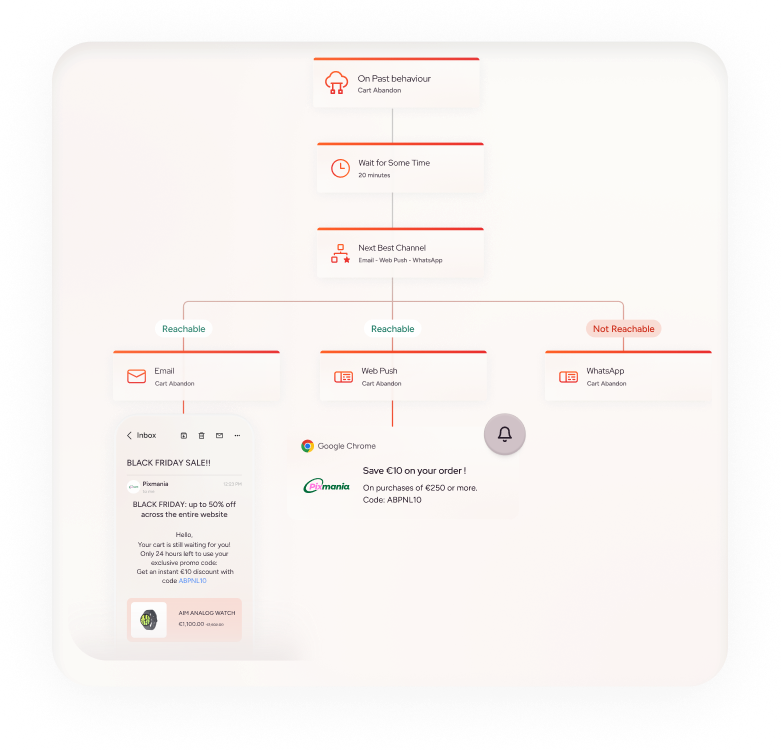
The fix is connecting real-time triggers, such as cart abandonment, browsing sessions, or loyalty milestones, so subscribers move between segments the moment their behavior changes, not weeks later when a marketer finally reruns the query.
Real-time triggers that move subscribers automatically
A cart abandonment event should shift a subscriber into a short-window, high-relevance segment immediately, while a loyalty tier upgrade should shift them into a segment with different cadence tolerance and content.
Building these transitions as automated rules inside your journey orchestration logic means segments stay current without a marketer manually reclassifying anyone.
Architect supports the full range of entry conditions this requires: behavioral events, API triggers from your own backend systems, low-inventory thresholds that flip a promotional segment into an urgency or substitution path, and business events such as a release date or availability change that previously lived in a system marketing could not reach.
Dynamic wait steps matter here too. A journey that pauses for a fixed 24 hours treats every subscriber identically; one that waits on each user’s own data until a replenishment window elapses or a condition is actually met keeps the segment membership honest for time-sensitive and state-dependent use cases.
Unifying SMS with email, app, and web behavior
Segmenting SMS in isolation from email, app, and web engagement creates contradictory messaging, where a subscriber gets a promotional text right after ignoring the same offer by email.
Unifying that behavioral data inside a customer data management layer gives every channel the same view of engagement decay, so cadence decisions on SMS reflect what’s actually happening across the whole relationship.
Where that data physically lives is a real evaluation criterion, not a technicality.
Insider One’s Unified Customer Database operates as a warehouse-native, composable CDP with bi-directional connectivity to Snowflake, Databricks, Google BigQuery, and Amazon Redshift, and supports defining segments by querying the warehouse directly without importing or duplicating the data.
That matters for SMS specifically, because cadence governance only works if the suppression decision is made against a complete, current profile rather than a partial copy that syncs on a schedule.
For example, Chemist Warehouse improved onsite revenue against a control group by unifying behavioral signals into segment logic that informed messaging beyond a single channel.
Building a frequency and fatigue governance layer
Segment tier should determine how many messages a subscriber can receive in a given window, not just what those messages contain.
Highly engaged subscribers can typically absorb a tighter cadence without fatigue, while low-engagement segments need fewer, more targeted sends rather than a reduced version of the same blast.
Building cadence caps directly into segment definitions turns frequency from a campaign-by-campaign guess into a governed system.
Cadence caps tied to segment tier
Setting a maximum message count per week or month at the segment level, rather than at the campaign level, prevents overlapping campaigns from stacking on the same subscriber.
A subscriber in a high-engagement tier might tolerate several messages weekly during a peak period; someone in a decaying-engagement tier should see that number drop automatically as their score falls, without a marketer having to remember to suppress them manually.
Two Insider One controls do this work together. Global and channel-level frequency capping enforce the volume ceiling across SMS, email, push, WhatsApp, and in-app, so campaigns launched by different teams cannot collectively exceed a subscriber’s tolerance.
Journey Prioritization then decides which message earns the remaining slot, selecting the most relevant message for that customer at that moment, rather than defaulting to whichever campaign was scheduled first.
Capping alone protects the subscriber; prioritization protects the revenue.
Consent recency and opt-out risk as segment fields
Consent recency and frequency tolerance should live inside the segment schema itself, alongside behavioral and lifecycle attributes, rather than in a separate compliance spreadsheet checked after a campaign is built.
Treating consent age and opt-out risk as segment fields means a subscriber who consented long ago, or who shows early disengagement signals, automatically routes into a lower-frequency, lighter-touch path.
Timing rules belong in the same schema.
Silent Hours in Insider One support multiple configurable quiet periods, so weekday, weekend, and market-specific windows can differ, and respect each recipient’s own time zone rather than area code alone, which matters for a travelling or relocated subscriber whose number no longer reflects where they are.
Campaign approval workflows add role-based sign-off so a cadence exception is a decision someone owns, not an oversight.
That reduces compliance exposure while also protecting the opt-in base from erosion. For example, Watsons improved return on ad spend by 50% during a high-volume seasonal event by applying tighter, segment-aware cadence rather than uniform blasting across its full list.
- Flag subscribers approaching consent-recency thresholds so they move into a re-permission or lighter-cadence path automatically
- Cap message frequency per segment tier so highly engaged subscribers aren’t throttled and disengaged ones aren’t overwhelmed
- Route early opt-out risk signals, such as declining click rate over consecutive sends, into a suppression or win-back segment before the unsubscribe happens
- Review subscriber analytics for the campaigns generating the highest unsubscribe rates, and treat those as segment design problems rather than creative problems
Conclusion
SMS segmentation stops protecting your list the moment it becomes a static, one-time targeting exercise instead of a live governance system. Segments built on engagement decay, cadence tolerance, and consent recency do more than lift one campaign’s click-through rate; they keep subscribers opted in over the long run.
The programs that last treat frequency as a segment attribute, not an afterthought, and they build those segments somewhere the behavioral data, the cadence rules, and the sending channel all share one profile.
To evaluate the fit of customer data management for your use case, book a personalized demo to review your goals, data requirements, and implementation constraints with the Insider One team.
FAQs
Treating segments as static, built once from demographics or past purchases and left alone. Behavior shifts constantly, and a segment that doesn’t refresh from live engagement data quickly becomes inaccurate, sending the wrong cadence to subscribers whose attention has already changed. Segments that read from live behavioral data, and segment size trends that show drift over time, are what turn this from a recurring cleanup task into a managed system.
SMS delivery visibility is near-universal, so a high open rate can mask genuinely low engagement. Click-through rate, response rate, and opt-out rate reflect actual subscriber action, making them far more reliable indicators of whether a segment is healthy or fatiguing. Subscriber-level analytics that attribute unsubscribes back to specific campaigns close the loop between a cadence decision and its cost.
Behavioral segmentation groups subscribers by what they do, such as browsing, cart activity, or click history, while demographic segmentation groups them by who they are. Behavioral data determines cadence and timing more reliably, while demographics still inform tone and language. The strongest models layer both, then add lifecycle stage to decide urgency.
Consent recency should function as a segment field, not a separate compliance check. Subscribers with older consent or declining engagement can route automatically into lower-frequency or re-permission paths, reducing both opt-out risk and compliance exposure at the same time. Pair it with Silent Hours configured per user time zone and role-based campaign approval so timing and governance are enforced by the platform rather than by memory.
Tying maximum message frequency to segment tier, rather than setting it per campaign, stops overlapping campaigns from stacking on the same subscriber. Highly engaged tiers can absorb more messages, while decaying-engagement tiers automatically receive fewer, better-targeted sends. Frequency capping sets the ceiling; journey prioritization then decides which message is worth the slot, so the cap protects the subscriber without costing you the most relevant send.
Fewer than most teams build, and each one should map to a distinct cadence or content decision. If two segments receive the same messages at the same frequency, they are one segment with extra maintenance cost. A practical starting structure is three to five engagement tiers governing cadence, crossed with lifecycle stage governing content, then real-time behavioral triggers layered on top for short-window moments such as cart abandonment.
It applies recency, frequency, and monetary logic to engagement rather than purchases alone, ranking subscribers by how quickly their attention is falling away. A subscriber who clicked consistently for three months then went quiet for two weeks carries different risk than one silent for two months, and should be treated differently. Calculating it requires arithmetic over event history, counts, sums, and averages across a rolling window, which event aggregates make available as a segmentable field.
Behavioral and engagement-decay segments should refresh continuously from live events rather than on any schedule, because a subscriber whose behavior changed on Tuesday should not receive Monday’s cadence on Friday. The periodic review is a different exercise: audit segment definitions quarterly, check segment size trends for cohorts that have quietly grown or collapsed, and retire any segment that no longer changes a cadence or content decision.
Yes, and it is one of the most common causes of avoidable opt-outs. Segmenting SMS in isolation produces contradictory experiences, such as a promotional text arriving immediately after the same offer was ignored by email. Cadence decisions only hold up when every channel reads the same engagement history, which means unifying SMS, email, app, and web behavior in one customer data layer and enforcing frequency caps globally rather than per channel.

Keep Reading
7 min.

Muharrem Derinkok
4 Jun 2026
11 min.

Chris Baldwin
2 Jun 2026
4 min.
Chris Baldwin
3 Feb 2026