

 Platform Overview

 Integration Hub

 Insider One AI™

 Customer Data Management

 Personalization

 Journey Orchestration

 Reporting & Data

 Behavioral Analytics

 Web
Web

 Email
Email

 Site Search

 Conversational CX

 WhatsApp

 Web Push

 InStory

 App
App

 SMS & RCS

 Join the $0 Migration Movement™

 The Insider One Difference

 Compare Vendors

 Switch to Insider One

 Success Story

 Retail & Ecommerce

 Financial Services

 Travel & Hospitality

 Beauty & Cosmetics

 Automotive

 Telecommunications

 Total Economic Impact™ Study

 Blog
Blog

 E-Books & Guides

 Glossary
The Best Predictive Modeling Software for Marketing Teams in 2026

Updated on 25 Aug 2026
9 min.
Table of Contents
- Summary
- What predictive modeling actually solves for marketers
- Core capabilities worth testing before you buy
- How enterprise suites and CEPs approach prediction differently
- Matching model type to marketing use case
- Rolling out predictive models without a dedicated data science team
- Conclusion
- Frequently asked questions
Most Popular
Summary
- Judge predictive modeling platforms on how fast a prediction becomes a live campaign, not on the accuracy percentage a vendor shows in a demo
- Churn, customer lifetime value (CLV), propensity, and next-best-action models solve different problems and need different activation paths, so match the model to the use case first
- Enterprise data suites and customer engagement platforms (CEPs) handle prediction differently; know which structure fits a lean marketing operations team before you shortlist
- You can roll out predictive models without a dedicated data science team if you start with one use case, run a holdout test, and prove incremental lift before scaling
- Explainable models beat black-box accuracy scores when marketers need to defend a segment or campaign decision to leadership
Predictive modeling software for marketing teams turns behavioral, transactional, and engagement data into forward-looking scores, such as churn risk, purchase propensity, and lifetime value, that tell you what a customer will likely do next instead of what they already did. The software matters less for its algorithms than for how quickly a prediction becomes a live, cross-channel campaign.
This guide is built for marketing operations leads, lifecycle and customer relationship management (CRM) managers, and growth marketers at mid-market and enterprise B2C brands shortlisting predictive analytics or customer engagement platforms without a dedicated data science team behind them.
You’ll get a framework for judging model types, transparency, and activation speed, plus a realistic rollout plan that proves lift before you scale to more model types.
What predictive modeling actually solves for marketers
Predictive modeling solves a timing problem. It tells you which customer is worth acting on right now, not which segment they historically belonged to. Four model types cover most marketing use cases, and each answers a different question about what a customer is about to do.
- Propensity to purchase: scores the likelihood a customer buys in a defined window, used to suppress paid spend on unlikely buyers and prioritize high-intent ones
- Churn risk: flags accounts likely to lapse before they go quiet, giving lifecycle teams a window to intervene with a retention offer
- Customer lifetime value forecasting: projects future revenue per customer, so budget and loyalty investment go where the return is largest
- Next-best-action: recommends the single most relevant offer, message, or channel for one person at a given moment
Plenty of platforms market “predictive” features that are really recency, frequency, monetary (RFM) segmentation with a new label. Static RFM tiers group customers by past behavior and barely move between campaigns.
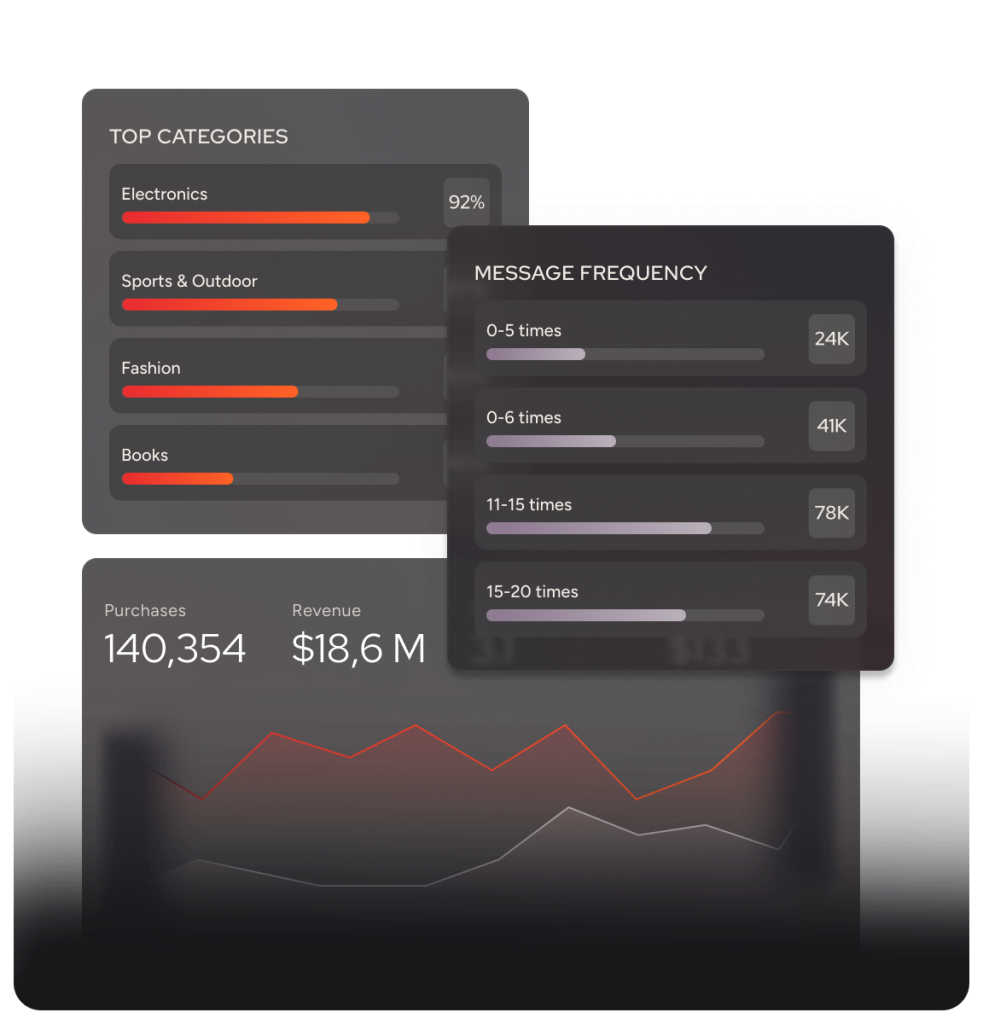
Genuine predictive modeling, like the behavioral analytics that power Insider One’s Predictive Segments, scores likelihood to purchase, engagement level, and discount affinity continuously, so segments shift as behavior changes rather than sitting static for a quarter.
Core capabilities worth testing before you buy
Test explainability and activation speed before you sign, not the accuracy percentage in a sales deck. A model that’s ninety percent accurate but unexplainable, and disconnected from your send tool, delivers less usable lift than a simpler model your team trusts and can act on immediately.
Model transparency and explainability
Push every vendor to show you why a specific customer landed in a segment, not just the segment itself. Marketing teams increasingly need to defend campaign decisions to legal, finance, or leadership, and a black-box score with no visible reasoning is a difficult thing to stand behind in that conversation.
Our own breakdown of the data science behind predictive modeling and recommendation engines covers what explainable scoring actually looks like in practice.
Native activation versus manual export
Ask whether a prediction flows straight into a journey or whether it has to be exported as a list and reloaded somewhere else.
Every manual handoff between the model and the channel adds delay, and churn or propensity scores lose relevance fast. Platforms with prediction and journey orchestration built into the same system remove that handoff entirely, so a score updates and the campaign reacts in the same workflow.
How enterprise suites and CEPs approach prediction differently
Enterprise data suites typically house predictive modeling inside a broader analytics or data cloud product, built for a data science team to configure and marketing to consume secondhand.
A churn score often lives in a separate environment from the channel that needs to act on it, so it has to travel through an integration before a lifecycle campaign can use it.
That structure works when a brand has analysts dedicated to feeding the model.
Customer engagement platforms generally build prediction closer to the campaign layer, which shortens the path from score to send.
The tradeoff is that model depth and explainability vary widely across these tools, and few expose the reasoning behind a prediction clearly enough for a marketer to defend it to leadership without pulling in an analyst first.
AI-native customer data management platforms close that gap by keeping prediction and activation inside one system. Insider One scores customers with Insider One AI™ and feeds that score straight into a live journey, so a churn or propensity score updates a campaign without a manual export step between the model and the message.
Our customer data management page covers how that unified structure holds together at scale.
Matching model type to marketing use case
Churn and winback models for lifecycle and retention
Churn models feed lifecycle and retention campaigns because they hand a CRM manager a ranked list of accounts drifting away, with enough lead time to intervene through email, SMS, or push before the customer disengages entirely.
Winback flows built on churn scores, rather than a blanket “we miss you” send to everyone inactive for ninety days, target only the accounts genuinely worth the discount or outreach.
For example, Slazenger built retention and winback flows across channels on Insider One’s platform and reported a 49X return on investment from its omnichannel approach. Understanding what actually counts as churn rate for your business is the first step before any model can score it accurately.
Propensity and next-best-offer models for paid media and upsell
Propensity-to-purchase and next-best-offer models plug directly into paid media suppression and upsell flows, cutting ad spend on customers unlikely to convert while surfacing the highest-intent shoppers for retargeting.
For example, Adidas used propensity-driven personalization to increase average order value by 259% and conversion rate by 13%. The same logic applies to upsell and cross-sell: a next-best-offer model recommends one relevant product instead of a generic “you might also like” carousel.
Rolling out predictive models without a dedicated data science team
A realistic implementation timeline and change management
Start with one model and one campaign, not a full predictive rollout across every channel at once.
Predictive Segments powered by Insider One AI update automatically as customer behavior changes, which means a marketing operations team doesn’t need an in-house data scientist to keep predictions current once the initial setup is complete.
A workable sequence over roughly six weeks looks like this:
- Weeks one and two: connect your data sources, define the business problem, and pick a single model, such as churn risk for a specific lifecycle segment
- Weeks three and four: activate the first campaign built on that score and set up a holdout group for measurement
- Weeks five and six: review results with stakeholders, document the lift, and get sign-off to add a second model type
Proving incremental lift before you scale
Hold out a control group that receives no predictive-driven treatment, and compare its outcomes against the group your model actually targets. The gap between the two, not the raw campaign performance, is your incremental lift and the number that justifies expanding the program.
Present that comparison to leadership before adding a second or third model type, since a clear result on one use case earns the budget and trust needed to scale further. Our guide to predictive analytics for customer journey orchestration walks through how to structure that comparison across channels.
Conclusion
Predictive modeling software earns its budget when a score becomes a campaign in minutes, not when it posts the highest accuracy number in a demo.
Match the model type to the business problem, insist on explainability, and prove incremental lift on one use case before you scale to the next. That sequence, more than any algorithm, is what determines whether prediction actually changes revenue.
To evaluate the fit of Insider One AI for your use case, book a personalized demo to review your goals, data requirements, and implementation constraints with the Insider One team.
Frequently asked questions
Predictive analytics is the broader practice of using historical data to inform decisions, while predictive modeling is the specific statistical or machine learning technique that scores individual customers on a defined outcome, such as churn or purchase likelihood. Marketing teams need the modeling layer to act on individuals, not just trends.
Yes, as long as the platform trains and retrains models automatically rather than requiring manual feature engineering. Start with one model type, measure lift against a holdout group, and expand once the first use case proves incremental value to leadership.
Start with churn risk if retention is a bigger cost than acquisition, or propensity to purchase if you’re trying to cut wasted paid media spend. Both models have clear, measurable lifecycle or media use cases and give you a fast, defensible first result.
Ask whether segments update continuously as behavior changes, or whether they’re recalculated on a fixed schedule like static RFM tiers. Also ask the vendor to show you the reasoning behind an individual score. If they can’t explain it, it’s likely rebranded segmentation.
Predictive lead scoring tools use the same underlying propensity modeling approach but apply it to leads instead of existing customers, ranking who is most likely to convert. The activation path matters just as much here: a lead score needs to reach sales or a nurture flow quickly to be useful.

Keep Reading
7 min.

Muharrem Derinkok
4 Jun 2026
11 min.

Chris Baldwin
2 Jun 2026
4 min.
Chris Baldwin
3 Feb 2026