

 Platform Overview

 Integration Hub

 Agent One™

 Agent One™ Teams

 Customer Data Management

 Personalization

 Journey Orchestration

 Reporting & Data

 Behavioral Analytics

 Web
Web

 Email
Email

 Site Search

 Conversational CX

 WhatsApp

 Web Push

 InStory

 App
App

 SMS & RCS

 Join the $0 Migration Movement™

 The Insider One Difference

 Compare Vendors

 Switch to Insider One

 Success Story

 Retail & Ecommerce

 Financial Services

 Travel & Hospitality

 Beauty & Cosmetics

 Automotive

 Telecommunications

 Total Economic Impact™ Study

 Blog
Blog

 E-Books & Guides

 Events

 Glossary
Personalized Site Search: The Key to Better Conversions

Updated on 1 Sep 2026
10 min.
Table of Contents
- Summary
- Why search is the highest-intent moment shoppers give you
- What a personalized product discovery experience includes
- Where rule-based search breaks down at scale
- How search personalization connects to the customer journey
- How to choose and measure a search personalization strategy
- Conclusion
- Frequently Asked Questions
Most Popular
Summary
- Search is the moment a shopper tells you exactly what they want, but many ecommerce teams still run it on static, rule-based logic while personalization budget goes to email and push
- A real product discovery personalization engine blends real-time behavioral ranking, segment-based results, and faceted navigation, not just keyword matching
- Large or fast-changing catalogs expose the limits of rule-based search quickly, especially on mobile, where filter design and result density decide whether a shopper stays or leaves
- Search behavior is customer data and should feed email, push, and on-site messaging instead of sitting in a search vendor’s silo
- Track revenue per search and exit-after-search rate, and weigh point-solution search tools against unified personalization platforms before committing budget
Your search bar returns a dozen mismatched results for a query that should surface two, and by the time a shopper scrolls past the noise, they have already opened a competitor’s tab. That is the quiet failure point in many ecommerce funnels: a shopper raises their hand and states exactly what they want, and the site answers with generic, unranked results.
This guide is for ecommerce directors, digital experience leads, and growth marketers managing large or fast-changing catalogs who have personalized every outbound channel except the one where intent is highest. Personalized site search means ranking, filtering, and merchandising results based on real-time behavior, segment, and context, not static keyword rules.
You will learn what a real product discovery personalization engine includes and how to connect search data to the rest of your customer journey.
Why search is the highest-intent moment shoppers give you
A shopper who types a query has already skipped the browsing phase and told you precisely what they are looking for. That is a stronger intent signal than a click on a homepage banner, yet many search bars still treat every query the same way regardless of who is asking or what they have browsed before.
The imbalance shows up in where personalization budget actually goes. Teams invest heavily in tailoring email subject lines, push timing, and on-site banners, then leave the search results page running on rule-based logic that has not changed since launch, turning the results page into a static utility instead of an active merchandising surface.
That gap widens as catalogs grow: a rules engine tuned for a thousand products starts failing quietly at ten thousand, returning technically correct but commercially irrelevant results.
Closing that gap means treating personalized search as its own discipline, with the same rigor applied to ranking and relevance that you would apply to a lifecycle campaign.
What a personalized product discovery experience includes
A real product discovery personalization engine ranks results by behavior, adjusts them by segment, and lets shoppers self-filter without hitting a dead end. It is the difference between a search bar that finds keyword matches and one that understands intent, inventory, and individual context at the same time.
Behavioral ranking and segment-based results
Real-time behavioral ranking reorders results based on what a specific shopper has clicked, purchased, or ignored, not a fixed relevance score set once and forgotten. Segment-based results layer on top of that: a loyalty member searching “jacket” might see premium lines first, while a first-time visitor sees best-sellers.
Faceted navigation lets shoppers narrow by size, price, or attribute without collapsing the result set to zero. Levi’s paired Eureka and Smart Recommender to drive a 31X return on investment, a result tied to unifying search relevance with product recommendations rather than running them as separate systems.
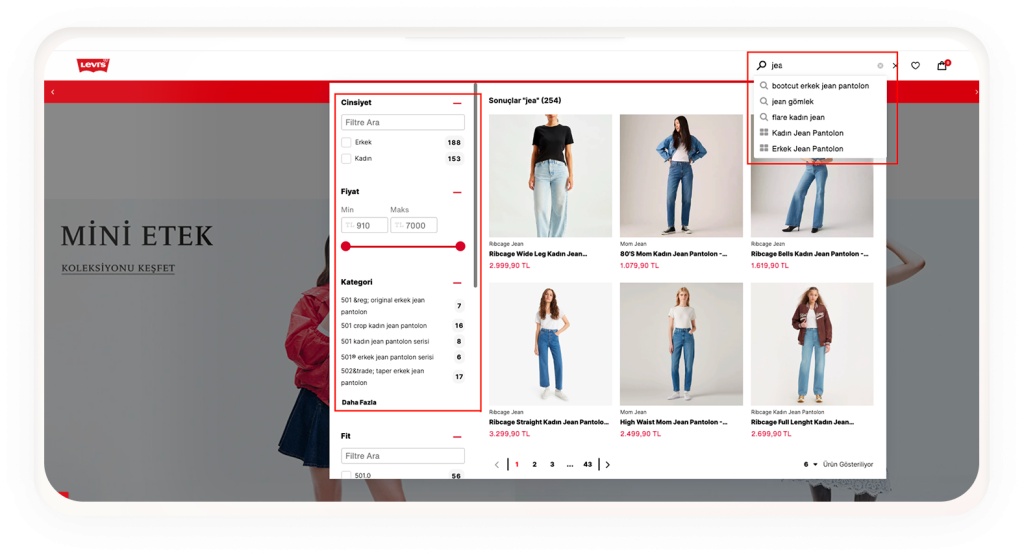
That kind of outcome depends on ranking logic that reflects live behavior, not a rules file updated once a quarter.
Zero-result and synonym handling
A search for “sneakers” that misses everything tagged “trainers” does not just lose one conversion; it teaches the shopper the search bar cannot be trusted. That distrust carries into every future visit unless synonym mapping, typo tolerance, and graceful zero-result fallbacks step in to show close matches instead of a blank page.
Where rule-based search breaks down at scale
Rule-based search breaks down when catalog size or turnover outpaces a team’s ability to manually maintain synonym lists, ranking rules, and merchandising overrides. Keyword-only matching works fine for a few hundred stable products, but it collapses under thousands of SKUs with seasonal turnover, regional variants, or frequent price and stock changes.
The strain shows up fastest on mobile, where screen space forces harder tradeoffs. A filter panel that works on desktop becomes an obstacle on a five-inch screen if it demands too many taps before a shopper sees relevant results, and cramming twenty products into a mobile viewport buries the ones that would have converted.
OLX reached an 8.2% click-through rate on mobile web, a signal that mobile-specific search and discovery tuning pays off when catalogs are large and browsing happens mostly on smaller screens. Mobile search needs its own design decisions, not a shrunk-down desktop layout.
Common failure points at scale include:
- Synonym and taxonomy drift as new categories or brands get added faster than rules can be updated
- Static ranking that never reflects real-time stock levels, so out-of-stock items outrank available ones
- Filter panels built for desktop density that overwhelm mobile shoppers
- Zero-result pages that show nothing instead of adjacent, in-stock alternatives
How search personalization connects to the customer journey
Why isolated search data limits retargeting
Search behavior should feed the same customer profile that powers your email, push, and on-site messaging, not sit isolated in a separate search vendor’s dashboard. A shopper who searched for a product but did not buy is a stronger retargeting signal than most browsing behavior, and that signal loses value the moment it is trapped in a standalone tool.
This is where a structural gap becomes visible across parts of the market, though tradeoffs vary by vendor. Some point-solution search tools deliver strong ranking, but their behavioral personalization can be tied to fuller adoption of a single vendor’s broader ecosystem rather than a portable layer that plugs into whatever else a team is running.
Some engagement-first platforms, built primarily around messaging orchestration across email, push, and SMS (short message service), do not natively own the on-site search layer, which can push teams toward adding another vendor to close the gap.
Certain commerce stacks that lean on separate platform providers sometimes hand off search relevance to third-party engines rather than delivering discovery personalization natively, adding a data hop where intent can get lost between systems.
Closing the gap with a unified customer profile
A unified customer data platform that treats search as first-party behavioral data closes that gap by feeding it into the same one-to-one personalization logic that drives other channels. A shopper who searched “waterproof boots” three times without converting should trigger a different push notification and a different homepage than someone who never searched at all.
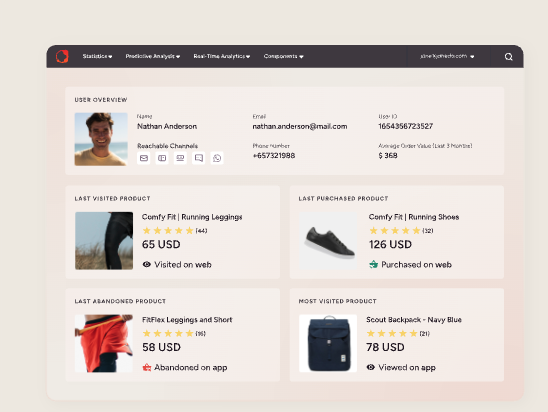
That kind of coordination only works when search data lives in the same system as everything else, rather than sitting in a report that marketing checks once a month.
How to choose and measure a search personalization strategy
Track revenue per search and exit-after-search rate as core signals, since both connect search behavior directly to commercial outcomes rather than vanity engagement metrics. Revenue per search shows whether ranking improvements are actually driving purchases, while exit-after-search rate flags when shoppers give up right after seeing results, usually pointing to relevance or filter problems rather than product availability.
El Corte Inglés PT lifted average order value by 37% after investing in a more relevant, personalized discovery experience, illustrating that search quality and basket value move together when product recommendation logic ties directly to search context.
When weighing point-solution search tools against unified personalization platforms, consider these factors:
- Whether search data automatically feeds email, push, and on-site messaging, or requires a separate integration project
- Whether ranking personalization is portable, or tied to a single vendor’s broader ecosystem
- How the tool handles zero-result queries, synonyms, and mobile-specific filter design out of the box
- Whether your team can adjust merchandising rules directly, without waiting on engineering resources for every catalog change
- How quickly the platform reflects real-time stock and pricing changes in ranked results
The right choice depends on how fragmented your stack already is. Teams running search, recommendations, and messaging across separate vendors often carry an integration tax that shows up as slower launches and inconsistent personalization, even when each individual tool performs well in isolation.
Conclusion
Search is the moment a shopper hands you their intent directly, and treating it as a static utility wastes that signal. The stronger approach ranks results by behavior, connects search data to your broader customer journey, and measures success through revenue per search rather than search volume alone. Brands that unify discovery with the rest of their personalization stack convert more of the intent they are already earning.
To evaluate the fit of Smart Recommender and Eureka for your use case, book a personalized demo to review your goals, data requirements, and implementation constraints with the Insider One team.
Frequently Asked Questions
Personalized site search ranks and filters on-site search results based on real-time shopper behavior, segment, and context, rather than static keyword matching. It adjusts what a shopper sees based on their browsing history, purchase patterns, and stated preferences, so two shoppers searching the same term can see different, individually relevant results.
AI-powered site search uses behavioral signals and machine learning to continuously adjust ranking, while rule-based search relies on manually maintained keyword rules and synonym lists. AI-driven ranking adapts as catalogs and shopper behavior change, while rule-based systems require constant manual upkeep to stay accurate at scale.
A zero-result search tells the shopper the site cannot understand their intent, which damages trust immediately and often ends the session. Strong synonym mapping and fallback logic that surfaces close, in-stock alternatives instead of a blank page prevent that trust loss and keep shoppers engaged with relevant options.
Yes. Search behavior is a strong intent signal that should inform retargeting, product recommendations, and messaging timing across every channel, not stay isolated in a standalone search tool. Feeding that data into a unified profile lets a missed search trigger a more relevant push notification or email instead of a generic one.
Revenue per search and exit-after-search rate are the two most direct commercial indicators, since they connect search quality to actual purchase behavior rather than raw engagement volume. Click-through rate on results and zero-result frequency are useful supporting metrics for diagnosing where relevance is breaking down.
A standalone tool can improve ranking quality on its own, but it typically requires a separate integration to connect search behavior with email, push, and on-site messaging. A unified platform removes that integration step by treating search as one data source among many within the same customer profile.

Keep Reading
4 min.

Chris Baldwin
3 Feb 2026
8 mins.
Chris Baldwin
8 Oct 2026
8 mins.
Chris Baldwin
8 Oct 2026