

 Platform Overview


 Integration Hub


 Agent One™


 Agent One™ Teams


 Customer Data Management


 Personalization


 Journey Orchestration


 Reporting & Data


 Behavioral Analytics


 Web


 Email


 Site Search


 Conversational CX


 WhatsApp


 Web Push


 InStory


 App


 SMS & RCS


 Join the $0 Migration Movement™


 The Insider One Difference


 Compare Vendors


 Switch to Insider One


 Success Story


 Retail & Ecommerce


 Financial Services


 Travel & Hospitality


 Beauty & Cosmetics


 Automotive


 Telecommunications


 Total Economic Impact™ Study


 Blog


 E-Books & Guides


 Events


 Glossary
How Omnichannel Marketing Bridges Your Website, App, and Messaging Channels Into One Customer State

Updated on 10 Nov 2026
8 min.
Table of Contents
- Summary
- What omnichannel marketing strategy looks like when it actually works
- Where execution breaks down for omnichannel marketing strategy
- The data and orchestration layer teams usually miss
- How to fix omnichannel marketing strategy without adding more channel chaos
- What to evaluate before choosing a platform
- Conclusion
- Frequently Asked Questions
Most Popular
Summary
- An omnichannel marketing strategy is stronger when website, app, and messaging teams can use a unified customer profile instead of relying on separately managed tools.
- Customer data, events, and attributes can help teams build behavior-based journeys across configured channels, including app push and WhatsApp.
- Evaluate whether your chosen platform can connect unified data, journey orchestration, personalization, recommendations, and product discovery for the use cases that matter to your business.
- Unified customer data paired with journey orchestration can help teams coordinate cross-channel customer journey orchestration at scale.
- Evaluate platforms on unified data, segmentation, journey orchestration, personalization, product discovery, and the channels you need, not channel count alone.
A customer abandons a cart on your website, opens your app twenty minutes later, and still sees a generic “new arrivals” push notification instead of a reminder about the shoes they left behind. That gap is not a messaging failure. It’s an architecture failure, and it’s the reason an omnichannel marketing strategy either becomes a genuine competitive edge or stays a slide deck promise.
This article is for marketing and lifecycle managers at mid-market and enterprise consumer brands evaluating or scaling a customer engagement platform.
We’ll walk through what real cross-channel execution looks like, where it typically breaks, the data and orchestration layer most vendor content skips entirely, and what to check before you commit to a platform. By the end, you’ll know exactly which architectural questions separate a true cross-channel customer journey orchestration setup from three well-marketed tools pretending to be one.
What omnichannel marketing strategy looks like when it actually works
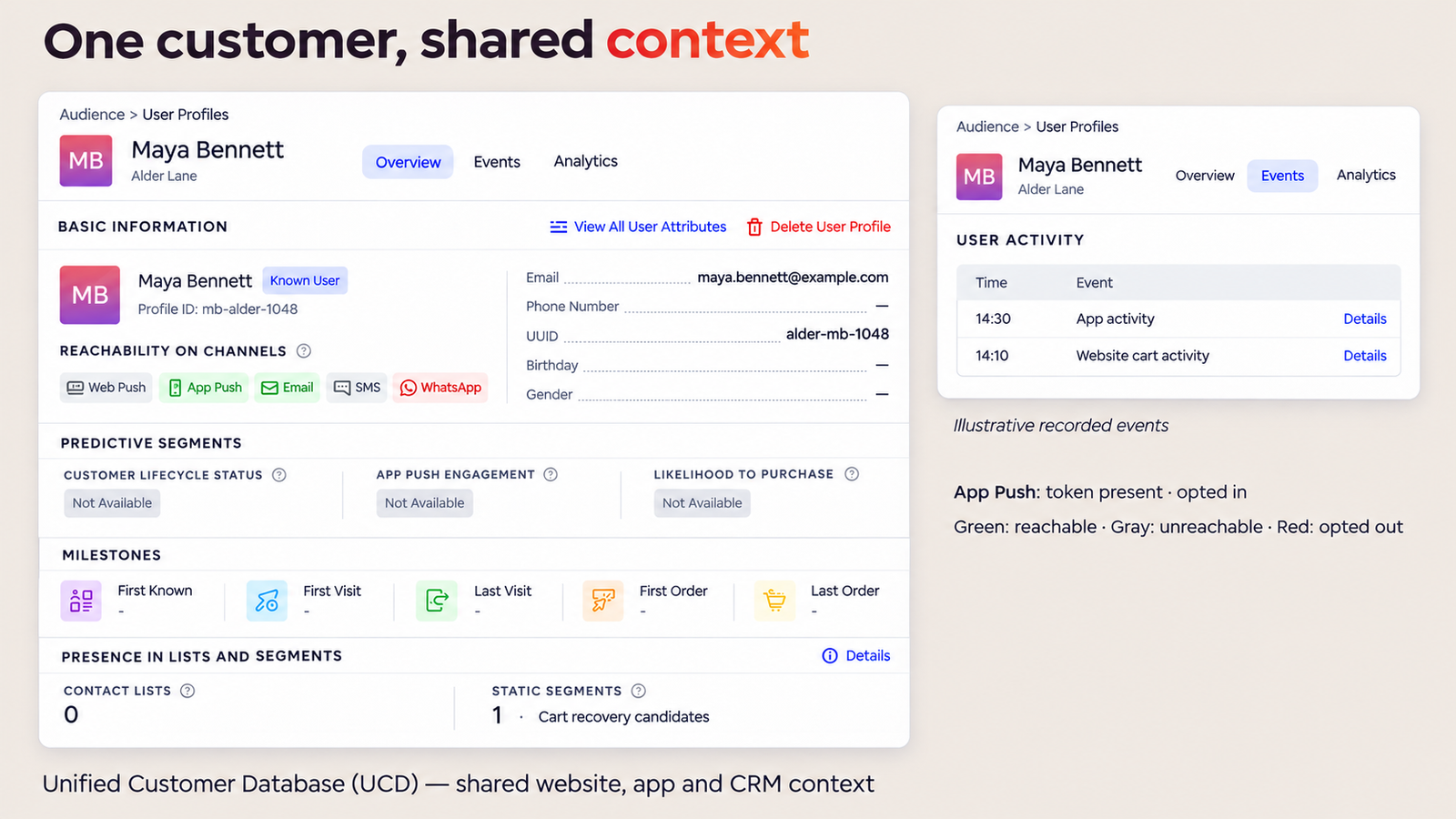
A working omnichannel marketing strategy connects customer data, segmentation, and journey orchestration so teams can use customer behavior to deliver more consistent experiences across configured channels. It isn’t three teams checking the same dashboard once a day. It requires a customer-data strategy that makes relevant profiles, events, and attributes available for segmentation, personalization, and configured journeys.
The practical goal is to collect relevant website behavior, app events, customer attributes, and product data so marketers can build segments and personalize journeys using a more complete customer view. If your web team and app team are each optimizing against their own copy of the customer, you don’t have omnichannel. You have multichannel with a shared logo.
Insider One’s Journey Orchestration works with the platform’s customer data, segmentation, personalization, and configured channels to help marketers build cross-channel journeys from relevant user events and attributes. That’s a structurally different approach from treating web personalization as a repurposed version of app messaging.
Where execution breaks down for omnichannel marketing strategy
Execution can break down when teams buy channel tools without defining how customer data and journey context will be shared, leaving teams with partial views of the customer. Web personalization lives in one system, app push in another, messaging in a third, and nobody owns the merged profile that should drive all three. The result is a brand that looks coordinated in a slide but behaves like three separate brands in production.
This is where teams should examine whether their platform can extend customer context beyond messaging into onsite personalization and product discovery.
For many consumer brands, on-site personalization, search relevance, and recommendations should be considered alongside in-app and push messaging when planning the customer experience. A customer who just viewed a product on your website deserves more than a repurposed push template; they deserve a homepage, search result, and recommendation set that already reflects that behavior before they even open the app.
Complexity compounds as brands add channels without resolving the underlying data problem. Each new channel, WhatsApp, SMS, in-app messaging, adds another system that needs the same customer context, and without a shared layer, every addition multiplies the number of places a profile can disagree with itself.
Teams often respond by adding more integration middleware, which adds latency instead of removing it.
The loyalty, search, and recommendation gap
A useful evaluation question is whether the platform can support unified customer data, personalization, product recommendations, and search and merchandising for the experiences your team wants to deliver.
When customer data, search relevance, and recommendations are managed separately, teams should confirm how those systems exchange the context needed for consistent web and app experiences. The fragmentation just moves one layer deeper.
The data and orchestration layer teams usually miss
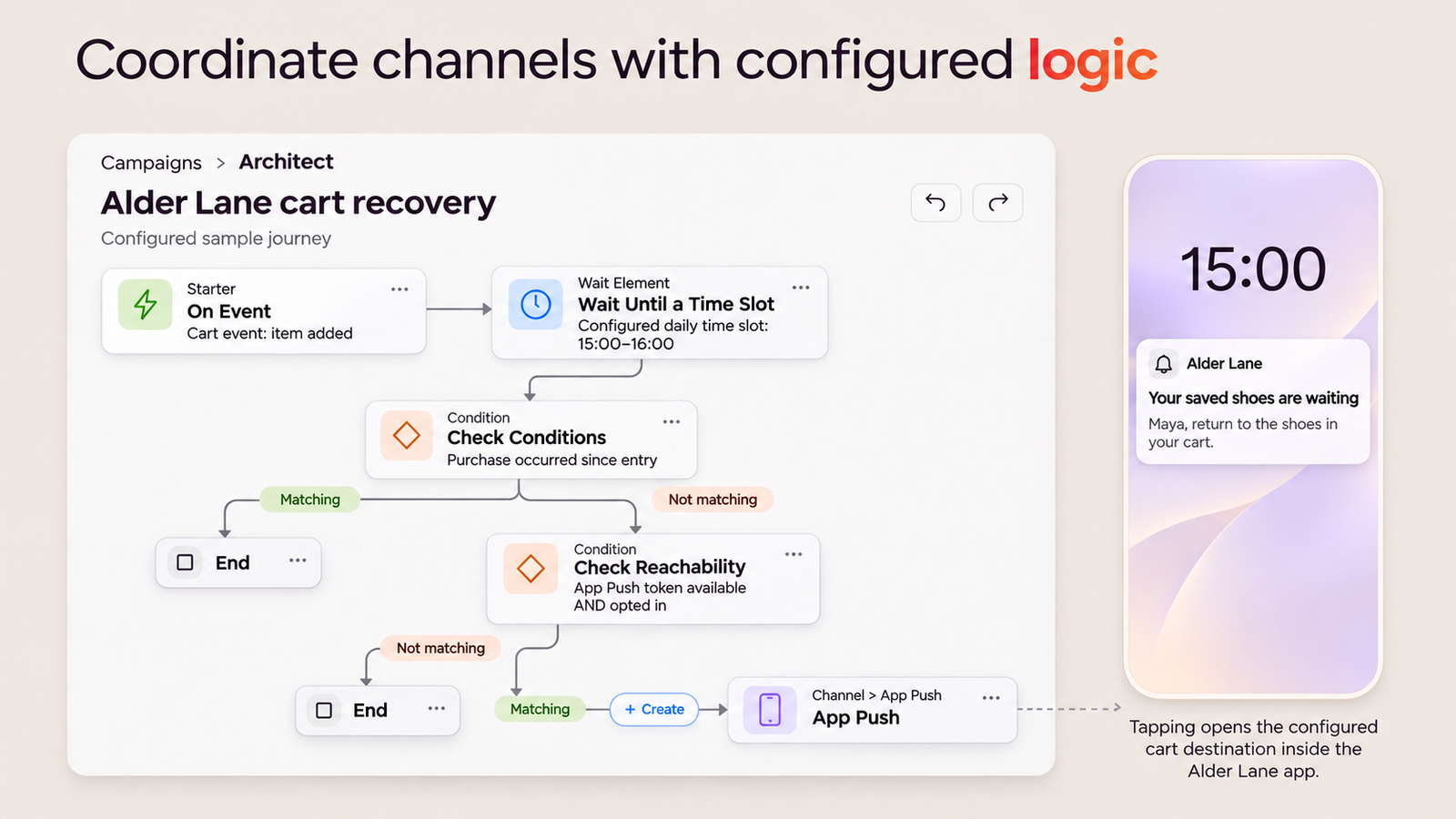
A key implementation layer is the collection of user events, attributes, and product data that helps create unified user profiles and support personalization across channels.
Teams should define how anonymous and known identifiers, such as device IDs, emails, phone numbers, and app logins, will be connected within their customer-data strategy. Web SDK, Mobile SDKs, and the Upsert API can provide the events, attributes, and product data that support unified profiles and personalization.
This is the mechanical difference between “omnichannel is important” content and an actual working system. When a customer abandons a browse session, the Insider One platform can use available customer data and journey configuration to support relevant follow-up across configured channels. Relevant website, app, and customer-data inputs can inform journey design instead of being used only for reporting after the fact.
The orchestration layer should give marketers a practical way to coordinate timing, content, and channel activation for each journey. Instead of relying on disconnected channel campaigns, marketers can use segments, journey logic, and available customer context to coordinate Email, SMS, WhatsApp, Web Push, and mobile push campaigns. Insider One’s AI capabilities include Agent One, an agentic AI system for customer engagement that is designed to plan, execute, learn from, and optimize engagement toward defined goals.
For a customer example, OLX achieved an 8.2% click-through rate on mobile web with triggered push notifications on mobile web, as described in the linked case study. The case study is a useful example of using mobile-web engagement tactics as part of a broader customer-experience strategy.
How to fix omnichannel marketing strategy without adding more channel chaos
The fix starts with consolidating customer data before adding a single new channel, because every new channel added on top of fragmented data multiplies the fragmentation instead of solving it. A unified customer-profile strategy can provide a strong foundation, with Customer Data Management supporting identity and profile management across web, app, and messaging for the use cases a business chooses to activate.
Root-cause fixes look different from channel-level patches. Instead of adding a new tool for every new touchpoint, the priority is defining how existing channels will use relevant customer data, segmentation, and journey logic. Concretely, that means:
- Auditing which channels currently hold their own siloed customer records instead of referencing a shared profile
- Mapping where website and app personalization decisions are made independently of the messaging stack
- Confirming how customer events, attributes, and product data are collected and made available for segmentation and journey activation
- Checking how product discovery, including search and recommendations, connects to customer data and personalization workflows
Tied to outcomes, this is structural, not cosmetic. Virgin Megastore achieved a 350% increase in conversion rate through personalized Web Push notifications, according to the linked case study. The linked case study attributes the result to personalized Web Push notifications and provides a useful example for teams evaluating targeted channel campaigns.
Messaging-specific channels benefit the same way. Teams should define how WhatsApp interactions and Web Push campaigns use available customer data and journey rules so messaging can remain coordinated across configured channels. Clarins México grew WhatsApp sales 20x using Insider One’s chatbot capability, according to the linked case study, which describes automated customer-service and commerce flows through WhatsApp.
What to evaluate before choosing a platform
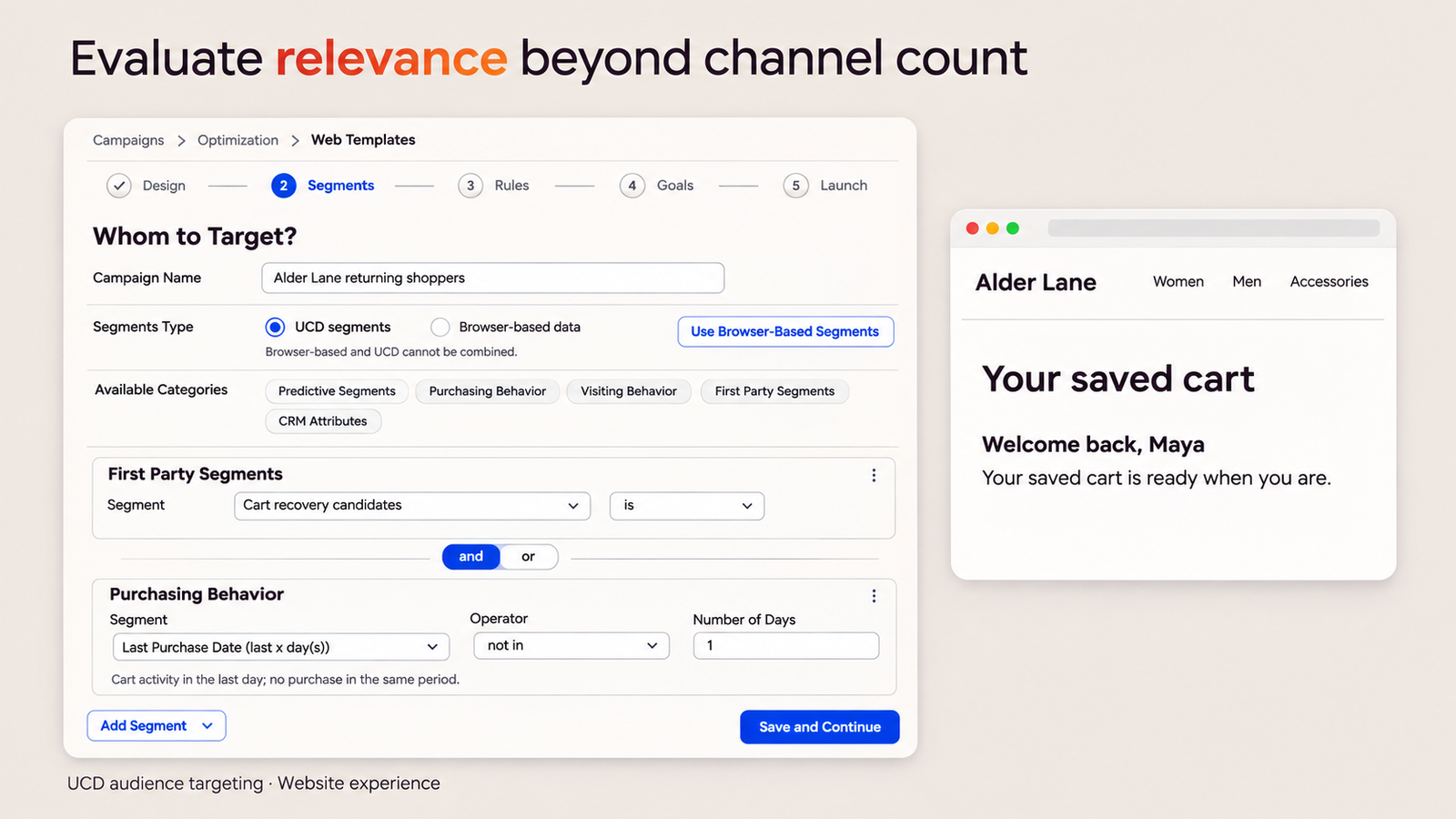
Evaluate a platform on how it unifies data before you evaluate how many channels it supports, because channel count without data unification just gives you more places for the customer profile to disagree with itself. The real decision criteria sit underneath the channel logos on a vendor’s homepage.
Ask vendors to show, not describe, the mechanics:
- How identity resolution merges anonymous and known profiles across web, app, and messaging in practice
- How customer events, attributes, and product data can be used in segments and cross-channel journeys
- Whether on-site personalization is a first-class capability or a repurposed messaging template
- How product recommendations and search and merchandising can support personalized onsite discovery
- How journey orchestration, segmentation, and configured channels support the customer experiences your team wants to deliver
These criteria connect directly to scale. A brand running a handful of campaigns may be able to manage fragmented data; as behavior-triggered journeys expand across Web, app, and Email, evaluating data collection and journey coordination becomes more important. Reviewing how an omnichannel customer engagement platform handles integrations with your existing commerce and data stack early prevents a costly architecture rebuild later. For a deeper comparison of what separates unified platforms from channel-first tools, see our breakdown of the best platforms for unified customer profiles.
Conclusion
Omnichannel marketing becomes practical when website, app, and messaging teams can use unified customer profiles, relevant data inputs, and coordinated journey design instead of relying on loosely connected tools. Brands can strengthen omnichannel execution by connecting customer data, segmentation, personalization, product discovery, and journey orchestration before expanding their channel mix. That’s the shift worth building toward in 2026 and beyond.
To evaluate the fit of the Insider One platform, Customer Data Management, and AI capabilities for your use case, book a personalized demo to review your goals, data requirements, and implementation constraints with the Insider One team.
Frequently Asked Questions
It’s an approach that connects website, app, and messaging experiences through customer data, segmentation, personalization, and cross-channel journeys, so teams can make experiences more consistent across touchpoints. It differs from multichannel marketing, where channels may run in parallel without a coordinated approach to customer data, segmentation, and journey design.
Cross-channel customer journey orchestration coordinates actions across configured channels using customer data, segments, and journey logic. Multichannel marketing can involve independently managed channel campaigns, which can make it harder to coordinate customer experiences across touchpoints.
Because a customer’s behavior on your website is one of the strongest signals for what they’ll want in your app minutes later. If the two run on separate systems, you lose that signal, and the app experience reverts to generic messaging instead of reflecting what the customer just did.
A customer data platform can help teams collect and organize user attributes, events, and product data into unified customer profiles that support segmentation and personalization. Without it, teams may lack the customer profiles, events, and attributes needed to support segmentation and journey orchestration, which is why orchestration and unified data should be evaluated together.
The appropriate timing depends on the journey, customer expectations, available data, channel configuration, and your implementation requirements. This depends on your data collection, identity-management approach, channel configuration, and implementation requirements, not just your messaging tool’s send speed.

Keep Reading
4 min.

Chris Baldwin
3 Feb 2026
9 mins.
Chris Baldwin
11 Nov 2026
11 mins.
Chris Baldwin
11 Nov 2026