

 Platform Overview


 Integration Hub


 Agent One™


 Agent One™ Teams


 Customer Data Management


 Personalization


 Journey Orchestration


 Reporting & Data


 Behavioral Analytics


 Web


 Email


 Site Search


 Conversational CX


 WhatsApp


 Web Push


 InStory


 App


 SMS & RCS


 Join the $0 Migration Movement™


 The Insider One Difference


 Compare Vendors


 Switch to Insider One


 Success Story


 Retail & Ecommerce


 Financial Services


 Travel & Hospitality


 Beauty & Cosmetics


 Automotive


 Telecommunications


 Total Economic Impact™ Study


 Blog


 E-Books & Guides


 Events


 Glossary
Journey Agent helps teams build marketing journeys by describing them

Updated on 14 Oct 2026
8 min.
Table of Contents
- What Journey Agent is and how it fits inside Architect
- Why journey creation slows down lifecycle marketing
- How Journey Agent builds and edits journeys on the canvas
- Core capabilities that make Journey Agent useful for practitioners
- Types of journey use cases teams can build with Journey Agent
- Comparing conversational journey building with manual canvas assembly
- Components of Journey Agent
- Types of Journey Agent workflows
- Why teams are investing in conversational journey orchestration now
- Getting started with Journey Agent
- FAQ
Most Popular
Building a journey should not start with dragging boxes across a canvas. It should start with a clear sentence, then move straight into a validated flow that is ready to refine.
Journey Agent changes how practitioners build journeys in Architect. Instead of assembling every step by hand, teams can describe the flow they want and shape it directly on the canvas in a live conversation.
What Journey Agent is and how it fits inside Architect
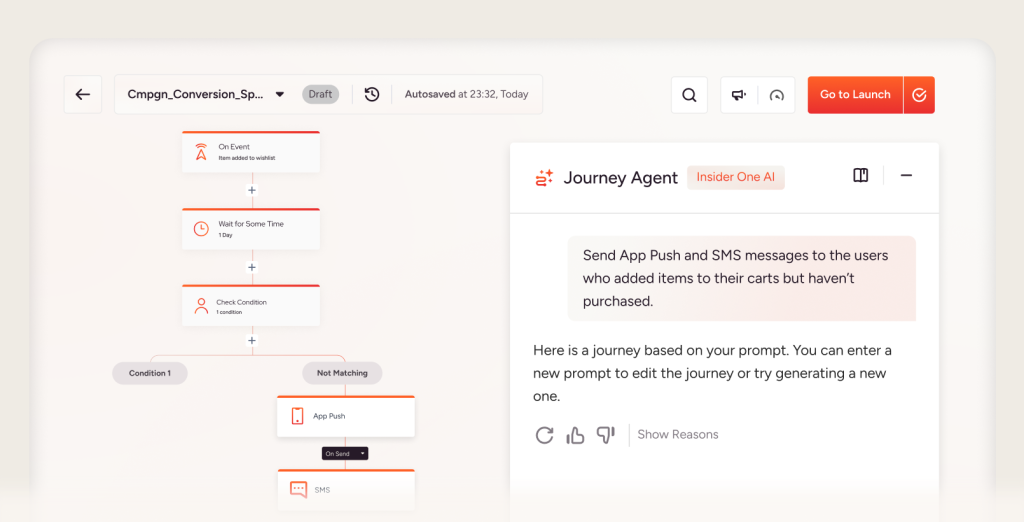
Journey Agent is a conversational journey builder inside Architect. It translates a plain-language prompt into a journey draft, then lets marketers keep refining that journey through the same conversation while the structure updates on the canvas.
That matters because journey creation is usually a sequence of small manual tasks: place a step, connect a branch, check the logic, then repeat until the flow is usable. Journey Agent keeps the marketer in the same workspace and works like a guided co-pilot for journey assembly. A useful shorthand is this: it works like a VLOOKUP for journey logic, transforming a description into a structured draft the canvas can use.
Why journey creation slows down lifecycle marketing
Lifecycle teams move quickly when they are testing onboarding, winback, abandoned cart, price drop, or loyalty flows. The bottleneck is rarely the idea. It is the build process. Every new branch, condition, and channel step adds more room for structural mistakes and more time spent checking whether the journey still makes sense.
Journey Agent addresses that friction by reducing the gap between intent and a first draft. It gives hands-on marketers a faster way to move from brief to build, which lowers the skill barrier for practitioners and frees experienced teams from starting every journey from scratch.
How Journey Agent builds and edits journeys on the canvas
The experience begins with a natural-language prompt. A marketer can describe a flow in plain English, switch languages mid-conversation, and ask for the journey to be shaped around a specific goal or audience pattern.
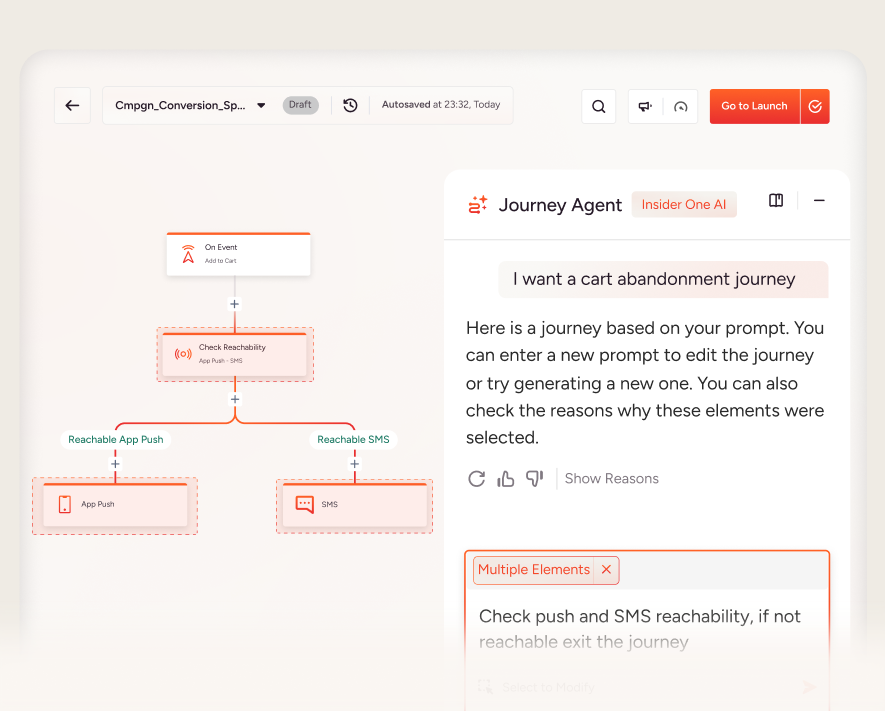
From there, Journey Agent places the relevant elements on the canvas and wires the structure together. It supports iterative editing, so the conversation does not end after the first draft. Teams can refine a branch, add a channel step, or adjust a segment of the journey without rebuilding the entire flow.
It also supports selection-aware editing, which means a marketer can choose a specific part of the journey and modify only that area. That keeps the rest of the structure intact and makes live iteration more precise.
Core capabilities that make Journey Agent useful for practitioners
Conversational journey creation
- Plain-language prompting: Marketers describe the journey they want, and Journey Agent turns that description into a canvas-ready structure.
- Iterative editing: The conversation continues after the first draft, so teams can refine journeys without restarting the build.
Structural validation before launch
- Built-in checks: Journey Agent looks for structural issues before saving, including cycles, orphan steps, and A/B allocation problems.
- Confidence at build time: Teams can catch issues earlier, which reduces the chance of finding them only when a journey is nearly ready to launch.
Selection-aware refinement
- Branch-level editing: Users can select a specific part of the journey and update only that section.
- Controlled changes: This helps practitioners make targeted edits without disturbing the broader flow logic.
Multilingual collaboration
- Language flexibility: Teams can work in their own language and switch mid-conversation.
- Broader accessibility: That makes the capability more usable for distributed teams and regional operators.
Reasoning support
- Explains its reasoning: Journey Agent can explain why it made a structural choice when asked.
- Transparent interaction: That gives marketers more context while they review and refine the draft.
Types of journey use cases teams can build with Journey Agent
Onboarding journeys
A lifecycle manager can describe a welcome flow for new signups, then refine the timing and channel order in conversation. For example, a journey might begin with a welcome message on day 0, followed by an email on day 2 and an in-app step later in the sequence.
Winback journeys
Teams can create winback journeys for dormant audiences without manually stitching the logic together step by step. Journey Agent is useful here because the structure often depends on time gaps, channel sequencing, and conditional branches that are easier to describe than to build from scratch.
Abandoned cart journeys
Practitioners can use it to assemble transactional recovery flows with clear timing and follow-up logic. A marketer can prompt the journey in one sentence, then adjust the branch that handles non-openers or add a follow-up message where needed.
Loyalty and retention journeys
Journey Agent also fits ongoing loyalty programs where the journey logic needs to respond to behavior over time. It helps teams keep the flow structured while testing different paths for engagement, repeat purchase, or reactivation.
Comparing conversational journey building with manual canvas assembly
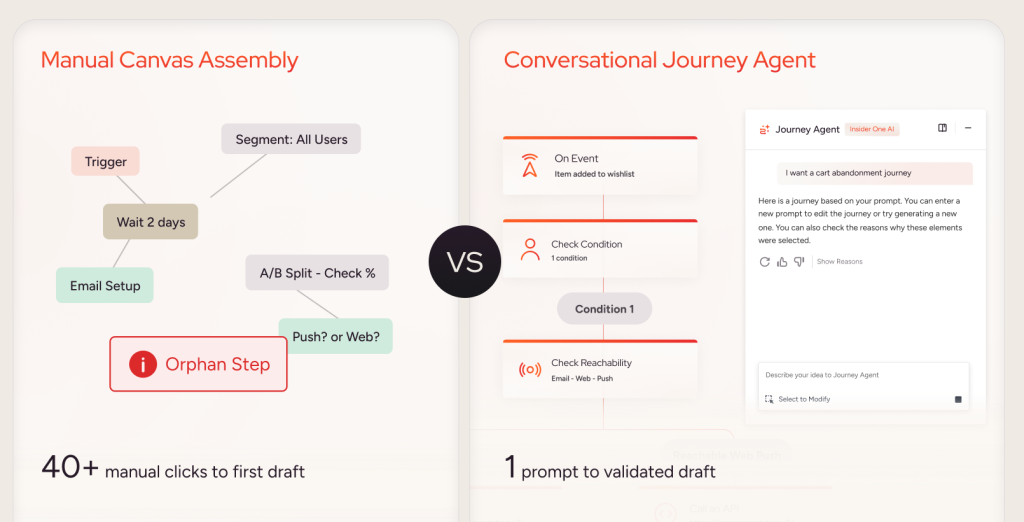
| Criterion | Manual canvas assembly | Journey Agent |
| Starting point | Marketers place each step by hand | Marketers describe the journey in plain language |
| Draft speed | Slower for complex flows | Faster first draft creation |
| Iteration | Requires repeated structural edits | Supports ongoing conversational refinement |
| Precision edits | Changes often affect neighboring steps | Selection-aware editing narrows the scope of change |
| Validation | Structural issues are usually checked late | Structural issues are flagged before saving |
| Accessibility | Higher skill barrier for new practitioners | Lower barrier for hands-on marketers |
Components of Journey Agent
- Conversational prompt interface: The starting point for describing the journey in natural language.
- Canvas-based journey assembly: The workspace where the structure appears and updates in real time.
- Selection-aware editing: The control layer for modifying a specific branch or section.
- Structural validation: The safeguard that checks the journey for logic issues before it is saved.
- Multilingual interaction: The capability that lets teams move between languages within the same conversation.
Types of Journey Agent workflows
- First-draft generation: Useful when a team wants to move from idea to an editable journey quickly.
- Iterative refinement: Useful when a live draft needs branch changes, step adjustments, or channel updates.
- Branch-specific editing: Useful when only one part of a larger journey needs attention.
- Live prototyping: Useful for CS and SE teams building or adapting a journey during a consumer call.
Why teams are investing in conversational journey orchestration now
Journey orchestration is moving toward more conversational creation because teams want to spend less time on repetitive setup and more time on the structure of the experience itself. Public platform moves across the market reflect that shift. Adobe has described Journey Agent as a way to orchestrate cross-channel experiences across journey ideation, analysis, and optimization, and Microsoft’s Journey Creation Agent similarly frames journey building as a natural-language workflow.
That direction is useful for practitioners because it reduces the distance between planning and execution. It also makes journey creation more approachable for lean teams that need to ship and revise flows quickly without adding unnecessary process overhead. In that context, Journey Agent positions Architect as a place where practitioners can design journeys by conversation, then keep adjusting them in the same workspace.
For teams thinking about how journey work fits into broader orchestration, our guide to agentic commerce explains how conversational interfaces are changing how marketers structure experiences. For a related view on how AI is being used inside marketing workflows, our article on conversational commerce beyond chatbots offers a useful category lens.
Getting started with Journey Agent
Not every team needs more manual journey building. If you want to move faster from idea to structured flow, Journey Agent is available as part of Insider One.
FAQ
What is Journey Agent?
Journey Agent is a conversational journey builder inside Architect that turns plain-language prompts into a journey draft on the canvas. It is designed for practitioners who want to describe the flow they need and refine it in the same workspace. The result is a faster path from concept to a structured journey that can be edited and validated before launch.
How is Journey Agent different from a first-draft generator?
A first-draft generator produces an initial version and then leaves most of the work to manual editing. Journey Agent is built for ongoing conversation, so marketers can keep refining the journey after the first draft is created. That makes it more useful for complex flows where timing, branching, and channel order often need multiple rounds of adjustment.
What kinds of journeys can teams build with Journey Agent?
Teams can use it for onboarding, winback, abandoned cart, price drop, and loyalty journeys. Those are common lifecycle flows where practitioners need to move quickly and keep the structure clear. Journey Agent is useful because those flows often contain branching logic that is easier to describe than to build step by step.
Does Journey Agent help catch journey errors?
Yes. It includes structural validation before saving, which helps surface issues such as cycles, orphan steps, and A/B allocation problems earlier in the process. That matters because structural problems are easier to correct while the journey is still being shaped. In practice, it gives marketers more confidence before a flow is ready to launch.
Can teams work in more than one language?
Journey Agent supports multilingual interaction, so teams can work in their own language and switch mid-conversation. That is useful for distributed marketing teams and regional operators who collaborate on the same journey. It keeps the conversation usable without forcing everyone into a single working language.
How does Journey Agent support more experienced marketers?
It does not replace practitioner judgment. It gives experienced marketers a faster way to shape and refine journeys while keeping control of the canvas. That is especially helpful when teams want to prototype live, test a branch, or edit only one part of a larger flow without rebuilding everything around it.

Keep Reading
4 min.

Chris Baldwin
3 Feb 2026
10 min.
Chris Baldwin
28 Oct 2026
10 mins.

Nicolas Algoedt
28 Oct 2026