

 Platform Overview

 Integration Hub

 Agent One™

 Agent One Teams™

 Customer Data Management

 Personalization

 Journey Orchestration

 Reporting & Data

 Behavioral Analytics

 Web
Web

 Email
Email

 Site Search

 Conversational CX

 WhatsApp

 Web Push

 InStory

 App
App

 SMS & RCS

 Join the $0 Migration Movement™

 The Insider One Difference

 Compare Vendors

 Switch to Insider One

 Success Story

 Retail & Ecommerce

 Financial Services

 Travel & Hospitality

 Beauty & Cosmetics

 Automotive

 Telecommunications

 Total Economic Impact™ Study

 Blog
Blog

 E-Books & Guides

 Glossary
How to Turn Your SMS Channel into a Two-way Revenue Machine

Updated on 7 Jul 2026
10 min.
Table of Contents
Most Popular

Summary
Conversational SMS drives stronger engagement than one-way broadcasts by encouraging replies and capturing valuable customer data. Success depends on AI-powered conversations, unified customer profiles, and measuring interaction-based metrics that improve personalization and long-term revenue.
When someone replies to a brand text and hears nothing back, the relationship shifts. The channel stops feeling like communication and starts feeling like a notice board.
That silence is where SMS programs quietly lose subscribers, and where the gap between broadcast and conversational design becomes a business problem rather than a strategic preference.
Consumer expectations around messaging shifted when WhatsApp, Instagram DMs, and iMessage became the default way people communicate with brands and each other. The channel itself is no longer the differentiator.
What differentiates you is whether the line goes both ways. Brands that acknowledge this are treating SMS as a dialogue channel, while brands that do not are accelerating their own opt-out rates.
Why one-way SMS is losing ground
The expectation gap is already costing you
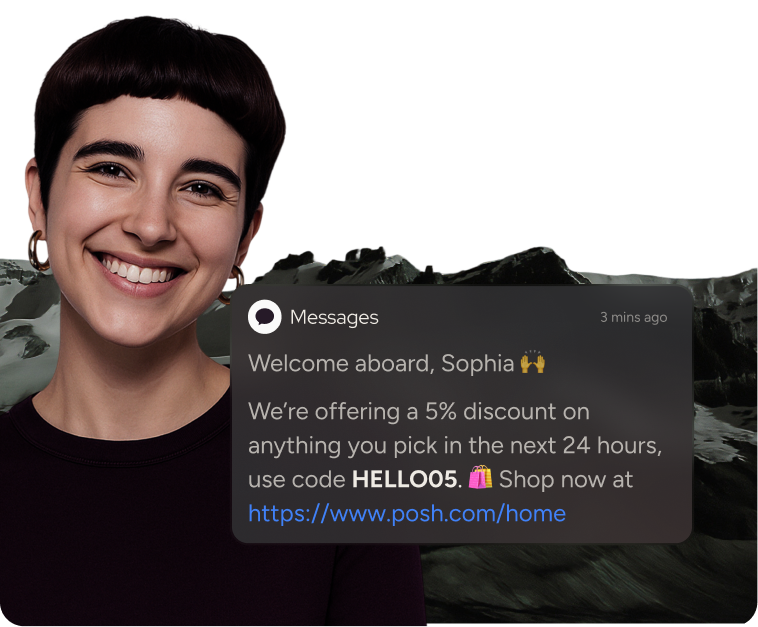
The problem with broadcast SMS is not copywriting or sending timing. It is the implicit promise the channel makes. When someone receives a text, every instinct tells them a reply is possible.
The moment they text back and hear nothing, you have not just failed a service moment. You have confirmed that your brand is not actually present, and that the relationship is transactional in the most limiting sense.
Audiences conditioned by messaging apps, where response is immediate and natural, find broadcast-only SMS increasingly outdated. Opt-outs spike not just from irrelevant messages but from the compounding frustration of one-way communication.
The channel starts to feel less like a relationship and more like a company announcement feed, and when that perception takes hold, subscriber retention suffers across the board.
Broadcast costs you more than opt-outs
The financial case for moving beyond broadcast extends past subscriber retention. Reply-inviting programs surface preference and intent data that broadcast-only campaigns rarely capture through other means.
That data sharpens future segmentation, reduces wasteful sends, and improves the signal quality feeding your advertising audiences.
Every unanswered reply is a missed data point, and at scale those gaps compound into a personalization deficit that shows up across your broader channel performance.
What makes SMS truly conversational
Four components have to work together before a program earns the label “conversational SMS marketing.” Get three of four right and the fourth creates a bottleneck that undermines the rest.
The four pillars of a conversational SMS program
Reply-inviting copy. The first pillar is how messages are written. Messages framed as statements produce lower reply rates than messages written as open-ended prompts.
The difference is intentional: a prompt signals that a response is expected and welcome, not just technically possible. Conversational SMS marketing begins at the copy level, before any routing or automation enters the picture.
Intelligent reply routing. When a reply arrives, something has to decide what happens next. In basic platforms, that decision is a keyword match: if the reply contains “YES,” “STOP,” or a recognized command, a rule fires.
Every reply that falls outside those keywords drops into a void. More advanced routing uses configured rules and journey logic to move people into the right follow-up flow, which is what separates a functional compliance tool from a more responsive two-way channel.
Artificial intelligence (AI)-assisted response handling. In Insider One, Sirius AI can help teams generate SMS copy and accelerate journey creation, while automated reply flows and routing logic can support common first-touch responses when they are properly configured.
The value here is not cost reduction alone: it is availability. Customers reply on their own schedule, and brands can use automation, unified profiles, and clear escalation rules to reduce delay and drop-off.
A profile enrichment loop. Every reply a customer sends can contain a signal, including stated preferences, questions, and timing. When the flow is configured to capture that signal, teams can use it to update segmentation and follow-up logic.
A connected customer data platform (CDP) can then give teams a unified place to use that context in later segmentation and follow-up planning.

Keyword triggers vs. natural language: why the distinction matters
Enterprise SMS platforms vary significantly in how they handle inbound replies. Some receive a reply and fire a predefined response based on keyword matching: type “INFO” and get a link, type “STOP” and get unsubscribed.
That architecture handles compliance and basic routing, but it does not handle conversation.
Open-ended reply flows are useful because customers often answer in their own words, while keyword systems require them to answer in yours. When those replies are captured and routed with clear journey logic, teams can sort people into more relevant follow-up paths without forcing every response into a rigid command structure.
That distinction is what makes the experience feel more conversational. The personalization value comes from how well reply data is captured, interpreted, and used in segmentation and follow-up logic, not from assuming every inbound message is handled autonomously.
Designing messages that start conversations
Construction principles
Conversational messages are shorter, warmer, and more specific than broadcast messages. They close with a prompt, not a URL. A hard call-to-action tells the customer what to do. An open-ended prompt invites them to tell you something.
The second type generates a reply; the first generates a click at best, and nothing further.
Micro-segmentation matters here, and it goes beyond the lifecycle stage. A customer in their first 30 days responds to a different tone than a loyal buyer of three years.
Someone who browsed a category without purchasing needs a different opening than someone who just completed a transaction. Brevity and timing carry their own message: a short, well-timed text signals that you know who the recipient is and respect their attention. Customers who feel recognized are more likely to write back.
Message patterns by use case
Post-purchase feedback: “Your order arrived. How’s it looking so far?” This is a minimal prompt with no instruction attached. It invites candor.
From there, reply data can feed journey logic: positive feedback can trigger a follow-up or review request, while complaints can route into a service handoff with more customer context attached.
Re-engagement: “It’s been a while. Still interested in [category]? Reply YES or tell us what you’re looking for now.” The either/or construction respects customers who want a simple path while opening a richer channel for those who want to articulate something more specific.
Preference capture: “Before your next send, quick question: do you prefer hearing about new arrivals, deals, or restocks?” Three options, plain language, low friction. When connected to profile and journey logic, that reply can inform the customer profile and shape future messages they receive.
Product discovery: “Not sure where to start? Reply with what you’re shopping for and we’ll point you to the right place.” This hands control to the customer.
For undecided browsers, browse abandonment, or cart abandonment audiences, it converts indecision into a directed conversation and generates the kind of stated intent data that can improve the next SMS, email, push, or app experience.
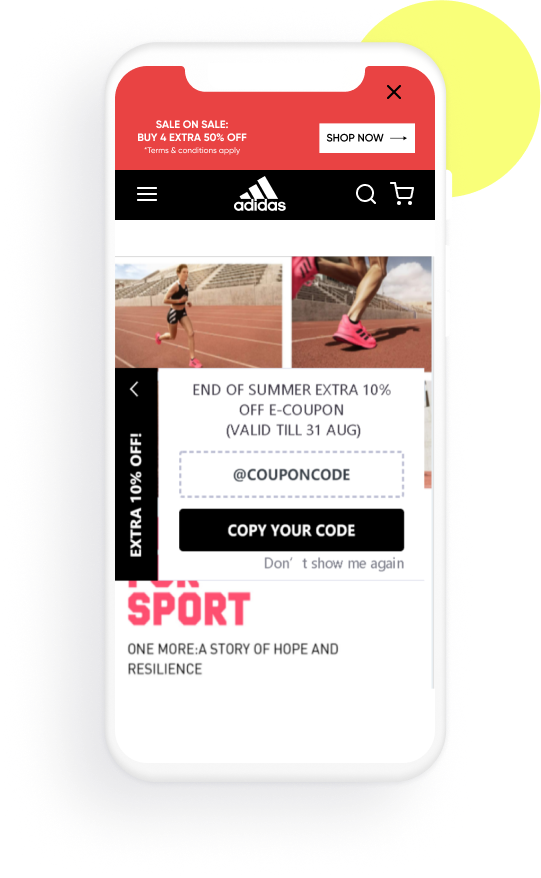
If you want an external proof point, review the Adidas case study directly rather than treating it as evidence for this exact conversational SMS workflow. For a cleaner pilot, focus on one reply-driven use case you can validate on your own subscriber data first.
Curious what a conversational pilot would look like on your own SMS list? Book a personalized demo and we’ll map a single use case, post-purchase feedback or re-engagement, against your actual subscriber data.
Scaling replies with AI and human handoff
The AI-first, human-when-it-matters model
A practical model is to let automation handle structured reply flows, preference capture, and off-hours continuity while humans step in for complex service issues or higher-stakes purchase conversations. This is not about removing humans from the channel.
It is about placing humans where they add the most value, while using Architect, unified profiles, and well-defined escalation rules to keep the experience responsive and relevant.
The handoff trigger matters as much as the AI’s capability. Explicit requests for a person, unresolved questions, and other predefined escalation conditions should route to a live queue.
When that handoff fires, the agent needs full context: everything the AI exchanged, the customer’s profile, their history, and the conversation thread. A handoff with no context is a worse experience than no handoff at all.
Insider One’s approach to journey orchestration is designed to help teams coordinate follow-up steps with more customer context, rather than treating SMS as a standalone send.
Infrastructure requirements
Running conversational SMS at scale requires more than strong copy or a capable AI layer. Before launch, brands need phone numbers, GDPR opt-in, SMS opt-in, a sender name, and an opt-out keyword and short code configured in line with local regulations.
From there, reply-routing rules, journey logic, and clean customer data determine whether inbound signals become useful follow-up actions instead of dead ends.
Unified customer profiles that aggregate email, push, app, and SMS data into a single view make it easier to interpret reply signals alongside other channel data instead of treating SMS as an isolated program.
This is where Insider One can make a stronger evaluation case: Architect orchestrates the journey logic, Customer Data Management unifies the profile, and Sirius AI features such as SMS AI Text Generator and Smart Journey Creator help teams launch and refine messaging faster in one platform instead of treating SMS replies as isolated events.
Measuring a conversational SMS program
Replace the broadcast key performance indicator (KPI) stack
Broadcast programs are measured on open rate, click-through rate, and opt-out rate. Those metrics tell you whether a message was received and whether it prompted an immediate action, but they tell you nothing about relationship quality, conversation depth, or long-term subscriber value.
A conversational SMS marketing program needs different instruments to surface what is actually working.
Reply rate is the foundational metric: if it is not moving, the program is not working, regardless of what click rates show. Reply-to-conversion rate connects conversational engagement to revenue, answering the question every finance leader will eventually ask.
Conversation depth measures how many turns a conversation averages before it resolves, which indicates whether your AI is handling complexity or simply deflecting it.
Agent handoff rate shows what proportion of conversations escalate, helping you calibrate AI scope and human capacity. Subscriber retention by cohort is the long view: do conversational subscribers stay longer and buy more than broadcast-only subscribers?
Teams should test that assumption against their own cohorts instead of treating it as a guaranteed outcome.
Reply data as a zero-party data engine
Every reply a customer sends is an explicit signal, stated in their own words, without inference or behavioral modeling. That is the definition of zero-party data, and it is increasingly valuable as third-party signal quality degrades across the industry.
A customer who replies “I’m looking for running shoes under $100” has just provided a preference, a category intent, and a price point, none of which required a survey or a predictive model. It came from a conversation.
Feed those signals back into your segmentation and you reduce the volume of irrelevant sends. Reduce irrelevant sends and opt-out rates fall. Lower opt-outs mean a healthier list and better deliverability.
The compound effect of a well-run conversational SMS marketing program is a subscriber base that is more engaged, better understood, and more valuable across every dimension. That is not a channel tactic in isolation. It is a cross-channel marketing strategy with SMS at the center of the data loop.
If you want to see how Insider One’s Architect, Customer Data Management, and Insider One AI™ combine journey orchestration, unified customer data, and AI-assisted message creation in one platform, book a personalized demo to see the exact use cases, decision logic, and growth levers most relevant to your team.
Frequently asked questions
No. The AI-first model is specifically designed to make two-way SMS workable for mid-market teams with limited headcount.
Automation can handle structured reply flows and first-touch acknowledgments, while human agents enter the conversation when a question, exception, or higher-stakes moment requires it. That means a small team can run a meaningful conversational program if the routing, journey logic, and escalation rules are configured well.
This is where AI-assisted architecture becomes useful. Automated flows can acknowledge replies outside business hours, capture structured preferences, and keep the next step moving until a human review is needed.
When a live team picks the conversation back up, having customer context and prior journey logic available makes that handoff more useful than a disconnected one-off reply.
Start with one use case that already generates organic replies, such as post-purchase feedback, re-engagement, browse abandonment, or cart abandonment. Build a focused reply flow for that single thread and connect the response data to the customer profile.
Measure reply rate and reply-to-conversion rate for 60 days. The data from that single flow will tell you where to invest next and give you the internal proof of concept needed to expand into cross-channel orchestration.
Not necessarily, but it depends on what your current platform can do with inbound messages. Keyword-only routing systems are useful for compliance and simple automation, but they are more limited when teams want richer intent capture and follow-up logic.

Keep Reading
7 min.

Muharrem Derinkok
4 Jun 2026
11 min.

Chris Baldwin
2 Jun 2026
4 min.
Chris Baldwin
3 Feb 2026