

 Platform Overview


 Integration Hub


 Agent One™


 Agent One™ Teams


 Customer Data Management


 Personalization


 Journey Orchestration


 Reporting & Data


 Behavioral Analytics


 Web


 Email


 Site Search


 Conversational CX


 WhatsApp


 Web Push


 InStory


 App


 SMS & RCS


 Join the $0 Migration Movement™


 The Insider One Difference


 Compare Vendors


 Switch to Insider One


 Success Story


 Retail & Ecommerce


 Financial Services


 Travel & Hospitality


 Beauty & Cosmetics


 Automotive


 Telecommunications


 Total Economic Impact™ Study


 Blog


 E-Books & Guides


 Events


 Glossary
CDP Real-Time Data Activation: How Live Customer Data Reaches Every Channel

Updated on 23 Nov 2026
13 mins.
Table of Contents
- Summary
- What is CDP real-time data activation?
- The five stages between a customer action and a channel response
- Real-time, near-real-time, or batch: match the speed to the use case
- How real-time activation works on each channel
- Native activation vs. exporting to destinations
- Coordination rules that keep real-time activation relevant
- Example: one cart event across four channels
- How to verify a CDP's real-time claims
- Metrics that show activation is working
- How Insider One activates CDP data across channels
- Where to start with real-time activation
- Frequently asked questions
Most Popular
Summary
- CDP real-time data activation turns a customer action into a profile update, a segment or decision change, and a channel response within seconds rather than hours
- Real-time is only as fast as the slowest stage: event collection, identity resolution, profile updates, segment evaluation, and delivery all have to keep pace
- Most programs need a mix of speeds, so reserve real-time for in-session, abandonment, and suppression use cases and let batch handle slower-moving segments
- Cross-channel activation needs shared rules for suppression, frequency, consent, and channel priority, applied at the moment a message is sent
- A CDP that activates natively in its own channels removes the export step where much of the delay and data drift occurs
A customer adds a jacket to their cart in your app, then buys it on desktop ten minutes later. If your customer data platform (CDP) updates profiles overnight, the cart abandonment SMS still goes out that afternoon. The data existed. It did not reach the channel in time.
That gap matters because customers notice it. McKinsey research found that 71% of consumers expect personalized interactions and 76% get frustrated when they do not get them. A message based on yesterday’s behavior is personalized in name only.
This guide is for CRM, lifecycle, and martech leaders who need to understand how a CDP turns live behavior into coordinated action across web, app, email, SMS, WhatsApp, push, and paid media. It covers the stages where delay builds up, which use cases need real-time speed, how activation differs by channel, the coordination rules that keep fast messaging relevant, and the questions to ask before trusting a vendor’s real-time claim.
What is CDP real-time data activation?
CDP real-time data activation is the process of using a customer’s latest behavior, captured and unified by a customer data platform, to trigger or change an experience in a channel within seconds of that behavior. Activation can mean sending a message, changing what a website or app screen shows, adding someone to an ad audience, or suppressing a message that is no longer relevant.
The CDP Institute defines a CDP as packaged software that creates a persistent, unified customer database that other systems can access, as MarTech’s analysis of real-time CDPs points out. That definition says nothing about speed. A CDP can unify data well and still activate it on a nightly schedule, so real-time activation is a capability to verify rather than one that comes with the category.
Three things separate real-time activation from standard data activation:
- The trigger for the CDP information to update is a customer event, such as a page view, cart update, purchase, or app open, not a scheduled list pull
- The profile and segment membership update before the channel acts, so the message reflects the latest behavior
- Suppression runs as fast as sending, so a conversion stops related messages on every channel
The five stages between a customer action and a channel response
Every real-time activation passes through the same chain. Real Story Group has observed that many CDPs are fast at the edges, with streaming ingestion and webhook triggers, while enrichment, identity stitching, and segment refreshes in the middle still run on schedules. Mapping the stages shows you where your own delay sits.
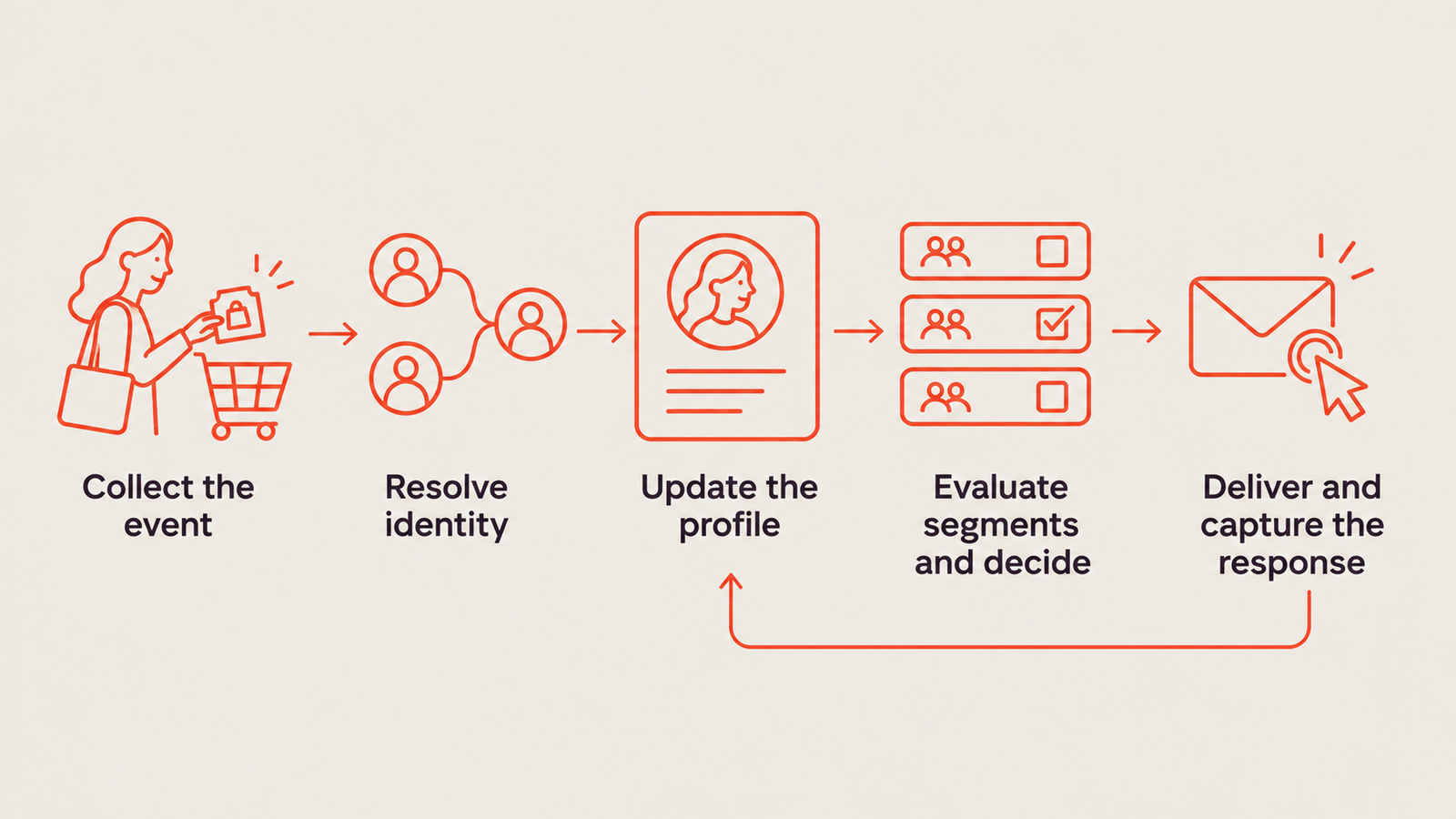
1. Collect the event
Web and app SDKs, server-side APIs, and connectors send events into the CDP. Streaming ingestion is now common. The larger risk is upstream systems, such as point-of-sale or CRM, that only send files in batches. Data that arrives instantly can still describe something that happened yesterday.
2. Resolve identity
The CDP decides which profile the event belongs to. Deterministic matching on a login, email address, or customer ID is fast. Merging an anonymous browsing session into a known profile after login is where many platforms lag, and an unresolved event can trigger a message to an incomplete version of the customer.
3. Update the profile and computed attributes
The event changes profile attributes and calculated metrics such as cart value, last category viewed, or number of purchases in the past 30 days. If those calculations run hourly, every segment built on them is up to an hour old.
4. Evaluate segments and decide
Segment membership is re-evaluated when the event lands, and a decision layer, made up of journey rules, AI models, or both, chooses whether to act, on which channel, and with what content. This is also where eligibility checks belong: consent, frequency limits, and active suppressions.
5. Deliver and capture the response
The channel sends the message or renders the experience, and the outcome (delivered, opened, clicked, converted, unsubscribed) flows back into the profile. Without that feedback, the next decision is made on incomplete data.
A practical test is to write down the expected time for each stage of your highest-value use case. The total is your actual activation latency, regardless of what a product page claims.
Real-time, near-real-time, or batch: match the speed to the use case
Not every use case needs a response in seconds, and real-time pipelines cost more to build and run.
As MarTech notes, interest-based messaging can work with data that is weeks old, while in-session personalization needs profile updates at very high speed. Decide speed per use case, not per platform. The latency ranges below are working guidelines rather than industry standards.
| Speed | Typical latency | Good fit | Why |
| Real-time | Seconds or less | In-session web and app personalization, cart and browse abandonment triggers, conversion-based suppression, order and transactional updates | The value of the response drops once the session or moment ends |
| Near-real-time | Minutes | Paid media audience refreshes, lead scoring updates, price-drop and back-in-stock alerts | A short delay does not change the outcome |
| Batch | Hours to daily | Newsletter audiences, lifecycle segments such as lapsed or VIP customers, predictive model retraining, reporting | Inputs change slowly, and scheduled processing is cheaper and more stable |
One rule is worth applying everywhere: if a delay can produce a wrong message, such as a discount on something the customer already bought, the suppression side of that use case needs real-time speed even when the send side does not.
How real-time activation works on each channel
The same live profile does a different job in each channel. The table shows what real-time data changes, a typical trigger, and the constraint to plan for.
| Channel | What real-time data changes | Example trigger | Plan for |
| Website | Banners, recommendations, content blocks, and search results in the current session | Category browsed, cart value changes | Anonymous visitors need session-level profiles before they log in |
| Mobile app | In-app messages, screen content, and recommendation slots | App opened after a period of inactivity | SDK event coverage across app versions |
| Triggered sends and content assembled at send time | Cart abandoned, order placed | The gap between a purchase and the suppression of pending sends | |
| SMS and RCS | Short, time-sensitive alerts | Price drop on a viewed item | Country-level consent rules and quiet hours |
| Template-based and conversational messages | Item back in stock, order status change | Template approval and opt-in status | |
| Web and app push | Re-engagement when the customer is away from the site or app | Wishlist item discounted | Opt-in rates and notification fatigue |
| Paid media | Audience inclusion and exclusion in ad platforms | Recent purchaser removed from acquisition ads | Ad platforms process audience changes on their own schedules |
The paid media row deserves attention. Even when the CDP updates a segment instantly, the ad platform decides when the change takes effect, so plan for near-real-time at best and check each platform’s documentation for its refresh behavior.
Native activation vs. exporting to destinations
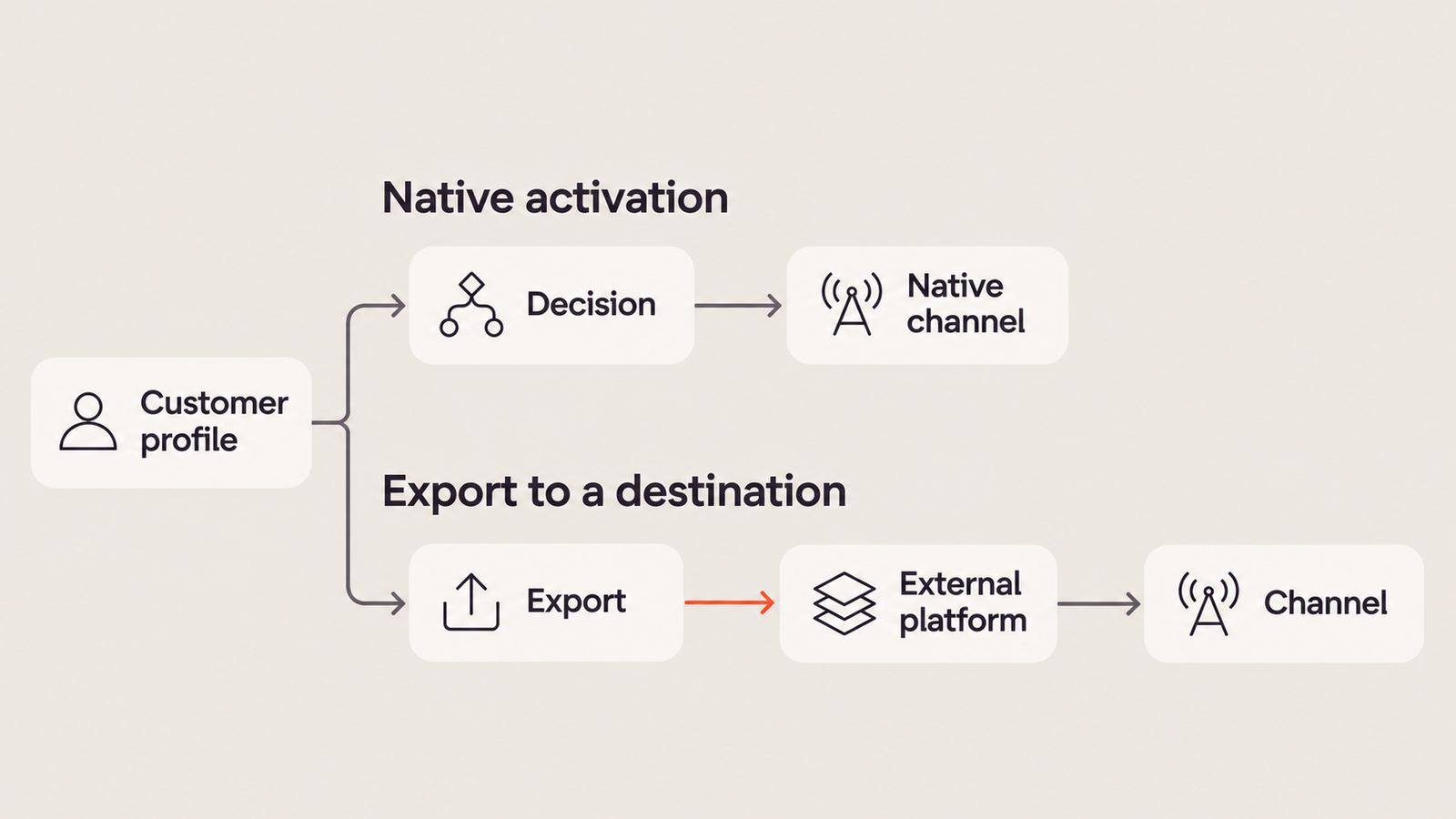
CDPs get data to channels in two broad ways. In the export model, the CDP, or a data warehouse using reverse ETL, syncs profiles and segments to separate email, SMS, push, and ad platforms. Each destination keeps its own copy of the data, its own suppression list, and its own timing. In the native model, the CDP and the channels run on one platform, so a journey reads the live profile and sends directly.
| Factor | Export to destinations | Native activation |
| Time from event to send | Adds a sync step per destination, often on a schedule | Event, profile update, and send happen in one system |
| Cross-channel suppression | Each destination manages its own list, so a purchase can take a full sync cycle to stop messages | One journey can stop every channel when a conversion arrives |
| Consent enforcement | Checked separately in each system | Checked once, at the point of activation |
| Copies of customer data | Profile data is copied into every destination | Fewer copies to secure and keep consistent |
| Best fit | Warehouse-centric stacks where most use cases run in batch | Teams that need cross-channel journeys and in-session use cases without custom integration work |
Most enterprises use both: native activation for owned channels, plus exports to ad platforms and to a warehouse for analytics. The useful question is which use cases depend on an export step, and whether that step runs fast enough for them.
Coordination rules that keep real-time activation relevant
Speed without coordination produces faster mistakes. Define these rules once, at the profile or journey level, instead of rebuilding them in every channel.
Conversion-based suppression
A purchase, booking, or sign-up should remove the customer from every journey promoting the same thing, across every channel, at least as fast as those journeys send.
Cross-channel frequency limits
Cap the total number of messages per customer across email, SMS, WhatsApp, and push combined. Four well-timed messages from four channels on the same day still add up to too many.
Consent and preference checks at send time
Check consent when a message is about to go out, not when the segment was built. A customer who opted out of SMS ten minutes ago should not receive an SMS that was queued an hour ago.
Channel priority
When a customer qualifies for several channels, decide which goes first and which waits. Fixed rules, such as app push first and email after a set window, and AI-driven channel selection based on each customer’s engagement history both work, provided a single layer makes the decision.
Holdout groups
Keep a small control group out of each real-time journey. Without one, you cannot tell whether the trigger caused the conversion or simply arrived before it.
Example: one cart event across four channels
A shopper adds running shoes to their cart in your app and leaves. Here is how a CDP with native activation can handle it:
1. The app SDK sends the add-to-cart event, and the CDP attaches it to the shopper’s profile and updates cart value and last category viewed
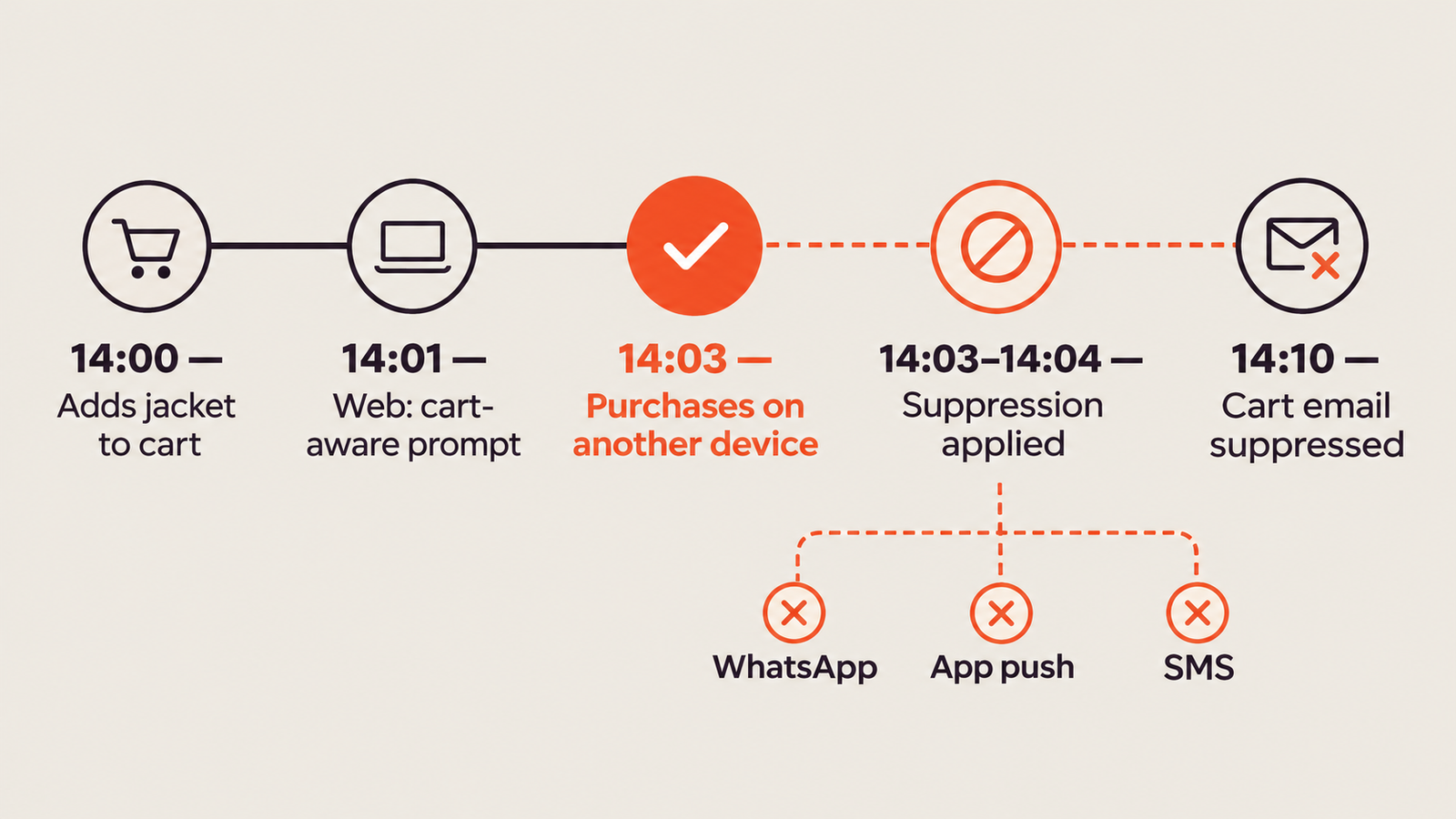
2. The event enters a cart abandonment journey immediately, and after a defined wait time, the journey checks whether a purchase event has arrived from several channels
3. With no purchase, the journey confirms push opt-in and sends an app push showing the shoes
4. If the push is not opened within the set window, the journey checks email consent and frequency limits, then sends an email with the cart and two recommendations from the viewed category
5. The shopper opens the email on a laptop, and the website shows the same shoes in a returning-visitor banner because web and app share the profile
6. The shopper buys on desktop, and the purchase event exits them from the journey, cancels the pending SMS step, and removes them from the cart abandoner ad audience at the platform’s next refresh
Each step reads from and writes to the same profile. Remove one link and the shopper receives a reminder for shoes they already own. In Insider One, this pattern runs in Architect with an On Event journey starter, which enters users into a journey as soon as they perform a specified event.
How to verify a CDP’s real-time claims
Ask vendors to demonstrate one use case end to end, from event to delivered message, rather than ingestion speed alone. Real Story Group also recommends asking for visibility into each step, such as when the data was updated and when the segment was re-evaluated. These questions expose most gaps:
- After an event arrives, how long until a segment that depends on it updates?
- Do computed attributes update on every event or on a schedule?
- How quickly are anonymous sessions merged into a known profile after login?
- Can a conversion stop pending messages on every channel from within the same journey?
- Is consent checked at send time or when the segment is built?
- Which destinations receive data by streaming, which by scheduled sync, and how often does each sync run?
- What monitoring shows data ingestion health and delays?
Metrics that show activation is working
Delivery counts tell you data moved. These metrics tell you whether activation is doing its job:
- Event-to-activation latency: time from the triggering event to the message sent or experience shown, measured per use case
- Suppression accuracy: share of converted customers who still received a related message afterward, with a target of zero
- Profile match rate: share of events attached to a known or persistent profile
- Incremental lift: conversion rate of a triggered journey compared with its holdout group
- Messages per customer per week: total across channels, to catch over-messaging early
- Opt-out rate after triggered messages: an early sign that timing or relevance is off
How Insider One activates CDP data across channels
Insider One brings its CDP, journey orchestration, and 12+ native channels into one platform, so most activation happens without an export step. The capabilities most relevant to real-time activation:
- Data in: 100+ out-of-the-box integrations, a bidirectional connection to your data warehouse, and data transformation that standardizes event formats as they flow in
- Identity: Identity Resolution Management to control how profiles are unified and how personally identifiable information is handled
- Segmentation: 120+ out-of-the-box filters and triggers across traits, behaviors, and preferences, plus aggregations that calculate behavioral metrics from event data in real time
- Orchestration: Architect journeys that start on customer events, on business events sent by API, or on API calls for transactional messages
- Activation: web, app, email, SMS and RCS, WhatsApp, web push, and more from the same profile, plus remarketing audiences for Google Ads and TikTok, and Streaming APIs that send data in real time to other connected systems
- Governance: consent management with a full history of opt-in dates and sources, and compliance with GDPR and CCPA
Euronews shows how this works at scale. Using Architect, the publisher built segments driven by real-time behavioral triggers such as article views and session activity, and synced them automatically with its advertising systems. The result was more than 600M data points processed monthly, 6B journey entries in one year, and a 12% increase in app push opt-ins within two months.
Vogacloset combined Insider One’s CDP and Architect to reach a 30X ROI by personalizing the messaging experience for users’ using their real-time interactions with the business.
For teams moving toward agentic marketing, Agent One™ adds self-optimizing intelligence that works from the same unified profiles. To see which activation use cases fit your data sources, try the CDP Explorer.
Where to start with real-time activation
Start with one use case where delay produces a wrong message, usually conversion-based suppression or cart abandonment. Map its five stages, measure the latency of each, fix the slowest one, and only then expand to more use cases and channels. Real-time activation is a property of the whole pipeline, so improving one stage at a time is the most reliable way to get there.
To review your data sources, identity setup, and channel mix with the Insider One team, book a personalized demo. If you prefer to explore on your own first, the Interactive Platform Tour includes self-guided demos of unified profiles, real-time segments, and cross-channel journeys.
Frequently asked questions
Real-time data collection means events reach the CDP as they happen. Real-time activation means those events change what the customer experiences, through a message, a page, or an audience, within seconds. A CDP can collect in real time and still activate on a schedule if identity resolution, segment updates, or channel syncs run in batches.
No. The standard CDP definition requires a unified, persistent customer database accessible to other systems, but it does not require real-time processing. Some CDPs focus on data unification and pass segments to other platforms on a schedule, while others include their own channels and journey orchestration. Verify each stage’s latency for your use cases before buying.
Reverse ETL copies modeled data from a data warehouse into operational systems, usually on a schedule, which suits batch use cases. A CDP collects events directly, resolves identity, and keeps profiles current, which suits triggered and in-session use cases. Many teams use both, with the warehouse handling analytics and modeling and the CDP handling real-time activation.
Yes. A CDP can build a profile from an anonymous visitor’s session, using a device or cookie identifier, and personalize the website or app based on pages viewed and items added to the cart. When the visitor logs in or shares an email address, identity resolution merges that history into their known profile so later messages reflect it.
Store consent and channel preferences on the unified profile, update them as soon as a customer changes them, and check them at the moment a message is sent rather than when a segment is built. Limit how many systems hold copies of personal data, and set retention periods so profile and event data are kept only as long as needed. Confirm specific legal requirements with your own counsel.
It depends on how many data sources you connect, how clean your event data is, and how many channels you activate at once. Starting with web and app SDKs plus one or two channels is usually faster than a full rollout. For Insider One customers, the migration-as-a-service program provides a tailored plan aimed at activation in 4 to 6 weeks.
AI agents use real-time CDP data as the input for their decisions, such as which customers to target, which channel to use, and when to send. If profiles and consent status are hours old, the agent decides on outdated information. Real-time activation gives agents current profiles to act on, while human-set rules for frequency, suppression, and budget keep their decisions within limits.

Keep Reading
4 min.

Chris Baldwin
3 Feb 2026
11 mins.
Chris Baldwin
23 Nov 2026
10 mins.

Nicolas Algoedt
23 Nov 2026