

 Platform Overview

 Integration Hub

 Agent One™

 Agent One Teams™

 Customer Data Management

 Personalization

 Journey Orchestration

 Reporting & Data

 Behavioral Analytics

 Web
Web

 Email
Email

 Site Search

 Conversational CX

 WhatsApp

 Web Push

 InStory

 App
App

 SMS & RCS

 Join the $0 Migration Movement™

 The Insider One Difference

 Compare Vendors

 Switch to Insider One

 Success Story

 Retail & Ecommerce

 Financial Services

 Travel & Hospitality

 Beauty & Cosmetics

 Automotive

 Telecommunications

 Total Economic Impact™ Study

 Blog
Blog

 E-Books & Guides

 Events

 Glossary
CDP Capabilities Checklist: What to Look for in 2026

Updated on 30 Sep 2026
8 min.
Table of Contents
- Summary
- How do you test identity resolution instead of just asking about it?
- Does the architecture fit how your team actually works?
- Is the real-time activation claim backed by numbers?
- Can the platform separate real AI from a labeled segment?
- Does governance hold up past the primary channel?
- Conclusion
- Frequently asked questions
Most Popular
Summary
- Score identity resolution against your own messy, multi-source data during a proof-of-concept, not against a vendor’s cleaned demo dataset
- Decide between a composable, warehouse-native model and a packaged customer data platform based on your engineering capacity, and check whether the vendor forces the choice at all
- Require latency numbers and channel-level controls before accepting any real-time activation claim at face value
- Separate artificial intelligence that lives natively in the profile layer from bolt-on features layered over static segments, and score agentic capability on whether it can be evaluated and governed
- Verify consent propagation to every downstream destination and model total cost of ownership against your actual profile and event growth
Our last shortlist all checked the same boxes on paper. Every vendor claimed real-time activation, cross-device identity resolution, and built-in artificial intelligence. Then we ran a proof-of-concept against our own data, and two of the four fell apart within a week.
That gap between the RFP answer and the operational reality is the reason most CDP evaluations underperform.
A customer data platform unifies customer data from every touchpoint into a single profile, then makes that profile usable for targeting, personalization, and reporting. This piece is for marketing operations leaders, martech and data leads, and CX directors evaluating or renewing one in 2026.
What follows is not another feature-matching checklist. It’s a scored, depth-testing framework built around the five areas where vendor claims and operational reality diverge most: identity resolution, architecture fit, real-time activation, AI readiness, and governance economics. Each section tells you what to demand proof of before you sign.
How do you test identity resolution instead of just asking about it?
Identity resolution is the single most overstated capability on any CDP scorecard, and the only way to evaluate it honestly is to demand proof against your own data, not a demo environment.
Ask every finalist to run a match-rate test using a sample of your actual customer records, pulled from email, mobile app, point of sale, and web analytics, before you score this category at all.
Deterministic matching links records using shared identifiers like email or phone number and is reliable but limited to channels where that identifier already exists.
Probabilistic matching infers connections across devices and sessions using behavioral and contextual signals, and it’s what actually closes the gap between a known customer and an anonymous browsing session.
A platform strong on one and silent on the other is only solving half the problem.
The red flag to watch for: some engagement-first platforms match known identifiers well within their own software development kit but rely on identity resolution that has already happened upstream, in a separate data warehouse or a dedicated CDP feeding them clean profiles.
That’s a legitimate architecture in some stacks, but it’s not native cross-device resolution, and most public RFP templates never force vendors to disclose the distinction.
• Request match-rate results against your own multi-source sample, not a vendor-curated dataset
• Ask explicitly whether cross-device matching happens natively or depends on identity already resolved by another system
• Score confidence tiers separately: deterministic matches should be near-certain, probabilistic matches need a documented accuracy range
Does the architecture fit how your team actually works?
The right architecture depends on your engineering capacity and existing data stack, not on which model sounds more modern.
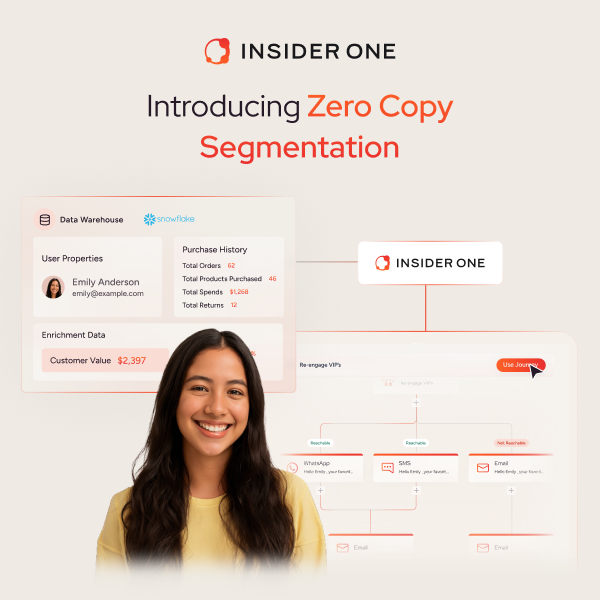
A composable, warehouse-native approach keeps customer data inside platforms like Snowflake or BigQuery and activates it without duplicating a full copy, which appeals to teams with strong data engineering resources and an existing warehouse investment. A packaged CDP unifies and stores data inside its own environment, trading some flexibility for faster time to activation.
Neither model is universally correct, and vendors on both sides will tell you it is. Teams with lean engineering headcount often move faster with a packaged model that handles ingestion, resolution, and governance in one place.
Teams with mature data platforms and dedicated analytics engineers may get more long-term value from a zero-copy, warehouse-native setup that avoids redundant storage and keeps a single source of truth.
Whichever direction you lean, the proof-of-concept has to run on your live warehouse data, not a sanitized dataset the vendor prepared in advance.
Messy fields, duplicate records, inconsistent timestamps, and partial profiles are exactly what expose whether the platform’s real-time claims and resolution logic hold up outside a controlled demo.
Our Customer Data Management approach is built to unify this kind of fragmented data without forcing a rebuild of your existing stack, which is worth confirming directly with any vendor on your list.
Is the real-time activation claim backed by numbers?
Every CDP on the market claims real-time activation, and almost none will quote you a specific latency number unless you ask directly. Push the finalist to commit, in writing, to how long it takes from event capture to activation across each channel you actually use, not just their fastest or most native surface.
“Real-time” without a number attached is a marketing shorthand, not an operational commitment. Some platforms deliver activation in seconds on their own messaging channels but add meaningful delay when the same trigger has to reach a paid media platform, a warehouse export, or an offline point-of-sale system.
That gap matters most in high-velocity use cases like cart abandonment, fraud flags, or inventory-based personalization.
Beyond speed, check whether orchestration covers your full channel mix or only the vendor’s native surfaces. A platform can be genuinely fast within its own email and push infrastructure while offering shallow, delayed, or API-only support for paid social, offline retail, or third-party messaging tools.
Journey Orchestration built to span owned, paid, and offline channels in a single flow is a meaningfully different capability than fast delivery on one channel alone.
• Get a written latency commitment per channel, not a single blended average
• Confirm coverage across paid, owned, and offline touchpoints, not just the vendor’s messaging suite
• Ask for a live trigger-to-delivery demonstration during the proof-of-concept, timed independently
ECCO’s team saw this play out directly: connecting real-time behavioral data to orchestrated, cross-channel campaigns helped drive a 7.4x return on investment and a 95% conversion rate uplift, a result that depends on activation actually reaching every channel in the mix, not just the fastest one.
Can the platform separate real AI from a labeled segment?
The honest test for artificial intelligence readiness is whether the modeling lives natively in the profile layer or sits on top of static, manually built segments.
Native AI recalculates predictions, such as churn risk or next likely purchase, continuously as new behavioral data arrives. A bolted-on feature typically scores a segment once, then leaves it static until someone manually refreshes it.
Ask each vendor to show, in the proof-of-concept, how a prediction updates in response to a live behavioral event rather than a scheduled batch job. This single test exposes more about architecture than any product deck.
Agentic capability is the next layer buyers should be scoring for in 2026. Ask specifically how the platform supports next-best-action decisioning and autonomous orchestration across the full journey, not just personalized product recommendations.
Our AI overview covers how agentic orchestration and predictive modeling should work directly at the profile layer rather than as a separate reporting add-on. Ask any competing vendor to demonstrate the equivalent in a live environment, not a roadmap slide.
• Require a live demonstration of a prediction updating from a real-time event, not a static segment refresh
• Ask how next-best-action logic is generated: rules-based, predictive, or autonomous
• Confirm whether agentic orchestration spans the full journey or only a single campaign type
Does governance hold up past the primary channel?
Consent management only counts if it propagates to every downstream destination a customer’s data reaches, not just the primary activation channel where the opt-in was originally captured.
A platform can respect an unsubscribe on email while still passing that same profile into an advertising audience or a third-party warehouse export, and that gap creates real regulatory exposure.
Ask each finalist to map exactly where a consent change flows once it’s recorded: advertising platforms, data warehouses, analytics tools, and any connected integrations in your stack. If the answer is vague or channel-specific, treat it as a gap, not a technicality, because it’s the kind of detail that surfaces during an audit rather than a demo.
What should the pricing conversation actually cover?
Pricing structured around current profile and event volume rarely reflects the cost curve two years into a contract.
Model pricing against a realistic growth scenario, doubled event volume, new markets, added channels, and confirm exactly which usage triggers overage charges before you negotiate anything else.
Exit terms deserve the same scrutiny as onboarding terms. Confirm data portability, export formats, and any wind-down costs in writing before signing, since these terms are far harder to negotiate after the contract is active.
A platform’s why Insider One page or equivalent vendor documentation should make these terms discoverable without a sales call, and if it doesn’t, ask directly.
Conclusion
A CDP capabilities checklist only earns its name when it forces proof, not promises. Score identity resolution, architecture fit, real-time activation, artificial intelligence, and governance against your own messy data, not a vendor’s curated demo.
The teams that renew with confidence in 2026 are the ones who tested depth before they signed, not after.
To evaluate the fit of Customer Data Management and AI capabilities for your use case, book a personalized demo to review your goals, data requirements, and implementation constraints with the Insider One team.
Frequently asked questions
It’s a scored evaluation framework covering identity resolution, architecture fit, real-time activation, artificial intelligence readiness, and governance. Unlike a generic feature list, it requires vendors to prove each capability against your own data during a proof-of-concept rather than describing it in an RFP response.
A composable CDP activates data directly inside your existing warehouse, such as Snowflake or BigQuery, without duplicating storage. A packaged CDP unifies and stores data inside its own environment. The right choice depends on your engineering capacity and how much control your team wants over the underlying data layer.
Ask for a written latency commitment per channel, a live demonstration of identity resolution against your own multi-source data, proof that predictions update from real-time events, a full map of consent propagation across destinations, how agent quality is evaluated on an ongoing basis, and clear exit and data portability terms before signing.
Some platforms perform native probabilistic matching across devices, while others depend on identities already resolved upstream by a separate system. Both approaches can work, but only one qualifies as native cross-device resolution, and most standard evaluation templates never test the difference directly.
Score three things beyond the demo. Whether the agent draws on the unified profile rather than a knowledge base alone, so it knows the customer’s history. Whether it can take actions in connected systems rather than only answering questions. And whether the vendor can show how agent quality is measured over time across accuracy, tool calls, policy compliance, and tone, because a demo conversation is a sample of one.
Marketing operations to define the use case, a data engineer or analytics engineer to supply the real, unclean sample, and someone from legal or privacy to test consent propagation. The most common evaluation failure is a proof-of-concept scored entirely by marketing on data prepared by the vendor, which tests neither the architecture nor the governance.
Record a consent change in the pilot environment, then check every destination it should reach: the ad platform audience, the warehouse export, the analytics tool, and any connected integration. Note how long propagation takes as well as whether it happens at all. A change that eventually propagates after 24 hours is a different risk profile than one that propagates immediately, and only one of those is defensible in an audit.
Model pricing against realistic profile and event growth over two to three years, not current volume. Confirm which usage thresholds trigger overage charges, and get data export and exit terms in writing before you negotiate the initial contract.

Keep Reading
7 min.

Muharrem Derinkok
4 Jun 2026
11 min.

Chris Baldwin
2 Jun 2026
4 min.
Chris Baldwin
3 Feb 2026