

 Platform Overview

 Integration Hub

 Agent One™

 Agent One Teams™

 Customer Data Management

 Personalization

 Journey Orchestration

 Reporting & Data

 Behavioral Analytics

 Web
Web

 Email
Email

 Site Search

 Conversational CX

 WhatsApp

 Web Push

 InStory

 App
App

 SMS & RCS

 Join the $0 Migration Movement™

 The Insider One Difference

 Compare Vendors

 Switch to Insider One

 Success Story

 Retail & Ecommerce

 Financial Services

 Travel & Hospitality

 Beauty & Cosmetics

 Automotive

 Telecommunications

 Total Economic Impact™ Study

 Blog
Blog

 E-Books & Guides

 Events

 Glossary
CDP for B2B Companies: Use Cases and Buying Guide

Updated on 30 Sep 2026
8 min.
Table of Contents
- Summary
- Why generic CDPs break down for B2B buying committees
- Five B2B use cases where a CDP pays for itself
- How should you orchestrate cross-channel campaigns for complex deals?
- What should you actually test before you buy a B2B CDP?
- Should you build, buy, or extend your existing stack?
- Conclusion
- Frequently asked questions
Most Popular
Summary
- A B2B customer data platform (CDP) succeeds or fails on account-level identity resolution, not the contact-level profiles built for B2C shopping carts
- Five use cases deliver measurable payback: golden account records, account-based marketing (ABM) signal aggregation, sales handoff, lifecycle suppression, and expansion signals from product usage
- Test identity resolution and account hierarchy modeling against your own messy customer relationship management (CRM) and marketing automation platform (MAP) data, never a vendor’s clean demo dataset
- Ask specifically whether the platform can segment on non-person entities such as accounts, subsidiaries, and product instances, because that is what account-level logic actually requires
- Confirm native integrations with your CRM, MAP, and product analytics stack before you sign a contract, not after
- Scope one high-leverage workflow for rollout instead of attempting full data unification in the first quarter
Picture a large enterprise contract moving through procurement. Six people touch your website and download the same pricing guide, but your customer relationship management (CRM) logs one contact and your marketing automation platform logs a different one entirely.
Neither system shows which of those six people are actively engaged this week, or what any of them did last week.
That gap is why generic customer data platform (CDP) comparisons fall short for B2B teams: they unify shopping behavior for one shopper, not a buying committee moving through a nine-month sales cycle.
A CDP built for business-to-business sales unifies signals at the account level first, then resolves individual stakeholders underneath it, connecting your CRM, marketing automation platform, product analytics, and ad platforms into one persistent record.
This guide is for marketing operations leaders, demand generation and revenue operations (RevOps) managers, and customer experience (CX) or data leads evaluating a CDP for B2B at a mid-market or enterprise software as a service (SaaS) or industrial company.
You’ll get five use cases where the return is measurable, a short list of what to test before signing, and a realistic view of build versus buy tradeoffs.
Why generic CDPs break down for B2B buying committees
Generic CDPs struggle in B2B because they’re built around a single decision-maker, not a committee of six to ten stakeholders spread across procurement, technical evaluation, and finance.
Most retail-style CDP logic assumes one person browses, adds to cart, and buys within days, and forcing that model onto an enterprise sales motion produces fragmented, contact-level profiles that never roll up into a coherent account view.
Multi-stakeholder deals need account-level unification
A single enterprise account might generate activity from a procurement lead, two technical evaluators, a budget owner, and an executive sponsor, each engaging different content on different channels.
A CDP designed for B2B has to model that hierarchy, nesting individual profiles under a parent account and rolling engagement up so RevOps sees deal momentum, not isolated clicks.
Long sales cycles require persistent identity resolution
Enterprise sales cycles routinely run six to eighteen months, during which stakeholders change jobs, contacts go quiet, and new evaluators join.
Identity resolution has to persist across that window, stitching marketing touches, sales conversations, and product usage into one continuous account timeline instead of resetting every time a cookie expires.
Our Customer Data Management layer is built to hold that timeline together as accounts, not just individuals, move through the funnel.
Five B2B use cases where a CDP pays for itself
A B2B CDP earns its budget through five specific workflows that generic marketing tools handle poorly: deduplicating account records, aggregating stakeholder intent for account-based marketing, routing real-time signals to sales, suppressing redundant messaging, and surfacing product usage data for expansion revenue.
Deduplicating account records into one golden record
When the same enterprise account exists as four different entries across your CRM and marketing automation platforms, reporting on deal size, engagement, or renewal risk becomes guesswork.
A CDP reconciles those duplicate records into one golden account, so marketing, sales, and customer success work from the same source of truth.
Aggregating stakeholder-level intent for account-based marketing
Account-based marketing works only when you can see intent across the whole buying group, not just the contact who filled out a form.
A CDP pulls together content downloads, webinar attendance, and website visits from every known stakeholder at an account, then rolls that activity into a single account score your team can act on.
Routing real-time buying signals to sales before they call
A prospect researching pricing pages or requesting a competitor comparison is a stronger signal than a newsletter open, but most sales reps never see it in time.
A CDP can push that account-level signal into the CRM the moment it happens, giving reps context before their next call instead of after the deal has cooled.
Suppressing redundant messaging as accounts change stage
Sending top-of-funnel demand generation content to an account that just signed and entered onboarding wastes the budget and annoys a customer who already bought.
A CDP applies lifecycle rules at the account level, so messaging logic adjusts as a deal moves from prospect to customer, without marketing ops manually rebuilding suppression lists.
Surfacing product usage data for expansion and renewal signals
For B2B SaaS companies, product usage often predicts churn and expansion better than any marketing engagement metric.
A CDP that ingests product analytics alongside CRM and marketing automation platforms data lets customer success and sales see declining usage or feature adoption spikes at the account level, turning renewal and upsell motions into a repeatable process. For a deeper look at how these workflows compare across industries, see this breakdown of CDP use cases.
How should you orchestrate cross-channel campaigns for complex deals?
Cross-channel orchestration in B2B means coordinating sales outreach, paid media, and email around a single account-level signal, not firing the same campaign to every contact who matches a persona. The problem with treating each channel independently is timing: a rep call that lands three weeks after an ad click has already lost the moment.
Triggering coordinated sequencing when a buying signal fires
When an account-level intent signal fires, whether that’s a pricing page visit from multiple stakeholders or a spike in trial usage, the right response is a coordinated sequence: a targeted ad refresh, a personalized email to the right stakeholder, and a task in the CRM for the assigned rep, all triggered from the same event. Journey Orchestration built for account-level triggers keeps every channel pointed at the same deal.
Adjusting messaging automatically as accounts move through funnel stages
As an account moves from awareness to active evaluation to closed-won, the messaging that made sense earlier becomes noise. Orchestration logic needs to adjust automatically, dialing down broad nurture content once a deal enters late-stage evaluation and shifting to onboarding content the moment a contract closes.
This is the layer where artificial intelligence (AI) decisioning in omnichannel marketing earns its place, since it can adjust message priority based on account stage rather than a static campaign calendar.
What should you actually test before you buy a B2B CDP?
Test identity resolution and account hierarchy modeling against your own messy CRM and MAP export, not a vendor’s polished demo dataset, before you sign anything.
Your actual account records almost certainly include duplicate domains, subsidiaries logged as separate companies, and contacts tied to the wrong account, which is exactly where most CDPs reveal their real limitations.
Evaluate identity resolution with your own data
Ask any vendor to run a pilot on a real export of your account and contact records. Check how many duplicate accounts it correctly merges and how it handles parent-subsidiary relationships.
A platform that performs well on a curated demo but struggles with your actual data hierarchy will create more manual cleanup work than it saves, regardless of how the sales pitch reads.
Confirm native integrations with your CRM, MAP, and product analytics stack
A CDP is only as useful as the systems it connects to, so verify native, two-way integrations with your specific CRM, MAP, and product analytics tools before contract signing, not a generic promise of seamless connectivity.
Review the Integrations list directly and ask for a reference customer running a comparable stack, since integration depth varies widely even among platforms that claim broad connector coverage.
Should you build, buy, or extend your existing stack?
Weigh platform CDPs bundled into a larger CRM or marketing suite against standalone or niche B2B specialists based on what you already run, not on brand recognition alone. Bundled platform CDPs can be a reasonable choice when your CRM, MAP, and analytics already live entirely inside one vendor’s ecosystem.
The tradeoff is that they sometimes lock account-hierarchy logic to that vendor’s proprietary data model, which makes cross-ecosystem unification harder later.
Match the CDP to your existing stack, not the other way around
If your stack is more heterogeneous, spanning a CRM from one vendor, a product analytics tool from another, and a MAP from a third, a neutral CDP that treats every source as a first-class integration usually resolves account data more completely than a platform built to favor its own products.
Reviewing our Why Insider One page is a useful way to compare that neutral-integration approach against ecosystem-locked alternatives.
Scope one high-leverage workflow before attempting full unification
Full data unification on day one is an unrealistic first milestone for most B2B teams, given the number of systems and stakeholders involved. Scope a single high-leverage workflow instead, such as account deduplication or ABM signal aggregation, and prove the return within one quarter. Teams that try to unify everything at once tend to stall in scoping meetings instead of shipping a working pilot.
Conclusion
A B2B CDP only earns its budget when it’s evaluated on account-level identity resolution and buying-committee logic, not on features borrowed from B2C retail comparisons.
Prioritize the use case with the clearest revenue tie, test on your own messy data, and confirm integration depth before you sign. Teams that scope narrow and prove value first build the internal case for full-scale rollout.
To evaluate the fit of Customer Data Management for your use case, book a personalized demo to review your goals, data requirements, and implementation constraints with the Insider One team.
Frequently asked questions
A B2B CDP prioritizes account-level identity resolution over individual contact profiles, modeling buying committees and parent-subsidiary hierarchies rather than single-shopper journeys. It also needs to persist identity across sales cycles that run months, not days, connecting CRM, marketing automation, and product usage data into one continuous account timeline.
Through support for non-person entities. The platform needs to treat an account, a subsidiary, or a contract as an object it can segment and score against, with individual contacts nested underneath. Lookup Tables provide this in Insider One. Where a platform lacks it, hierarchy has to be flattened into attributes copied onto every contact record, which works until the hierarchy changes and every copy has to be updated.
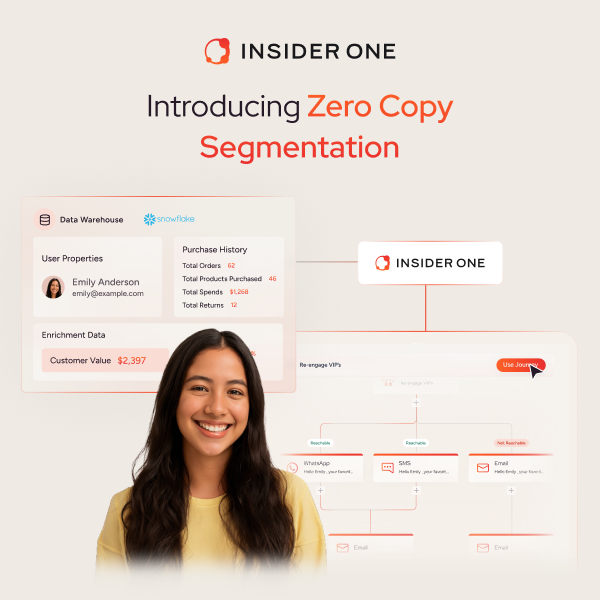
Timelines vary by data complexity and integration count, but scoping one workflow, such as account deduplication or ABM signal aggregation, can show measurable results faster than attempting full data unification. Teams that try to unify every source in the first phase generally see rollout stretch well beyond initial estimates. Where account data already sits in a cloud warehouse, zero-copy segmentation removes the migration phase and shortens the first milestone considerably.
No. A CDP unifies and resolves data across your CRM, MAP, and other systems, but it doesn’t replace their transactional roles. Your CRM still manages deal stages and pipeline, and your MAP still sends campaigns. The CDP sits underneath both, giving them a shared, accurate account view to act on.
Aggregate stakeholder activity to the account, then weight it by signal strength and recency rather than counting raw events. A pricing page visit from three distinct people in one week is a materially different signal from thirty blog visits by one person, and a score that cannot tell them apart will route the wrong accounts to sales. This requires event aggregation computed at the account level rather than reporting rolled up after the fact.
The right choice depends on your existing stack and data complexity rather than a single universal answer. Prioritize platforms with proven account hierarchy modeling, native integrations with your specific CRM and product analytics tools, and a track record of handling messy, duplicate-heavy B2B data, not just demo-clean datasets.
A real export of your account and contact records including the hard cases: free-email-domain contacts, subsidiaries, resellers, and divisions that buy independently. A defined pass condition for duplicate merging and hierarchy handling agreed before the pilot starts. A write-back test to your CRM. And a consent propagation check, since B2B data crosses into ad platforms and warehouses as readily as B2C data does.
Use a control group and accept that the read takes longer than a B2C test would. Withhold a defined share of comparable accounts from the orchestrated journeys and compare pipeline creation, stage velocity, and win rate over a period at least as long as your median sales cycle. Reporting a B2B result after six weeks measures engagement, not pipeline, and finance will identify that immediately.
Most CDP platforms are designed for marketing operations and RevOps teams to configure directly, though initial integration setup often benefits from technical involvement, particularly for custom product analytics connections. Ongoing use, such as building segments or adjusting orchestration rules, is often manageable without a dedicated engineering resource, though this depends on how customized your workflows and data sources are.

Keep Reading
7 min.

Muharrem Derinkok
4 Jun 2026
11 min.

Chris Baldwin
2 Jun 2026
4 min.
Chris Baldwin
3 Feb 2026