

 Platform Overview

 Integration Hub

 Agent One™

 Agent One Teams™

 Customer Data Management

 Personalization

 Journey Orchestration

 Reporting & Data

 Behavioral Analytics

 Web
Web

 Email
Email

 Site Search

 Conversational CX

 WhatsApp

 Web Push

 InStory

 App
App

 SMS & RCS

 Join the $0 Migration Movement™

 The Insider One Difference

 Compare Vendors

 Switch to Insider One

 Success Story

 Retail & Ecommerce

 Financial Services

 Travel & Hospitality

 Beauty & Cosmetics

 Automotive

 Telecommunications

 Total Economic Impact™ Study

 Blog
Blog

 E-Books & Guides

 Glossary
SMS Marketing Platforms Built for Advanced Segmentation and Performance Analytics

Updated on 29 Jun 2026
9 min.
Table of Contents
- Summary
- How to compare SMS marketing platforms for advanced segmentation?
- Which SMS marketing platforms support advanced segmentation best?
- What is advanced segmentation in SMS marketing?
- How do you build a data architecture for SMS segmentation?
- How do you build compliance-aware SMS segmentation?
- How do you coordinate SMS with email and other channels?
- Why is Insider One the recommended platform for advanced SMS segmentation?
- FAQs
Most Popular
Summary
Advanced SMS marketing platforms use real-time behavioral data, predictive insights, and dynamic segmentation to deliver more relevant campaigns. The best platforms update audiences instantly and support complex targeting at scale.
Most SMS marketing platforms for advanced segmentation claim to support behavioral targeting. But when you try to build a segment like “viewed product X multiple times recently AND hasn’t purchased AND hasn’t received any message recently,” you discover the platform can’t execute that logic without manual workarounds or IT intervention.
The gap between what vendors promise and what marketers can actually build determines whether your cart abandonment message arrives while intent is still high or long after the customer has moved on.
This guide evaluates SMS platforms on segment builder depth,real-time refresh capability, and cross-channel orchestration to help you identify which tools support truly advanced segmentation and which require compromise.
How to compare SMS marketing platforms for advanced segmentation?
Your segment refresh runs overnight. By morning, the customer who abandoned their cart late at night has already purchased from a competitor. That’s the cost of batch processing in a channel built for immediacy.
| Platform | Segment logic depth | Refresh latency | Predictive segments | Cross-channel orchestration | Native compliance controls |
| Insider One | Nested AND/OR, exclusions | Real-time | Yes | Yes | TCPA quiet hours, consent join |
| Klaviyo | Nested AND/OR | Hourly to real-time | Limited | Email/SMS | Manual configuration |
| Attentive | Attribute-based | Near-real-time | Limited | No | Strong consent management |
| Postscript | Attribute-based | Near-real-time | No | No | Basic opt-in/out |
| Braze | Nested AND/OR, exclusions | Real-time | Yes | Yes | Manual configuration |
| Bloomreach | Nested AND/OR, exclusions | Real-time | Yes | Yes | Manual configuration |
CDP-native platforms typically support deeper segmentation because they unify behavioral events, consent data, and channel activity in one profile. Ecommerce-native tools often prioritize native commerce workflows over cross-channel rule depth, so teams should validate cross-channel logic in product demos and customer references.
Which SMS marketing platforms support advanced segmentation best?
Many vendors market advanced segmentation, but the actual depth depends on their event model, exclusion logic, and segment refresh speed.
Many product pages describe advanced segmentation at a high level but do not show full segment logic, exclusions, and refresh behavior in a working UI. We evaluate each platform on segment builder depth, trigger events, identity resolution, compliance controls, and known limitations.
Insider One
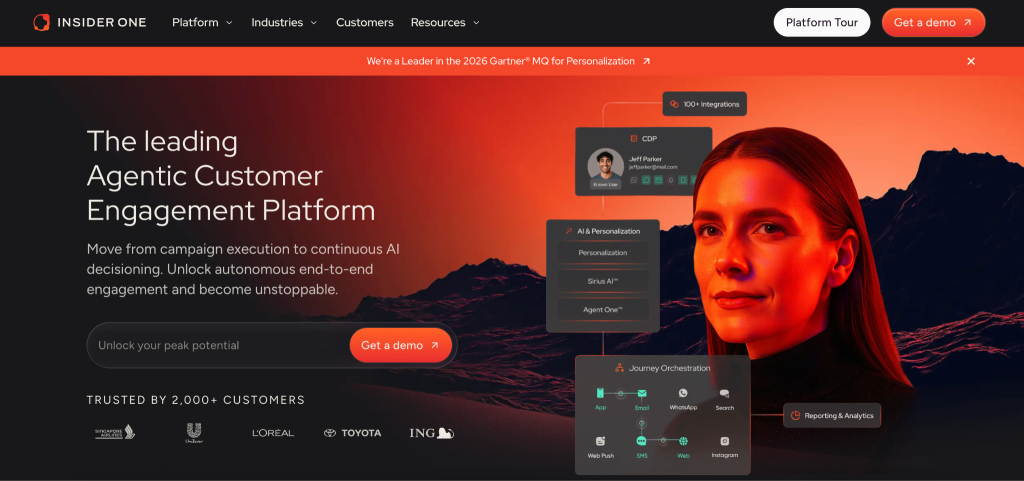
Teams running SMS alongside email, web push, and WhatsApp need segments that update in real time and respect cross-channel frequency caps. Insider One’s customer data platform unifies behavioral events across all channels into a single profile. A segment like “browsed product X recently AND has not received any message recently AND is opted in for SMS” executes without manual list exports.
Segmentation relies on event-based triggers and predictive segments powered by Sirius AI™, Insider One’s extensive set of AI capabilities. Architect, Insider One’s customer journey orchestration solution, handles cross-channel journey logic. Segments refresh in real time, not on a batch schedule.
Main features:
- Nested AND/OR logic with unlimited depth and exclusion operators
- Predictive segments for likelihood to purchase, churn, and discount affinity
- Cross-channel frequency capping and consent-aware targeting
Ideal for:
- Mid-market and enterprise teams running omnichannel campaigns
- Ecommerce brands needing RFM and product affinity segments
- Teams that want marketer autonomy without IT dependency
Pricing:
- MTU-based pricing with no hidden charges for data, storage, or events
If you want to see what real-time segments and cross-channel caps look like in an actual build (not a slide), request a demo and bring your hardest use case.
Klaviyo
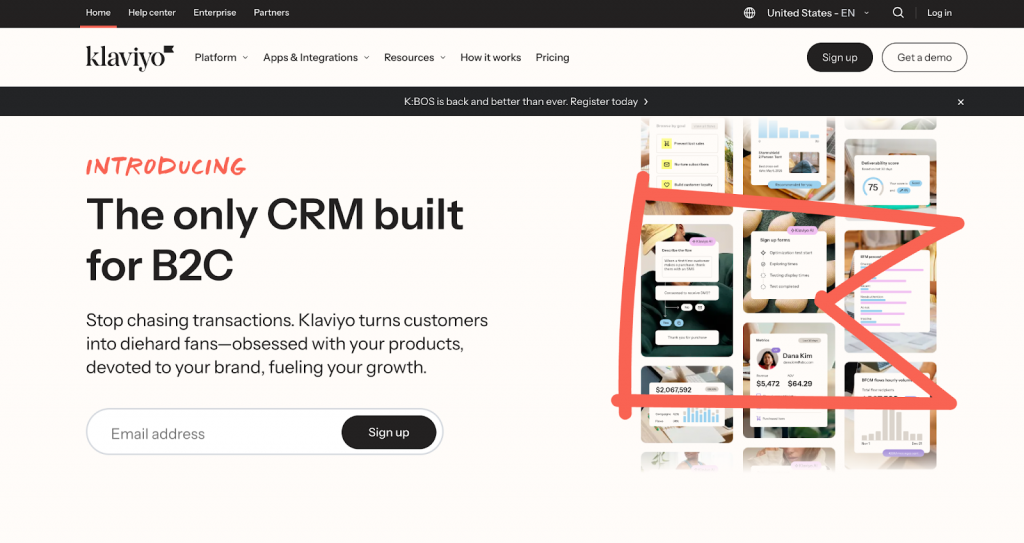
A Shopify merchant wants to send an SMS to customers who viewed a product repeatedly but haven’t purchased, excluding anyone who received an email recently. Klaviyo’s segment builder supports this logic natively through nested conditions and catalog event triggers.
RFM-based segments work well. Some Klaviyo segment types refresh on a schedule rather than instantly, and teams often configure cross-channel caps manually, so buyers should confirm refresh behavior and cap logic during evaluation.
Predictive segments focus on a narrower set of use cases, such as expected date of next order and churn risk.
Pricing: Tiers based on contact count, SMS credits purchased separately, overage charges apply
Attentive

Sending an SMS during quiet hours or without proper opt-in creates legal exposure. Attentive’s identity layer and consent management are central strengths, while teams with more complex nested logic should validate segmentation depth during evaluation.
Behavioral triggers and subscriber attributes work well. Attentive Signal handles identity resolution. Predictive segments require specific data thresholds, and teams should confirm how many nested conditions and exclusions the segment builder supports.
Pricing: Based on messages sent, enterprise contracts negotiated individually
Braze

A financial services brand wants to send an SMS only if the customer didn’t open the email within a short timeframe and hasn’t hit the global frequency cap.
Braze’s Canvas supports this logic, but the learning curve and cost are higher than ecommerce-native tools.
Segment builder depth, holdout groups, and channel preference logic are strong. Teams that want a full CDP with Braze typically add an external data layer or separate CDP. Pricing complexity with credits and data points requires careful management.
Pricing: Enterprise pricing, credit-based model, annual contracts
Bloomreach
Targeting customers with a high likelihood to purchase in the near term with a time-sensitive SMS offer? Bloomreach’s predictive engine supports this.
Accessing predictions requires understanding threshold configuration and retrain cadences.
Some advanced logic relies on Jinja templating, so teams should confirm how much developer support they need for segmentation and personalization.
The platform operates as multiple products with separate Engagement and Discovery modules. Pricing is event-based.
Pricing: Event-based, separate pricing for Engagement and Discovery
What is advanced segmentation in SMS marketing?
Most platforms claim advanced segmentation without defining what that means. Here’s a maturity model to assess where you stand:
| Level | Segment logic | Refresh cadence | Example |
| Basic | Static lists, manual upload | Daily or manual | “All customers who purchased in a recent period” |
| Intermediate | Attribute-based rules | Hourly | “Customers in California who spent above a certain amount” |
| Advanced | Behavioral events, nested AND/OR, exclusions | Real-time | “Viewed product X multiple times AND no purchase AND no message recently AND opted in” |
| Predictive | ML-based propensity scores | Continuous | “High likelihood to purchase in the near term AND discount-averse” |
Self-assessment questions:
- Can you build a segment based on an action a user took recently?
- Can you exclude users who received an email recently?
- Does your segment automatically suppress users in their local quiet hours?
- Can you target users based on predicted likelihood to purchase?
If you’re not sure where your current stack lands on this model, request a demo to map your segments to the maturity level that’s actually achievable today.
How do you build a data architecture for SMS segmentation?
A segment that depends on stale data sync will always be late. Your architecture determines what’s possible.
- Native platform data: Events flow directly into the SMS platform’s data model. This works for Klaviyo or Postscript with Shopify, but you’re locked into that platform’s schema and refresh cadence
- CDP-native: A customer data platform unifies events from all sources and activates segments to SMS. It adds a layer but enables cross-channel logic
- Warehouse-native: Segments built in the data warehouse and synced via reverse ETL. This works for teams with strong data engineering, though sync frequency and schema mapping add complexity
- Hybrid: CDP for real-time behavioral data, warehouse for historical data, identity resolution stitching them together. Highest implementation cost but most flexibility
Phone number normalization matters. Use an internationally standardized phone number format. Consent must act as a first-class join in your data model, not a filter applied right before sending.
To evaluate your architecture (and see what “real time” really looks like end to end), use the product demo hub and follow the data from event to segment to send.
How do you build compliance-aware SMS segmentation?
A quiet-hours violation isn’t a campaign metric problem. With rising TCPA class action lawsuits, it’s serious legal exposure. Embed compliance directly into segment logic.
- Consent join: Every SMS segment must include an AND condition for SMS opt-in status as a first-class criterion
- Quiet hours by timezone: Segment logic must account for the recipient’s timezone, not yours. Pattern: “opted in AND current time in recipient timezone is within permitted sending hours”
- DND suppression: Customers who have unsubscribed must be excluded at the segment level, not just the suppression list
- State-specific rules: Some states have stricter requirements. Pattern: “opted in AND (state is not FL OR explicit consent for marketing)”
Audit logging requirements mean the segment definition itself becomes part of your compliance record.
How do you coordinate SMS with email and other channels?
Sending an SMS and an email about the same cart abandonment within a short period isn’t personalization. It’s noise, and consumers will abandon brands that overwhelm them with excessive messages.
- Channel arbitration: If a customer prefers SMS based on engagement history, send SMS. If no preference signal exists, default to email first, then SMS if no open within a set timeframe
- Global frequency cap: No customer receives more than a set number of messages across all channels in a specific period. This requires a unified view of all channel activity
- Per-channel caps: SMS has a lower tolerance threshold than email. Pattern: “max a limited number of SMS per week AND max a limited total messages per week”
- Attribution windows: SMS attribution windows are typically shorter than email because of higher immediacy
If you’re ready to stop channel collisions and run one coordinated policy across SMS, email, push, and WhatsApp, request a demo to see how arbitration and caps work in a live journey.
Why is Insider One the recommended platform for advanced SMS segmentation?
Teams that need real-time, cross-channel segmentation struggle when they stitch together multiple tools. Insider One solves this by unifying data, AI, and journey orchestration in one place.
- Segment logic depth: Nested AND/OR with unlimited depth, exclusion operators, behavioral event triggers
- Refresh latency: Real-time segment compute, not batch
- Predictive segments: Likelihood to purchase, churn, and discount affinity
- Compliance controls: Consent-aware targeting with quiet hours, DND suppression, audit logging
- Cross-channel orchestration: Architect supports SMS alongside email, web push, WhatsApp, and app with channel arbitration and frequency capping
If you want to see the segmentation, compliance, and orchestration stack working as one system, not separate connected workflows, explore the product demo hub and preview the exact capabilities this guide is built on.
FAQs
Basic segmentation uses static lists or simple attribute filters like location and purchase history. Advanced segmentation uses behavioral events, nested logic with exclusion operators, real-time refresh, and predictive scores to target customers based on actions and intent.
TCPA requires express written consent for marketing SMS, but double opt-in is a best practice rather than a strict legal requirement in most cases. Some platforms and carriers recommend it to reduce complaints and improve deliverability.
SMS attribution windows are typically shorter than email because of higher immediacy. A common approach is a short window for click attribution and a slightly longer window for conversion attribution, adjusted based on your purchase cycle.
Quiet hours restrict when marketing SMS can be sent, typically during overnight hours in the recipient’s timezone. Platforms with compliance controls enforce this at the segment or send level to reduce legal exposure.
Shortcodes have higher throughput and better deliverability but cost more and require carrier approval. Application-to-person long code numbers are cheaper and faster to provision but have lower throughput and require registration with The Campaign Registry.

Keep Reading
7 min.

Muharrem Derinkok
4 Jun 2026
11 min.

Chris Baldwin
2 Jun 2026
4 min.
Chris Baldwin
3 Feb 2026