

 Platform Overview

 Integration Hub

 Agent One™

 Agent One Teams™

 Customer Data Management

 Personalization

 Journey Orchestration

 Reporting & Data

 Behavioral Analytics

 Web
Web

 Email
Email

 Site Search

 Conversational CX

 WhatsApp

 Web Push

 InStory

 App
App

 SMS & RCS

 Join the $0 Migration Movement™

 The Insider One Difference

 Compare Vendors

 Switch to Insider One

 Success Story

 Retail & Ecommerce

 Financial Services

 Travel & Hospitality

 Beauty & Cosmetics

 Automotive

 Telecommunications

 Total Economic Impact™ Study

 Blog
Blog

 E-Books & Guides

 Glossary
Everything You Need To Create the Best SMS Marketing Campaigns

Updated on 19 Jun 2026
13 min.
Table of Contents
- Summary
- What is an SMS marketing campaign?
- What makes an SMS campaign "best"?
- What compliance essentials shape SMS marketing?
- How should you organize SMS campaigns by lifecycle and objective?
- What industry-specific SMS triggers drive the highest engagement?
- How do you engineer SMS messages that perform?
- What do real-world SMS marketing examples look like?
- How should you measure and benchmark SMS campaigns?
- How does Insider One help teams run the best SMS marketing campaigns?
- Frequently asked questions
Most Popular
Summary
Successful SMS marketing starts with unified customer data, not better copy alone. Triggered, personalized messages (like welcome flows and abandoned carts) outperform generic blasts, while compliance, cross-channel coordination, and the right metrics (revenue per message and opt-outs) determine long-term success. A unified CDP helps brands avoid data gaps, message conflicts, and disconnected customer experiences.
Most marketing teams send SMS campaigns. Few run best SMS marketing campaigns that actually drive measurable revenue without burning through their subscriber list. Timing, behavioral triggers, and compliance guardrails shape whether an SMS program scales efficiently.
You need a structured approach to campaign taxonomy, message engineering, and cross-channel orchestration that treats SMS as a revenue channel, not a broadcast tool.
What is an SMS marketing campaign?
An SMS marketing campaign is a permission-based text message sent to opted-in subscribers to drive a specific action. The real constraint isn’t the channel, it’s the data layer underneath it.
Teams running SMS from an isolated tool send messages without knowing whether a subscriber just purchased via email, browsed a product three times, or has a high predicted lifetime value. A unified customer profile resolves this, giving every SMS message access to real-time behavioral context.
Campaigns generally fall into distinct modes. Broadcast campaigns are scheduled, audience-wide messages used for major promotions or product drops. Triggered campaigns are behavioral, individualized messages sent in response to user actions like cart abandonment or product views.
Triggered campaigns like abandoned cart and welcome series often outperform broadcast blasts because they respond to intent signals, but benchmark the gap with your own conversion rate and revenue per message data.
What makes an SMS campaign “best”?
Teams often measure SMS success by open rates alone. This tells you nothing about revenue impact or list health. A structured rubric helps you evaluate whether a campaign actually drives value.
| Criterion | What to measure | Signal of success |
| Revenue per message | Total attributed revenue divided by messages sent | Higher than channel cost per message |
| Opt-out rate | Unsubscribes divided by messages delivered | Stable or declining over time |
| Incrementality | Lift versus holdout group | Positive lift after controlling for organic behavior |
Early-stage programs with small lists lack the statistical significance needed for incrementality testing. In that scenario, focus on opt-out rates and qualitative feedback before scaling your spend.
What compliance essentials shape SMS marketing?
A brand sends a flash sale message late in the evening local time to a segment that includes subscribers in a state with earlier quiet hours. The message complies with federal Telephone Consumer Protection Act (TCPA) rules but violates state-level regulations. This happens when teams treat compliance as a final legal review step rather than an operational constraint built into journey logic.
- Express written consent: Requires clear disclosure and affirmative action, captured at checkout, via pop-up, or through keyword opt-in
- Quiet hours: Federal baselines exist, but state-level variations require strict enforcement by recipient time zone
- Required disclosures: Message frequency, data rate language, and STOP/HELP instructions
- Long code registration: Registration helps prevent carrier filtering and ensures deliverability
If you operate in healthcare, financial services, or any regulated vertical, involve your legal team early. Consent requirements in these industries exceed the TCPA baseline.
Insider One’s Architect platform enforces cross-channel frequency caps natively and automatically diverts time-sensitive messages to Web Push or WhatsApp when a time-zone guardrail blocks SMS delivery, eliminating manual exception handling.

How should you organize SMS campaigns by lifecycle and objective?
A team with a large subscriber list and no triggered flows often asks whether they should start with abandoned cart or win-back campaigns. The answer depends on their cart abandonment volume and whether they have enough lapsed customers to make win-back meaningful. Start with the highest-volume, highest-intent trigger you can measure today.
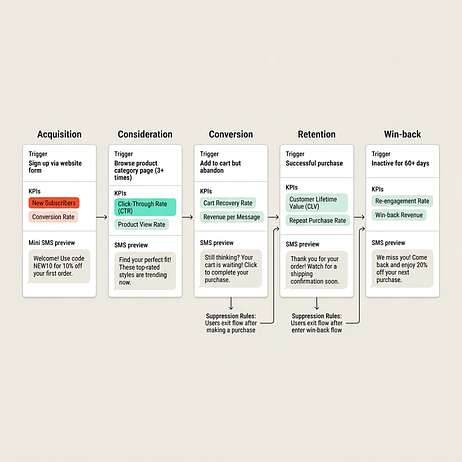
| Lifecycle stage | Campaign type | Primary trigger | Primary KPI |
| Acquisition | Welcome series | New subscriber opt-in | First purchase rate |
| Consideration | Browse abandonment | Product view without cart add | Return visit rate |
| Conversion | Abandoned cart | Cart created, no purchase | Cart recovery rate |
| Retention | Replenishment | Predicted rebuy window | Repeat purchase rate |
| Win-back | Reactivation | No purchase in X days | Reactivation rate |
Every triggered campaign requires an exit condition. If a subscriber receives a browse abandonment message and then adds an item to their cart, suppress them from the browse flow and enter them into the cart flow. Without suppression logic, subscribers receive conflicting messages that erode trust.
How should a welcome series work?
Welcome messages sent shortly after opt-in often see higher engagement than delayed messages, so compare click-through rate and first purchase rate by send delay. This rule only applies if the subscriber expects immediate communication. If the opt-in happens via checkout, delay the welcome until after order confirmation to avoid message collision.
- Timing: Send the first message shortly after keyword opt-ins, but wait until after order confirmation for checkout opt-ins
- Content: Set expectations about message frequency, deliver any promised incentive, and include a clear call-to-action (CTA)
- Variants to test: Messages with and without a discount, a standalone message versus a short series
If your brand positioning is premium or your margins don’t support first-purchase discounts, emphasize exclusive access instead of discounts. Offer early access or members-only content rather than a price reduction.
How should you run an abandoned cart campaign?
Most teams send a cart abandonment message at a fixed delay. High-performing programs use SMS automation with a timed sequence, escalating urgency, and conditional discounting. With nearly seven in 10 carts abandoned online, abandoned cart recovery serves as the primary revenue driver for most SMS programs.
- Timing ladder: Send the first message soon as a reminder with no discount, follow up later to add urgency, and introduce a discount only after additional time if your margin allows
- Deep links: Use tap-through links that restore the cart in-app or on the web
- Suppression: Exit the flow immediately if the purchase completes or the cart is emptied
- Multi-channel branching: If the subscriber opens the initial email within the first hour, suppress the SMS entirely. If they ignore both email and SMS but show a high predicted lifetime value (LTV), trigger an MMS or WhatsApp message containing a product affinity visual, sourced from their browse history, with an interactive tap-to-add button. Architect handles this conditional branching natively from a single visual canvas, without requiring separate tools or manual suppression rules.
Aggressive discounting in cart flows trains subscribers to abandon intentionally. Track whether your cart abandonment rate increases after introducing discounts. If it does, remove the discount or limit it to first-time buyers.
How should you approach browse abandonment?
A subscriber views multiple products in one session and receives multiple browse abandonment messages over the next several days. They unsubscribe immediately. The campaign generates zero revenue and costs you a subscriber.
- Trigger conditions: Set a minimum view depth, such as spending meaningful time on a product page or viewing multiple different products
- Frequency caps: Enforce a maximum browse abandonment message per session and limit repeat messages per week
- Suppression: Exit the browse flow if the subscriber adds an item to their cart
Before launching this flow, calculate your expected revenue per message. If your average order value is low and your per-message cost is high, the math rarely works for browse abandonment.
How do back-in-stock and low-stock alerts work?
Back-in-stock alerts require capturing intent at the product level and triggering messages when inventory changes. Without a queue system, you either message everyone at once and overwhelm demand, or you miss the window entirely.
Place a “notify me” button on the product detail page that captures the phone number and SKU, then confirm the opt-in with an immediate acknowledgment message. When stock replenishes, message subscribers in opt-in order, giving them a time-limited window to purchase before notifying the next batch.
When should you use flash sales and promotional broadcasts?
Flash sales generate immediate revenue spikes but train subscribers to wait for discounts. Teams that run weekly flash sales often see declining open rates and increasing opt-outs over time, so monitor both metrics by campaign cadence.
- Cadence governance: Set a maximum frequency based on your vertical, limiting higher-consideration verticals to infrequent sends per month
- Call-to-action (CTA) clarity: Include a clear primary call-to-action per message
- Urgency mechanics: Use real deadlines and countdown language that matches actual inventory constraints
If your margins are thin, avoid flash sales entirely. Frequent discounting undermines premium brand positioning.
How should you handle win-back and reactivation?
Treating all lapsed customers the same wastes margin on low-value segments and under-invests in high-value ones. Win-back campaigns require tiering by recency and historical value.
- Tier (recent lapse, high value): Use a personal outreach tone with no initial discount, escalating to an exclusive offer if they don’t respond
- Tier (recent lapse, low value): Send a standard win-back message with a modest incentive
- Tier (long lapse, any value): Use stronger incentives and accept a lower conversion rate
Lead with an emotional appeal or product news. Introduce a discount only in the final message of the sequence. If a user doesn’t respond after several messages, suppress them from the win-back flow.
What industry-specific SMS triggers drive the highest engagement?
Retail and e-commerce dominate most SMS playbooks, but the channel drives measurable revenue across verticals when triggers are tied to real-time data events rather than generic schedules.
Travel and hospitality: Price drop alerts for browsed routes, upgrade availability notifications, loyalty point updates timed to post-travel windows, and real-time operational alerts like gate change notifications
Beauty and CPG: Replenishment triggers based on predicted rebuy cycles, VIP early access to limited launches, and product waitlist notifications using back-in-stock queue logic
Fintech: Low-balance alerts, reward threshold notifications tied to card activity, and account milestone messages, each requiring vertical-appropriate consent and frequency governance
Healthcare and wellness: Appointment reminders, prescription refill alerts (with appropriate consent handling for regulated communications), and wellness check-in sequences tied to engagement signals
Insider One’s unified customer profiles store vertical-specific attributes, flight itineraries, predicted rebuy cadence, account activity, that Architect uses as trigger conditions, ensuring every message arrives at the moment of highest intent, not on a generic schedule.
How do you engineer SMS messages that perform?
Teams often treat SMS copy as a miniature email. SMS has strict character limits, lacks rich formatting, and relies on interruptive delivery. What works in an email subject line fails completely in a text message.
- AI-Powered Personalization: Sirius AI™ goes beyond basic name tokens, it dynamically injects individualized product recommendation arrays into every message via short-links, using real-time affinity signals, browse history, and price-drop triggers to make each SMS feel genuinely 1:1
- Character discipline: Sirius AI™ automatically generates and tests copy variants that fit within SMS character limits, eliminating manual A/B setup while maximizing click intent across localized markets
- CTA focus: Every message should prioritize a primary action
- Predictive send timing: Sirius AI™ calculates the optimal send window per individual subscriber using historical engagement patterns, and automatically routes to the next-best channel, Web Push or WhatsApp, if a time-zone guardrail blocks SMS delivery
- Predictive triggers: Use Sirius AI™’s Likelihood to Purchase and Likelihood to Churn scores as campaign triggers, moving SMS orchestration from reactive behavioral signals to proactive interventions before revenue is at risk
How does cross-channel orchestration work with SMS?
A subscriber abandons a cart and receives an email soon after, an SMS later, and a push notification afterward. These messages feel like spam from three different systems because they lack coordination. Orchestration means sequencing channels intentionally and suppressing redundant messages.
Start with the lowest-cost channel like email, then escalate to higher-engagement channels like SMS or push notifications if the user doesn’t respond. Suppress SMS and push notifications if the subscriber converts after the email.
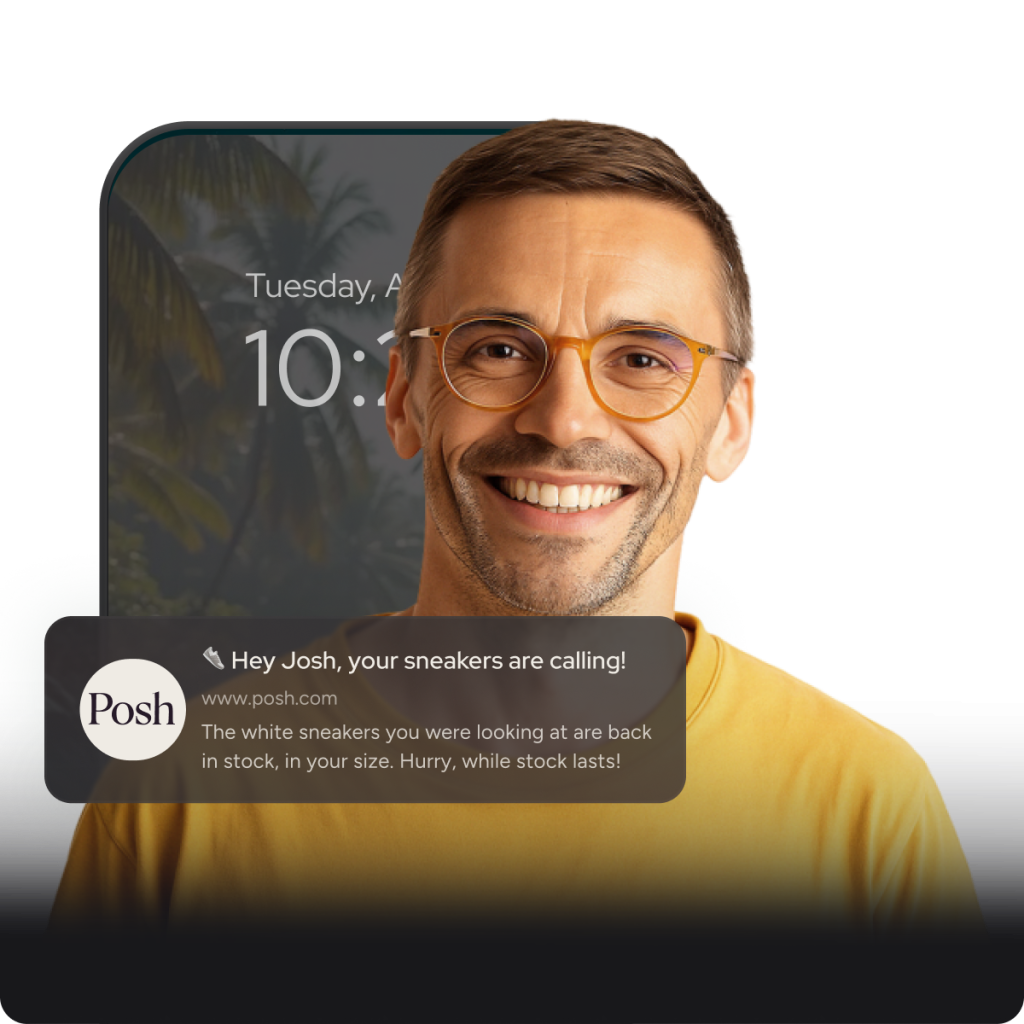
Effective cross-channel campaign management requires a platform that tracks engagement in real time. If your email and SMS tools operate in silos, you’ll need to build manual suppression rules.
What do real-world SMS marketing examples look like?
Use these annotated sms marketing examples as patterns to learn from, not templates to copy verbatim. Each example highlights what makes the message effective and what you should adapt for your own program.
Welcome series:
“Welcome to [Brand]! Get a discount on your first order with code WELCOME. Shop now: [link]. Reply STOP to opt out.”
Immediate value delivery, clear incentive, and compliant opt-out language. Test without a discount for premium positioning.
Abandoned cart:
“Forget something? Your [Product Name] is still in your cart. Complete your order before it sells out: [link]”
Product-specific personalization, urgency without a discount, and a direct link. Test adding a product image for visual categories.
Back-in-stock alert:
“Good news: [Product Name] is back! You are first in line. Grab it now before it sells out again: [link]”
Exclusive framing and clear scarcity. Test different time-limit windows for the queue.
Promotional text message example:
“Flash sale: limited time only. Savings on everything. Shop now: [link]. Ends soon.”
Real deadlines and a single, focused CTA. Test specific category discounts instead of site-wide offers.
Win-back campaign:
“We miss you! Here is a discount to welcome you back: [link]. Expires soon.”
Strong incentive tied to a strict expiration window. Test leading with new product announcements before offering the discount.
How should you measure and benchmark SMS campaigns?
Teams often report SMS success by calculating the total revenue attributed to SMS-touched customers. Without a holdout group, you can’t know how much of that revenue would have happened organically. Incrementality testing proves whether SMS actually drives lift.
- Delivery rate: Messages delivered divided by messages sent, where low rates indicate list hygiene or deliverability issues
- Click-through rate: Clicks divided by messages delivered, which is consistently higher for triggered campaigns than broadcasts
- Revenue per message: Total attributed revenue divided by messages sent, which matters most for ROI
- Opt-out rate: Unsubscribes divided by messages delivered, signaling list health
Insider One’s native, continuous control groups remove the need for manual holdout configuration. The platform automatically splits eligible subscribers into test and holdout cohorts for every campaign, runs multi-variant experiments without requiring data-science resources, and surfaces incrementality results in real time, so you always know whether SMS is driving genuine lift or simply attributing organic revenue.
How does Insider One help teams run the best SMS marketing campaigns?
Running the campaigns described in this guide requires a platform that unifies customer data, supports behavioral triggers, and orchestrates across channels. Stitching together separate tools won’t get you there efficiently.
Architect, Insider One’s customer journey orchestration engine, lets teams build triggered SMS flows with conditional branching, A/B testing, cross-channel suppression, and native frequency capping from a single visual canvas.
Unified customer profiles, powered by Insider One’s built-in CDP, connect browsing behavior, purchase history, predicted lifetime value, and channel preferences so every SMS benefits from real-time context, not stale batch exports.
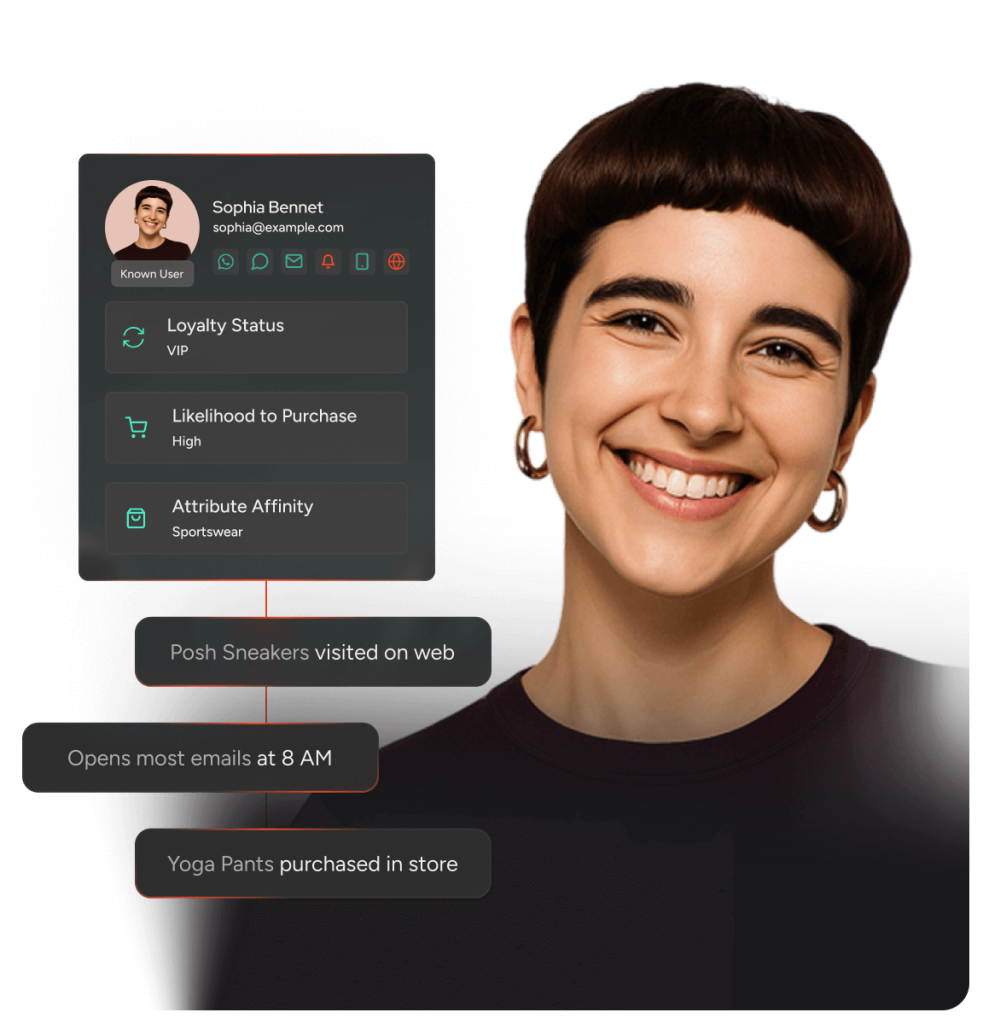
Architect enforces time-zone guardrails automatically, routing messages to Web Push or WhatsApp when an SMS delivery window is blocked, artificial intelligence (AI)-powered personalization eliminating manual exception handling and ensuring compliance at scale.
Sirius AI™, Insider One’s AI engine, goes beyond send-time optimization. It auto-generates localized SMS copy variants, automatically trims messages to comply with character limits, predicts subscriber churn before a win-back is triggered, selects the next-best channel in real time, and dynamically inserts individualized product recommendations, including price-drop alerts and affinity-based alternatives, into every message.
Sirius AI™ also powers WhatsApp Business API integration, enabling rich media messages and interactive buttons that bypass standard MMS constraints. Cross-channel orchestration coordinates:
- SMS
- push notifications
- web personalization
so subscribers receive a coherent experience instead of redundant messages from siloed tools.
Request a demo to see how Insider One helps marketing and customer engagement teams break free from siloed tools and drive measurable incremental revenue. Or explore real-world outcomes from brands running SMS at scale on the Insider One Success Stories page—from multi-channel cart recovery workflows to loyalty reactivation programs.
Frequently asked questions
Broadcast campaigns are scheduled messages sent to your entire audience or a large segment at once, like flash sales or product announcements. Triggered campaigns are automated messages sent to individual subscribers based on their behavior, like cart abandonment or browse activity.
Your opt-in language should clearly state the type of messages subscribers will receive, the expected frequency, that message and data rates apply, and instructions for opting out via STOP.
Set frequency caps by campaign type, use suppression logic to prevent redundant messages across channels, and monitor opt-out rates as an early warning signal. Triggered campaigns based on behavior cause less fatigue than broadcast promotions.
Yes, through MMS (Multimedia Messaging Service) and WhatsApp Business API. MMS supports images, GIFs, product carousels, and longer text but costs more per message and requires recipient device support. Insider One’s native WhatsApp Business API integration goes further, enabling interactive buttons, rich media cards, and product showcase carousels that bypass standard MMS constraints, all orchestrated from the same Architect canvas as your SMS flows. Evaluate whether the visual engagement lift justifies the per-message cost difference, or whether WhatsApp’s richer interactive format is a better fit for your audience and region.
MMS delivers images, GIFs, and short videos to any mobile number without requiring an app install, making it universally accessible but limited to one-way media delivery. WhatsApp Business API supports interactive buttons, product carousels, and two-way conversation flows, but requires recipients to have WhatsApp installed. Insider One’s orchestration layer lets you use both within the same customer journey, routing each subscriber to the richest format their device and region support.
TCPA governs SMS marketing in the United States, but global programs require additional guardrails. GDPR applies to subscribers in the EU and mandates explicit consent with clear purpose disclosure. Regional carriers in Southeast Asia and the Middle East operate through local aggregators with their own registration and frequency requirements. Insider One’s Architect platform enforces regional frequency caps and consent controls without requiring separate suppression lists, ensuring compliance across markets from a single orchestration layer.

Keep Reading
7 min.

Muharrem Derinkok
4 Jun 2026
11 min.

Chris Baldwin
2 Jun 2026
4 min.
Chris Baldwin
3 Feb 2026