

 Platform Overview

 Integration Hub

 Agent One™

 Agent One Teams™

 Customer Data Management

 Personalization

 Journey Orchestration

 Reporting & Data

 Behavioral Analytics

 Web
Web

 Email
Email

 Site Search

 Conversational CX

 WhatsApp

 Web Push

 InStory

 App
App

 SMS & RCS

 Join the $0 Migration Movement™

 The Insider One Difference

 Compare Vendors

 Switch to Insider One

 Success Story

 Retail & Ecommerce

 Financial Services

 Travel & Hospitality

 Beauty & Cosmetics

 Automotive

 Telecommunications

 Total Economic Impact™ Study

 Blog
Blog

 E-Books & Guides

 Events

 Glossary
Top Cross-Channel Email Personalization Platforms for 2026

Updated on 24 Sep 2026
9 min.
Table of Contents
- Summary
- What is a cross-channel platform that integrates email personalization?
- What platform categories support cross-channel email personalization?
- Which platforms integrate cross-channel personalization with email?
- How does cross-channel personalization with email work end to end?
- Why do unified customer profiles and identity resolution matter for email?
- How do journey orchestration and suppression rules work together?
- How do dynamic email content and product recommendations work?
- How can you build a personalized platform shortlist?
- Frequently asked questions
Most Popular
Summary
Cross-channel personalization platforms combine customer data from every touchpoint into a unified profile to deliver real-time, personalized email and coordinated experiences across channels. The best choice depends on whether you need an all-in-one platform or have the technical resources to connect separate data and email tools, but real-time event streaming is essential for timely campaigns like cart abandonment and browse recovery.
A platform truly integrates cross-channel personalization with email when it can suppress a send based on a conversion that happened in another channel recently. Not after a long delay.
Most marketing teams treat email as a separate channel with its own audience lists, triggers, and performance dashboard.
The result? A customer who just bought on mobile still receives the cart abandonment email later. The gap is a missing foundation: a unified customer profile that updates in real time and an orchestration layer that coordinates decisions across channels.
What is a cross-channel platform that integrates email personalization?
A platform qualifies if it can suppress an email when a customer converts on another channel quickly, not after a long delay. Cross-channel differs from multichannel because the profile is shared and decisions are coordinated, not siloed. Omnichannel describes a consistent experience; cross-channel describes coordinated action.
To qualify as integrated, a platform needs:
- Unified customer profile: Updated in real time across web, app, email, and messaging
- Native or tightly integrated email sending: With dynamic content support
- Orchestration layer: That arbitrates channel selection and timing
- Suppression and frequency capping: That spans channels
Platforms requiring batch file exports to an external email service provider don’t qualify as integrated.
What platform categories support cross-channel email personalization?
Teams evaluating platforms see overlapping feature lists and struggle to understand where email personalization logic actually lives. The market breaks into several categories.
| Category | Email integration pattern | Identity model | Best for |
| Customer engagement platform | Native email service provider (ESP) with real-time triggers | Deterministic, profile-centric | Teams wanting turnkey orchestration without data engineering |
| CDP + email service provider (ESP) via reverse ETL | Audience sync to external ESP | Deterministic or probabilistic | Teams with data engineering capacity who want warehouse-native truth |
| Marketing cloud suite | Embedded ESP with journey builder | Varies by module | Enterprises already invested in vendor ecosystem |
| Warehouse + reverse ETL + ESP | Scheduled or streaming sync | Warehouse-defined | Teams prioritizing data ownership over orchestration speed |
Customer engagement platforms offer fast trigger latency but require profile data to live in the platform. CDP + ESP patterns preserve the warehouse as source of truth but introduce sync lag and failure points. Marketing clouds provide breadth but often require multiple modules with inconsistent identity.
If your team cannot tolerate batch sync delays for cart abandonment, customer engagement platforms or streaming-native CDPs are the only viable options. If you want a clear recommendation for your stack and latency requirements, schedule a demo and we’ll map the fastest path to real-time triggers.
Which platforms integrate cross-channel personalization with email?
The platforms below represent the major categories, each with distinct approaches to email integration.
Insider One
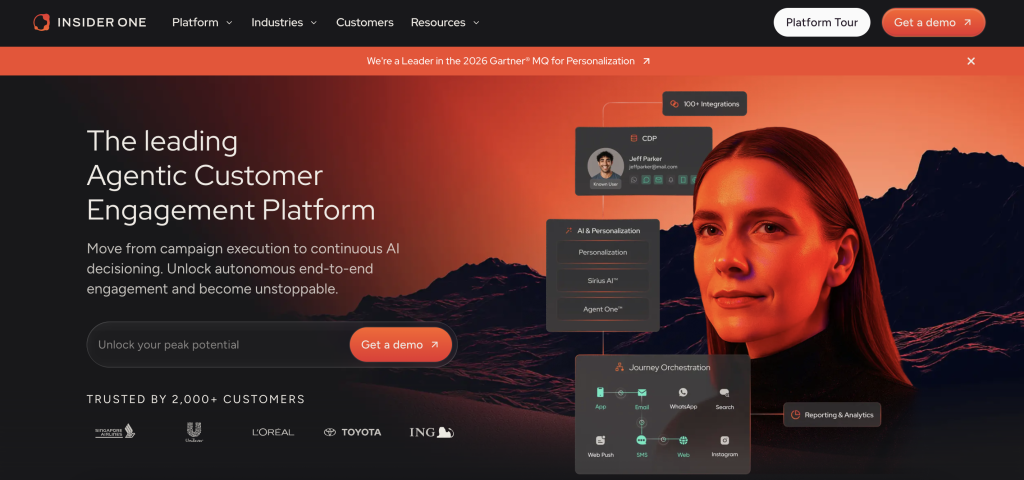
Insider One unifies CDP, artificial intelligence (AI), personalization, journey orchestration, and email into a single platform, and it is the only approach in this guide that delivers native real-time execution and warehouse-native data ownership at the same time, rather than forcing a choice between turnkey orchestration and warehouse truth.
Email is native to the platform. Triggers fire quickly after a behavioral event. The Unified Customer Database resolves identity across web, app, and offline channels, ensuring suppression and personalization reflect the full customer context.
Architect, Insider One’s customer journey orchestration solution, serves as the canvas for building cross-channel journeys with email, push, SMS, WhatsApp, and web. Sirius AI™, Insider One’s extensive set of AI capabilities, powers Next Best Channel selection and Send Time Optimization without manual configuration.
Teams can go live quickly, with predictable MTU-based pricing and no hidden charges for data, storage, or events.
The Unified Customer Database is also warehouse-native and composable, with bi-directional connectivity to Snowflake, Databricks, Google BigQuery, and Amazon Redshift and zero-copy segmentation, so teams get warehouse-native truth and turnkey real-time orchestration in one platform rather than choosing between them.
Main features:
- Native email with sub-minute behavioral triggers for cart abandonment, browse, and price drop
- Unified Customer Database with real-time identity resolution across channels
- Architect for drag-and-drop journey orchestration with A/B auto-winner selection
- Sirius AI™ for Next Best Channel, Send Time Optimization, and predictive segmentation
- Smart Recommender for AI-powered product recommendations in email, on the website, in-app, and within site search results via Eureka, so the same recommendation logic spans every surface rather than stopping at the inbox
Ideal for: Mid-market to enterprise teams running complex omnichannel campaigns who want to consolidate CDP, personalization, and email into one platform without dedicated data engineering.
If you want to see how native email, real-time identity, and cross-journey suppression work together in one place, start with the product demo hub and jump straight to the workflows that matter.
Braze

Braze is a customer engagement platform with native email, push, in-app, and SMS. Email triggers fire via Canvas, their journey builder, with Liquid templating for dynamic content. Currents streams behavioral data to warehouses for analysis.
Braze supports fast trigger latency and mobile-first orchestration through Canvas and its native mobile channels. Teams often pair Braze with a separate customer data platform (CDP) or warehouse for identity resolution.
Best for mobile-first brands with existing data infrastructure who want a dedicated engagement layer.
Iterable
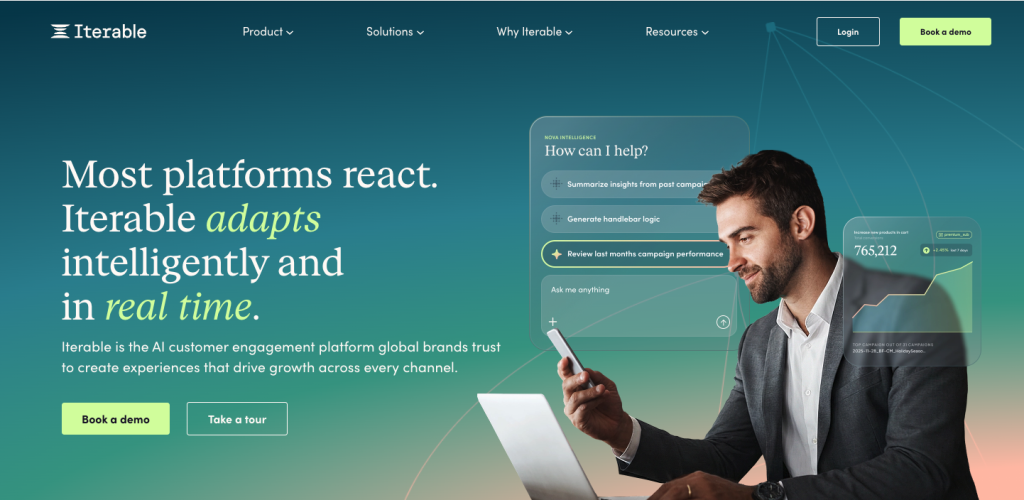
Iterable is a customer engagement platform with native email, push, SMS, and in-app messaging. Email personalization uses handlebars templating with catalog-driven dynamic content.
Strong catalog sync for product recommendations and a flexible API-first architecture stand out. Identity resolution relies on deterministic matching, so teams with complex identity graphs may need supplementary tooling.
Best for growth-stage ecommerce and media brands with catalog-heavy personalization needs.
Adobe Journey Optimizer and Real-Time CDP (RTCDP)
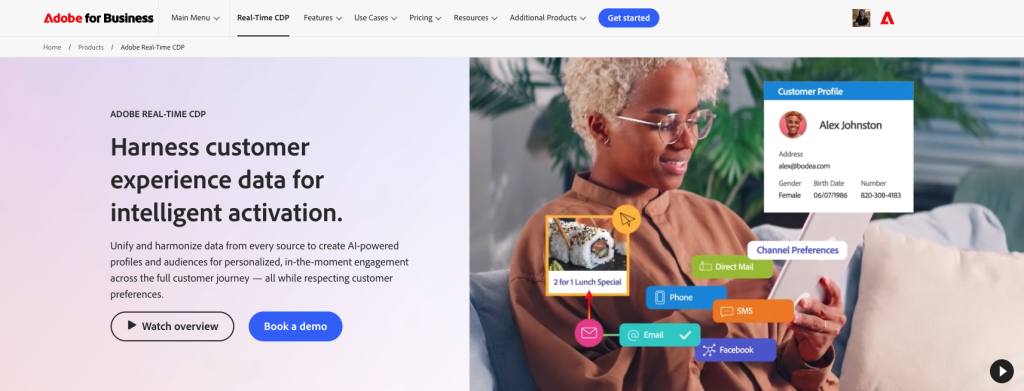
Adobe Journey Optimizer sits on top of Real-Time CDP to orchestrate email and other channels. Identity resolution supports deterministic and probabilistic matching with a device graph, and email triggers can fire in real time when segments update.
Adobe Journey Optimizer and Real-Time CDP support identity resolution and offer management for enterprise teams. Implementation complexity is high.
Teams typically need dedicated Adobe specialists or systems integrator support. Best for enterprises already invested in the Adobe ecosystem with data engineering resources.
Salesforce Marketing Cloud and Personalization
Salesforce Marketing Cloud includes Email Studio for sending and Journey Builder for orchestration. Marketing Cloud Personalization adds real-time behavioral tracking and decisioning, while email triggers can fire via Journey Builder with data extensions storing audience attributes.
Salesforce Marketing Cloud connects with Salesforce systems for sales-aligned marketing workflows. Real-time trigger latency depends on data extension refresh cadence, and some use cases require batch processing.
Best for enterprises with heavy Salesforce customer relationship management (CRM) investment seeking unified sales and marketing data.
Klaviyo
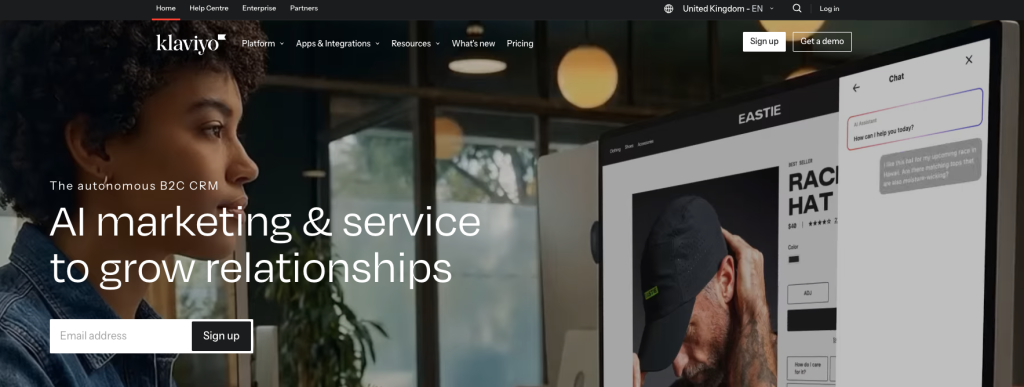
Klaviyo is an email and SMS platform with strong ecommerce integrations like Shopify and BigCommerce. Flows trigger based on behavioral events with native catalog sync for product recommendations.
Klaviyo offers ecommerce integrations and a flow builder across email, SMS, RCS, mobile push, and WhatsApp.
The gap for cross-channel teams is the depth of the on-site experience layer: no-code, AI-driven web and category-page personalization, on-site product discovery, and native AI site search sit outside the platform’s core or require developer work on a higher-tier add-on, so teams needing that depth typically pair Klaviyo with a personalization tool or reverse ETL pipeline to extend reach.
CDP or warehouse with reverse ETL and ESP
This pattern uses a CDP or warehouse as the source of truth, with reverse ETL tools syncing audiences to an email service provider. Email triggers depend on sync frequency. Real-time requires streaming or webhook-based activation.
Data ownership and flexibility are the strengths since the warehouse remains the single source of truth. Sync lag introduces latency, failure points multiply across the stack, and operational burden shifts to data and marketing ops teams.
Best for teams with data engineering resources who prioritize warehouse-native identity and cannot adopt a bundled platform.
How does cross-channel personalization with email work end to end?
Teams often activate a platform without a tracking plan, then discover months later that key events are missing or inconsistently named. A successful implementation requires several phases:
- Tracking plan and event schema: Define events like page view, add to cart, and purchase with required properties
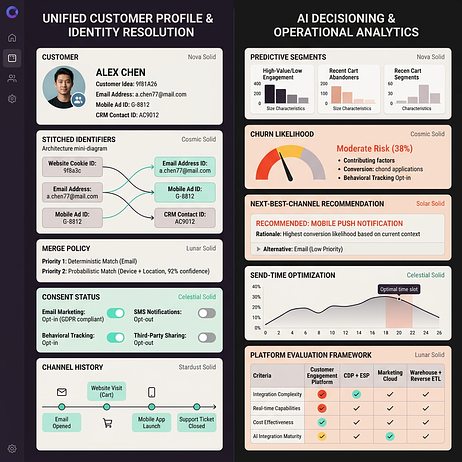
- Identity resolution and profile unification: Configure merge policies, primary keys, and unsubscribe propagation rules
- Segmentation and audience building: Create segments based on behavioral and attribute criteria
- Journey orchestration and channel activation: Build journeys with triggers, conditions, and channel actions
- Measurement and iteration: Define KPIs, configure holdouts, and establish a reporting cadence
Skipping the tracking plan leads to inconsistent event data that breaks segmentation and personalization downstream. Phase one takes longer than teams expect. It also prevents massive rework later. If you want a proven tracking plan and event schema you can adapt fast, schedule a demo and we’ll walk through what “good” looks like for real-time email triggers.
Why do unified customer profiles and identity resolution matter for email?
A customer has multiple email addresses and unsubscribes from one. Does the unsubscribe apply to all of them? The answer depends entirely on your identity resolution policy.
Define these decisions before platform configuration:
- Primary key selection: Email is often the anchor identifier, but some platforms use a customer ID with email as an attribute
- Merge policy: Define survivorship rules for conflicting attributes to determine which email wins when profiles merge
- Unsubscribe propagation: Decide whether unsubscribes apply to the email address, the profile, or both
- Anonymous-to-known stitching: Determine how behavioral history from anonymous sessions merges when a user identifies via email
Defaulting to “most recent” without considering a preference hierarchy creates problems. Document these policy decisions clearly before you begin platform configuration. Then sanity-check your approach against real-world edge cases in the product demo hub so suppression, consent, and stitching don’t break at scale.
How do journey orchestration and suppression rules work together?
A customer is eligible for both a cart abandonment email and a promotional campaign. Without suppression rules, they receive both. That feels spammy and degrades the brand experience.
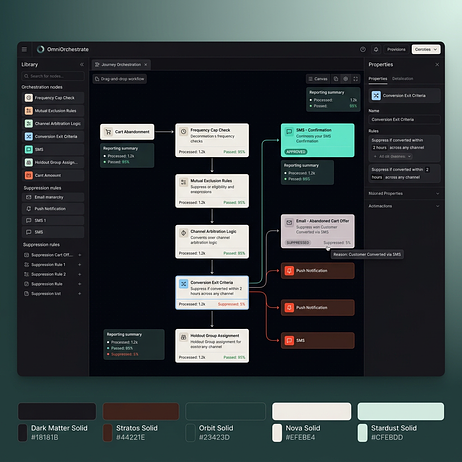
A strong suppression approach includes several layers:
- Frequency caps: Limit total messages per channel per time window
- Mutual exclusion: Prevent a user from being in multiple journeys simultaneously
- Channel arbitration: Select the best channel when multiple are available
- Exit criteria: Remove users from journeys when they convert or become ineligible
- Holdouts: Exclude a portion of eligible users for incrementality measurement
When a trigger fires, the orchestration layer should check frequency cap, mutual exclusion, and channel arbitration before deciding to send or suppress. Platforms without cross-journey suppression require manual workarounds via segment exclusions. If you want to see what automated, cross-channel suppression looks like in practice, schedule a demo and we’ll show the exact rules and guardrails.
How do dynamic email content and product recommendations work?
Should product recommendations render at send time or open time? The answer affects your fallback logic and overall campaign performance.
- Personalization tokens: Merge fields for attributes like name or loyalty tier that render at send time
- Conditional blocks: Show or hide content based on segment membership or attributes at send time
- Product recommendations: AI-selected products based on behavior that can render at send time or open time
- Fallback logic: Define what displays if recommendations fail, such as bestsellers or static content
Open-time rendering provides fresher recommendations but introduces latency and dependency on external services. Send-time rendering is faster but may show stale inventory. For high-volume sends, send-time with robust fallback is safer. For triggered emails with small audiences, open-time provides better relevance.
How can you build a personalized platform shortlist?
Choosing the right platform depends on your current stack, team capabilities, and email use cases. Schedule a consultation to receive a shortlist based on your specific requirements, including architecture review and integration planning. Use the product demo hub to preview the core journeys first, then we’ll pressure-test fit against your data, latency, and suppression requirements.
Frequently asked questions
A CDP unifies customer data and builds audiences but typically requires an external provider for email sending. A customer engagement platform includes native email alongside other channels, with orchestration and personalization built in.
Cart abandonment emails perform best when sent soon after the event, which requires streaming or webhook-based integration. Batch sync with slower cadence cannot meet this latency target.
Configure mutual exclusion rules that prevent a user from entering multiple journeys simultaneously, and set frequency caps that limit total emails per time window.
Most models require a meaningful period of engagement history and sufficient opens or clicks per user to learn individual patterns. Without sufficient data, the model defaults to population averages.
Configure holdout groups that exclude a portion of eligible users from campaigns, then compare conversion rate and revenue between the exposed and holdout groups. The difference represents incremental lift attributable to the campaign.

Keep Reading
7 min.

Muharrem Derinkok
4 Jun 2026
11 min.

Chris Baldwin
2 Jun 2026
4 min.
Chris Baldwin
3 Feb 2026