

 Platform Overview

 Integration Hub

 Agent One™

 Agent One Teams™

 Customer Data Management

 Personalization

 Journey Orchestration

 Reporting & Data

 Behavioral Analytics

 Web
Web

 Email
Email

 Site Search

 Conversational CX

 WhatsApp

 Web Push

 InStory

 App
App

 SMS & RCS

 Join the $0 Migration Movement™

 The Insider One Difference

 Compare Vendors

 Switch to Insider One

 Success Story

 Retail & Ecommerce

 Financial Services

 Travel & Hospitality

 Beauty & Cosmetics

 Automotive

 Telecommunications

 Total Economic Impact™ Study

 Blog
Blog

 E-Books & Guides

 Glossary
Optimizing Email Send Times With AI: What Actually Moves the Needle

Updated on 4 Aug 2026
13 min.
Table of Contents
Most Popular

Summary
- Artificial intelligence (AI) send time optimization predicts a personal delivery window for each subscriber instead of applying one “best hour” to the whole list
- Insider One’s Send Time Optimization (STO) scores all 24 hourly slots per subscriber from their own open and click history, weighting clicks 2.5 times more heavily than opens, and recalculates that window every time the subscriber engages
- Because clicks outweigh opens by design, machine-generated and privacy-proxy opens carry far less influence over the predicted window than they would in an open-only model
- Subscribers with no engagement history have no window to predict, so the platform-level answer is importing historical behaviour into a unified profile on day one rather than waiting months for a model to warm up
- A perfectly timed email can still collide with other campaigns, so timing belongs to the orchestration layer alongside Journey Prioritization, frequency capping, Silent Hours, and channel selection
- Isolating true lift requires a holdout, not a before-and-after comparison of open rates, Architect Control Group reserves a portion of your audience so incremental revenue can be measured directly
- Conversion rate, click rate, revenue per recipient, and unsubscribe rate matter more than open rate when judging whether timing changes are working
We turned on send-time optimization and watched open rates climb, then checked revenue and found nothing had moved. That gap is the real story behind AI send time optimization: it predicts the hour each subscriber is statistically most likely to open, click, and convert, then times delivery to that window instead of sending the whole list at once.
This article is for lifecycle and customer relationship management (CRM) marketers, marketing operations leads, and platform evaluators who have already tried a vendor’s send-time feature and want to know why the reported lift didn’t show up in revenue.
You’ll get the exact scoring mechanics behind a predicted send window, the data-maturity thresholds that determine whether personalization is real on day one, the orchestration decisions that determine whether a “perfectly timed” email actually lands cleanly, and a testing framework that separates real lift from noise.
Why ‘best time to send’ is the wrong question
A single send hour for an entire list ignores real differences in subscriber behavior. A night-shift nurse, a commuter checking email at 7 a.m., and a parent who only opens messages after the kids are asleep all follow different patterns.
Profile-level prediction replaces that single average with a distinct window built from each subscriber’s own history.
That shift matters because timing built this way isn’t only about inbox placement.
Send time optimization (STO) uses a subscriber’s own engagement signals, with click activity treated as the most reliable indicator of genuine interest, to identify the best time to deliver within a 24-hour range, favoring the moment a subscriber is likely to act rather than only glance.
In Insider One, that same logic extends beyond email: campaigns can also be scheduled against each recipient’s own time zone rather than an account-level default, so a subscriber who has moved or is travelling still receives messages at a sensible local hour.
Treating timing as a single number to chase misses the real target: the combination of opens, clicks, and conversions moving together is what compounds into revenue, not a lift in a single vanity metric.
How the models actually predict a subscriber’s window
The prediction is built from behavior, not guesswork. Insider One’s Send Time Optimization logs each subscriber’s engagement into 24 one-hour slots covering a full day, then calculates an optimality score for every slot.
Opens and clicks are not treated equally: an open contributes a weight of 0.4, while a click contributes a weight of 1.0, so a click counts for two and a half times as much as an open.
The slot with the highest optimality score becomes that subscriber’s optimal sending hour. As new engagement data arrives, the slot scores update and the optimal hour is recalculated, so the window tracks behavior rather than staying fixed.
If two slots tie, the existing optimal hour is retained until another slot genuinely scores higher, which prevents the window from oscillating on thin data.
Three inputs shape the accuracy of that window over time:
- Individual engagement history, the subscriber’s own pattern of opens and clicks accumulated across all 24 hourly slots
- Weighting logic, which privileges clicks over opens so the window anchors to the hour someone acts, not merely the hour a message is rendered
- Time zone handling, so scheduled delivery reflects each user’s local time rather than account-level default settings
That weighting is doing quiet but important work. Automated image pre-fetching and privacy-proxy behavior, the kind generated by mail clients rather than an actual person checking their inbox, inflate open counts without reflecting genuine interest.
Because a click is worth 2.5 opens in the score, a window anchored on machine-generated opens is far harder to produce than it would be in a model that treats every open as equal evidence.
This is also where the underlying data architecture starts to matter more than the algorithm. A timing model is only as good as the profile it reads from.
Insider One runs Send Time Optimization against the same Unified Customer Database that powers segmentation, recommendations, and journeys, so the engagement signals feeding the window are the same signals every other channel and agent reads.
On platforms where the engagement layer and the customer data layer are separate systems joined by scheduled exports, the timing model is scoring a partial, delayed copy of the customer.
The cold-start and data-volume problem nobody flags upfront
A subscriber with no engagement history has no pattern for the model to learn from, which is exactly the limitation vendors rarely lead with. New subscribers, dormant accounts reactivating, and lists that haven’t generated enough opens or clicks yet all fall into this gap.
The behavior here should be stated plainly rather than hidden behind a vague “default.” When a subscriber has no prior opens or clicks to score, Insider One sends the campaign immediately rather than holding it back for a window that cannot yet be predicted.
Nobody sits in a queue waiting for a model to make up its mind, and no fabricated “optimal hour” gets applied to someone the system has never seen engage.
That makes cold start a data-maturity question, not a modeling one, and it is answerable at the platform layer rather than the feature layer. The faster real history lands in the customer profile, the shorter the cold-start period.
Insider One’s Unified Customer Database ingests historical engagement, purchase, and behavioral data through 100+ plug-and-play integrations and connects bi-directionally to Snowflake, Databricks, Google BigQuery, and Amazon Redshift, so a brand migrating onto the platform starts with years of accumulated history rather than an empty profile from the go-live date forward.
Low-volume accounts face a related ceiling: when list size or daily send volume is small, individual engagement histories build slowly, and per-subscriber prediction takes longer to become meaningful. I
n those cases, time-zone-based scheduling and lifecycle-stage segmentation are the more reliable levers until real engagement accumulates.
This threshold is worth confirming with any platform before assuming send-time predictions are personalized from day one.
Ask directly what happens to a subscriber with no history, whether historical engagement data can be imported at onboarding, and whether the timing model reads from the same live profile as the rest of the stack, since those three answers determine whether the feature works as described.
When send-time AI should be overridden
Predictive timing should defer to the calendar when the message itself is time-bound. A flash sale ending at midnight, a cart-abandonment nudge tied to a same-day promotion, or a shipping deadline reminder all lose their purpose if delivery waits for someone’s predicted window instead of going out now.
In those cases, a fixed send time beats a personalized one, because the offer’s urgency outranks the subscriber’s historical habits. The same holds for transactional messages, order confirmations, shipping updates, and account notifications delivered through Transactional Journeys for Email and SMS, which should fire on the event, not on a predicted engagement window.
The subtler failure mode is collision, not urgency. A send-time engine optimizing in isolation can schedule a promotional email for the same hour a transactional receipt, a push notification, or a text message already lands, creating inbox and device clutter instead of a clean signal.
Timing decisions have to be reconciled with frequency capping, which limits how many messages a subscriber receives in a given window, and with channel selection, which decides whether email, push, or SMS is the right channel for the message.
This is where send-time optimization stops being a standalone feature and becomes an orchestration problem.
Insider One resolves it with four controls that sit above any individual campaign. Journey Prioritization selects the most relevant message for each customer at a given moment instead of letting whichever campaign was scheduled first win by default.
Global and channel-level frequency capping limit total volume per subscriber across email, push, SMS, WhatsApp, and in-app. Silent Hours suppress delivery during quiet periods, with support for multiple configurable windows so weekday, weekend, and market-specific rules can differ.
And Next Best Channel routes the message to the channel each user is actually reachable on, rather than sending everything everywhere.
Leroy Merlin used journey orchestration to coordinate journeys across channels, an approach that depends on sequencing and capping decisions working together rather than a single channel’s timing in isolation.
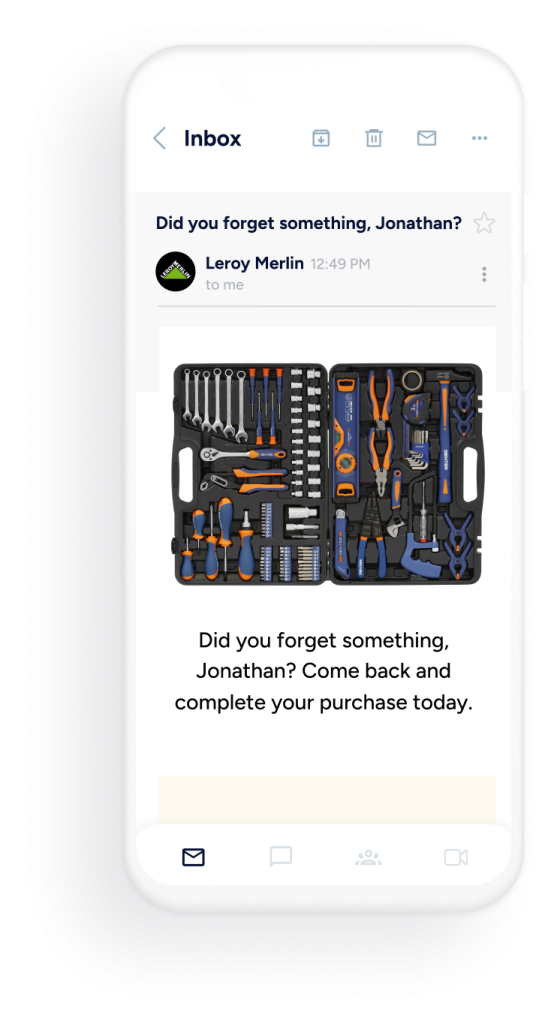

Journey Orchestration is built for exactly this kind of coordination, so a predicted send window for email doesn’t undercut a push notification landing an hour later, or the reverse.
Because Architect, the Unified Customer Database, and Insider One’s AI agents run on one platform rather than three integrated systems, the prioritization decision and the timing decision are made against the same live profile at the same moment.
Proving it works: testing, metrics, and common pitfalls
The only way to know if send-time optimization is driving revenue is to isolate it from everything else running at the same time.
That means a genuine control group, not a before-and-after comparison across two different weeks with different subject lines, offers, or segments layered in.
Setting up a control group
Split a comparable audience into two groups before launch.
One group receives sends at the AI-predicted window, the other receives the same content and offer at a standard fixed time, with every other variable, subject line, creative, offer, and segment, held identical between groups.
Insider One supports this natively rather than through spreadsheet gymnastics. Architect Control Group reserves a defined portion of your user base that receives no messages from a given journey, so incremental lift is measured against a true holdout instead of a historical baseline.
Event-based conversion tracking then attributes revenue to the specific events that matter to your business, and the Unified Analytics Dashboard reports test and control performance side by side.
Run the test across enough sends to smooth out day-to-day noise, and resist the temptation to tweak content mid-test. Any change reintroduces the confounding variable you’re trying to remove.
How engagement differs when you look past open rate
Open rate alone tells you almost nothing about revenue impact, since it can rise from better inbox placement while conversion stays flat. Judge true lift against a broader set of signals instead:
- Click rate, to confirm the timing change is driving engagement past the open
- Conversion rate, the metric that ties timing directly to revenue rather than attention
- Unsubscribe and complaint rate, to catch cases where more frequent “optimal” touches fatigue subscribers
- Revenue per recipient, compared between test and control groups over the same period
- Deliverability health, since inbox placement, warm-up status, and sender reputation can move any of the metrics above independently of timing
If the control group performs comparably to the send-time group once these metrics are weighed together, the lift may be a placement effect rather than a revenue driver. That’s worth investigating before crediting the AI feature with results it didn’t produce.
Insider One’s Insights Agent shortens that investigation considerably.
Rather than configuring a dashboard for each cut of the data, you can ask in plain language which cohort moved, compare periods, and get a diagnosed root cause rather than a number, across email, SMS, WhatsApp, web push, app push, on-site, and journeys, all queried against live behavioral data rather than a stale export.
The table below summarises what to verify in any send-time evaluation, and how Insider One answers each question.
| Evaluation question | What a weak answer looks like | How Insider One answers it |
|---|---|---|
| How is the send window scored? | “Proprietary AI” with no published mechanic | 24 hourly slots per subscriber; clicks weighted 1.0, opens 0.4; highest-scoring slot wins |
| What happens to a brand-new subscriber? | A vague “default” that is never defined | The campaign sends immediately rather than assigning an invented window |
| Can historical engagement shorten cold start? | History begins at go-live | 100+ native integrations plus bi-directional Snowflake, Databricks, BigQuery and Redshift connectivity |
| How are collisions with other channels resolved? | Per-campaign scheduling only | Journey Prioritization, global and channel frequency capping, Silent Hours, Next Best Channel |
| Does timing respect the recipient’s local time? | Account-level time zone only | Email and SMS can be scheduled against each recipient’s own time zone |
| How is incremental lift proven? | Before-and-after open rate comparison | Architect Control Group holdout plus event-based conversion tracking and unified analytics |
Conclusion
Send-time optimization only compounds into revenue when it’s treated as a data-maturity and orchestration problem, not a single toggle.
That means understanding exactly how the window is scored, getting real engagement history into the customer profile early, coordinating timing with prioritization, frequency caps, Silent Hours, and channel choice, and validating lift with a real holdout instead of a reported percentage.
Get those right, and personalized timing stops being a vanity metric and starts becoming a measurable part of the customer journey.
To evaluate the fit of journey orchestration for your use case, book a personalized demo to review your goals, data requirements, and implementation constraints with the Insider One team.
FAQs
It’s a feature that predicts the hour each subscriber is most likely to open, click, and convert, based on their own engagement history, then times delivery to that window instead of sending to the entire list at once. Insider One scores all 24 hourly slots in a day for each subscriber, weighting clicks at 1.0 and opens at 0.4, and sends at the start of the highest-scoring slot.
Basic scheduling sets one fixed hour for an entire list or segment. Predictive send time assigns a distinct window per subscriber, built from that individual’s own open and click history, and recalculates the window every time they engage. Insider One also supports scheduling against each recipient’s local time zone, which is a separate and complementary control.
The model needs engagement history to identify an accurate window. When a subscriber has no prior opens or clicks, Insider One sends the campaign immediately rather than assigning an invented window. The fastest way to shorten that cold-start period is importing historical engagement data into the Unified Customer Database at onboarding, through native integrations or a bi-directional warehouse connection, so profiles arrive populated rather than empty.
Yes, for time-bound messages. Flash sales, same-day deadlines, cart-abandonment nudges tied to expiring offers, and transactional messages such as order confirmations and shipping updates should go out on a fixed schedule or on the triggering event, since urgency outweighs personalized timing in those cases.
Run a control group that receives identical content at a fixed time while a comparable group gets AI-predicted timing. In Insider One, Architect Control Group holds out a defined share of your audience so incremental lift is measured against a true holdout. Compare click rate, conversion rate, unsubscribe rate, and revenue per recipient between groups, not just open rate, before crediting the feature with any lift.
Indirectly. Spreading sends across 24 hourly windows smooths delivery volume rather than concentrating it in one spike, and higher genuine engagement supports sender reputation over time. Deliverability itself is governed by separate controls: automated email warm-up orchestration with daily send limits and a real-time tracker, ISP-level throttling, and regional sending infrastructure with EU-based servers for brands with data-residency requirements.
Timing personalization applies across channels, but the right control differs by channel. For email, per-subscriber engagement scoring predicts the optimal hour. For SMS and push, scheduling against each recipient’s local time zone, combined with Silent Hours configured for multiple quiet periods across weekdays, weekends, and specific markets, is usually the stronger lever, both for engagement and for responsible-messaging compliance.
Send time optimization decides when a single message should be delivered to a given subscriber. Journey prioritization decides which message that subscriber should receive when they qualify for several at once. Frequency capping is a third and distinct control that sets the ceiling on total volume. A mature programme uses all three: capping limits how much, prioritization decides what, and send-time optimization decides when.
It depends on engagement volume per subscriber rather than on elapsed time, since the model needs enough opens and clicks distributed across hourly slots to distinguish a genuine pattern from noise. High-frequency senders reach that point quickly; low-volume programmes take longer. Importing historical engagement data into the Unified Customer Database at onboarding is the fastest way to shorten the ramp, because profiles arrive with pattern history already in place.

Keep Reading
7 min.

Muharrem Derinkok
4 Jun 2026
11 min.

Chris Baldwin
2 Jun 2026
4 min.
Chris Baldwin
3 Feb 2026