

 Platform Overview

 Integration Hub

 Agent One™

 Agent One™ Teams

 Customer Data Management

 Personalization

 Journey Orchestration

 Reporting & Data

 Behavioral Analytics

 Web
Web

 Email
Email

 Site Search

 Conversational CX

 WhatsApp

 Web Push

 InStory

 App
App

 SMS & RCS

 Join the $0 Migration Movement™

 The Insider One Difference

 Compare Vendors

 Switch to Insider One

 Success Story

 Retail & Ecommerce

 Financial Services

 Travel & Hospitality

 Beauty & Cosmetics

 Automotive

 Telecommunications

 Total Economic Impact™ Study

 Blog
Blog

 E-Books & Guides

 Events

 Glossary
How AI Personalization Powers Every Stage of the Customer Lifecycle

Updated on 5 Oct 2026
10 min.
Table of Contents
- Summary
- Why lifecycle marketing breaks down without a unified AI decisioning layer
- Stage 1: acquisition and activation, using predictive signals before the first purchase
- Stage 2: engagement and expansion, personalizing the moments that drive repeat revenue
- Stage 3: retention and churn prevention, acting on risk scores before engagement drops
- Building the stack: what a lifecycle-ready AI personalization platform must do
- Frequently asked questions
Most Popular
Summary
AI-driven customer engagement works best when all customer data and decisions are unified in a single platform. Real-time behavioral signals, predictive scoring, and cross-channel orchestration enable true 1:1 personalization from the first interaction through retention, while transparent attribution helps measure business impact.
The metrics look fine on paper. Email open rates are trending up, push notifications are driving solid click-throughs, and the SMS program is live and producing results. Yet the revenue numbers don’t move the way the channel metrics suggest they should, and that gap deserves a closer look.
The problem usually isn’t the channels or the content. It’s that each stage of the customer journey is being optimized independently, by separate tools with separate models that have never shared data.
The acquisition platform promises a discount. The retention model, unaware of that promise, fires a full-price upsell three days later.
The customer notices the contradiction even when the marketers don’t, and that contradiction erodes trust incrementally across every subsequent interaction.
This is the operational gap that AI-driven personalization is genuinely built to close, but only when it operates across the full lifecycle rather than within a single stage.
The difference between AI as a feature and AI as an infrastructure decision is exactly that: one improves a campaign, the other compounds across every customer interaction.
The sections below walk through how that compounding works, stage by stage, and what it takes to build the stack that sustains it.
Why lifecycle marketing breaks down without a unified AI decisioning layer
When lifecycle tools are purchased by stage, they generate stage-specific models. An onboarding tool learns what drives the first purchase. A retention tool learns what predicts churn.
Neither model ever sees the full arc of customer behavior, so neither model can account for what the other is doing.
A customer who was aggressively discounted during acquisition looks, to the retention model, like a price-sensitive shopper who needs ongoing incentives to stay.
The retention model isn’t wrong, given the data it has. But the full picture tells a different story, and acting on a partial picture is how personalization quality degrades over time.
The case for a continuous decisioning loop
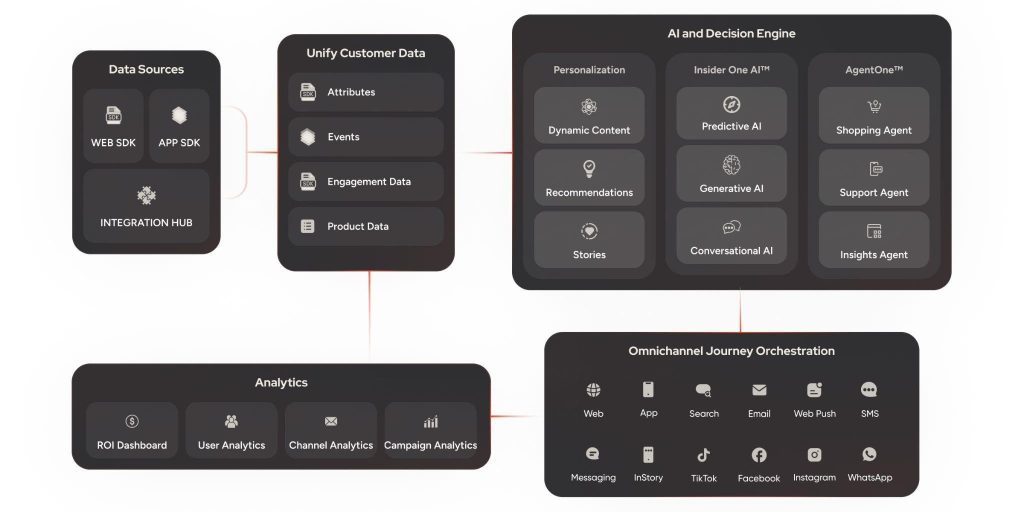
The more effective architecture is a shared AI layer that ingests behavioral signals from every lifecycle stage and updates its decisions continuously.
Channel preference observed during onboarding informs send-time optimization during retention. Purchase velocity during the engagement phase improves churn risk scoring six months later.
First-session content affinity shapes product recommendations in the second year.
This isn’t a theoretical benefit: it’s the structural difference between a stack where AI tools are stitched together and one where AI decisioning is native to the platform itself.
Journey Orchestration at this level requires a single customer profile that every model reads from and writes to, which is why the data layer isn’t an integration problem; it’s a prerequisite.
Stage 1: acquisition and activation, using predictive signals before the first purchase
Scoring anonymous visitors before they identify themselves
Personalization doesn’t have to wait for an email address. Session-level behavioral signals, including scroll depth, category hover patterns, device type, referral source, and time-on-page, are strong enough inputs for a predictive model to estimate whether an anonymous visitor is likely to convert in this session, this week, or not at all.
Insider One’s AI personalization capabilities apply this kind of likelihood-to-purchase scoring to anonymous sessions, enabling the platform to adapt what a first-time visitor sees before any form is filled out.
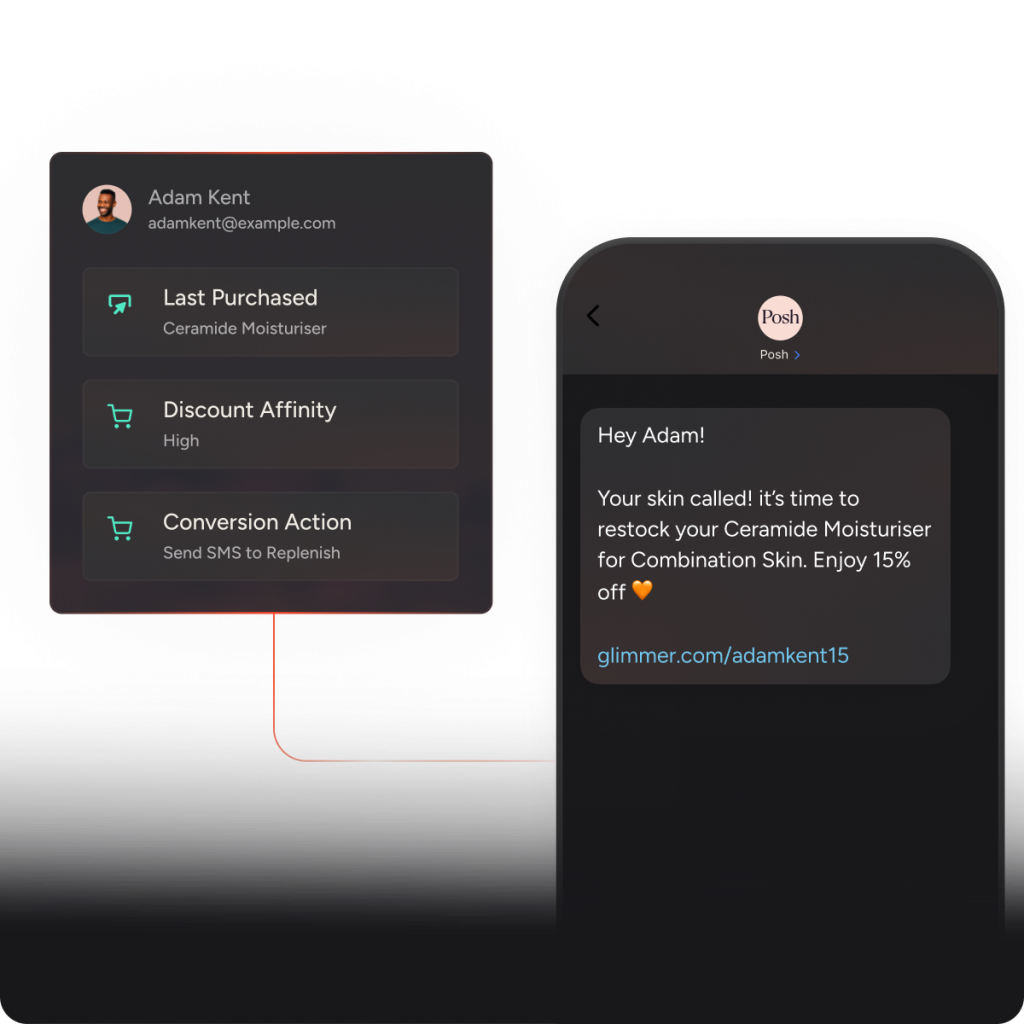
A high-intent visitor needs urgency and social proof, while a lower-intent visitor benefits from content that reduces friction and builds category familiarity.
Rule-based welcome journeys can’t make this distinction because they have no signal to act on before someone identifies themselves.
Replacing fixed sequences with adaptive activation flows
Static onboarding flows treat every new customer as structurally identical by sending on day one, day three, and day seven, regardless of early behavioral signals.
What changes in most rule-based programs is only the subject line. AI-driven activation works differently: the sequence length, channel mix, and offer value adapt based on predicted lifetime value signals gathered from early behavioral data.
A new subscriber who immediately browses high-margin categories and adds to cart without purchasing is sending clear signals that should compress the sequence and escalate the offer.
A subscriber who reads three blog posts and exits probably needs educational content before a conversion ask.
Lifecycle marketing programs that adapt this early develop a compounding advantage because they build a more accurate profile from day one, not day 30.
Stage 2: engagement and expansion, personalizing the moments that drive repeat revenue
Moving from RFM cohorts to true 1:1 decisioning
Recency, frequency, and monetary (RFM) segmentation is a useful heuristic, but it’s a blunt instrument for personalization. Two customers with identical RFM scores behave differently because their product affinities, content preferences, and channel responsiveness differ.
AI identifies those differences by tracking which formats each individual engages with, which product categories attract repeat attention, and which send windows produce the highest response rates.
The result is that the same email campaign can deliver meaningfully different content, timing, and channel combinations to different people, without requiring marketers to build separate journeys for each segment.
This is what 1:1 decisioning actually means in practice, and it scales in ways that rule-based segmentation cannot.
Cross-sell and upsell trigger logic across channels
Expansion revenue doesn’t appear on a schedule. It appears when a specific behavioral combination makes a customer ready to buy more: a second purchase within a compressed window, a shift in category browsing, or a spike in product page visits without a transaction.
A unified lifecycle model sees these signals and uses them to time cross-sell and upsell triggers precisely.
Philips achieved a 40.1% conversion rate increase with Insider One’s Smart Recommender, illustrating how personalized product recommendations surfaced at the right moment across email and on-site translate directly into expansion revenue.
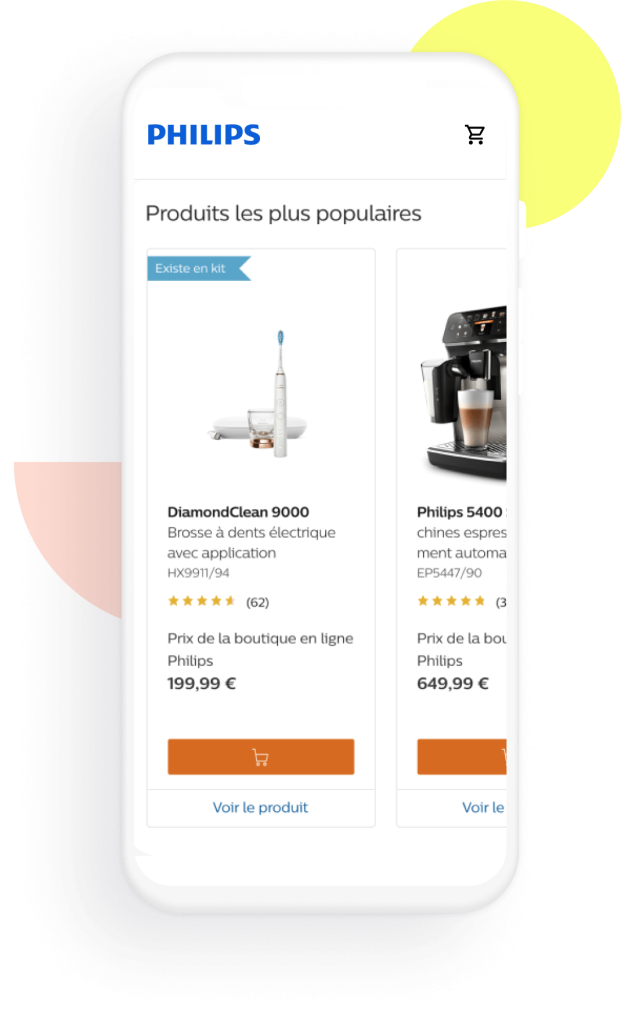
The important detail is that the trigger logic crossed channels: the same behavioral signal informed both the email sequence and the on-site recommendation layer simultaneously.
The channel mix matters as much as the message. A push notification at 9 AM works for one customer segment and alienates another. AI-powered SMS marketing and email need to be coordinated by the same model that sees the full channel history, or the experience fragments.
When cross-sell triggers are orchestrated from a single canvas, the system suppresses the email for a customer who already clicked the SMS, preventing the redundancy that trains customers to ignore communications.
Stage 3: retention and churn prevention, acting on risk scores before engagement drops
What predictive churn models actually need to work
Generic churn models, typically built on recency alone, identify at-risk customers too late. By the time a 60-day silence triggers a re-engagement flow, many of those customers have already decided they’re done.
Predictive churn models built on lifecycle-wide data see earlier warning signals: a shift in category affinity, a change in session depth, or a drop in response rate across channels even when total recency looks acceptable.
These upstream signals give marketers a multi-week window to act with a personalized retention incentive rather than a generic “we miss you” blast. The intervention doesn’t have to be a discount.
For high-value customers, it might be early access to a new category, a content piece that matches their affinity profile, or a personalized recommendation based on what they viewed but never purchased.
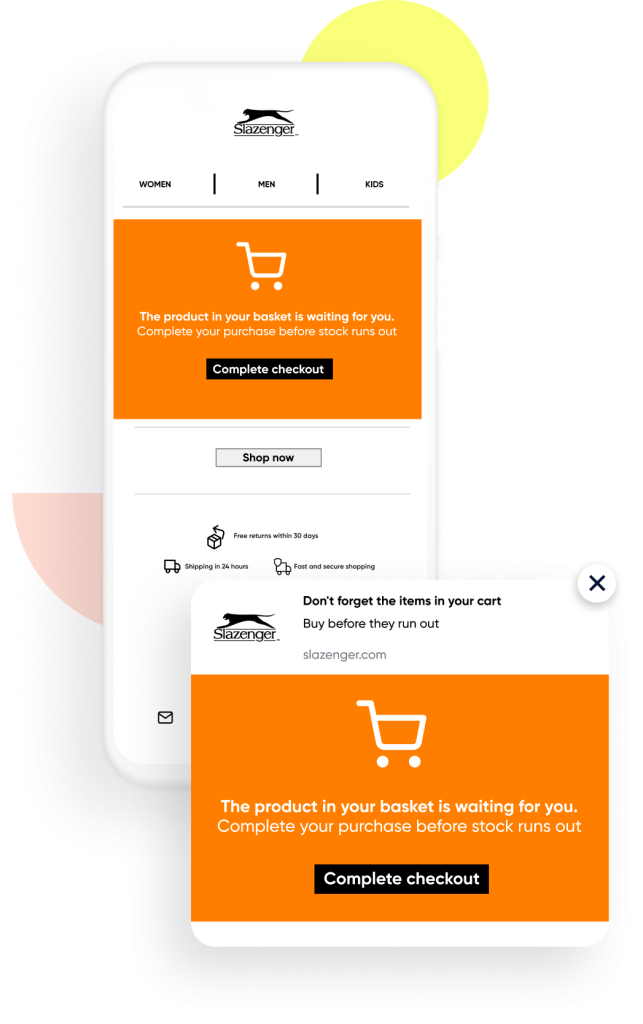
Slazenger gained 49X ROI in only eight weeks with Insider One’s omnichannel solution, a result that reflects what happens when retention efforts are coordinated across channels with real behavioral context, rather than applied uniformly to a re-engagement list.
Managing send frequency and fatigue without going dark
Retention programs face a specific tension: the customers most at risk of churning are also the ones most likely to unsubscribe if over-messaged. AI-driven frequency optimization resolves this by calculating the optimal contact cadence for each individual based on their historical response patterns, not a platform default.
A customer who consistently opens email on Sundays and ignores weekday sends should receive Sunday emails, not a five-day cadence that buries the signal in noise.
The suppression logic should also be smart enough to reduce overall volume while maintaining presence on the channel where each customer is most likely to respond. This protects deliverability and brand trust while still reaching the customers who need a retention touchpoint.
Omnichannel marketing automation done well means the system knows when to pull back as much as when to push forward.
Building the stack: what a lifecycle-ready AI personalization platform must do
Five core platform capabilities
Not every platform that claims AI personalization can sustain the compounding lifecycle loop described above. The architecture has to meet five specific conditions:
• Unified customer profile: Online and offline behavioral data merged into a single profile that every AI model reads from and writes to in real time. Batch-updated profiles create lag that undermines trigger precision
• Real-time behavioral triggering: The platform must act on behavioral signals within the same session, not the next day, because session-level urgency disappears quickly
• Single-canvas orchestration: Cross-channel journeys built and monitored from one interface, so suppression logic, channel coordination, and A/B testing operate on the same data without manual reconciliation
• Native AI decisioning: Personalization models built into the platform, not connected via API to a separate vendor. Bolt-on AI creates the same siloing problem at the model level that point tools create at the platform level
• Transparent attribution reporting: Marketers need to see which AI decisions drove which outcomes, or the program becomes a black box that can’t be iterated on meaningfully
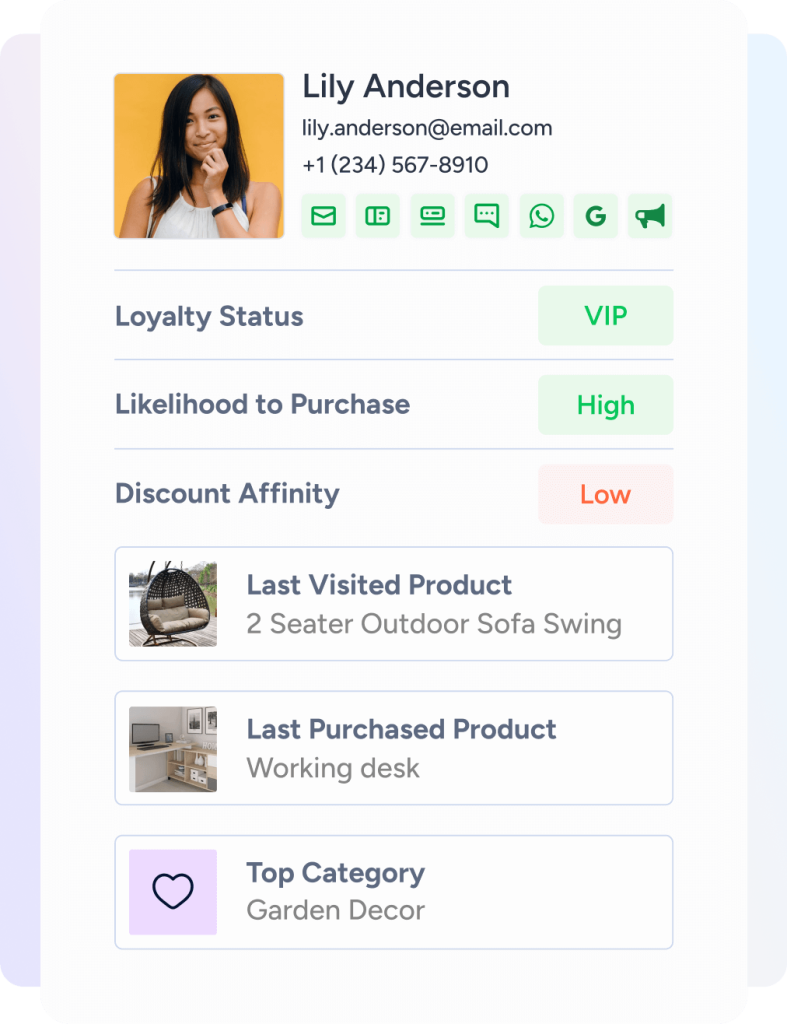
Insider One’s platform is built around these capabilities, combining Customer Data Management with Sirius AI™ for real-time decisioning, and Architect for single-canvas journey orchestration across every channel.
Because the customer data layer is warehouse-native and composable, with bi-directional connectivity to Snowflake, Databricks, Google BigQuery, and Amazon Redshift, profiles update in near real time rather than on an overnight batch, and the AI Analytics Assistant explains report results in plain language and recommends optimizations, so attribution stays transparent rather than becoming a black box.
The same decisioning layer reaches beyond send decisions: Agent One runs agentic, conversational personalization through AI shopping agents on WhatsApp and Instagram, while Smart Recommender, Liquid personalization, and Eureka site search apply it across web, app, and email, so one profile drives messaging, on-site discovery, and conversation rather than three disconnected experiences.
A practical evaluation checklist for lifecycle teams
Before committing to a platform or assessing whether your current stack can support a compounding AI program, work through these questions:
• Can the platform ingest and act on behavioral signals in the same session, or does it batch-process overnight?
• Is the AI decisioning native to the platform, or does it require a separate integration to a machine learning vendor?
• Can a single journey canvas suppress, branch, and re-route across email, SMS, push, and on-site without custom engineering?
• How long does it take to build, launch, and iterate a new lifecycle journey after the initial implementation?
• Does attribution reporting show model-level decisions, or only campaign-level aggregates?
If the honest answer to any of these is “we’d need to check with the vendor” or “that requires a custom build,” the platform may not be architected for lifecycle-wide AI personalization. It may be capable for individual campaign optimization, but the compounding loop requires infrastructure answers, not workaround answers.
MadeiraMadeira achieved 52X ROI with Architect, a result that reflects what sustained, cross-stage orchestration delivers when the infrastructure is genuinely lifecycle-ready from day one.
Ready to see what a compounding lifecycle AI program looks like in practice? Book a personalized demo with Insider One to explore how Architect and Sirius AI™ work together to connect acquisition, engagement, and retention into a single decisioning loop, and see the attribution reporting that shows exactly which AI decisions drove revenue at each stage of the customer lifecycle.
Frequently asked questions
No, but the data you have needs to be unified and accessible in real time. Predictive models trained on behavioral signals, even from smaller datasets, outperform rule-based segmentation when the inputs are clean and current. The quality and freshness of data matters more than raw volume, particularly in early lifecycle stages where session-level signals carry significant predictive weight.
The key difference is latency and model awareness. Integrated tools share data, but typically on a batch basis, and each tool’s model remains independent. A native decisioning layer operates from a single customer profile in real time, so the retention model can account for what the acquisition model promised, and the engagement model can suppress a cross-sell trigger if a retention intervention is already active for that customer.
Early-stage improvements, particularly in activation and engagement, are often visible within six to twelve weeks of deployment as the models accumulate sufficient behavioral signal. The genuine compounding effect, where retention models benefit from acquisition-stage data and expansion triggers reflect full purchase history, typically takes four to six months to express fully. Teams that run proper attribution reporting from day one understand their return on investment trajectory much earlier than teams relying on last-click metrics.

Keep Reading
4 min.

Chris Baldwin
3 Feb 2026
8 mins.
Chris Baldwin
8 Oct 2026
8 mins.
Chris Baldwin
8 Oct 2026