

 Platform Overview

 Integration Hub

 Insider One AI™

 Customer Data Management

 Personalization

 Journey Orchestration

 Reporting & Data

 Behavioral Analytics

 Web
Web

 Email
Email

 Site Search

 Conversational CX

 WhatsApp

 Web Push

 InStory

 App
App

 SMS & RCS

 Join the $0 Migration Movement™

 The Insider One Difference

 Compare Vendors

 Switch to Insider One

 Success Story

 Retail & Ecommerce

 Financial Services

 Travel & Hospitality

 Beauty & Cosmetics

 Automotive

 Telecommunications

 Total Economic Impact™ Study

 Blog
Blog

 E-Books & Guides

 Glossary
How AI-Powered Campaign Creation Actually Works, and What Many Platforms Get Wrong

Updated on 9 Jul 2026
9 min.
Table of Contents
- Summary
- Why campaign creation is still slow even when AI is involved
- What end-to-end AI campaign creation actually requires
- Where some platforms leave gaps teams cannot close alone
- How Insider One builds AI campaign creation from the data layer up
- Measuring what AI-powered campaign creation should actually deliver
- Frequently asked questions
Most Popular


Summary
AI campaign creation is most effective when it connects customer data, audience segmentation, content generation, journey orchestration, and optimization in a single workflow. A unified platform enables faster campaign execution, better personalization, and improved marketing performance.
A campaign that takes two weeks to build, requires four stakeholders to approve, and produces nearly identical messaging for every audience segment is not a resourcing problem. It is a platform architecture problem.
When AI is added to a workflow that was never redesigned around it, the bottlenecks shift slightly but the overall cycle time barely moves.
The harder problem is not generating one piece of copy faster. It is connecting audience logic, content decisions, channel sequencing, and delivery optimization into something that runs as a coherent system rather than a collection of isolated AI features added to a manual workflow.
That distinction, AI as a feature versus AI as the operating layer of campaign creation, separates platforms that genuinely accelerate teams from those that add complexity while calling it progress.
Why campaign creation is still slow even when AI is involved
The execution-layer trap
When platforms add AI features without redesigning the workflow beneath them, the bottleneck shifts but does not disappear. Subject line generation lands in your campaign builder, but audience building still requires a data analyst.
Send-time optimisation runs automatically, but journey logic is still assembled by hand in a canvas that communicates with nothing outside itself. The AI is real; the automation is selective, and teams end up doing manual work between the AI steps.
This is the execution-layer trap: AI that improves individual tasks while leaving the process architecture untouched.
A marketer who can generate five subject line variants in thirty seconds still spends days defining segments, building logic branches, coordinating across channels, and waiting for engineering to connect the right data sources. The headline capability is fast. The actual campaign is not.
Fragmented data is the upstream problem
Beneath slow execution is a deeper issue: fragmented customer data. When AI draws on profiles that are incomplete, delayed, or siloed across systems, every decision it makes downstream is compromised from the start.
Audience predictions built on partial behavioral signals will miss or misclassify users. Personalized content generated without purchase history or lifecycle context will miss the mark. Channel selection based on limited engagement data will default to the wrong touchpoint at the wrong moment.
This is a data architecture problem, not an AI quality problem. A model is only as reliable as the inputs it operates on, and if those inputs are scattered across a customer relationship management (CRM) system, an email service provider, a mobile app, and an analytics platform that share no unified identity layer, the AI is working with a partial picture regardless of how sophisticated its algorithms are.
Resolving this at the model level is not possible. It has to be addressed at the data layer.
What end-to-end AI campaign creation actually requires
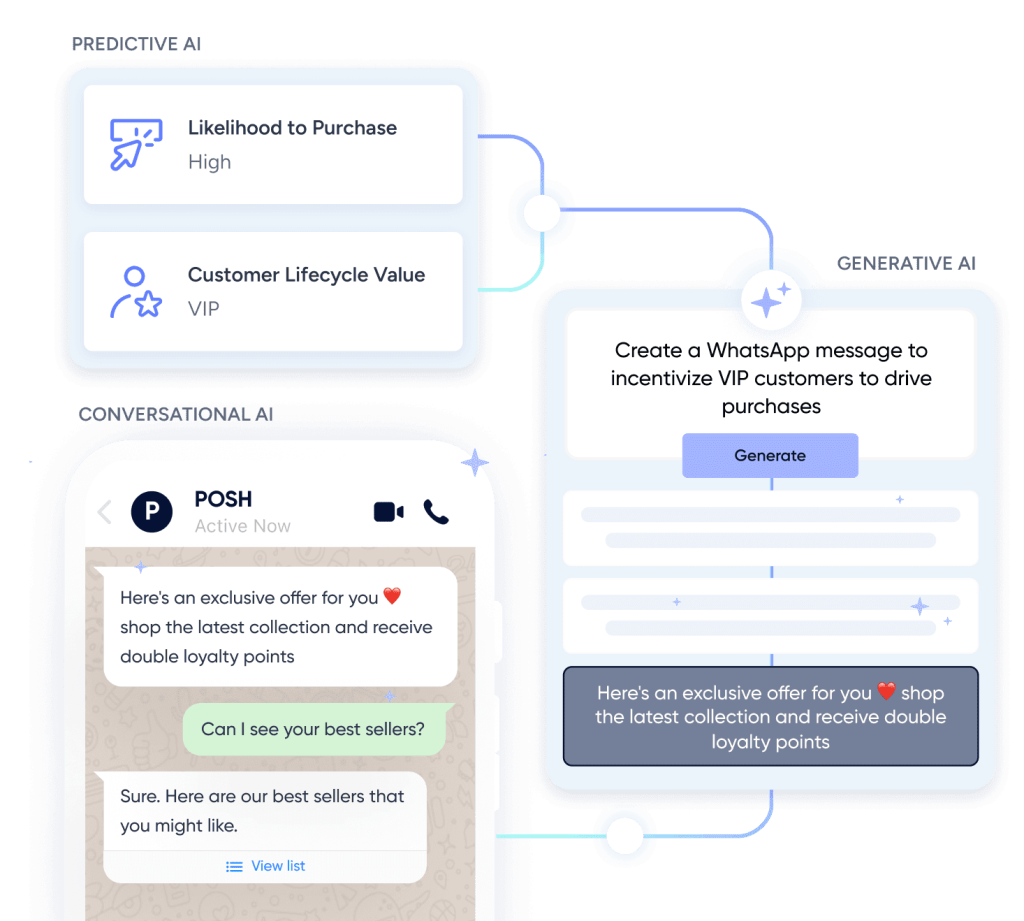
Genuine AI-powered campaign creation is not one feature. It is five connected layers that each depend on the others functioning correctly.
Unified customer data is the foundation. Every AI decision, from who to target to what to say to where to say it, needs a complete, real-time customer profile spanning online behavior, offline interactions, purchase history, and channel preferences. Without this foundation, the layers above operate on guesswork.
Predictive segmentation builds on that unified data to identify audiences based on forward-looking signals: likelihood to purchase, probability of churn, predicted lifetime value. Static rule-based segments miss users who are about to convert and include users who have already disengaged. Predictive segmentation moves targeting logic from historical to anticipatory.
Generative content handles personalized copy, imagery, and messaging variations at scale, calibrated to the segment, the channel, and the moment. This is where large language model capabilities create real value, but only when they are informed by the unified profile below them.
Autonomous journey orchestration connects content delivery across channels in a sequence that adapts to real user behavior. If a user opens an email but does not click, the next touchpoint adjusts. If they convert on mobile, the desktop journey pauses. The logic runs without manual intervention.
Self-optimizing delivery closes the loop, continuously learning which variants, timings, and channel combinations are performing and reallocating toward them without requiring a marketer to run a manual review every week.
Removing any one of these layers forces teams back into manual work. A platform that generates copy but requires manual audience selection is not end-to-end AI campaign creation. It is AI-assisted creation, which is a real and useful capability, but a different one entirely.
Where some platforms leave gaps teams cannot close alone
The CDP dependency problem
Some platforms in this category do not include a native customer data platform (CDP), which means their AI campaign features operate on whatever customer data has been connected through an external integration.
That integration introduces latency, requires ongoing engineering maintenance, and rarely achieves the completeness of a truly unified profile. When AI decisions about audience, content, and channel selection are made on that partial data, the outputs reflect the gaps in the input rather than the sophistication of the model.
For marketing teams, this creates a structural dependency that does not go away. Engineering resources stay in the loop to manage the data pipeline, adding weeks to any change in data strategy and making the “autonomous campaign creation” story difficult to deliver in practice.
Teams that sign up for AI-powered marketing often find they have also signed up for a data integration project that never quite finishes.
The specialist overhead problem
At the other end of the spectrum, some enterprise platforms offer genuinely powerful AI capabilities but require specialist implementation and technical configuration to activate them. The AI exists; accessing it as a marketer, without a certified partner or a dedicated technical team, is a different matter entirely.
This dynamic makes campaign creation slower at launch and more expensive to maintain. It also positions the marketing team as a requestor rather than an operator.
Marketer-owned workflows, where a senior marketing manager can build, launch, and optimize a cross-channel campaign with significantly fewer handoffs, remain out of reach for many teams in this configuration.
How Insider One builds AI campaign creation from the data layer up
Starting with a unified 360-degree profile
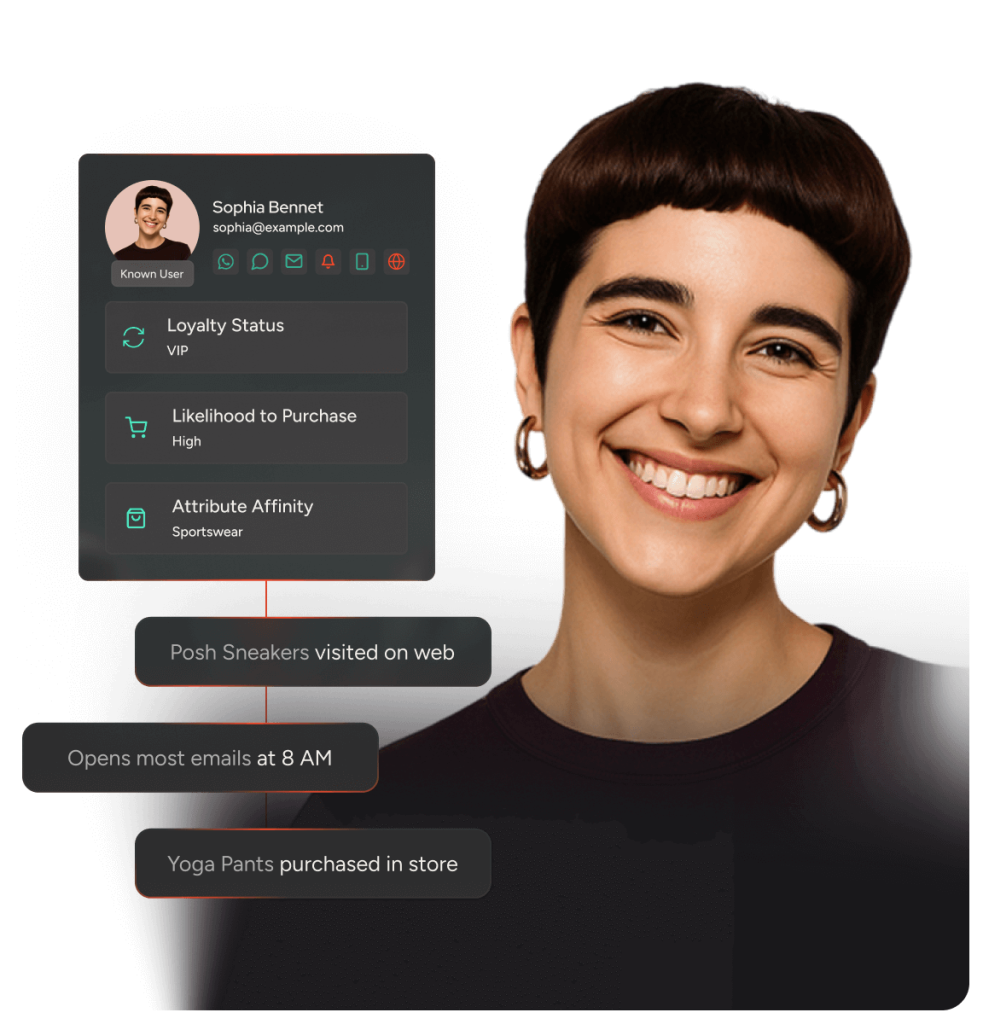
Insider One’s approach begins with its built-in enterprise CDP, which unifies data from every online and offline source into a single customer profile that updates in real time.
This includes anonymous visitor behavior, which means AI personalization can begin before a user has ever identified themselves. The profile covers behavioral signals, transactional history, channel engagement, lifecycle stage, and predictive attributes calculated by the platform’s own models.
Because this data layer is native to the platform rather than a third-party integration, it does not introduce the latency or completeness gaps that external CDP dependencies create.
Every AI feature in the stack draws on the same unified profile, so audience decisions, content decisions, and channel decisions all work from the same picture of the customer. That coherence is what makes the outputs meaningfully better.
From data to campaign, with minimal engineering involvement
From that unified foundation, Insider One AI™ handles the layers that would otherwise require manual assembly. Predictive segmentation identifies the right audiences based on behavioral and transactional signals.
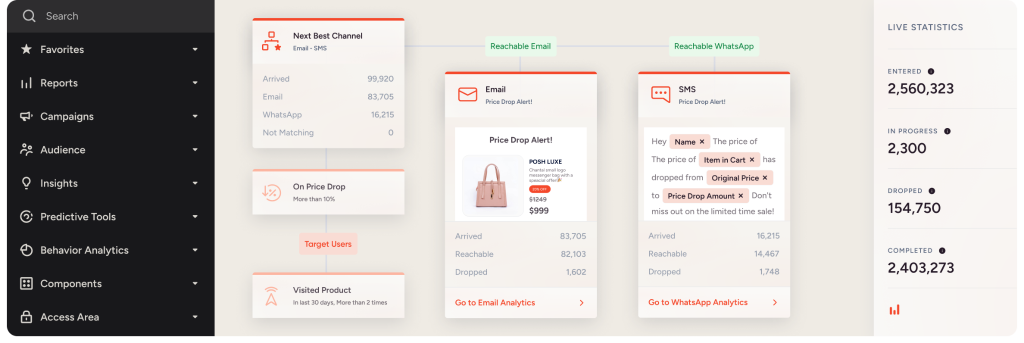
Generative content tools produce personalized copy and imagery variants calibrated to segment, channel, and context. Architect, Insider One’s journey orchestration canvas, sequences cross-channel delivery across multiple touchpoints and adapts automatically as users respond or disengage.
Send-time optimization and A/B auto-winner selection handle delivery optimization continuously after launch.
The result is that a senior marketer can move from brief to live campaign with significantly fewer handoffs than a fragmented stack requires.
Adidas achieved a 259% increase in average order value and a 13% uplift in conversion rate in a single month working with Insider One’s personalization capabilities, and MadeiraMadeira achieved 52X ROI using Architect for journey orchestration across their customer base.
The speed comes from removing the manual coordination between layers, not from optimizing the layers individually.
This architecture also supports omnichannel marketing automation across channels that many teams currently manage in separate tools: email, SMS, web push, app push, WhatsApp, on-site, and paid media audiences, all coordinated through a single workflow with a consistent data layer underneath.
Curious what it looks like to move from brief to launched campaign without the manual coordination tax? Step through Insider One’s interactive platform tour, over 80 use cases across roles and industries, no forms, no waiting.
Measuring what AI-powered campaign creation should actually deliver
The metrics that reveal real capability
Open rates and click-through rates measure campaign outputs. They do not reveal whether AI is doing what it claims. The metrics that separate genuine AI-powered campaign creation from AI-flavored manual marketing are different.
Campaign build time is the most honest signal. If a platform’s AI features do not reduce the time from brief to launch, they are not automating the work; they are decorating it.
Teams should track this before and after platform changes and remain skeptical of any vendor who does not raise the question.
First-touch conversion rates reveal whether predictive segmentation is identifying the right audiences at the right moment in their lifecycle. A platform targeting based on likelihood-to-purchase signals should outperform one targeting based on historical behavioral rules, and the difference should show up in early-funnel conversion data.
Revenue per campaign captures the compounding effect of better personalization across a larger audience. When AI-driven personalization is working at scale, revenue per campaign should improve even as the target audience expands, because relevance is increasing rather than decreasing with scale.
Engineering involvement is a proxy metric for true autonomy. If launching or modifying a campaign still requires a developer request, the platform has not delivered marketer-owned campaign creation, regardless of what its AI features are called.
Questions to ask before committing to a platform
Teams evaluating AI campaign platforms should pressure-test three things.
First, whether the AI features work from a native data layer or depend on an external CDP integration: if it is the latter, factor in the ongoing cost and latency of that dependency.
Second, whether a non-technical marketer can build and launch a complete cross-channel campaign with minimal engineering involvement: request a live demonstration, not just a feature walkthrough.
Third, whether the platform learns and self-optimizes continuously after a campaign launches, or whether optimization requires a manual review cycle.
For a deeper look at what cross-channel campaign management looks like when it is built correctly, the complete guide to cross-channel campaigns covers the structural decisions teams need to make before choosing a platform.
If you’d rather pressure-test these questions against a live platform than a slide deck, book a personalized demo to walk through your specific use cases with our team, or explore the self-guided platform tour at your own pace beforehand.
Frequently asked questions
AI-assisted campaign creation improves individual tasks within a manual workflow: generating subject lines, suggesting send times, recommending segments. AI-powered campaign creation replaces the workflow itself, handling audience selection, content generation, journey orchestration, and delivery optimization as a connected system.
The distinction matters because AI-assisted platforms can reduce effort without reducing the cycle time or the engineering dependency of campaign production.
Technically, yes. In practice, the quality of AI outputs depends directly on the completeness and freshness of the customer data feeding them. Without a unified customer profile, predictive segmentation and personalization decisions operate on partial signals, which limits their accuracy.
Teams using AI campaign tools without a native CDP typically need to invest in a separate data integration layer, which adds cost, latency, and ongoing maintenance overhead.
Timeline varies by platform, data readiness, and team configuration. Platforms with a native CDP and pre-built AI models can produce measurable results within the first campaign cycle. Platforms that require custom implementation, external integrations, or specialist configuration take longer to reach autonomous operation.
Teams should evaluate not just what a platform can do at full maturity, but how quickly it can reach that state with their existing data and team structure.
A capable AI campaign builder should span the channels where your customers actually engage: email, SMS, web push, app push, WhatsApp, on-site messaging, and paid media audience sync at minimum.
Single-channel or dual-channel AI tools limit the value of journey orchestration because they cannot adapt the full experience based on cross-channel behavior. The more channels the AI can coordinate simultaneously, the more accurately it can meet customers at the right moment with the right message.

Keep Reading
7 min.

Muharrem Derinkok
4 Jun 2026
11 min.

Chris Baldwin
2 Jun 2026
4 min.
Chris Baldwin
3 Feb 2026