

 Platform Overview


 Integration Hub


 Agent One™


 Agent One™ Teams


 Customer Data Management


 Personalization


 Journey Orchestration


 Reporting & Data


 Behavioral Analytics


 Web


 Email


 Site Search


 Conversational CX


 WhatsApp


 Web Push


 InStory


 App


 SMS & RCS


 Join the $0 Migration Movement™


 The Insider One Difference


 Compare Vendors


 Switch to Insider One


 Success Story


 Retail & Ecommerce


 Financial Services


 Travel & Hospitality


 Beauty & Cosmetics


 Automotive


 Telecommunications


 Total Economic Impact™ Study


 Blog


 E-Books & Guides


 Events


 Glossary
The agentic AI use cases enterprise marketers should adopt first

Updated on 28 Oct 2026
7 min.
Table of Contents
- Summary
- What actually makes AI 'agentic' versus just automated?
- What are the quick-win use cases for content and send-time agents?
- Which use cases depend on unified customer data first?
- What do high-autonomy decisioning and churn-response agents look like?
- How do you build governance so your agentic AI pilot doesn't get cancelled?
- Conclusion
- Frequently Asked Questions
Most Popular
Summary
- Agentic AI splits into decisioning agents that recommend an action, in addition to action-taking agents that execute it. That split determines how much governance sign-off you need
- Content generation and send-time optimization are the safest agentic AI use cases to deploy first because they touch messaging, not customer accounts or entitlements
- Segmentation and journey orchestration agents need unified first-party data before they can run without constant manual correction
- Next-best-action, offer-selection, and churn-response agents deliver the strongest return and carry the most risk, since they act without a human checkpoint
- A staged adoption sequence, not a feature checklist, is what keeps agentic AI pilots from stalling before they reach production
Agentic AI use cases are the specific marketing tasks where an artificial intelligence (AI) agent plans, decides, and acts across several steps on its own, instead of waiting for a marketer to approve each one. That’s different from generative AI, which drafts content on request, and from rule-based automation, which follows a fixed if-this-then-that script.
This article is for enterprise marketing, customer relationship management (CRM), and lifecycle leaders deciding which agentic AI use cases to greenlight now and which ones need governance built underneath them first. You’ll get a staged adoption sequence, not a feature list, covering content and send-time agents, segmentation and journey orchestration, and high-autonomy decisioning and churn-response agents, along with the guardrails that keep a pilot from getting shelved before it reaches production.
What actually makes AI ‘agentic’ versus just automated?
Agentic AI differs from standard automation because it plans a sequence of actions and adjusts that sequence based on new information, rather than executing one pre-written rule. That planning and self-adjustment is the entire reason enterprise teams treat it differently in a governance review.
Rule-based automation and agentic planning
A rule-based workflow sends an abandoned-cart email three hours after checkout, every time, for every customer. A generative AI tool writes the subject line when a marketer asks it to. In a general agentic-AI model, a system may decide whether to send, select from available channels, draft copy, and adjust a subsequent step based on customer responses without someone re-triggering the workflow.
Decisioning agents versus action-taking agents
Decisioning agents recommend an action, such as the next-best offer or channel, and leave a human or a downstream system to execute it. Action-taking agents go further and execute a decision directly, such as sending a message or updating a record, with the required approval model determined by the implementation.
Our breakdown of AI marketing agents and their use cases covers this split in more detail, and it matters more for governance sign-off than any underlying model architecture, because an action-taking agent carries far more operational risk than one that only recommends.
What are the quick-win use cases for content and send-time agents?
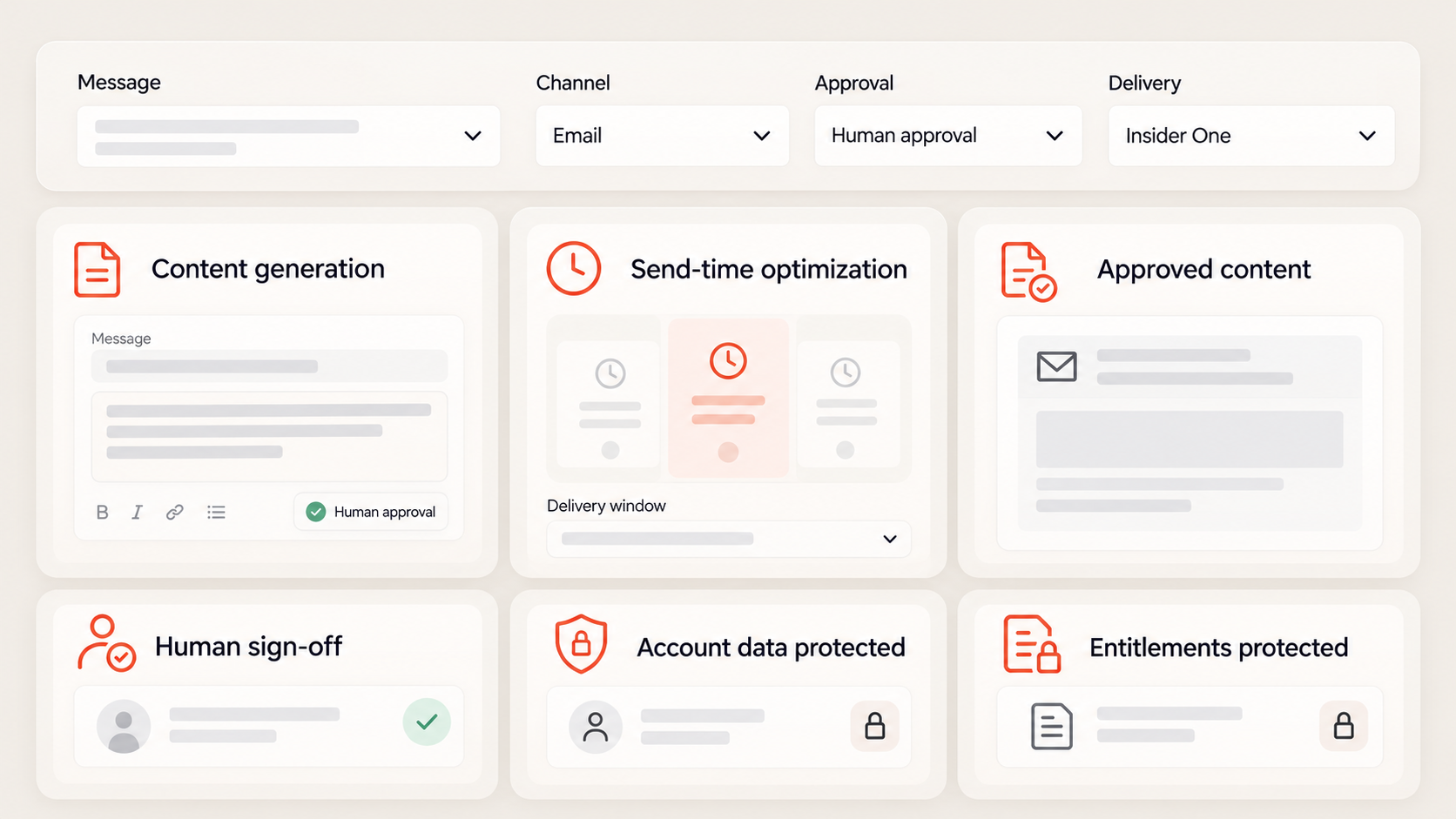
Content generation and send-time optimization can be lower-complexity starting points when an agent adjusts a message or delivery window rather than a customer’s account, order, or entitlement.
Content and creative agents
In a general agentic-AI model, content agents may help teams develop subject lines, push notifications, and creative variants using approved customer and campaign context. Within Insider One, Agent One is the agentic AI system for customer engagement: it plans, executes, learns from, and optimizes engagement toward defined goals.
This is the shift our personalization guide covers at the individual-customer level rather than the segment level, and governance should reflect the data, channel, approval, and brand requirements involved.
Send-time and channel-selection agents
In a general agentic-AI model, send-time approaches may evaluate engagement patterns when teams determine delivery windows, rather than relying on one fixed send hour for a whole segment. Channel-selection approaches may similarly evaluate configured channels within the limits of the implementation and approved engagement strategy. Their governance requirements still depend on the data used, the configured channel, the approval process, and the potential customer impact.
Which use cases depend on unified customer data first?
Segmentation and journey orchestration agents often benefit from clean, unified first-party data, because data quality and identity resolution can materially affect the accuracy of the customer record feeding them.
Audience-building agents
In a general illustrative model, audience-building approaches can use behavioral and CRM data to refresh segments as new signals become available, rather than relying only on scheduled batch updates. That depends on connecting user attributes, behavioral events, and product data through SDKs or APIs so teams can build and maintain unified customer profiles. A Customer Data Management layer can unify those signals and provide a stronger foundation for segmentation, personalization, and cross-channel engagement.
Journey orchestration agents
In a general illustrative model, journey orchestration approaches can adapt a multi-channel campaign path when configured customer signals indicate that a different next step may be appropriate. Leroy Merlin used Architect to increase ecommerce revenue by 8.8%; its case study describes strategic journeys and personalized price-drop notifications designed to reduce navigation abandonment and encourage returning users to complete purchases. Because these agents touch multiple channels at once, most enterprise teams pair them with clear journey orchestration rules and human review of the first live journeys before removing that checkpoint.
What do high-autonomy decisioning and churn-response agents look like?
Next-best-action, offer-selection, and churn-response agents can make higher-impact decisions per customer, so teams should introduce them only when their data foundation, approval model, and governance controls are ready.
Next-best-action and offer-selection agents
In a general agentic-AI model, a next-best-action approach may recommend a message, channel, or incentive using the decision criteria and approval limits that a team defines, rather than applying one blanket discount rule to a segment. For Insider One deployments, Agent One can support goal-oriented customer engagement by planning, executing, learning from, and optimizing engagement, while teams determine the appropriate approval model for each use case, a distinction our piece on AI agents versus chatbots also addresses.
Churn-prediction and retention agents
In a general agentic-AI model, retention approaches may use signals such as reduced app activity, a skipped renewal, or an unresolved support ticket to recommend a workflow for review. Teams should define approval limits before allowing any retention action to be executed, particularly where an action could affect pricing, incentives, or customer eligibility. A cautious implementation may begin this use case in decisioning mode and expand to action-taking only after a defined review window and readiness assessment.
How do you build governance so your agentic AI pilot doesn’t get cancelled?
Agentic AI pilots can stall when a team automates decisioning and action-taking before the supporting data and governance layer is ready, even when the underlying use case is sound. It’s a pattern enterprise teams keep running into: a pilot proves the concept in a sandbox, then can’t clear budget approval for production because nobody can explain how the agent decided, what happens when it’s wrong, or who signs off when it acts on live customer data.
The adoption order
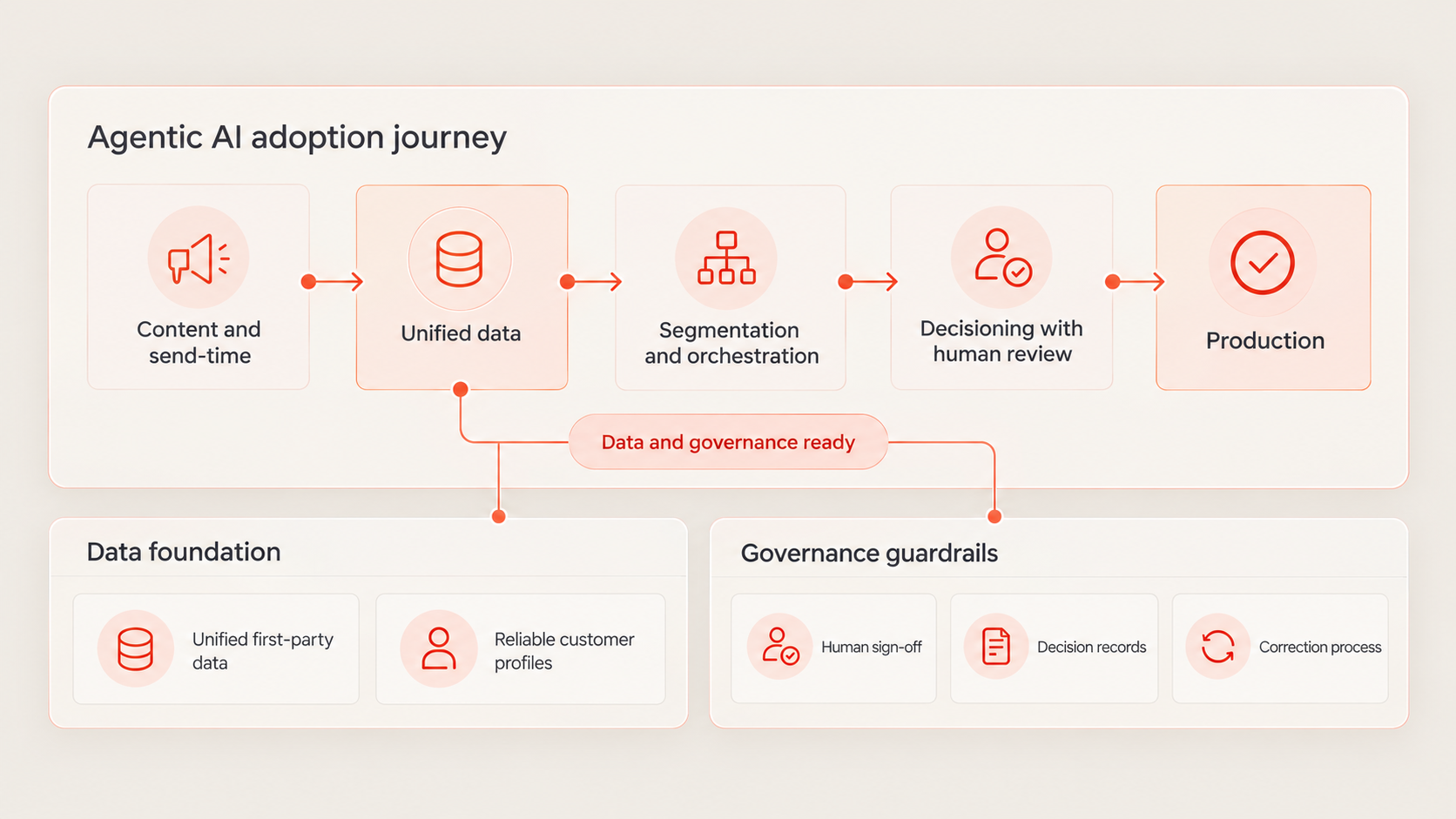
A practical sequence can move through four stages, with each stage informing readiness for the more involved versions of agentic AI:
- Begin with content and send-time use cases when their data, channel, approval, and brand requirements are manageable.
- Unify data and deploy segmentation and journey orchestration agents once that data layer is reliable
- Introduce decisioning agents in recommend-only mode, with a human approving the first cycles
- Turn on action-taking autonomy only after the decisioning stage has a track record
Skipping directly to autonomous offer selection or churn response without that foundation can make it harder to maintain executive confidence during a pilot.
Guardrails and success metrics
Enterprise teams that keep pilots alive past the first budget review build guardrails in from the start, not after a problem surfaces:
- A human sign-off checkpoint before any action-taking agent goes fully autonomous
- Documented decision records that show why an agent chose a given message, channel, or offer.
- A documented process for reviewing and correcting decisions or offers that are flagged as wrong.
- Success metrics beyond pilot-stage conversion, including production uptime and false-positive rates on triggers like churn alerts
Reviewing our Why Insider One page shows how Insider One brings shared customer profiles, journey orchestration, personalization, messaging, recommendations, and analytics together in one platform for phased deployment.
Conclusion
Agentic AI use cases can struggle to reach production when a team automates decisioning before the data and governance layer is ready. Treat this as a maturity ladder: content and send-time first, segmentation and orchestration next, decisioning and full autonomy last. That sequence, more than any single feature, is what keeps a pilot funded through to production.
To evaluate the fit of Architect and Customer Data Management for your use case, book a personalized demo to review your goals, data requirements, and implementation constraints with the Insider One team.
Frequently Asked Questions
Generative AI drafts content when prompted, such as a subject line or an image variant. Agentic AI plans and executes a sequence of steps on its own. In a general illustrative model, it may decide whether to send, select from available channels, and adjust subsequent steps based on customer responses without a marketer prompting each step individually.
Content generation and send-time optimization can be practical starting points when teams have defined their messaging, data, channel, approval, and brand requirements. They can help teams establish an operating model before expanding into segmentation, journey orchestration, or higher-impact decisioning use cases.
Pilots can stall when a team automates decisioning or action-taking before the underlying data is unified and governance checkpoints exist. Without documented decision records, correction processes, and clear accountability, leadership may lack the information needed to approve production investment.
A decisioning agent recommends an action, like a next-best offer, and leaves a human or system to execute it. An action-taking agent executes that decision directly. The distinction determines how much governance and human sign-off a use case requires before going live.
Segmentation, journey orchestration, and decisioning use cases often rely on unified behavioral, transactional, and CRM data for accurate, relevant decisions. Content and send-time use cases may have narrower data needs, but teams should still validate data quality, consent, channel setup, and approval requirements before deployment.

Keep Reading
4 min.

Chris Baldwin
3 Feb 2026
10 min.
Chris Baldwin
28 Oct 2026
10 mins.

Nicolas Algoedt
28 Oct 2026